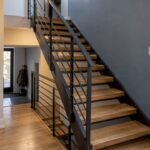
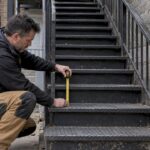
Picket railings are the safer default for most Montreal projects: they pass the 100 mm opening rule without drama, need almost no upkeep, and suit high-traffic buildings. Cable railings win on views and a lighter, modern look, but they only perform if they are fabricated, tensioned and re-checked properly. Both can be built to code in steel, stainless steel or aluminum. The right choice depends on who uses the guard, how much maintenance you will accept, and what your inspector will test.
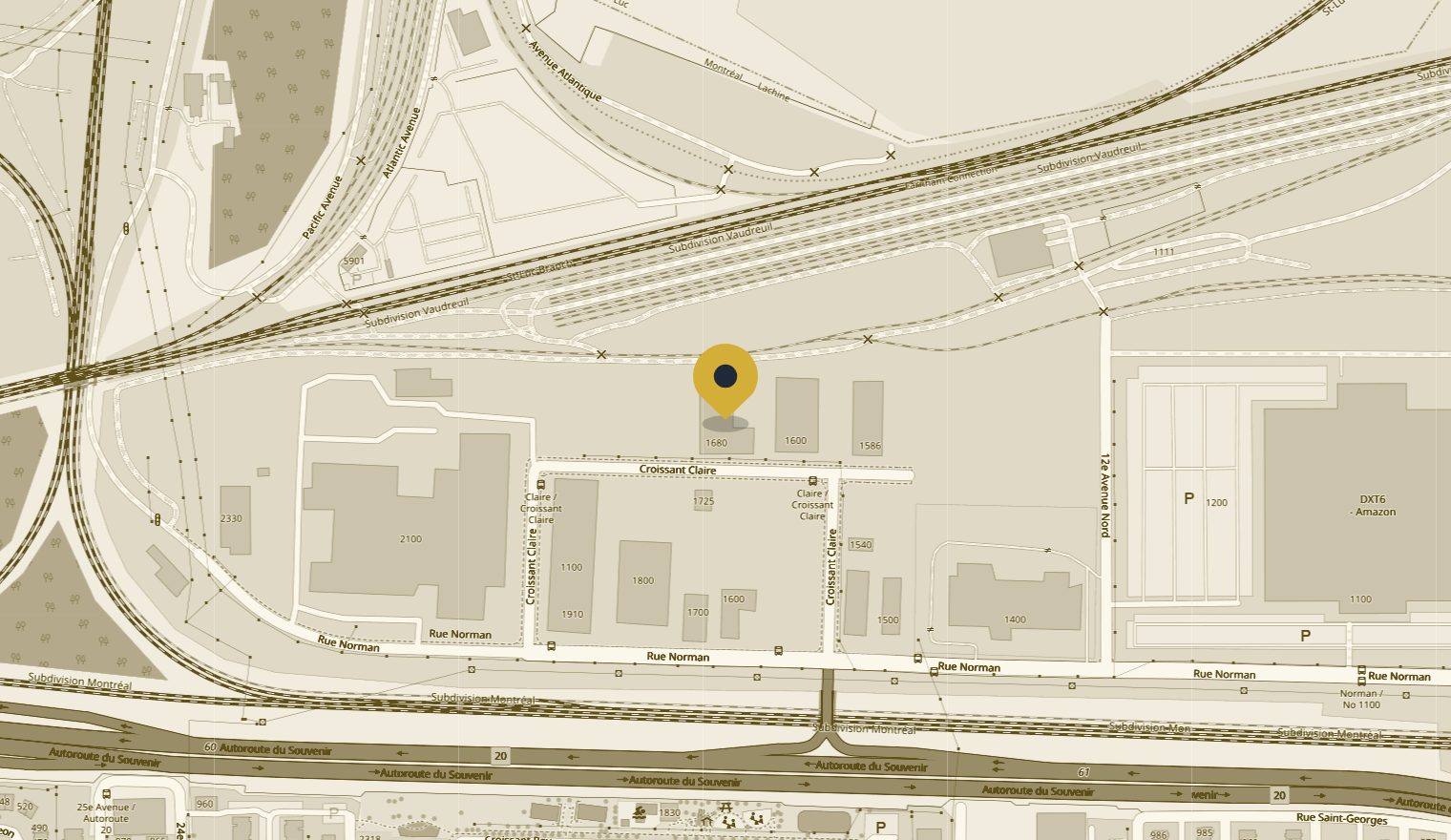
This guide compares the two on the points that decide real projects in Greater Montreal: code, deflection, winter, maintenance, appearance, fabrication and installation. We build custom metal railings in our Lachine shop, so the advice below comes from the fabrication side.
TL;DR
- Picket (baluster) railings are forgiving, durable and the easiest to get through an inspection. They are the usual pick for condos, rental buildings and commercial properties.
- Cable railings give a nearly open view, but each cable must stay tight enough that a 100 mm sphere cannot pass, even when someone leans on it.
- Whichever you choose, the Quebec code rules are the same: a guard where the drop exceeds 600 mm, and no opening a 100 mm sphere can pass through.
- Cable systems need periodic re-tensioning. Large property owners often prefer pickets to avoid that recurring labour.
- Both are fabricated in-shop and installed by our team across Greater Montreal. Send us your drawings or photos for a quote.
Table of Contents
- What the code asks of both systems
- Picket railings: the dependable default
- Cable railings: light, modern, and unforgiving of shortcuts
- Side by side
- The Montreal factor: winter, snow and salt
- Choosing by building type
- Mistakes that fail inspection
- Our perspective
- Get a railing built and installed in Greater Montreal
- FAQ
- Sources
What the code asks of both systems
Before style, there is the code. In Quebec, the Construction Code, Building chapter, is based on the National Building Code of Canada and amended by the province. The RBQ’s summary of the changes to the Quebec code is the document most inspectors and designers work from. Three numbers matter for this comparison:
- 600 mm: a guard is required when the change in elevation exceeds 600 mm.
- 1070 mm: the minimum guard height for most balconies and similar locations, measured from the finished floor surface, not from the structural subfloor.
- 100 mm: the guard must not have openings through which a 100 mm sphere can pass.
The code does not care whether the infill is a flat bar, a round picket, glass or a stainless cable. It cares about the result: a barrier that holds and has no gap a child could slip through. That is why the comparison between cable and picket is really a comparison of how reliably each one keeps that opening under 100 mm.
We cover the height and measurement details in separate guides: balcony railing height in Montréal, the 60 cm trigger and anchoring and the 100 mm rule explained.
Fence or guardrail?
A common point of confusion: a fence and a guardrail are not the same thing. A guardrail protects against a fall from an elevated surface such as a balcony, deck or stair, and it must carry loads. A fence is generally a perimeter barrier that is not designed or required to resist those loads. If your barrier sits at the edge of a drop, treat it as a guardrail, whatever the product is called in the catalogue. The same RBQ document frames guardrails by their fall-protection function (art. 9.8.8.1).
Picket railings: the dependable default
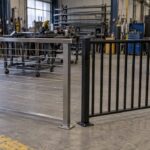
A picket railing uses vertical bars (balusters) between a top rail and a bottom rail or base plate. Steel, stainless steel and aluminum are all common.
Where pickets are strong
- Predictable spacing. Rigid vertical bars are welded or fastened at fixed centres. Once the gap is set under 100 mm, it stays there. Nothing stretches, loosens or sags.
- Low upkeep. There is no tension to maintain. A periodic inspection of the finish, fasteners and base connections is usually enough. See our notes on metal railing maintenance in Canada for care by material.
- Good fit for heavy use. Architects and property managers tend to favour pickets for multi-tenant and high-traffic buildings, because long-term maintenance is lower.
- Easy to customize. In a shop with CNC laser cutting, pickets can be plain bars or cut panels with patterns, logos or house numbers, while keeping the openings compliant.
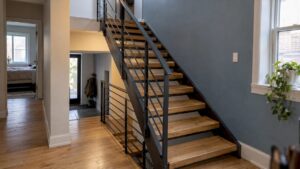
- Simple on stairs. Vertical pickets follow a sloped stringer with straightforward geometry.
Where pickets are weaker
- They block more of the view than cable does, especially with thick bars at close spacing.
- Horizontal rails or bars can be climbed, though vertical pickets do not have that issue.
- A traditional look is not what every modern design is after.
Cable railings: light, modern, and unforgiving of shortcuts
A cable railing runs tensioned stainless steel cables, usually horizontal, between sturdy end posts. Looking through the railing, you see mostly air.
Where cable is strong
- Views. For a rooftop terrace, a backyard deck or a balcony facing the river or the mountain, cable keeps sightlines open.
- A clean modern look. Slim cables suit contemporary architecture and pair well with stainless steel or black powder-coated posts.
- Little visual weight. Useful on small balconies where a heavy guard makes the space feel closed in.
Where cable demands care
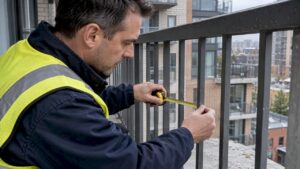
- Deflection. Cables can be pushed. An inspector may press on the cable and check whether the gap still stops a 100 mm sphere under load. Cables spaced exactly at 100 mm centre to centre are a mistake: the clear gap between two cables is smaller than the centre-to-centre spacing, but under pressure it can grow. In practice, designers aim for a real at-rest gap of roughly 90 to 95 mm to leave margin for deflection.
- Tension. Cables settle, and temperature swings loosen or tighten them. Cable systems need periodic re-tensioning. On one house this is a ten-minute job. On a 40-unit building it is a recurring labour cost.
- Post spacing and stiffness. The tighter the post spacing and the stiffer the end posts, the less the cable bows. Weak or widely spaced posts defeat the whole design.
- Stairs. On a sloped run every cable has a different length, and tensioners must accommodate the angle. It is feasible, but it is more fabrication and more adjustment than pickets.
- Climbability. Horizontal cables form a ladder. The code treats this differently depending on the height of the drop and the building type, so confirm the rule with us or with your architect before choosing horizontal cable for a high balcony or a public building.
Side by side
| Criteria | Picket railing | Cable railing |
|---|---|---|
| 100 mm opening | Fixed, easy to verify | Needs tight tension and stiff posts to hold under load |
| Maintenance | Low: inspect finish and fasteners | Periodic re-tensioning on top of finish checks |
| View | Partial | Nearly open |
| Best for | Condos, rentals, commercial, high-traffic use | Private decks, terraces, modern homes |
| Stairs | Straightforward | More complex, each cable cut to its own length |
| Customization | Wide: bar shapes, laser-cut panels | Fewer options: cable diameter, post style, finish |
| Inspection risk | Low | Higher if tension or post spacing is off |
| Cost drivers | Number of pickets, finish, length | Posts, tensioners, fittings, labour to tension |
On cost, there is no honest single number. Price depends on length, height, material, finish, stairs versus flat runs and site conditions. For ranges and what drives them, see our page on balcony railing cost in Montreal, or send us your project for a firm quote.
The Montreal factor: winter, snow and salt
Plenty of cable railing marketing comes from milder climates. Greater Montreal brings freeze-thaw cycles, snow loads, de-icing salt and long stretches below zero, and those conditions affect the choice.
- Temperature swings make cables expand and contract. A railing tensioned in July may be slack in January. Plan for a spring check.
- Snow and ice build up on horizontal members. Horizontal cables and bottom rails can hold snow and add load; vertical pickets shed it more easily. We go into anchors and loads in Montreal snow loads, anchors and shop details.
- Salt and moisture attack finishes and fasteners at the base of any railing. Material choice (stainless steel, galvanized steel with a proper coating, or aluminum) and detailing at the posts matter more than the infill type.
- Anchoring. Frozen ground, thin concrete edges and old balcony slabs are common in Montreal. The strongest cable railing is useless if the end posts move.
Choosing by building type
Homeowners on a balcony or deck
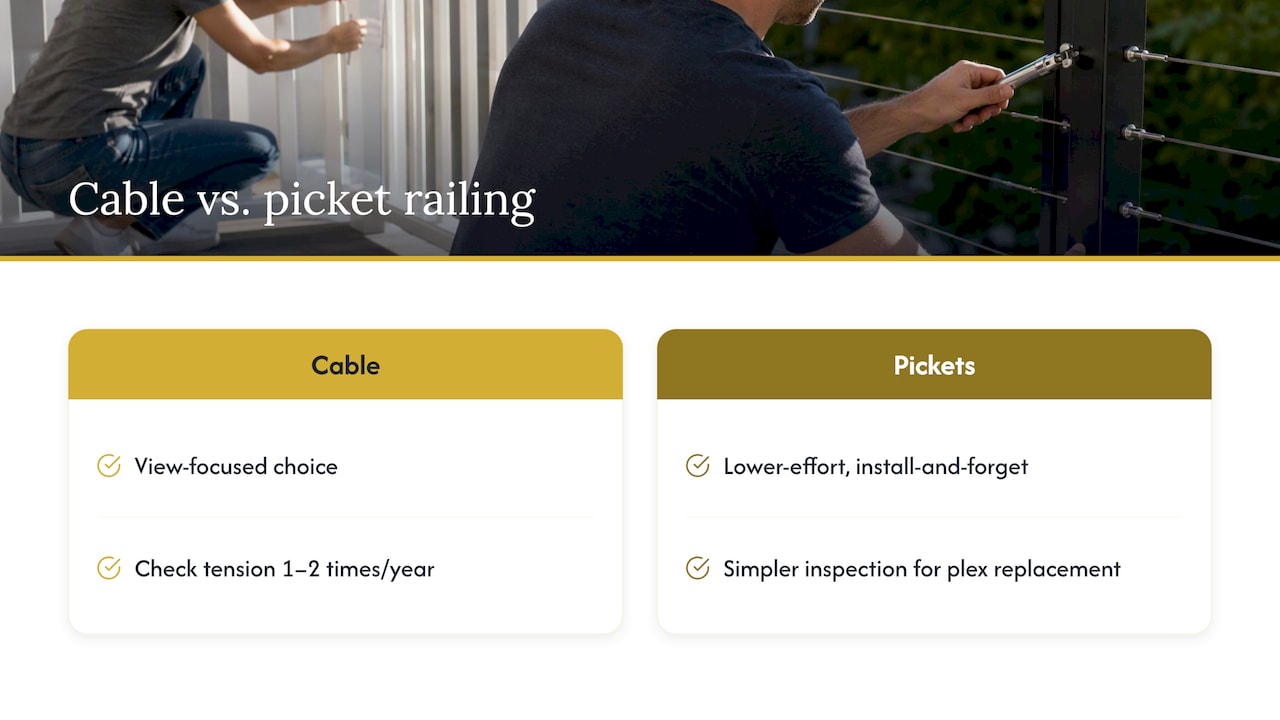
If the view matters and you will check the tension once or twice a year, cable is a legitimate choice. If you want to install and forget, pickets are the lower-effort option. For a plex balcony replacement on a tight schedule, pickets are also the simpler route to a clean inspection.
Condo boards and property managers
You are managing dozens of guards, residents who lean, lock in children and pets, and a budget that must survive board scrutiny. Pickets are usually the safer choice: fixed openings, little recurring labour and easy visual inspection. If a board wants cable on a feature area such as a lobby terrace, treat it as a maintained item and add it to the maintenance plan.
Contractors and architects
Specify the opening requirement as a result, not a product, and ask the fabricator for shop drawings showing post spacing, cable spacing, tensioner type and anchoring before approval. This avoids rework at inspection. If you are comparing fabricators, our three filters for vetting a metal fabricator is a useful checklist.
Restaurants, retail and commercial owners
Patios and mezzanines see crowds and frequent contact. Stainless steel pickets or laser-cut panels are durable and easy to clean. For stairs and landings, see our commercial metal stairs page.
Mistakes that fail inspection
- Measuring height from the wrong surface. The 1070 mm minimum is taken from the finished floor. If decking, tile or a membrane is added after the railing is set, the guard can end up short.
- Treating 100 mm as a centre-to-centre spacing. The rule is about the gap a sphere can pass through, so bar width and cable diameter change the calculation.
- Ignoring deflection. A cable railing that passes at rest and fails when pushed is a fail.
- Weak posts or anchors. The guard must hold the loads the code requires, and that starts at the base.
- Mixing up handrails and guards. A stair needs both in many cases, at different heights. Our guide to Montreal stair handrail heights and the outdoor handrail code requirements sort this out.
Quebec updated its Building chapter in 2025, and the government announcement on the code update lists changes to user safety and structural safety, among others. Confirm the current edition with your municipality or the RBQ before finalizing drawings, since requirements and borough permit rules can change.
Our perspective
We fabricate every railing in our own shop in Lachine and install it ourselves across Greater Montreal, so we see what happens between a drawing and an inspection. Our view: the infill type matters less than how well the system is built and who is accountable for it afterwards.
For most multi-unit and commercial work, we steer clients to pickets, with laser-cut detail if they want character. They are predictable, and the owner is not signing up for a tensioning routine. For a private home with a view worth protecting, we are glad to build cable, as long as the client understands the post spacing, the tensioning and the seasonal check it needs. We would rather say so at the quote stage than argue about it on the day of inspection.
What we ask of any railing project: measure from the finished floor, design the opening for the load case and not only the static case, and detail the anchors for a Montreal winter. Everything else is taste.
— Ash
Get a railing built and installed in Greater Montreal
We fabricate custom residential and commercial railings in steel, stainless steel and aluminum, and we weld, laser cut and form the parts in-house. The same shop builds metal staircases, so a stair and its guards can come from one team. We work with homeowners, contractors, architects and property managers, in French and English. Fabrication and installation are for projects within Greater Montreal. Send us your dimensions, photos or drawings and we will tell you which system suits the site. If you also want to weigh glass against metal, read our note on glass versus metal railings.
FAQ
Is cable railing allowed in Quebec?
There is no blanket ban on cable infill. The guard must meet the same requirements as any other: required where the drop exceeds 600 mm, at least 1070 mm high for most balconies, and no opening a 100 mm sphere can pass. Whether horizontal cable is acceptable depends on the building type and height, so check before you design.
Which is cheaper, cable or picket?
It depends on the project. Cable railings need stiff posts, tensioners and fittings plus labour to tension, while pickets need more individual bars. Length, finish and stairs change the result more than the infill type. For a firm number, send us the project details.
Which needs less maintenance?
Pickets. They have no tension to adjust, so a periodic look at the finish and fasteners is generally enough. Cable systems need re-tensioning from time to time, which is a real cost on large properties.
What is the difference between a fence and a railing?
A guardrail protects against falls from elevated surfaces such as balconies, decks and stairs, and must support loads. A fence is usually a perimeter barrier not required to do that.
Can I switch from picket to cable on an existing balcony?
Sometimes. The existing posts, anchors and slab edge must be strong and stiff enough for cable tension, and the new guard must meet the current height and opening rules. We assess this on site before quoting.
Sources
- RBQ: Principaux changements au Code de construction du Québec, Chapitre I, Bâtiment, et CNB 2015 (modifié)
- Gouvernement du Québec: Bâtiment, mise à jour du Code de construction et du Code de sécurité