The minimum bend radius is the tightest curve a piece of metal can take without cracking, wrinkling or collapsing. It is not one number. For sheet and plate it is a multiple of material thickness, and for tube it is a multiple of outside diameter. It also shifts with the alloy, the grain direction and the tooling. This guide gives you the working rules, two worked examples, and a checklist to confirm with your fabricator before a drawing is released.
TL;DR
- For sheet and plate, the radius is expressed as a multiple of thickness (written t). For tube, it is a multiple of outside diameter (written D), measured to the centreline.
- The absolute minimum a press brake can physically produce is not the same as the recommended radius. Design to the recommended one.
- Standard rotary draw tube bending typically starts at a centreline radius of 3 to 4 times the tube diameter. Going below 2 times usually calls for a mandrel.
- Grain direction, steel grade and thickness all change the answer, so confirm the radius with the shop that will form the part.
Table of Contents
- What minimum bend radius actually means
- Sheet metal and plate: how the radius is set
- Tube and pipe: radius as a multiple of diameter
- What affects the number: a quick reference
- What to confirm with your fabricator before you specify a bend
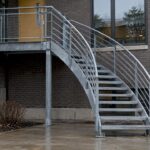
- Bend radius on railings, stairs and architectural work
- Our perspective
- Get your bend checked before you commit
- FAQ
- Sources
What minimum bend radius actually means
When metal bends, the outside surface stretches and the inside surface compresses. The tighter the radius, the more strain the outside fibres take. Past a certain point the outer face cracks, or on tube the wall flattens and wrinkles.
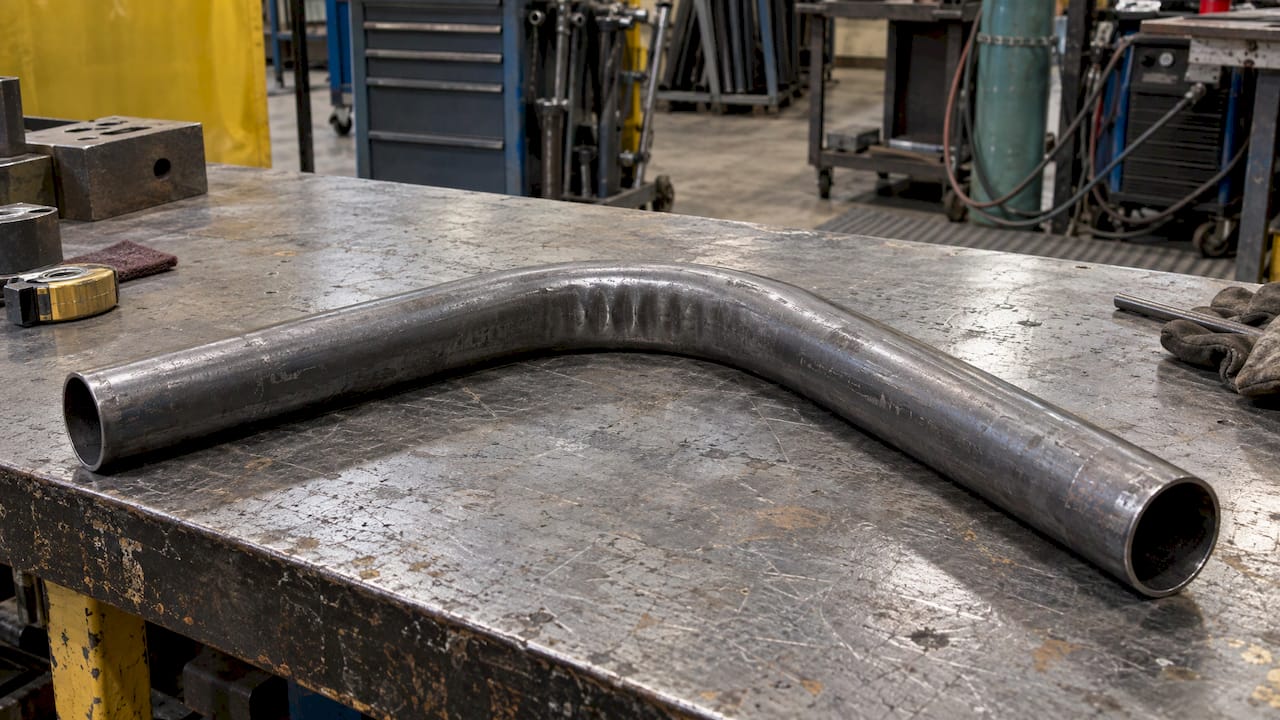
The inside radius is the dimension that matters on sheet and plate. On tube and pipe, shops talk about the centreline radius (CLR): the distance from the centre of the forming die to the centreline of the material being bent, as Ercolina’s Canadian FAQ defines it.
Two terms get confused constantly:
- Minimum inside radius: the smallest radius that is physically producible with press brakes and tooling that can handle the required tonnage.
- Recommended inside radius: the radius that is optimal in a typical application, the one you see on a bend allowance chart.
The Fabricator draws this distinction clearly, and it is worth building into your drawings. A part drawn at the theoretical minimum may be possible on paper and expensive, slow or risky on the shop floor.
Sheet metal and plate: how the radius is set
Radius as a multiple of thickness
For sheet and plate, the first rule of thumb is a ratio to thickness. Softer, thinner material tolerates a tight radius. Thicker, higher-strength material needs a more generous one.
The Fabricator gives a useful example for steel 0.5 to 0.8 in. thick: a grade 350/400 steel may have a minimum bend radius of 2.5 times the material thickness when bending transverse to the grain, while bending longitudinally may require 3.75 times the thickness. Same steel, same thickness, a 50% jump in radius from grain direction alone.
For cold-formed structural steel, the AISI cold bending guidelines list suggested minimum inside radii by grade. Their published table suggests, for example:
| Steel grade | Up to about 3/4 to 1 in. thick | Over 2 to 3 in. thick |
|---|---|---|
| A36 | 1.5t (up to 3/4 in.) | 2.0t |
| A572-50 | 1.5t (up to 1 in.) | 2.5t |
| A588 | 1.5t (up to 1 in.) | 2.5t |
| A514 | 1.75t (up to 3/4 in.) | 5.5t |
Those values apply when the bend line is perpendicular to the direction of final rolling. If the bend line runs parallel to the rolling direction, the same guidelines multiply the values by 1.5. That is why a drawing should always state which way the flat blank sits on the sheet.
Radius from the die opening in air bending
Most sheet work is air bent, and in air bending the radius is not chosen so much as produced by the die. The inside radius that results is a fraction of the die opening width.
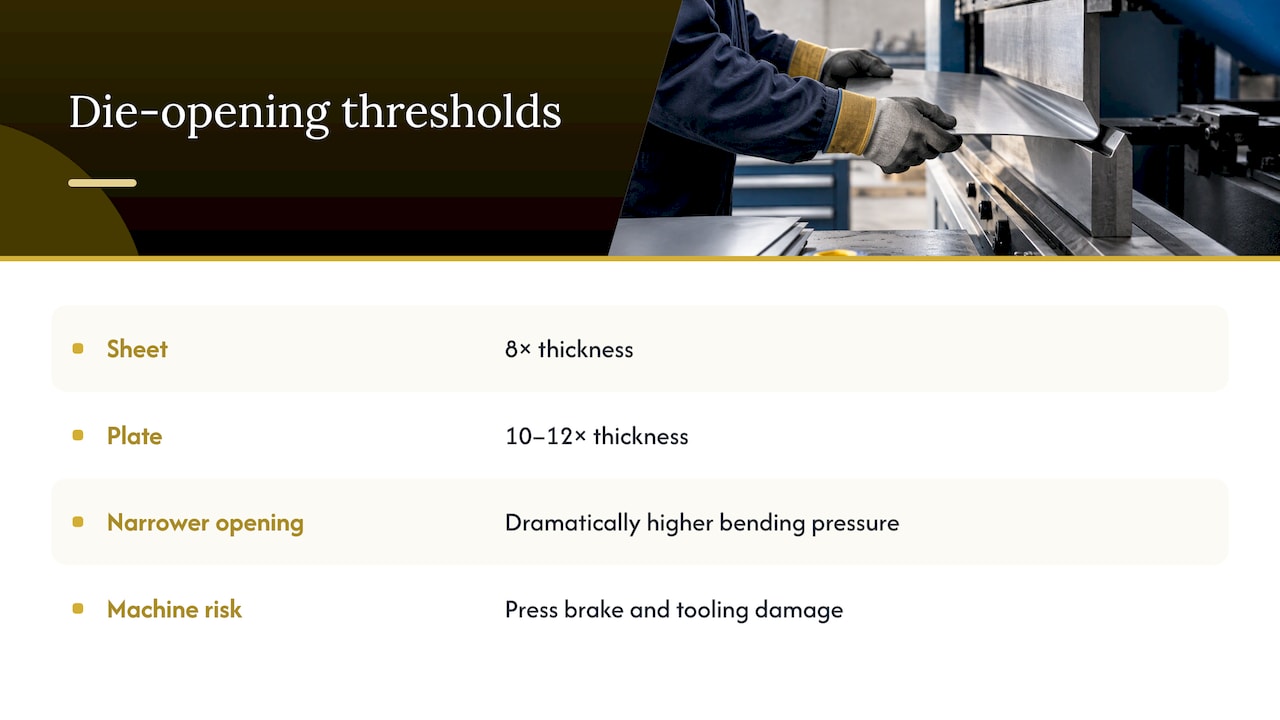
Canadian Metalworking reports the common practice for mild steel 0.500 in. (12.7 mm) thick and under: multiply the material thickness by 8 to get the die opening, then multiply the die opening by 16% (or divide by 6) to estimate the inside radius. Above 0.500 in., a die opening of at least 10 times the thickness is required.
Worked example, 1/4 in. mild steel plate:
- Thickness: 0.250 in. (6.35 mm)
- Die opening: 0.250 × 8 = 2.000 in.
- Resulting inside radius: 2.000 × 0.16 = 0.320 in., about 8.1 mm
That works out to roughly 1.3 times the thickness. If your drawing calls for a 1/8 in. (3.2 mm) radius on that 1/4 in. plate, it is tighter than the standard tooling for that material will naturally give, and the shop has to either use a different method or ask you to open the radius.
Why you should not chase the tightest possible bend
Using a die opening narrower than 8 times the thickness on sheet, or narrower than 10 to 12 times on plate, causes a dramatic increase in the pressure needed to bend the metal. The Fabricator says this is not recommended because of the risk of damage to the press brake and tooling. In practice, the minimum radius that the machine can survive is a poor design target. A slightly larger radius gives you a part that forms consistently, with less cracking risk and less cost.
The ideal radius for sheet metal
People often ask for one ideal number. The honest answer is that it is a range that depends on material and thickness, and that a radius close to the thickness, matched to the tooling the shop already runs, is usually the easiest to form. The way to avoid surprises is to pick the radius with the shop that will form the part, then use that same value in the flat pattern.
That flat pattern depends on it. The bend allowance is the arc length of the neutral axis, calculated from the bend angle, K-factor, material thickness and inside radius, according to The Fabricator’s explanation of K-factors. Change the radius and the flat blank changes length. A drawing that quotes one radius and a flat pattern built on another gives you a part that comes off the brake the wrong size.

Tube and pipe: radius as a multiple of diameter
Typical starting points
For tube, the rule is expressed in multiples of outside diameter. For standard rotary draw bending, guidelines published by a Canadian tube bending supplier in September 2026 state that the minimum standard bend CLR is 3 to 4 times the tube OD. They also note that tubes formed this way use a fixed bend die with a CLR specific to the tube diameter, that the minimum distance between consecutive bends is typically 3.0 to 5.0 in., and that the minimum straight length at the end is approximately 3.0 to 5.0 in.
Worked example, 2 in. (50.8 mm) OD tube:
- Minimum standard CLR at 3 to 4 times OD: 6 to 8 in. (about 152 to 203 mm)
- Gap between two consecutive bends: at least 3 to 5 in. of straight tube
- Straight length at each end: at least 3 to 5 in.
So a short bracket with two bends close together can fail on straight length long before it fails on radius. Check the spacing, not only the curve.
Material changes the starting ratio
Piping Technology System’s chart gives general starting CLR ranges by material. Its tubing bend radius chart lists:
| Material | Starting CLR |
|---|---|
| Annealed copper | 2D to 3D |
| Aluminum | 2D to 4D |
| Low-carbon steel | 3D to 4D |
| Annealed stainless | 3D to 4D |
| Hard or cold-worked stainless, titanium | 4D to 6D or greater |
The same source lists what the acceptable radius depends on: tube OD, wall thickness, material, hardness, bend angle, bending method, tooling design, and the permitted ovality and wall thinning. It also describes what happens inside the tube: the outside wall stretches, the inside wall compresses, and the cross-section tends toward an oval as the radius gets tighter.
When a mandrel comes into play
Bending to a CLR less than two times the diameter requires internal support from a mandrel to stop the tube collapsing, according to Ercolina’s Canadian FAQ. Mandrel bending generally needs more expensive machinery and tooling than non-mandrel rotary draw. That FAQ also advises reviewing the CLR at the design stage and weighing manufacturing cost, because the grade, wall thickness, type of bender, application and the appearance you need all feed into it.
For a guardrail post or a handrail, appearance matters as much as strength. A smooth, consistent curve is part of the look. A generous radius is often the better design decision, not only the cheaper one.
What affects the number: a quick reference
| Factor | Effect on minimum radius |
|---|---|
| Thicker material | Radius needs to be larger, as a multiple of thickness |
| Higher-strength grade | Larger radius required |
| Bend line parallel to rolling direction | Larger radius (AISI suggests 1.5 times the perpendicular value) |
| Thin tube wall relative to diameter | Higher risk of wrinkling, may need a mandrel |
| Harder or cold-worked material | Larger radius |
| Tighter radius than the tooling gives naturally | Higher tonnage, slower forming, more tooling risk |
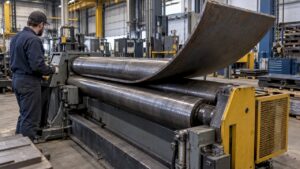
When you need to understand how forming differs from rolling for larger, gentler curves, our comparison of profile rolling vs forming explains which process fits which part. Very large radii on angle, flat bar or tube are typically a rolling job rather than a press brake job.
What to confirm with your fabricator before you specify a bend
For high-strength steel, Canadian Metalworking suggests confirming tensile strength, yield strength, minimum bend radius, recommended punch radius, recommended die opening for the thickness, minimum flange length for the V opening, and grain direction effects. That list works well for any bent part. Before you release a drawing, settle these points:
- Material and grade. Name the alloy and the standard, not only “steel” or “stainless”.
- Thickness or wall. Include tolerance if it matters.
- Inside radius. State it, and state whether it is inside or centreline.
- Grain direction. Mark the rolling direction on the flat pattern when the bend is critical.
- Flange or leg length. A short flange cannot sit properly in the die opening.
- Spacing between bends. On tube, allow for the straight lengths described above.
- Finish. If the part will be painted, galvanized or polished, tell the shop before forming, because cracking and marking show up in the finish.
- Welds near the bend. On welded tube, the seam is ideally placed at 90 degrees to the plane of the bend, at the neutral axis, so it does not sit in extreme tension or compression.
If the part is cut first, the order of operations matters too. A hole or slot too close to a bend line distorts when the metal stretches. Cutting and forming are cleanest when planned together, which is one reason laser cutting and bending work best in the same shop.
Bend radius on railings, stairs and architectural work
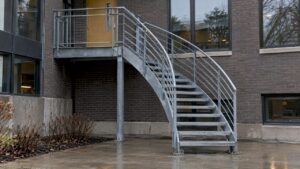
In Greater Montreal, most of the bent metal we see on projects is architectural: curved handrails, formed stair stringers, rolled guard sections and bent plate brackets. The radius decision here is rarely only about whether the metal can bend. It touches appearance, installation and compliance.
Guards and handrails for buildings in Quebec are governed by the construction code that applies to the project, which is based on the National Building Code of Canada (CNB). On a job site, your designer or engineer confirms the code requirements for guard heights, openings and loads, and the fabricated radius has to keep the finished assembly within them. A tight bend that thins the wall of a post, for instance, is a strength question as well as a cosmetic one. For site safety during installation and maintenance, CNESST rules apply to the people doing the work.
If you are specifying railings or stairs, our architectural metal specifications guide covers what to put on a drawing. When the choice is between structural shapes, HSS vs angle iron is a related decision, since hollow sections and angles bend very differently.
Our perspective
We form most of what we sell, and the lesson from the shop floor is simple: the radius on the drawing and the radius the tooling gives should be the same number before anyone cuts a blank.
Because cutting, bending, rolling and welding all happen in-house in Lachine, we can settle the radius, the grain direction and the bend order in one conversation. That is how a contractor or architect avoids the revision loop that happens when a drawing goes to one shop for cutting, another for forming and a third for welding.
Our advice is to design to the recommended radius, not the theoretical minimum, and to tell us the alloy, the thickness and what the part is for. We would rather help you choose a radius that forms cleanly and looks right on a railing than push a part to its limit. We handle small one-off jobs and large runs the same way, in French or in English.
Ash
Get your bend checked before you commit
If you have a drawing with bends on it, send it to us before it goes to a final revision. We form, roll and weld steel, stainless steel, aluminum and copper in our Lachine shop, and our team installs railings, stairs and fences across the island, Laval, the South Shore and the West Island.

For sheet and plate, see our custom metal forming and bending services. For curved profiles and tube, see profile rolling. For finished railing and stair projects, start from our railings page or metal staircases.
FAQ
What is the minimum bend radius for tubing?
For standard rotary draw bending, the minimum centreline radius is typically 3 to 4 times the tube’s outside diameter. Softer materials such as annealed copper can start lower, and hard or cold-worked stainless needs more. Below about 2 times the diameter, a mandrel is generally required to keep the tube from collapsing.
What is the ideal bend radius for sheet metal?
There is no single ideal value, because it depends on the material, its thickness and the tooling. For mild steel under 0.500 in. air bent in a die opening of 8 times the thickness, the resulting inside radius is about 16% of the die opening, roughly 1.3 times the thickness. Confirm the final value with the shop that will form the part.
Is the minimum bend radius the same as the recommended radius?
No. The minimum is the smallest radius the press brake and tooling can physically produce. The recommended radius is the one that works best in a typical application. Specifying the recommended value usually gives more consistent parts and lower tooling risk.
Does grain direction really change the bend radius?
Yes. In one published example for steel 0.5 to 0.8 in. thick, bending across the grain allowed 2.5 times the thickness, while bending along it needed 3.75 times. Mark the rolling direction on your flat pattern when the bend is critical.
Can you bend and install railings in Montreal from my drawing?
Yes, within Greater Montreal. We cut, form, weld and install in-house, and we can review the radii on your drawing before fabrication. Send the drawing with the material and thickness, and we will tell you what forms cleanly.
Sources
- Ercolina Frequently Asked Questions: Rotary Draw
- Minimum inside sheet metal bend radius vs what’s recommended, The Fabricator
- Fabrication Guidelines for Cold Bending, AISI
- Bending high-strength steel, Canadian Metalworking
- K-factors, Y-factors, and press brake bending precision, The Fabricator
- Tube Bending Guidelines, Rotary Draw
- Tubing Bend Radius Chart, Piping Technology System