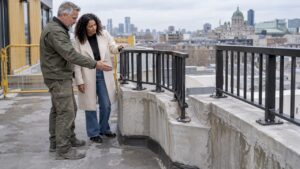
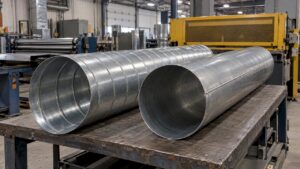
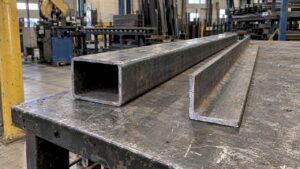
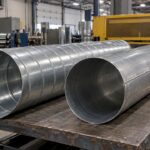
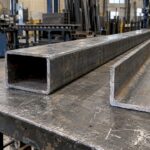
Galvanized steel is carbon steel with a zinc coating. Stainless steel is an alloy that resists corrosion all the way through. Galvanized is the better value for dry, protected, indoor sheet-metal work. Stainless is the better choice for wet, salted, washed-down, hot or hygiene-critical places. In Greater Montreal, with road salt, freeze-thaw cycles and humid summers, that line decides how long a part lasts.
We fabricate and weld in-shop in Lachine, so we get this question regularly from contractors, architects, restaurant owners and homeowners. This guide gives you the practical answer: how the two metals differ, how they behave in our climate, what they cost relative to each other, and how each one is cut, bent and welded.
TL;DR
- Galvanized steel is carbon steel with a sacrificial zinc coating. It suits dry, clean, protected interiors and costs far less.
- Stainless steel carries its protection in the alloy itself. It suits moisture, chlorides, salt, washdown and food-service work.
- Stainless 304 runs about three times the raw material cost of galvanized G90, and 316 about 3.8 times, before fabrication labour.
- Heat matters: published industrial practice covers galvanized to 400°F (204°C) and stainless to 650°F (343°C).
- Choose from the environment first. Then pick the grade (304 or 316) and the finish with your fabricator before cutting starts.
Table of Contents
- What actually separates the two metals
- Corrosion and lifespan in Montreal conditions
- Strength: the myth that stainless is always stronger
- Heat tolerance
- Cost: what the multiplier really means
- Quick comparison table
- Stainless is not one product: 304 or 316
- Code and specification in Quebec
- How to choose: a short decision path
- Our perspective
- How we fabricate it
- Work with a fabricator who installs
- FAQ
- Sources
What actually separates the two metals
Galvanized steel starts as ordinary carbon steel. A zinc layer, typically applied by hot dipping, is bonded to the surface. The zinc acts as a sacrificial barrier: it corrodes first so the steel underneath is protected (Durmahvac). That is why galvanized sheet needs no paint for many uses.
Stainless steel is an iron alloy with chromium, typically 10.5% or more. The chromium reacts with oxygen and forms a thin, stable oxide layer that repairs itself when scratched (same source). The protection is not a coating that can be used up. It is part of the metal.
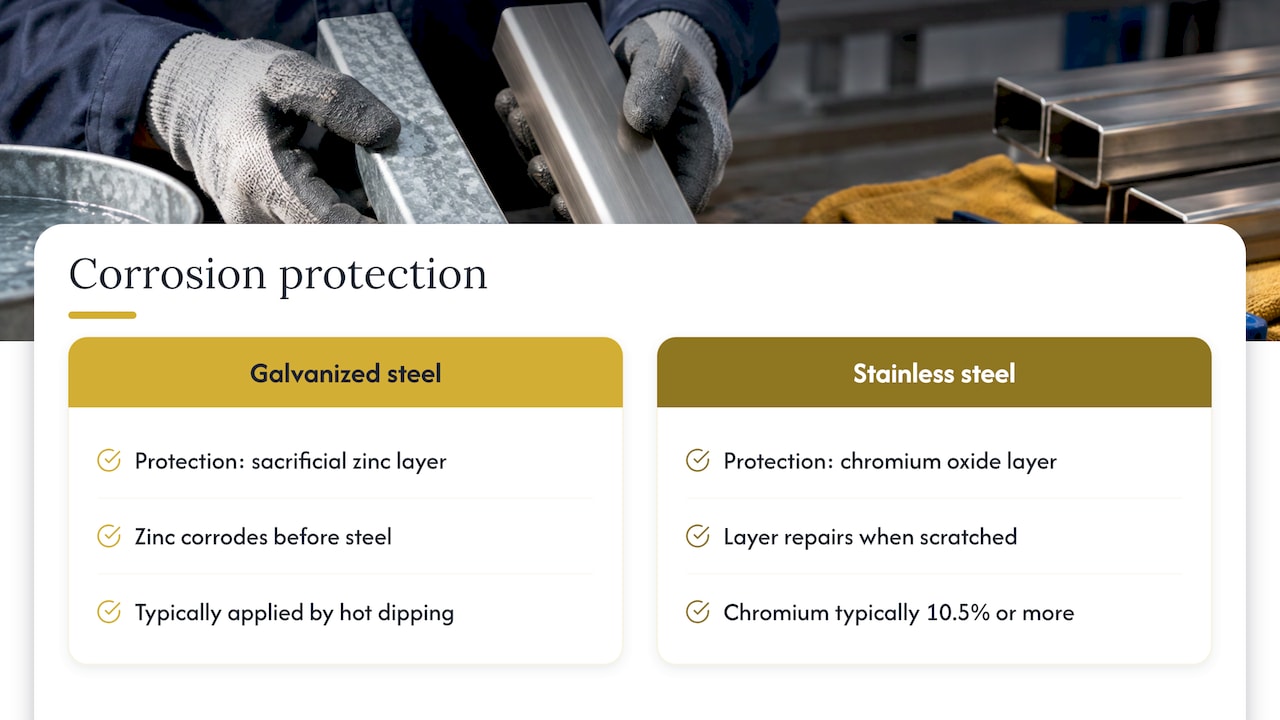
That single difference explains almost everything else in this guide: where each metal lasts, where it fails and why one costs more.
Corrosion and lifespan in Montreal conditions
In a dry, clean interior, galvanized steel gives long service and good value. Trouble starts when the zinc is exposed to persistent moisture, condensation, chemical attack or physical damage (Alpha Tube). A U.S. national laboratory resource makes the same point: galvanized steel is strong, rigid and rust-resistant, but not suited to corrosive environments (NLR resource map).
Now think about what Montreal throws at metal:
- De-icing salt. Chlorides are one of the conditions that consume zinc faster. Ground-level stairs, entrances and parking-adjacent guards take the worst of it.
- Freeze-thaw cycles. Water gets into cut edges, drilled holes and weld zones, then freezes.
- Humidity and condensation. Unheated spaces, rooftops and covered balconies stay damp longer than they look.
- Washdown and cooking. Restaurant and food-prep surfaces are cleaned with water and chemicals every day.
Durmahvac reports galvanized steel lasting under 10 years in harsh environments, against 20 to 30 years or more for stainless in the same conditions. Treat those figures as one supplier’s experience, not a guarantee. The direction is the useful part: the harsher the environment, the more the alloy’s built-in protection pays back.
For exterior steel railings, the choice is often not galvanized versus stainless at all but how the steel is finished. We cover coatings, drainage details and maintenance in rust prevention for steel railings in Montreal.
Strength: the myth that stainless is always stronger
People often ask which is stronger. The answer depends on the base steel, not the coating. Galvanizing does not change the tensile strength of the metal underneath (Unified Alloys). A galvanized part has the strength of the carbon steel it was made from. Stainless alloys span a wide range of strengths depending on grade and temper.
For most railings, stairs, brackets and enclosures, the governing factors are thickness, section shape, connection details and the load the code requires. Material choice is secondary. If you are sizing guards, our guardrail load requirements guide walks through what the rules ask for.
Heat tolerance
Temperature is where the gap becomes a hard limit rather than a matter of lifespan. A Canadian industrial-practice guide covers galvanized steel up to 400°F (204°C) and carbon or stainless steel up to 650°F (343°C) (SMACNA Alberta). The U.S. laboratory resource likewise says galvanized steel should not be used where high-temperature fluids are involved.
If a part sits near a cooking line, a furnace, a process oven or any surface that regularly runs hot, stainless is the safer starting point. If it lives at room temperature, heat should not drive the decision.
Cost: what the multiplier really means
One 2026 market analysis puts stainless 304 at roughly 3.0 times the raw material cost of galvanized G90, and stainless 316 at roughly 3.8 times (Taokron). Specifying stainless where G90 would do adds around 200% to the material bill, according to the same source.
Two cautions keep that number honest:
- It is raw material only. Labour, finishing, installation and lifespan change the picture. A part that needs replacing in a few years can cost more than one that is right the first time.
- Fabrication differs. Stainless is harder to drill and bend than galvanized steel (NLR resource map), so shop time rises along with metal cost. Budget for both.
We do not publish fixed prices because every job depends on size, thickness, quantity and site. We quote each project individually.
Quick comparison table
| Criterion | Galvanized steel | Stainless steel |
|---|---|---|
| Protection | Sacrificial zinc coating | Chromium oxide layer, part of the alloy |
| Damaged surface | Zinc can be breached at cuts, welds and scratches | Layer re-forms on its own |
| Wet, salty or washdown areas | Wears faster | Preferred |
| Dry, clean interiors | Good value | Often more than needed |
| Temperature reference | Covered to 400°F (204°C) | Covered to 650°F (343°C) |
| Raw material cost | Baseline (G90) | About 3.0× (304) to 3.8× (316) |
| Working it | Easier to cut, bend and drill | Harder to drill and bend |
| Typical Montreal use | Interior framing, sheet parts, protected components | Food service, exterior in salt exposure, architectural finishes |
Stainless is not one product: 304 or 316
Specifying “stainless” is not enough. Grade 304 covers most general applications. Grade 316 adds molybdenum for better resistance to chlorides and acids, which makes it the choice for marine settings or chemical exposure. Specifying the wrong grade is a real and common mistake (Durmahvac).
A practical rule for our region:
- 304 for restaurant counters, backsplashes, interior architectural panels and most protected applications.
- 316 where chlorides are a constant, such as exterior elements right at heavily salted entrances, or where cleaning chemicals are aggressive.
On a drawing, give the grade, the thickness and the surface finish (brushed, mirror, mill). It saves a round of questions and avoids a surprise at quote time.
Code and specification in Quebec
Quebec builds its Construction Code on the National Building Code of Canada 2020, with Quebec amendments (Légis Québec). The National Research Council also reminds readers that model codes only become law once a province or territory adopts them, and requirements may differ (NRC). So always check the Quebec version, not a generic reference.
On the material side, public Canadian specifications are explicit about galvanized sheet. One municipal specification calls for galvanized steel to meet ASTM A653/A653M with a Z90 zinc coating, with thickness and fabrication following SMACNA standards (City of Winnipeg specification). It is one example of how a spec names the standard, the coating weight and the thickness, and your drawings should do the same.
Where workers are involved, CNESST rules apply to the workplace. Quebec’s occupational health and safety regulation requires local exhaust at fixed workstations that emit gases, fumes, vapours, dusts or mists, which is one reason material compatibility and corrosion control matter in industrial settings (RSST). For industrial projects, confirm the requirements with your engineer or the CNESST.
For railings, stairs and guards, the same logic applies: the code sets the geometry and loads, and the material choice has to hold up in service. See our notes on architectural metal specifications for railings and stairs and handrail diameter rules in Montreal.
How to choose: a short decision path
- Where will the part live? Dry and heated interior: galvanized is usually enough. Exterior, wet, salted or washed: lean stainless, or a properly finished steel.
- How hot does it get? Above the galvanized range, go stainless.
- Is hygiene visible? Food service and anything customers see up close usually points to stainless.
- What is the budget over the life of the part? Compare installed cost and replacement interval, not material price alone.
- Which grade and finish? Settle 304 or 316 and the surface finish before cutting.
If your question is about stairs or railings outdoors, our comparison of steel and aluminum stairs for Montreal weather adds a third option worth weighing.
Our perspective
We cut, bend, roll and weld every part in our Lachine shop, then install it ourselves across Greater Montreal. That gives us direct control over quality, code compliance and timelines, and it shapes how we advise on material.
Our rule is simple: match the metal to the exposure, not to the habit. Steel is the practical backbone of most of what we build, and stainless is the right answer when the environment demands it. We work in steel, stainless steel, aluminum and copper, so we have no reason to push one metal over another. We recommend the one that will still look right and perform in ten winters.
The best projects start with a conversation before the drawings are final. Tell us where the part goes, what touches it and how it will be cleaned. We will tell you what we would cut, how we would form it and how we would join it.
Ash
How we fabricate it
Material choice and process go together. Here is how the shop work connects:
- Cutting. Our CNC laser cutting handles clean, repeatable profiles in steel and stainless. Thickness, grade and finish all affect the cut, so give us the specification up front. Our guide to what drives laser cutting cost in Montreal explains the variables.
- Forming. Stainless and galvanized sheet behave differently under a press brake, as the stainless is harder to bend. Our sheet bending and rolling service accounts for that in the setup.
- Joining. The weld is often the weak point in corrosion terms on any metal, so the joint design and finishing matter. Our welding service covers steel, stainless steel, aluminum and copper. If you are weighing joint types, read welded vs bolted railings.
Work with a fabricator who installs
If you are a contractor, architect, property manager or homeowner in Greater Montreal and you are deciding between galvanized and stainless for railings, stairs, fences or custom sheet-metal parts, send us the drawings or a sketch. We fabricate in-shop and install locally, serving the island, Laval, the South Shore and the West Island, in French and English.
Start with our railings and metal staircases pages, or contact us through manaracorp.com with your project details. No job is too small or too large, and we quote each one individually.
FAQ
Which is stronger, galvanized or stainless steel?
It depends on the base metal, not the coating. Galvanizing does not change the tensile strength of the steel beneath it, and stainless alloys vary by grade. For railings and stairs, thickness, section and connection design usually matter more than the material label.
Which costs more, galvanized or stainless?
Stainless costs more. One 2026 analysis puts 304 at about three times the raw material cost of galvanized G90, and 316 at about 3.8 times. Fabrication labour adds to the gap, so ask for a quote on your specific part.
Can galvanized steel be used outdoors in Montreal?
Yes, in many cases, since the zinc coating is designed to protect steel without paint. Persistent moisture, salt and coating damage shorten its life, though. For exposed locations, discuss the finish, drainage details and maintenance before choosing.
When should I specify 316 instead of 304?
Choose 316 when chlorides or acids are constant, such as marine settings or aggressive cleaning chemicals. Grade 304 covers most general uses. State the grade on the drawings so there is no confusion at quote time.
Sources
- Galvanized vs stainless steel comparison, Durmahvac
- General information on galvanized and stainless metal, NLR HVAC Resource Map
- Galvanized steel vs stainless steel, Unified Alloys
- Accepted industry practice for industrial construction, SMACNA Alberta
- Galvanized vs stainless steel cost analysis, Taokron
- National Building Code of Canada 2020 in the Quebec Construction Code, Légis Québec
- Building codes overview, National Research Council of Canada
- Specification for common work results, City of Winnipeg
- Règlement sur la santé et la sécurité du travail, CNESST