Laser cutting in Montreal is almost never a flat price per part. Shops quote from machine time, material, setup and file preparation, and finishing. Published benchmarks for Canada run from about $150 to $300 per hour of machine time, and the right number for your job depends on thickness, metal and quantity. This guide shows how the quote is built, so you can read one critically and send a file that costs less to cut.
We are a fabrication and welding shop in Lachine, so we price real jobs every week. We use that experience below. We do not publish a price list, because two parts that look alike can cost very different amounts to cut.
TL;DR
- Expect machine time to be the core of the quote. A Canadian benchmark puts it at $150 to $300 per hour, depending on material thickness and laser type.
- Setup and file preparation can add 15 to 30% on small custom batches, according to the same source. Clean files remove most of that.
- Thickness, cut length, number of pierces and material choice drive the price more than the part’s outline does.
- Cutting is often only one step. Bending, welding, finishing and installation change the total, so ask for them in one quote.
- If the part ends up in a railing or guard, Montreal rules and permits shape the design before the laser runs.
Table of Contents
- How a laser cutting quote is built
- A worked example of the arithmetic
- What moves the price up or down
- How to prepare files that quote fast
- Online shops, hobby studios and a local fabricator
- When laser cutting is part of a railing or stair
- Our perspective: price the whole job, not the cut
- Safety and compliance are part of the price
- Get a laser cutting quote from our Lachine shop
- FAQ
- Sources
How a laser cutting quote is built
Most quotes combine four things: material, cutting time, setup, and everything that happens after the cut. Some shops show these as separate lines. Others fold them into one price per part. The structure is the same either way.
Machine time
The laser is billed by the time it spends cutting your parts. Research on the Canadian market gives a typical range of $150 to $300 per hour, with the rate rising for thicker material and higher-power machines. Time depends on how far the beam travels (total cut length), how fast it can travel through that thickness, and how many times it has to start a new cut (pierces).
This is why a thin plate with a complex lace pattern can cost more than a thicker plate with four straight edges. Many small holes mean many pierces, and each one takes time.
Material
Material is billed by the sheet or by the weight used, plus the waste between parts. The metal itself changes the price in three ways:
- Type: carbon steel, stainless steel, aluminum and copper cost different amounts per kilogram and cut at different speeds.
- Thickness: thicker plate costs more to buy and cuts more slowly.
- Sheet size: parts are laid out (nested) on standard sheets. Poor nesting means paying for scrap.
Industry commentary notes that fiber lasers cut reflective metals such as aluminum and copper much faster and cleaner than older CO2 or plasma methods. If a shop quotes aluminum or copper, ask what laser it will run on. It affects speed and edge quality.
Setup and file preparation
This is the line most first-time buyers miss. The same source reports that setup and file preparation often add 15 to 30% to total project cost on small custom batches. Programming the nest, loading material and checking the first part cost the same whether you order one piece or fifty. That is why a single part can look expensive, and why ordering ten at once often costs far less than ten times the price of one.
Secondary operations
A flat laser-cut blank is rarely the finished product. Common extras include:
- deburring or edge finishing
- bending on a press brake
- rolling of sheet or profiles
- welding and assembly
- paint, powder coat or other finishing
- delivery or installation
Each of these adds labour that the cutting rate does not cover. Our work in these areas is on the pages for sheet bending and rolling, welding and profile rolling.
A worked example of the arithmetic
Here is a simple illustration, using only the benchmark figures above. It is arithmetic, not a quote from any shop.
Suppose a small batch of brackets needs two hours of total machine time. At $150 per hour that is $300. At $300 per hour it is $600. Now add the 15 to 30% setup and file-preparation allowance: the low end becomes about $345 and the high end about $780, before material and finishing.
That spread of more than $400 on a modest job is the reason shops ask for your drawing before they name a number. It is also why the useful question is not “how much per cut?” but “what is the total for these parts, finished, delivered or installed?”
What moves the price up or down
| Factor | Raises the cost | Lowers the cost |
|---|---|---|
| Thickness | Thick plate, slow cutting | Thinner gauge where the design allows |
| Cut length | Intricate patterns, many small holes | Simple outlines, fewer pierces |
| Quantity | One-off parts carry full setup | Batches share the setup |
| File quality | Open contours, missing dimensions, wrong units | Clean vector files with dimensions |
| Tolerance | Tight fits, special edge requirements | Standard tolerance where it is enough |
| Material | Copper, specialty alloys, stainless | Common carbon steel |
| Scope | Cutting plus bending, welding, finish | Cutting only |
Cut length and pierces
If you control one thing, control this. Merge features, avoid tiny holes that could be drilled in assembly, and let neighbouring parts share an edge when the shop’s nesting allows it.
Tolerance
Asking for tighter tolerance than the part needs adds inspection time and sometimes slows the cut. Specify the tolerance that matters at the mating surfaces and leave the rest standard. Our sheet metal laser cutting page covers the precision we work to.
Material choice
Switching from stainless to carbon steel, with a coating, can lower the bill on an indoor part. For outdoor work in Montreal winters, with salt and freeze-thaw cycles, the cheapest metal at purchase is not always the cheapest over ten years. Our guide to metal railing maintenance in Canada explains how finish and material interact. If you want to understand which regulations touch the material you choose, see our note on what shapes laser cutting materials in shops.
How to prepare files that quote fast
A clean file is the cheapest discount you can get. Before you send anything:
- Export 2D vector drawings (DXF or DWG) at 1:1 scale, in millimetres or inches, and say which.
- Close every contour. Open lines stop the machine or force manual repair.
- Remove duplicate lines and stray construction geometry.
- State the material, grade and thickness.
- State the quantity, including any repeat orders you expect.
- Mark bend lines, countersinks or tapped holes, if any, and say what finish you want.
- Say where the part is going and when you need it.
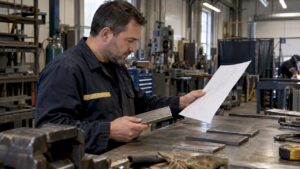
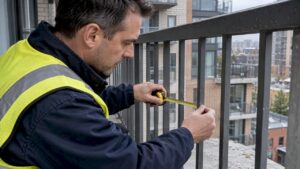
If you do not have drawings, a sketch with dimensions and photos of the site is enough for us to start a conversation. For homeowners with a balcony or stair project, that conversation often starts on site rather than from a CAD file.
Online shops, hobby studios and a local fabricator
You will find three kinds of providers when you search for laser cutting in Montreal, and they price differently.
- Hobby and design studios use smaller machines and often work in wood, acrylic and thin metal. They suit signs, art and small decorative pieces, and publish per-piece starting prices.
- Online manufacturing platforms offer instant quotes on uploaded files. They suit simple parts when you can wait for shipping and already know your specification.
- Local fabrication shops cut, form, weld and install. They suit structural, architectural and industrial parts, where the cut is one step in a larger assembly.
A forum thread that ranks for this search shows how easily expectations clash: someone asked why six holes could cost hundreds of dollars. The answer is almost always setup, minimums and material handling, not the length of the cut. A one-off job pays full setup, so a shop’s minimum order exists to cover it. If you only need a few holes in a thin sheet, a drill may truly be cheaper. If you need a precise pattern in structural steel, it will not be.
Our own work is in the third category. All fabrication and welding is done in-house in Lachine and installed by our team across Greater Montreal. We do not ship fabricated parts outside the region. That keeps quality, code compliance and timelines in one place, which matters when a laser-cut part has to fit a stair or a railing on site. Our laser cutting page lists what we cut.
When laser cutting is part of a railing or stair
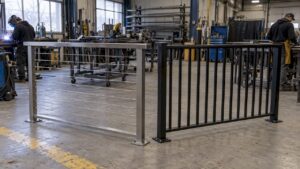
A large share of the laser-cut metal we handle ends up in guards, railings, stair parts and screens. In those cases the price of the cut is the smaller number. The code and permit questions decide the design, and the design decides the cut.
Heights and thresholds
The City of Montréal states that guardrails are required where a platform is 60 cm or more above ground, with a required height of 90 cm for elevations up to 180 cm and 107 cm above that. A laser-cut infill panel has to be sized for those heights from the start. Our guides to balcony railing height in Montréal and the balcony railing code go through the rule in detail.
Openings in the pattern
Decorative patterns look great in a laser-cut panel, but openings in a guard are regulated. Check them before you draw. Our page on guardrail spacing in Montreal explains the 100 mm rule, and the Quebec handrail requirements page covers guard and handrail dimensions for inspections. For stairs, see stair handrail heights in Montreal.
Permits add cost and time
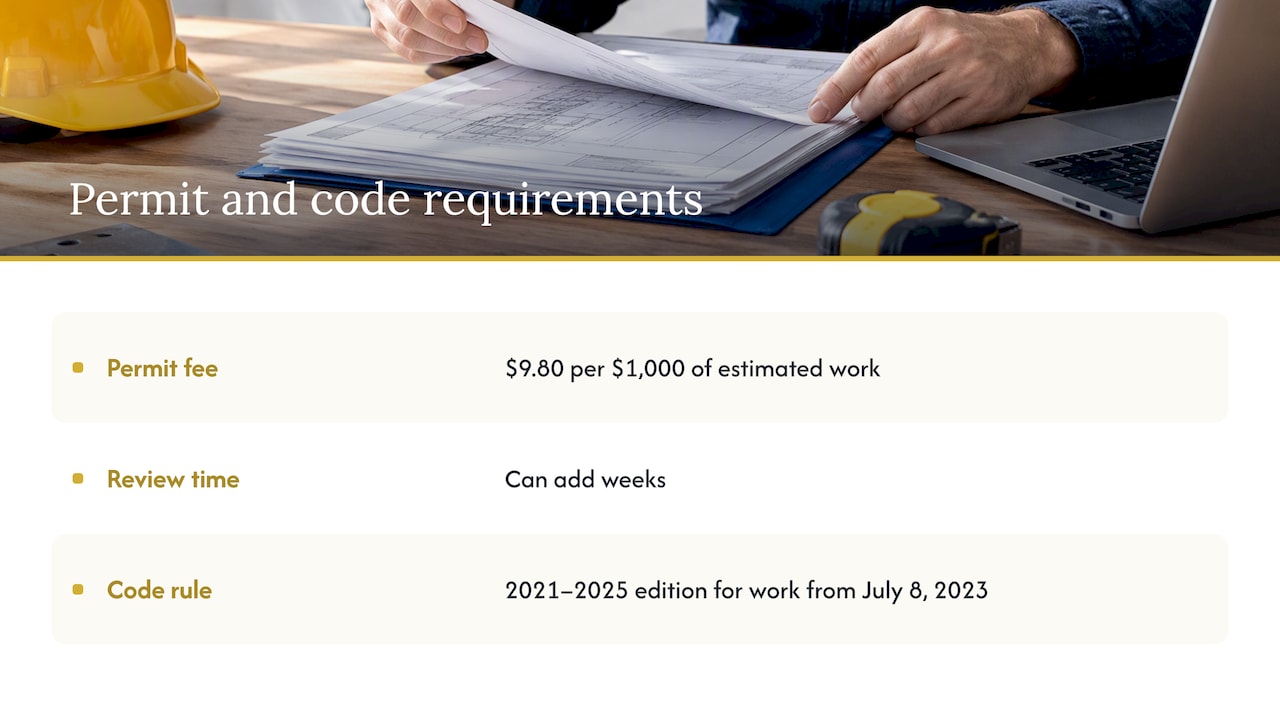
Replacing a balcony, gallery or similar structure generally needs a municipal permit. On the City’s page, the analysis fee is 9,80 $ per 1 000 $ of estimated work, subject to a minimum that the page lists. Permit review can also add weeks, so build that into your schedule and budget. Rules vary by borough, so check yours or ask us what your project is likely to need.
The building code itself is set by the province. The RBQ publishes the Construction Code, Building chapter, and works that began on or after 8 July 2023 follow the edition in force from 2021 to 2025. Confirm with your architect or the borough which edition applies to your project, because that can change.
Our perspective: price the whole job, not the cut
We see the same pattern again and again. A buyer collects three laser cutting quotes, picks the lowest, and then discovers that the flat parts still have to be bent, welded, finished and fitted by someone else. The cut was the cheap part. The coordination was not.
Our view is that laser cutting is a step in a process, and the best price is the one that covers the process. Because we cut, bend, roll, weld and install in our own shop in Lachine, we can look at a drawing and tell you where cost will hide: a tolerance that forces a second pass, a pattern that fails a guard opening rule, a bend too close to a hole. We would rather flag that before cutting than after.
Three habits save our clients money:
- Send drawings early, even rough ones. Changes before cutting are nearly free. Changes after are not.
- Group parts into one order. Setup is shared.
- Ask for the quote to state what is included: material, finish, delivery or installation, and permit support if relevant.
We work with general contractors, architects, designers, manufacturers, property managers and homeowners, in French and English. Small jobs and large jobs get the same attention. If you are comparing shops, our three filters for vetting a metal fabricator lay out what to check beyond the number.
— Ash
Safety and compliance are part of the price
A shop that prices very low may be saving somewhere you cannot see. In Quebec, the CNESST investigates serious workplace accidents, and its findings repeatedly point to training and hazard identification. In one published case, the agency’s report on a forklift fatality led to recommendations for training programs. Welding and cutting bring their own hazards, and the federal guide on welding and allied processes covers eye protection and radiation.
For a buyer, the practical point is simple. Ask whether the shop does its work in-house, who will be on your site, and how it handles safety and code compliance. Those answers affect delivery risk as much as price.
Get a laser cutting quote from our Lachine shop
If your parts are in Greater Montreal, send us your drawings or sketches through our laser cutting service page, and tell us the material, thickness, quantity and what happens after the cut. We cut, form, weld and, for railings and stairs, install. If the cut is part of a larger structure, see our railings and stairs pages. For a sense of how fabrication costs scale on bigger pieces, read our article on custom stairs and Montreal metal fabrication costs.
We quote project by project and do not publish prices, because an honest number needs your file.
FAQ
How much does laser cutting cost in Montreal?
There is no single price. Benchmarks for Canada put machine time at $150 to $300 per hour, and setup can add 15 to 30% on small batches. Material, thickness, cut length and finishing then decide the total. A quote from your drawing is the only reliable number.
Why is a small laser cutting job so expensive?
Because setup, programming and material handling cost the same for one part as for fifty. On a small order those fixed costs are spread over very few pieces. Combining parts into one order or ordering a few extra usually brings the unit price down.
What file format should I send?
A 2D vector file, usually DXF or DWG, drawn at full scale with closed contours. Add the material, thickness and quantity. If you only have a sketch, send it with dimensions and photos and we will tell you what is missing.
Does laser cutting for a railing need a permit?
The cutting itself does not, but replacing a balcony or its guard often does. The City of Montréal sets permit fees by the cost of work, and rules vary by borough. Check with your borough or ask us before the design is final.
Do you cut and install outside Greater Montreal?
No. We fabricate in Lachine and install across Greater Montreal, including Laval, the South Shore and the West Island. We do not ship fabricated parts outside that area.
Sources
- Laser Cutting Services in Canada, The Assembly
- Balcons, escaliers et autres éléments en saillie, Ville de Montréal
- Construire ou remplacer une terrasse, un balcon, une galerie ou un perron, Ville de Montréal
- Chapitre Bâtiment du Code de construction du Québec, RBQ
- CNESST investigation conclusions, Gouvernement du Québec
- Welding and Allied Processes, Canada.ca