Pick stainless steel when the project sits near water, handles food, or needs to last decades with almost no maintenance. Pick galvanized steel when the budget is tight, the environment is dry or mildly exposed, and a lifespan typical for such conditions is genuinely fine. The technical reason comes down to how each material fights rust: stainless is an alloy that grows a self-healing chromium oxide layer through its entire structure, while galvanizing coats plain steel in a sacrificial layer of zinc that corrodes first so the steel underneath doesn’t have to.
Before you specify either one, run through this:
- How severe is the exposure? Coastal spray, road salt, and chemical fumes all shorten galvanized lifespan fast.
- What design life does the project need? A 10 year fence and a 40 year marine railing are different conversations entirely.
- Who’s maintaining it, and with what budget? Zinc coatings can be touched up; stainless mostly takes care of itself.
Pro Tip: If you’re not sure which category your project falls into, describe the worst month of weather it will ever see. That single answer usually settles the material choice faster than any spec sheet.
Key Takeaways
Stainless steel resists corrosion through its entire alloy structure while galvanized steel relies on a zinc surface coating that wears out, which is why environment and design life should drive the material choice, not sticker price.
| Point | Details |
|---|---|
| Match material to exposure | Stainless for marine, chemical, or hygiene-critical uses; galvanized for dry or mild outdoor settings. |
| Know the failure mode | Stainless corrodes at scratches and heals itself; galvanized rusts once zinc wears through. |
| Price versus lifecycle cost | Stainless costs 3 to 5 times more upfront but often wins over 20 to 30 year horizons. |
| Weld safety differs | Galvanized welding produces zinc fumes and needs coating restoration; stainless needs passivation. |
| Get local fabrication support | Manaracorp specs, welds, and installs both materials across Greater Montreal, matching grade to exposure before fabrication starts. |
Table of Contents
- Stainless vs galvanized: the basic metallurgy
- Corrosion resistance and how long each one actually lasts
- Strength, weight, welding, and whether it’s magnetic
- Comparing price today against cost over 20 years
- Where each material actually gets used
- How to choose the right material for your project
- Fabrication considerations from a metal shop’s perspective
- How Manaracorp helps you get the material call right
- Sources
- FAQ
Stainless vs galvanized: the basic metallurgy
Stainless steel is an iron alloy containing at least 10.5% chromium, which reacts with oxygen to form a thin, invisible oxide film that repairs itself when scratched. The two grades you’ll run into constantly are 304, the workhorse for general fabrication, and 316 (or 316L, the low-carbon version), which adds molybdenum for real resistance to chlorides and pitting. Galvanized steel is a different animal: it’s ordinary carbon or mild steel dipped in molten zinc, a process called hot-dip galvanizing, or coated electrochemically in a thinner layer through electro-galvanizing.
That distinction changes how each material fails:
- Stainless resists corrosion throughout its cross-section, so a scratch or a cut edge stays protected.
- Galvanized steel only resists corrosion at the surface. Once the zinc is gone at a given spot, whether from abrasion, welding, or age, that spot rusts like any other mild steel.
- Coating thickness on galvanized parts directly dictates how long the sacrificial protection lasts before bare steel is exposed.
Corrosion resistance and how long each one actually lasts
Chromium oxide is homogenous. Zinc coating is a barrier with an expiry date. That’s the whole story of why stainless and galvanized age so differently, and it shows up clearly once you sort environments by severity.
| Environment | Galvanized (typical) | Stainless (typical) |
|---|---|---|
| Mild indoor / dry | 25+ years | Effectively indefinite |
| Urban outdoor | 15 to 25 years | 30+ years, minimal upkeep |
| Coastal / marine | Often under 10 years | 25 to 40+ years (316 or duplex) |
| Chemical / acidic exposure | Poor, rapid failure | Strong with correct grade selection |
A common G90 galvanized coating, roughly 25 microns per side, holds up for 10 to 25 years in a mild outdoor setting, but that number collapses fast near salt air or de-icing chemicals. In those conditions, zinc coatings deteriorate quickly enough that most engineers specify 316 or duplex stainless instead. Pitting resistance in chloride environments is often estimated using a PREN calculation, and higher-alloy grades score better on that scale for a reason.
Pro Tip: Cut edges and drilled holes on galvanized parts expose bare steel underneath the coating. Treat every fresh edge with a zinc-rich cold-spray before it ever sees weather, or you’ll be fixing rust spots within a year.
Strength, weight, welding, and whether it’s magnetic
Mild steel substrate under a zinc coating typically runs a lower yield strength than common stainless grades, though 304 and 316 also weigh more per volume, which matters on anything hung or spanned. Galvanized steel forms and bends easily since you’re shaping plain carbon steel before or after coating. Stainless work-hardens as you shape it, meaning it resists further bending the more you work it, which changes how a fabricator sequences a job.
Welding is where the two materials diverge sharply on safety, not just technique:
- Welding galvanized steel vaporizes the zinc at the heat-affected zone, producing toxic zinc oxide fumes that require ventilation and respiratory protection.
- That same heat destroys the protective coating right at the weld, so the zinc has to be ground back and a zinc-rich repair coat reapplied afterward.
- Stainless welding skips the fume issue but usually needs post-weld pickling or passivation to restore full corrosion resistance at the joint.
- Magnetic behaviour is a useful field clue: austenitic 304 and 316 are largely non-magnetic, while galvanized (plain steel underneath) is strongly magnetic. That matters for anything near motors, compasses, or sensitive instrumentation.
Pro Tip: A cheap magnet in your pocket tells you more on-site than a spec sheet you can’t find. Strong pull means plain or galvanized steel; a weak or no pull points to austenitic stainless.
Comparing price today against cost over 20 years
Stainless steel typically costs three to five times more than galvanized steel per kilogram, and that gap is the single biggest reason galvanized dominates cost-sensitive projects. But total ownership cost tells a different story once you factor in recoating, inspection, and eventual replacement.
- A small indoor or dry-climate railing rarely justifies stainless. Galvanized wins on price and lasts long enough that lifecycle cost barely enters the conversation.
- A coastal structure exposed to salt spray flips that math. Recoating a galvanized railing every 5 to 8 years, plus eventual replacement, often exceeds the upfront premium of specifying 316 stainless once, and walking away for 30 to 40 years.
- Lifecycle cost analysis tends to favour stainless once a project’s horizon stretches past 20 to 30 years or maintenance access is difficult, think rooftop equipment or structures over water.
Where each material actually gets used
Galvanized steel shows up constantly in guardrails, HVAC ductwork, chain-link fencing, and general structural work in dry or moderate climates, largely because it’s affordable and reliable in non-critical exposures. Stainless takes over anywhere hygiene, extreme corrosion, or long-term appearance matters most.
- A coastal condo railing calls for 316 stainless. Galvanized simply won’t survive salt spray at the lifespan the owner expects.
- An indoor cable tray or duct support in a dry warehouse is a fine fit for galvanized, or 304 if budget allows and appearance matters.
- Food processing equipment and medical fabrication need 304 or 316 for cleanability and chemical resistance, not just corrosion resistance.
- Heat exchangers, boilers, and chloride-heavy industrial settings favour stainless outright, since zinc coatings fail quickly at elevated temperatures and can’t be relied on there at all.
- Some projects split the difference with duplex stainless or specialty coatings when neither standard option quite fits the exposure or the budget.
How to choose the right material for your project
Run through this before you finalize a spec:
- Classify the exposure. Indoor and dry, urban outdoor, or coastal and chemical each point toward a different default material.
- Set the design life. A 10 to 15 year fixture and a 40 year structural component aren’t the same decision, even in identical environments.
- Price out maintenance, not just material. Recoating labour and access costs add up fast on anything hard to reach.
- Weigh appearance and hygiene needs. Food contact, medical use, and visible architectural elements usually tip toward stainless regardless of budget.
- Confirm fabrication and welding constraints. Galvanized needs post-weld zinc restoration; stainless needs passivation. Both take shop time.
When you’re talking to a supplier or fabricator, ask directly: what grade or coating class are they quoting (304, 316, or a specific G-number for galvanizing), what’s their post-weld restoration process, and what testing or inspection backs the claim. Red flags worth walking away from include a quote with no coating thickness or grade specified, no mention of post-weld treatment at all, or a lifespan claim that ignores your actual exposure category.
Field tests to confirm what you’re actually holding
A magnet settles most on-site confusion in seconds: strong pull means plain or galvanized steel, weak or no pull points to austenitic stainless. Beyond that, look for a dull, slightly mottled zinc patina (galvanized) versus a uniform, brighter finish (stainless), and check for mill stamps or grade markings on the material itself.
- Send a sample for lab testing if you see pitting, the part is structurally critical, or coating thickness is genuinely in question.
- Never weld a suspected galvanized part without confirming it first. Zinc fumes are a real hazard, and if there’s any doubt, stop and check with your fabricator before striking an arc.
Pro Tip: Keep a small grinder on hand during inspection. A quick spot-grind reveals bright steel under a zinc coating almost instantly, no lab required.
Fabrication considerations from a metal shop’s perspective
Post-fabrication handling is where most galvanized jobs go wrong. Every cut, drilled hole, or weld made after galvanizing exposes bare steel that needs a zinc-rich touch-up or it starts rusting within months. On stainless jobs, the extra material cost often gets recovered in labour, since there’s no fume control, no coating restoration step, and no repeat site visits to fix edge corrosion down the line.
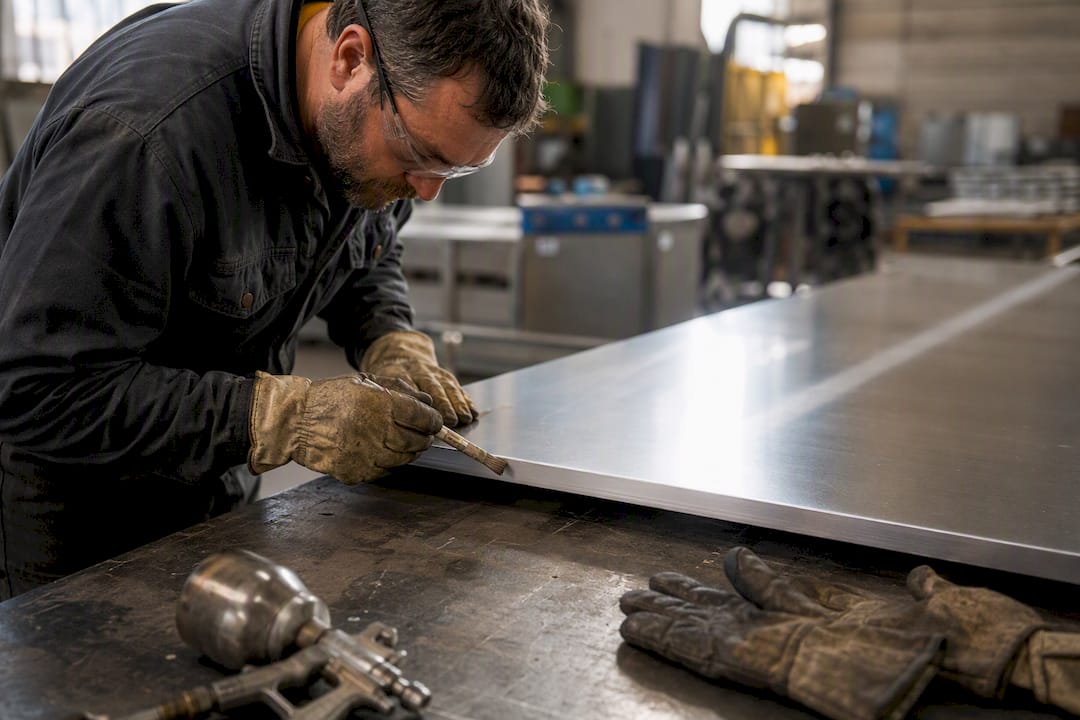
Before committing to a shop, ask whether they fabricate before or after galvanizing, what their re-coating procedure looks like, and what finish tolerances they hold on visible work.
Pro Tip: Design fasteners, brackets, and cut lines before galvanizing whenever possible. Pre-galvanize fabrication cuts down on field touch-ups and hidden labour that rarely show up in the original quote.
A fabricator’s honest take on material choice
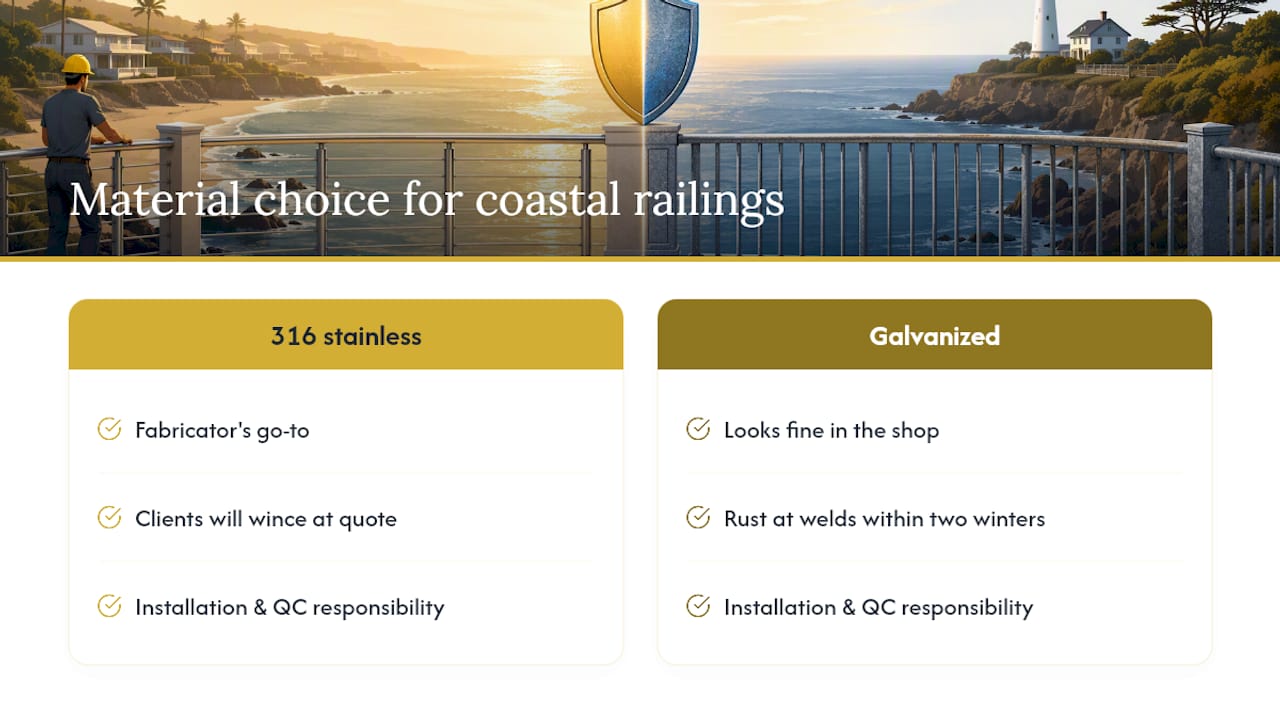
Ask me to spec a railing for a coastal condo and I’ll reach for 316 stainless almost every time, even knowing the client will wince at the number on the quote. Galvanized looks fine in the shop and starts showing rust streaks at the welds within two winters near salt air. That gap between shop-fresh and site-reality is exactly what local installation and quality control are supposed to catch before it becomes the client’s problem.
How Manaracorp helps you get the material call right
Choosing between stainless and galvanized isn’t a one-size answer, and getting it wrong means redoing work in five years instead of thirty. Manaracorp fabricates and welds steel, stainless steel, aluminum, and copper in-shop across Greater Montreal, covering everything from custom railings and stairs to sheet bending, rolling, and site welding, and every job gets checked against the actual exposure and lifespan the client needs before a single cut is made.
That means catching the details that cause callbacks later: confirming coating thickness on galvanized specs, planning post-weld zinc restoration properly instead of skipping it, and recommending 304 versus 316 based on where the piece actually lives, not just what’s cheapest to quote. Sheet forming and profile work happen in-house through Manaracorp’s sheet bending and rolling services, and tight-tolerance stainless components run through precision laser cutting before they ever reach a welder.
If you’re specifying material for a railing, staircase, fence, or ductwork project anywhere in Greater Montreal, get in touch for a material consultation and quote before you lock in a spec you might regret in a decade.
Sources
- Stainless Steel vs Galvanized Steel: Key Differences & Engineering Guide 2026 – EPCLand
- Stainless vs. Galvanized Steel: Corrosion Resistance, Life-Cycle Cost Analysis – MWalloys
- 7 Best Sheet Metal Materials for Outdoor Applications – SRMFG
- CISC code and welding practice notes (artifact) – Canada Commons
FAQ
Is galvanized better than stainless steel?
Neither is universally better. Galvanized wins on upfront cost for dry or mild environments, while stainless wins on lifespan and lower maintenance in marine, chemical, or hygiene-critical settings.
What two metals should not be used together?
Galvanized steel and copper (or copper alloys like brass) shouldn’t be in direct contact, since the zinc coating corrodes rapidly through galvanic reaction when paired with a more noble metal like copper.
Is galvanized steel rust proof?
No. Galvanized steel resists rust only as long as its zinc coating remains intact. Once the coating wears through at a scratch, weld, or cut edge, the exposed steel underneath rusts normally.
Is galvanized or stainless better for outdoor use?
For mild, dry outdoor conditions, galvanized is cost-effective and typically lasts 15 to 25 years. For coastal, humid, or chemically exposed outdoor settings, 316 stainless holds up far longer and needs little to no maintenance, which is why Manaracorp typically recommends it for exterior railings near water.