Spiral duct and welded duct are both round metal tube, but they are made differently. Spiral duct is wound from a continuous coil strip and mechanically locked along a helical seam. Welded duct is a flat sheet rolled into a cylinder and joined by fusing one straight seam. Spiral suits standard-gauge, low to medium pressure runs. Welded is the route when the spec calls for heavy gauge, stainless steel, or a continuous, gas-tight joint. This guide helps you choose between them, and shows what to put in your drawings so a shop can quote it correctly.
We are a fabrication and welding shop in Lachine, so we look at this from the bench: how the seam is made, what it can carry, and what the specifier needs to write down.
TL;DR
- Seam type: spiral is a locked helical seam made from coil on a tubeformer. Welded is a single straight seam fused along the length of a rolled sheet.
- Strength: the four-ply spiral seam works as a continuous rib, so thin-gauge spiral resists crushing well. Welded round duct is chosen when you need heavy gauge or a fused joint.
- Pressure and duty: a welded seam is the usual answer for stainless, high-temperature and severe industrial duty. Check the pressure class and the standard named in your spec.
- Cost: the cost gap comes mostly from forming speed and welding labour. Gauge, metal, diameter, fittings and finish matter as much as the seam.
- In Greater Montreal: we roll, weld and install custom round metal work in steel, stainless steel, aluminum and copper. Send us the drawings and the pressure class.
Table of Contents
- How the two seams are made
- Side-by-side comparison
- Strength and rigidity
- Leakage and joints
- Pressure class, temperature and standards
- Metals: steel, stainless steel, aluminum and copper
- What drives the cost
- Choosing between them: a short decision guide
- Perspective
- Work with a local fabrication and welding shop
- Preparing a drawing package that gets a fast quote
- FAQ
- Sources
How the two seams are made
Spiral lockseam
A spiral machine feeds a continuous strip of sheet metal, about six inches wide, and winds it into a tube. The edges interlock as they go, so the seam runs helically along the whole length. According to the Spiral Metal Pipe Association’s technical paper, the four-ply lockseam acts as a continuous reinforcing rib. They report crushing resistance of more than twice that of longitudinal lockseam or welded pipe.
No heat is involved in making the seam. The process is continuous, and the tube is cut to length as it comes off the machine. That is why spiral is so efficient for long runs of standard diameters in thin gauges.
Longitudinal welded seam
Welded round duct starts as a flat plate or sheet. It is rolled into a cylinder, and the two edges meet along one straight line. That line is then welded, and the weld is dressed to suit the finish required. Where the part is stainless or exposed, the weld is cleaned and finished to match the job.
This is a rolling and welding job rather than a coil-forming job. It is the same work we do every day: sheet bending and rolling followed by custom metal welding. Each section is made to the diameter, length and gauge on the drawing. Short sections, odd diameters, heavy plate and one-off transitions are all normal for this method.
Side-by-side comparison
| Criterion | Spiral lockseam | Longitudinal welded seam |
|---|---|---|
| How it is made | Continuous coil strip, wound and mechanically locked | Sheet rolled to a cylinder, one straight seam welded |
| Seam location | Helical, along the whole length | Single straight line |
| Typical gauge | Light to medium | Light to very heavy |
| Stiffness in thin gauge | High, the locked seam acts as a rib | Depends on gauge and added reinforcement |
| Best fit | Standard runs at low to medium pressure | Stainless, heavy gauge, high-temperature or demanding industrial work |
| Seam sealing | A mechanical joint, not a fused one | Fused, continuous joint |
| Short runs and special sizes | Needs the right coil width and tubeformer setup | Made to order from sheet or plate |
The table is a guide to the usual cases. The final call belongs to the pressure class, the metal and the standard in the project specification.
Strength and rigidity
Strength is where spiral earns its reputation. Because the lock seam folds four plies of metal together and winds around the whole tube, the wall is stiffened in every metre. The Spiral Metal Pipe Association paper reports that this lets spiral pipe resist crushing at more than twice the level of longitudinal lockseam or welded pipe. In practice, that means a thin-gauge spiral tube can hold its round shape without as much added reinforcement.
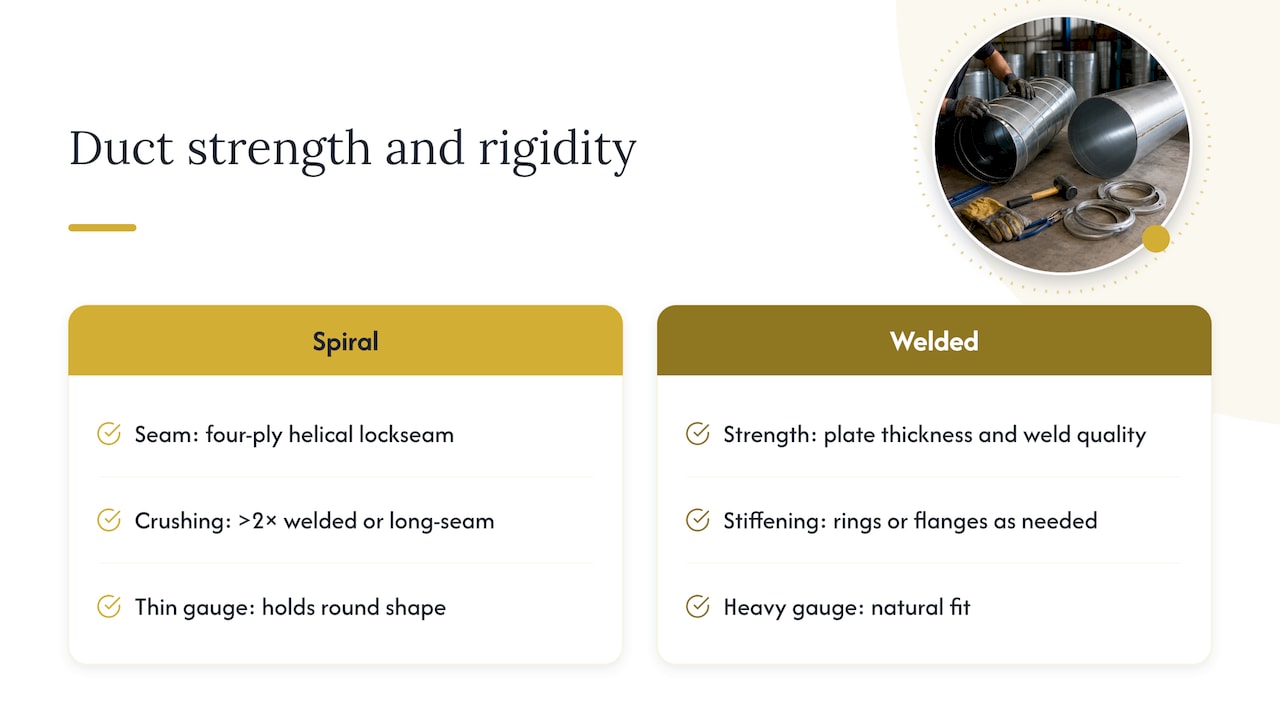
A welded tube gets its strength differently. It depends on the plate thickness, the weld quality and, when needed, stiffening rings or flanges. That is why heavy-gauge duty is a natural home for welded work. When the wall is thick, the tube does not rely on a seam fold for stiffness. A well-made weld also keeps the full section continuous. Thin walls and large diameters are the situation where you plan the reinforcement early.
What to put on the drawing: the gauge or thickness, the diameter, the length of each section, how sections are joined (flanges, slip couplings, welded collars) and any added stiffeners. If the tube will see negative pressure, say so. A negative pressure case is a collapse case, and the shop needs to know.
Leakage and joints
Leakage is often misunderstood in this comparison. The Spiral Metal Pipe Association states that a spiral system leaks under 1% of total system flow, while rectangular systems are often over 5%. That comparison is against rectangular, which has more joints and longer seams. It does not compare spiral with welded round.
Between spiral and welded round, the difference is in the kind of seam. A lock seam is a mechanical joint. A weld is a fused one. For most low-pressure work, a locked seam with sealed joints performs well. When the specification requires a gas-tight, continuous joint, a welded seam is the clearer way to meet it. Typical cases are fume or hot-gas duty, stainless duty, or anything where the tube contents must not escape at the seam.
Joints between sections matter as much as the seam. A tube is only as tight as its worst connection. A good drawing therefore says how sections are joined and sealed, not only how each section is made. If the specification defines a leakage class, put it on the drawings, since a quote that assumes one class will not match a build for another.
Pressure class, temperature and standards
Pressure is the main decision point. Two reference documents from the Sheet Metal Contractors Association of Alberta show how wide the territory is.
- The HVAC Duct Construction Standards (ANSI/SMACNA 006-2006) cover constructing ducts for pressures from ½ in. to 10 in. water gauge, positive and negative. The same page states that expanded tables cover round duct including 6 in. wg and sizes up to 96 in.
- The Round Industrial Duct Construction Standards (ANSI/SMACNA 005-2013) include a spiral duct chapter for Classes 1 and 2, with design pressures from 30 in. wg negative to 50 in. wg positive. The 2013 edition also introduces a Duct Class 5 for corrosives and spiral lockseam pipe.
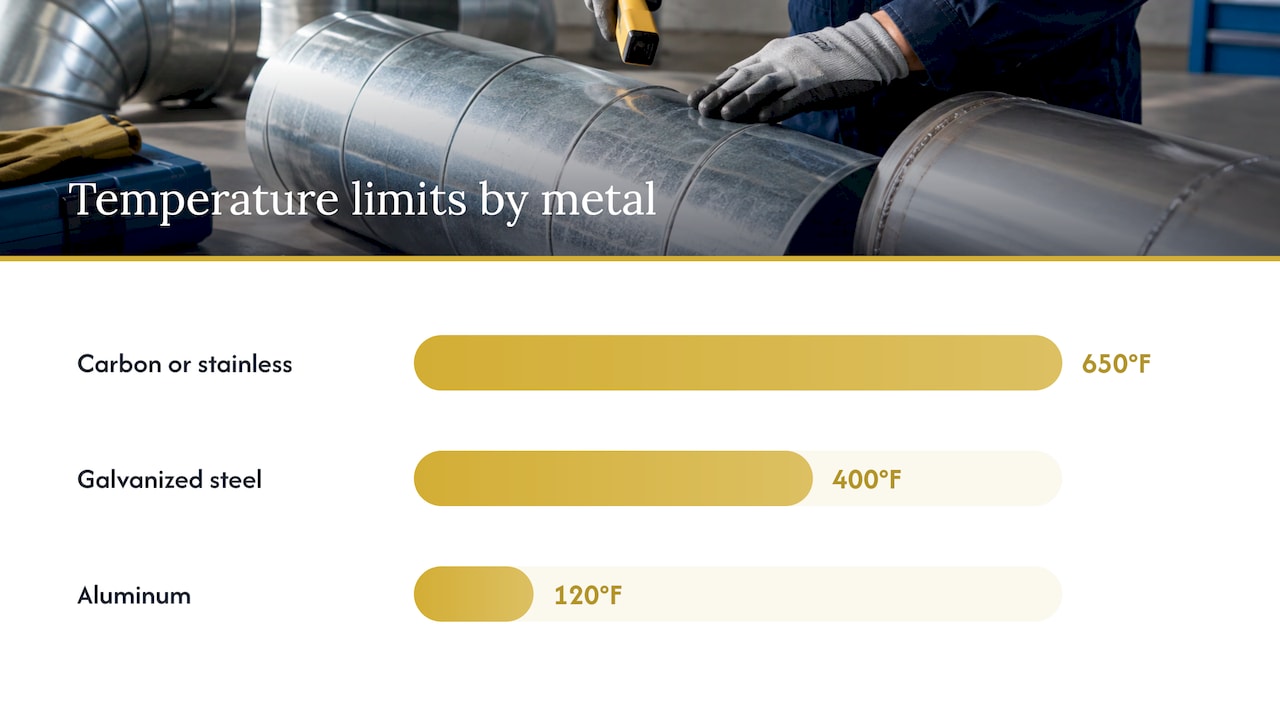
For industrial duty, SMACNA’s Accepted Industry Practice for Industrial Duct Construction covers round long-seam and spiral duct from 4 in. to 60 in. in diameter. It applies to operation from 4 in. to 20 in. wg, positive or negative. Temperature limits are up to 650°F for carbon or stainless steel, 400°F for galvanized steel and 120°F for aluminum.
These limits show why metal choice and seam choice go together. A galvanized tube and an aluminum tube do not share the same temperature ceiling, whatever the seam. If your process runs hot, the metal and the weld procedure are part of the same decision.
In Quebec, the specifying engineer or architect sets which standard and which edition apply, and the project documents carry that through. We build to the drawings and specifications we are given. For work on an occupied site, the general contractor’s site safety plan will also cover what the CNESST expects, and we coordinate with it. Always confirm which code edition governs before you issue the drawings.
Metals: steel, stainless steel, aluminum and copper
Seam choice and metal choice interact.
- Galvanized and carbon steel: the common choice for standard runs. Welding galvanized steel needs the coating handled properly, so tell the shop whether the weld zone will be touched up or coated after fabrication.
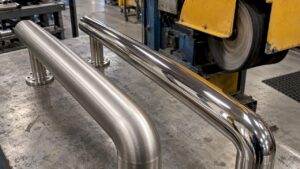
- Stainless steel: welded seams are the usual route here. A fused stainless seam can be finished to a clean, uniform look, which matters in exposed work such as restaurant and retail interiors, as well as for corrosion duty.
- Aluminum: light and corrosion-resistant, with the lowest temperature ceiling of the group in the SMACNA figures above. It welds well in skilled hands, but it needs its own process.
- Copper: a specialty choice for architectural and specific process uses, rolled and joined to drawing.
We work with steel, stainless steel, aluminum and copper in-house in Lachine. If a drawing mixes metals, tell us early so we can plan the weld process and the isolation between them.
What drives the cost
Spiral is generally the lower-cost way to make standard round tube, because the process is continuous. Welded round costs more per metre because each section is rolled and then welded by hand or machine, and the weld often needs finishing. That is the logic in industry commentary, and it matches how the work flows in a shop.
But a price per metre is only part of the total. These factors shift a quote more than the seam name does:
- Gauge or plate thickness. Heavier material costs more to buy, roll and weld.
- Metal. Stainless and aluminum cost more to buy and need more careful welding than mild steel.
- Diameter and section length. Long sections need handling and lifting plans. Short sections mean more joints.
- Fittings and transitions. Elbows, reducers, branches and one-off transitions often take more labour than the straight tube.
- Finish. Brushed, polished, painted, galvanized and left raw all price differently.
- Installation conditions. Access, height, crane or lift needs and site schedule.
We do not publish a price list for custom work, because every job depends on these inputs. A drawing, a quantity and a site address are enough for us to give you a real number.

Choosing between them: a short decision guide
Work through these questions in order.
- What is the pressure class, positive and negative? If it falls outside the range of a standard light-gauge run, plan for a heavier, welded build and confirm with the engineer.
- What is the metal and finish? Stainless and exposed architectural work lean toward welded seams that can be finished cleanly.
- Does the spec call for a gas-tight, fused joint? Then a welded seam is the direct answer.
- What is the temperature? Check the limits for your metal in the standard before you choose the gauge.
- How many sections, and how special are they? One-off diameters, short sections and transitions are well suited to rolling and welding to order.
- Who installs? If the same team fabricates and installs, sections fit the site as measured.
A worked example
Say an architect specifies a stainless round run, exposed in a Montreal restaurant, with a clean finish and a few custom transitions. The tube is visible to guests, so the seam is part of the look. A rolled and welded stainless build, with the weld dressed to match, fits that brief. The shop rolls each section, welds, finishes and installs. The drawing should list the grade, thickness, finish, section lengths and joint type.
Now take an industrial shop that needs a short run of heavy-gauge round sections with welded collars, for a process running at a pressure class the engineer has set. The work is rolled from plate, welded, checked against the drawing and delivered. Again the seam type follows from the duty, not from habit.
Perspective
We make round metal parts by rolling and welding, in-house in Lachine, and we see the same pattern on every quote: the seam matters less than the spec behind it.
When a drawing gives us the metal, the thickness, the pressure class and the joint type, we can price and build it without surprises. When it does not, we ask. That conversation costs a day, and it saves weeks on site.
Our approach is to control the work from the first cut to the last bolt. We roll, weld and install our own work, so what we measure on site is what we fabricate in the shop. For round welded sections in steel, stainless steel, aluminum and copper, that direct control lets us hold the tolerances, the weld finish and the schedule on small jobs and large ones alike.
If your specification calls for a fused, continuous seam, heavy gauge or a finished stainless look, send it to us. We will tell you what we can build, how we would build it, and what we need from the drawings.
Ash
Work with a local fabrication and welding shop
If your project needs rolled and welded round metal work in Greater Montreal, we can fabricate it in Lachine and install it with our own team. Our shop covers the island, Laval, the South Shore and the West Island, and serves general contractors, architects, designers, industrial manufacturers and homeowners in French and English.
Start with our custom metal fabrication and welding page, or go straight to sheet bending and rolling and profile rolling for the forming side. Our architectural metal specifications guide shows how we like drawings to be laid out, and the same habits (clear thickness, finish and joint notes) make any custom metal quote faster. Send us your drawings, quantities and site address, and we will come back with a quote. We do not ship fabricated parts outside Greater Montreal.
Preparing a drawing package that gets a fast quote
A complete package avoids back-and-forth. Include:
- Metal and grade, plus the finish and any post-weld treatment
- Thickness or gauge for each section
- Diameter and length of every section, with a schedule of transitions and fittings
- Pressure class, positive or negative, and the temperature range
- Joint type between sections and any required leakage class
- The standard and edition named by your engineer
- Site address, access conditions and target schedule
- Quantities, and whether installation is included
The more precise these are, the more precise the quote.
FAQ
Is spiral duct stronger than welded duct?
In thin gauges, usually yes. The four-ply lock seam works as a continuous rib, and the Spiral Metal Pipe Association reports crushing resistance of more than twice that of longitudinal lockseam or welded pipe. Welded tube reaches its strength through thickness, weld quality and added stiffeners, so it suits heavy-gauge duty well.
When should I specify a welded seam?
Choose welded when the project calls for a fused, continuous joint, heavy gauge, stainless steel or demanding industrial duty. The pressure class, temperature and metal in your specification decide it. Confirm the governing standard with your engineer, then send the drawings so the shop can quote against the same requirements.
Is spiral duct cheaper?
Per metre of standard tube, spiral is generally the lower-cost method because it is formed continuously. A welded tube adds rolling and welding labour. Gauge, metal, diameter, fittings, finish and installation affect the total more than the seam name, so quote the actual drawing rather than comparing per-metre figures.
What pressure ranges do the standards cover?
The SMACNA HVAC construction standard covers ½ in. to 10 in. water gauge, positive and negative. The industrial standard covers spiral duct design pressures from 30 in. wg negative to 50 in. wg positive. Your engineer sets the class for your system.
Can you fabricate and install round welded sections in Montreal?
We roll and weld custom metal in steel, stainless steel, aluminum and copper in our Lachine shop, and we install within Greater Montreal. Send your drawings with the metal, thickness, section lengths and joint details, and we will confirm the scope and quote it.
Sources
- Spiral Duct: How shape and connection technology contribute (Spiral Metal Pipe Association)
- Manuals, Sheet Metal Contractors Association of Alberta
- Accepted Industry Practice for Industrial Duct Construction, SMACNA Alberta