Powder coating wins on durability and environmental impact for most shop-applied metal parts. Paint wins when you need field application, tight tolerances, or a custom colour match on something that can’t fit in an oven. That’s the short answer, and the reasons behind it come down to film chemistry, cure method, and where the work actually happens.
Here’s how the top scenarios typically shake out:
- Batch metal parts headed outdoors (railings, fencing, machine frames): powder coating, almost every time.
- On-site structural steel, heat-sensitive assemblies, or anything too large to fit in an oven: liquid paint.
- Class-A automotive or architectural colour matching with tight tolerances: liquid paint, sometimes as a topcoat over a duplex system.
The rest of this piece backs those calls with the technical detail and shop-floor experience behind them, including where the two processes overlap and where a hybrid approach beats picking one exclusively.
Key Takeaways
Powder coating generally delivers longer service life and a lower environmental footprint for shop-applied metal parts, while liquid paint remains the practical choice for field work, tight tolerances, and custom colour matching.
| Point | Details |
|---|---|
| Durability edge goes to powder | Thicker cross-linked film (60 to 120 micrometres) resists chipping and abrasion better than single-coat paint. |
| Environmental profile favours powder | Near-zero VOCs and roughly 95% transfer efficiency make powder the lower-waste shop process. |
| Cost crosses over with volume | Paint often wins on small batches or prototypes; powder wins at scale due to lower per-part labour. |
| Tolerance planning matters | Parts with threaded holes or tight fits need masking or DFM allowances before powder coating. |
| Duplex systems extend harsh-environment life | Galvanizing plus a powder topcoat can add 1.5 to 2 times the service life of either finish alone. |
Table of Contents
- Powder coating vs paint: what powder coating actually is
- How liquid paint actually works, and where it still wins
- Durability, environment, and cost: the real trade-offs
- When to choose powder coating vs paint for your project
- What drives cost and timeline in a real quote
- Maintenance and touch-up: what keeps either finish working
- How a fabrication shop actually picks a finish
- Why the “just pick the durable one” advice misses the point
- Sources
- FAQ
Powder coating vs paint: what powder coating actually is
Powder coating starts as dry, pigmented resin, sprayed onto a grounded metal part using an electrostatic gun. The charged particles cling to the surface, then the part goes into an oven where heat melts the powder and cross-links it into a hard, continuous film. There’s no solvent flashing off, no drips, no runs from gravity while it’s still wet. The chemistry does the work once the heat hits it.
Cure temperatures generally sit at high temperatures requiring minutes of dwell time depending on part mass and powder chemistry, according to manufacturing data on powder cure cycles. That’s fast compared to multi-coat liquid systems, but it also means the substrate has to survive that heat without warping, melting, or losing temper.
Film thickness is where powder coating separates itself from paint mechanically. Dry film thickness on a powder job typically runs a moderate thickness considerably higher than that of a single coat of liquid paint, according to industrial finishing data. That thicker, cross-linked film is a big part of why powder resists chipping and abrasion better than a comparable paint coat. It’s also why powder coating can cause real headaches on threaded fasteners, bearing seats, or any part with a tight fit. A DFM allowance or masking plan has to account for that thickness before the part ever hits the booth.
Three powder chemistries cover most jobs:
- Polyester powders handle UV exposure well and are the default for outdoor architectural and automotive trim work.
- Epoxy powders offer excellent adhesion and chemical resistance but chalk under UV, so they’re mostly an indoor or hidden-surface choice.
- Hybrid epoxy-polyester blends split the difference, often used for general-purpose industrial parts where cost matters more than UV performance.
Statistic to know: optimised powder coating operations report material transfer efficiencies around 95%, with overspray reclaimed and reused rather than sent to waste, according to coating industry benchmarks. That reclaim capability is one reason powder coating shows up in nearly every environmental comparison as the lower-waste option.
How liquid paint actually works, and where it still wins
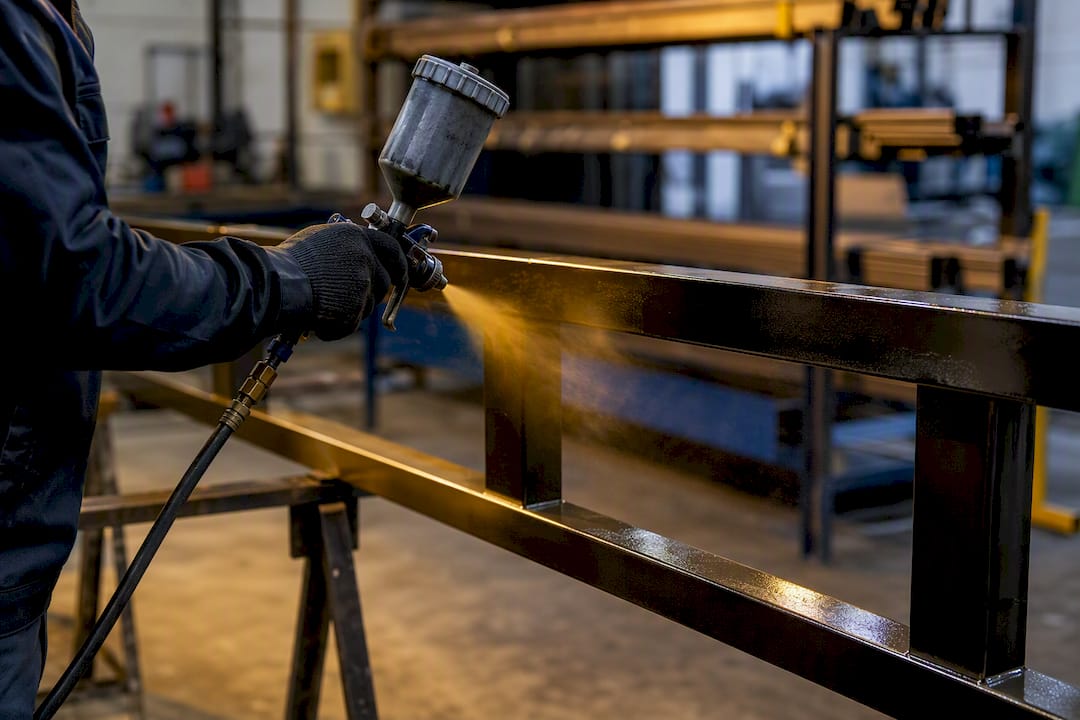
Liquid paint cures through one of three mechanisms: solvent evaporation, chemical cross-linking (as in two-part epoxy or polyurethane systems), or UV curing for specialized industrial lines. Waterborne paints have narrowed the VOC gap with powder in recent years, but solvent-based industrial coatings, especially the two-part urethanes used for heavy equipment, still off-gas meaningfully during application and cure.
The advantage paint holds onto is thinness and flexibility of application. A single coat runs 15 to 30 micrometres, thin enough to preserve tight tolerances on precision parts and to avoid the masking gymnastics powder coating sometimes demands. Liquid coatings can also go onto substrates powder can’t touch efficiently, including wood, masonry, plastics, and composites, according to coating comparison data.
Paint’s practical strengths show up in a few specific situations:
- Field touch-up and repair on installed assets, where bringing a part back to a shop oven isn’t realistic.
- Large, fixed structures like bridges, tanks, and structural steel that will never fit inside a curing oven.
- Bespoke colour work, since wet paint can be custom-tinted on demand without ordering a minimum batch of powder in a specific formulation.
- Heat-sensitive assemblies, including anything with electronics, rubber gaskets, or plastic components that can’t survive a 200°C bake cycle.
Worker safety and ventilation requirements are real considerations with solvent-based paints, particularly in enclosed shop environments, and they factor directly into equipment cost and labour planning.
Durability, environment, and cost: the real trade-offs
This is where the decision usually gets made, so it’s worth being precise about each axis instead of leaning on vague claims about one finish being “better.”
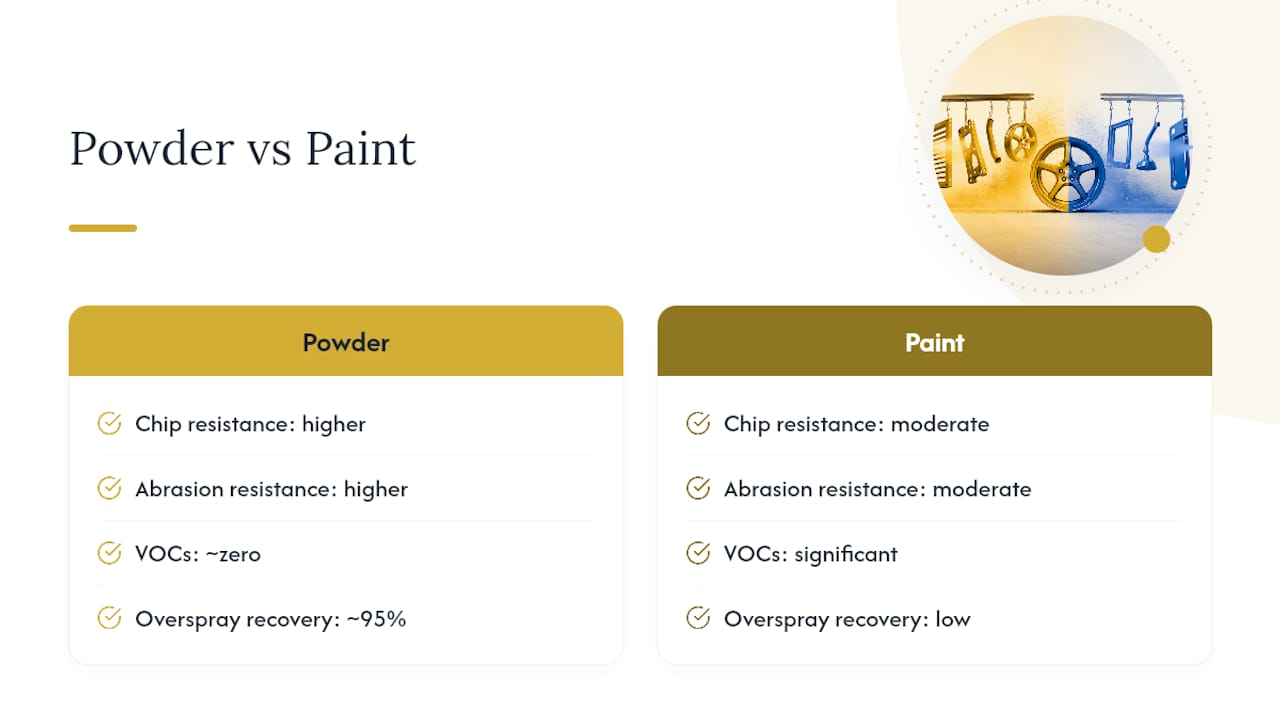
Durability and service life. Powder coating’s thicker, cross-linked film generally outperforms single-coat liquid paint on chip and abrasion resistance, which matters most on parts that get bumped, scraped, or handled, like railings, gates, and machine housings. In sheltered environments, a quality powder finish can last well beyond a decade. In coastal or heavily salted road environments, both finishes degrade faster, and that’s where a duplex system, hot-dip galvanizing under a powder topcoat, changes the math. Duplex systems can extend service life significantly compared to either finish alone, according to corrosion protection research. That’s a meaningful jump for anything going into a harsh outdoor environment for the long haul.
Environmental impact. Powder coating emits close to zero VOCs and reclaims oversprayed material for reuse, with transfer efficiencies around 95% in well-run operations. Liquid paint, particularly solvent-based industrial systems, releases VOCs during application and cure, and overspray from spray guns is largely unrecoverable. If sustainability reporting or workplace air quality is part of your decision, powder coating has the stronger case on paper.
Cost drivers. Powder coating requires a bigger upfront investment: a curing oven, an electrostatic booth, and pretreatment tanks. But at volume, the economics flip. Single-coat application, shorter cure cycles, and high material utilization bring per-part costs down as batch size grows, according to manufacturing cost analysis. Liquid paint has a lower barrier to entry, a spray gun and compressor can get you started, but multiple coats, inter-coat drying time, and higher labour intensity per part keep costs from dropping as sharply with volume. For a one-off prototype or a small batch of five parts, paint is often genuinely cheaper. For 500 identical brackets, powder usually isn’t close.
Colour and finish. Powder coating offers a wide standard colour range and increasingly sophisticated textures, but matching an existing colour exactly, or blending a custom shade on short notice, is harder than with wet paint. Class-A automotive finishes with mirror gloss and zero orange peel are still paint’s territory in most cases.
Repairability. Powder coating chips are hard to touch up invisibly. Liquid touch-up paint can patch a powder-coated part reasonably well for colour, but the finish, gloss and texture won’t match perfectly, and it won’t recreate the original film hardness. Paint touches up more predictably because you’re using the same material and process as the original coat.
Operational constraints. Oven size caps what powder coating can handle. A part too long, too tall, or too heavy for the shop’s oven simply can’t be powder coated there, full stop. Paint has no such ceiling, which is exactly why bridges and building exteriors get painted, not powder coated.
When to choose powder coating vs paint for your project
Four questions settle most of these decisions quickly:
- Does the part fit in an oven, and can it survive 190 to 205°C without deforming? If not, you’re using paint, no further debate needed.
- Is this a one-off or a production run? Prototypes and small batches often favour paint on cost; repeat runs of 50-plus identical parts usually favour powder.
- Will this finish need field touch-up after installation? Paint touches up more predictably. If the part lives somewhere hard to remove for a shop visit, that matters.
- Does the environment demand maximum corrosion protection? For harsh outdoor exposure, look at a duplex system, hot-dip galvanizing plus a powder topcoat, rather than either finish alone.
Shop-appropriate projects, removable railings, staircases, fences, furniture frames, HVAC components, almost always go to powder coating because they can be transported, hung on a rack, and run through a cure cycle. Field or oversized work, structural steel already welded in place, large tanks, heat-sensitive electrical enclosures, go to liquid paint because there’s no alternative.
Hybrid approaches are common in fabrication shops for good reason: powder-coat the removable components in the shop, then field-paint the welded connections or on-site joints after installation. That combination minimizes the weak points of each method, according to coating selection guidance.
Pro Tip: If you’re specifying a mixed-material project, tell your fabricator upfront which parts are removable and which are permanent. That single detail determines whether powder, paint, or both get used, and it changes the quote significantly.
What drives cost and timeline in a real quote
Per-part cost drops as volume rises for powder coating because setup, masking, and rack loading get amortized across more pieces. A single custom railing bracket costs more per unit powder coated than the same bracket ordered in a batch of 40. Liquid paint costs scale more linearly since each part still needs its own coats and dry time regardless of batch size.
Turnaround also differs. A powder line can cure a batch in under 20 minutes once it’s in the oven, though pretreatment and masking add time before that. Field painting depends on weather, dry-time windows between coats, and site access, and can stretch over days for a large structure.
When comparing quotes, insist on these line items so you’re comparing apples to apples:
- Surface preparation method (sandblasting, chemical pretreatment, or degreasing)
- Masking requirements for threaded holes or mating surfaces
- Transport to and from the coating facility if it’s off-site
- Number of coats and cure or dry time
- Quality assurance checks and warranty terms on the finish
A quote missing masking or QA details is usually missing real cost that shows up later.
Maintenance and touch-up: what keeps either finish working
Outdoor powder-coated or painted surfaces benefit from a rinse and visual inspection roughly twice a year, more often near salted roads or coastal air. Indoor finishes need far less attention, mainly a check for scratches near high-traffic contact points.
For touch-up, liquid paint on powder damage can hide a scratch reasonably well but rarely matches gloss and texture perfectly. Deep gouges or widespread failure call for a full recoat rather than spot repair. In sheltered environments, a good finish, powder or paint, can last 15 years or more. Exposed coastal or industrial settings cut that closer to 5 to 10 years unless a duplex system is involved.
How a fabrication shop actually picks a finish
At Manaracorp, the finish decision starts with tolerance and function, not aesthetics alone. A welded handrail or staircase with no threaded fasteners is a straightforward powder coating job. A precision bracket with a bearing seat needs masking planned before the part ever reaches the booth, because powder’s film thickness can throw off a fit that was machined to a few thousandths of an inch.
Custom ductwork fittings, railings, and welded assemblies each get evaluated on the same criteria: does it fit the oven, does it need field installation touch-up later, and does the tolerance allow for 60 to 120 micrometres of added film.
A useful quote request includes:
- Part dimensions and whether it needs to travel to a coating facility
- Any threaded, mated, or precision-fit surfaces
- Indoor or outdoor final placement
- Whether the piece will need field touch-up after installation
Why the “just pick the durable one” advice misses the point
The conventional wisdom treats this as a straight durability contest, and powder coating wins that contest often enough that a lot of guides stop there. That’s incomplete advice. The real decision hinges on whether the part can physically go into an oven, and that constraint eliminates powder coating for a huge share of real projects before durability even enters the conversation.
What gets underestimated is tolerance planning. A part specified without a coating allowance, then sent for powder coating, can come back not fitting its mating hardware, and that’s a design failure, not a coating failure. The fix isn’t choosing paint by default. It’s specifying the finish at the drawing stage, alongside material and dimensions, not as an afterthought once fabrication is done.
If there’s one thing worth prioritizing, it’s asking early whether the finish needs to survive field installation or repair, because that answer, more than any durability chart, usually decides the outcome.
— Ash
Sources
- Powder Coat vs Paint: Choosing the Right Industrial Finish
- Powder Coating vs Liquid Painting: Which Is Right for Your Project? | Moorhouse Blog
- Powder Coating vs Liquid Paint: OEM Guide for Large-Scale Mfg
FAQ
Is powder coating better than painting?
For durability and environmental impact on shop-applied metal parts, powder coating generally performs better due to its thicker cross-linked film and near-zero VOC emissions. Paint remains the better choice for field work, heat-sensitive assemblies, and precise colour matching.
What are the disadvantages of powder coating?
Powder coating requires oven curing, which limits part size and excludes heat-sensitive substrates, and its thicker film (60 to 120 micrometres) can interfere with tight tolerances unless masking or design allowances are planned. Touch-up is also harder to blend invisibly compared to paint.
What lasts longer, powder coat or paint?
Powder coating typically lasts longer than single-coat paint in most environments due to its thicker, cross-linked film resisting chips and abrasion better. In harsh outdoor or coastal conditions, a duplex system combining galvanizing with a powder topcoat can extend service life 1.5 to 2 times beyond either finish alone.
What is the average cost to powder coat?
Per-part powder coating costs drop significantly as batch size increases, since setup and masking get spread across more pieces, while small runs or prototypes often cost less with liquid paint. Getting a firm number requires a quote that specifies surface prep, masking, and volume, since these drive the final price more than the coating material itself.