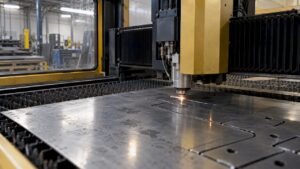
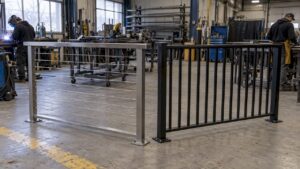
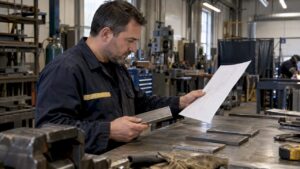
Realistic maximum thicknesses run from about 1 mm on a 500 W entry laser to roughly 50 mm carbon steel on a 20 to 30 kW fibre system, with aluminum and copper needing 30 to 40% more power at the same thickness. The real ceiling isn’t the machine’s rated maximum: it’s power, fibre versus CO2 design, assist gas, focus and nozzle setup, and the tolerance the part actually needs. A shop working to production tolerances of ±0.13 to ±0.05 mm, the range Manara Corp. holds day to day, will always quote a more conservative number than a spec sheet.
TL;DR:
- Most fibre lasers up to 20 to 30 kW can cut carbon steel up to 50 mm, but quality and speed decrease near this maximum.
- Material composition, surface condition, and desired finish significantly impact practical thickness limits beyond machine specifications.
- Correct focus, nozzle setup, assist gas, and pierce strategy are key variables influencing whether thick cuts succeed in practice.
- Choosing the optimal laser power involves matching the most common work shop’s thickness range rather than overspending on rare, heavy jobs.
- Outsourcing thick or precision cuts is often more feasible for low to moderate volume, tight-tolerance parts, especially with prior sample testing.
Table of Contents
- What are the laser cutting thickness limits by power?
- Which materials have different practical thickness limits?
- What variables actually change how thick you can cut?
- How do you choose the right laser power for your shop?
- How tight are shop tolerances at different thicknesses?
- When does it make sense to outsource thick or precision cutting?
- Get a test cut and production quote from Manara Corp.
- Where to verify machine specs and cutting standards
- Sources
- FAQ
What are the laser cutting thickness limits by power?
Manufacturer charts are the starting point, not the finish line. They tell you a machine can sever a given thickness, not that it will do so with a usable edge at a repeatable speed. That distinction drives every decision below.
The table below groups common industrial power bands against the thicknesses shops actually run in production, based on fibre and CO2 reference charts and power-selection guidance used across the industry.
| Power band | Carbon steel | Stainless steel | Aluminum | Copper/brass | Acrylic/wood (CO2) |
|---|---|---|---|---|---|
| 500 W–1 kW | 1–6 mm | 1–4 mm | 1–3 mm | 1–2 mm | 3–10 mm |
| 1–3 kW | 6–12 mm | 4–10 mm | 3 mm | 2–6 mm | 10–20 mm |
| 2–4 kW | 10–20 mm | 8 mm | 6 mm | 4–10 mm | 15–25 mm |
| 6–12 kW | 20–40 mm | 20–30 mm | 14 mm | 10 mm | not typical |
| 15–30 kW | 40–50 mm | 30–40 mm | 25–40 mm | 18 mm | not typical |
Read this chart as a range of what’s workable, not a promise of finish quality at the top edge of each band. A 12 kW fibre laser rated to sever 40 mm plate will do it, but the cut face at 40 mm looks nothing like the cut face at 15 mm on the same machine: more dross, wider kerf, more heat affected zone. Industry parameter guides note that some references push carbon steel to roughly 50 mm and aluminum to roughly 40 mm on 20 to 30 kW systems, but only with correct focus and nozzle strategy, and rarely at the speed a shop would use for a 10 mm part.
A few exceptions matter when you’re reading any thickness chart. Alloy composition shifts the numbers: high-carbon or coated steels absorb and conduct heat differently than mild steel, so the same laser cuts them slower or with more dross at a given thickness. Surface condition matters too. Mill scale, rust, and paint all reduce how much beam energy the material actually absorbs, which pushes the practical thickness ceiling down even when the spec sheet says otherwise. And the finish you want changes everything: a rough structural cut on 25 mm plate is a different job than a clean, weld-ready edge on the same plate.
Fibre and CO2 lasers aren’t interchangeable tools for this question. Fibre lasers dominate metal cutting today because metals absorb the shorter fibre wavelength far more efficiently, which is why the chart above skews fibre for anything above sheet gauge. CO2 lasers still hold an edge on thick or textured non-metals: acrylic, plywood, MDF, and some composites cut cleaner on CO2 because the beam interacts better with organic and non-conductive materials. If your job mixes a metal railing bracket with an acrylic signage insert, you’re likely looking at two different machines, not one.
Which materials have different practical thickness limits?
Every material behaves differently under a laser beam, and the differences are bigger than most buyers expect. Reflectivity, thermal conductivity, and how the assist gas interacts with the melt pool all shift where the practical ceiling sits.
- Mild and carbon steel cuts cleanest with oxygen assist gas, which triggers an exothermic reaction that adds cutting energy on top of the laser itself. That’s why steel scales to thicker sections on lower power than any other common metal. Structural brackets, base plates, and machine frames in the 10 to 25 mm range are steel’s sweet spot on mid-power fibre systems.
- Stainless steel usually runs on nitrogen assist gas to avoid oxidation at the cut edge, which readers care about because oxide-free stainless doesn’t need secondary finishing before welding or polishing. Nitrogen cutting demands more raw power than oxygen cutting at the same thickness, so stainless typically tops out a step below carbon steel at any given power band. Railings, kitchen equipment, and food-grade fabrication lean on this material.
- Aluminum reflects a meaningful share of the laser beam and conducts heat away from the cut zone quickly, which is why aluminum and copper commonly need 30 to 40% more power than steel does for the same section thickness. Nitrogen is standard here too, for clean, weldable edges. Aluminum shows up constantly in architectural panels, enclosures, and lightweight structural work.
- Copper and brass push reflectivity and conductivity even further than aluminum, and thick copper is genuinely difficult on anything under multi-kilowatt fibre power. Most shops keep copper and brass work in thinner gauges: electrical components, decorative trim, and small custom hardware.
- Acrylic, wood, and composites belong on CO2 systems rather than fibre for anything beyond thin gauge, since these materials absorb the CO2 wavelength far better. Signage, architectural models, and interior fit-out pieces are the typical output here.
The pattern across all five: reflective, conductive metals need more raw power at the same thickness than steel does, and the assist gas choice isn’t cosmetic. It changes the achievable thickness, the edge finish, and whether the part needs secondary cleanup before it moves to welding or installation.
What variables actually change how thick you can cut?
Power gets the headline, but the machine setup around it decides whether a thick cut actually works.
- Focal position and lens. Moving the focal point below the material surface, a negative focal offset, widens the kerf at the bottom of the cut, which is what makes molten metal ejection possible on plates over about 20 mm. Get this wrong and the cut simply won’t clear on thick material even with plenty of power on tap.
- Nozzle diameter, standoff, and gas pressure. Thicker sections need a larger nozzle bore and higher assist gas pressure to blow molten material clear of the kerf, particularly on stainless and aluminum where nitrogen has to do more physical work than oxidizing gas does on steel.
- Pierce strategy. Thick plate can’t be pierced the way thin sheet is. Controlled, staged pierce cycles, sometimes with a pre-pierce dwell, prevent the initial pierce from blowing out a crater that ruins the start of the cut path.
- Surface condition. Mill scale, rust, and painted coatings all cut absorption at the surface, which means the same program that cuts clean bare steel needs different power or speed settings on coated stock.
Pro Tip: If you’re quoting a job on plate with visible mill scale or old paint, budget extra pierce time and expect a slower cut speed than a clean-stock chart would predict. Skipping that adjustment is the single most common reason a first test cut misses target on thick material.
How do you choose the right laser power for your shop?
Size your machine for the work you do most often, not the rare oversized job. The 80/20 approach to power selection means picking a power band that covers roughly 80% of your typical order thickness, then routing the occasional outlier job to a shop with heavier equipment rather than overbuying capacity you’ll rarely use.
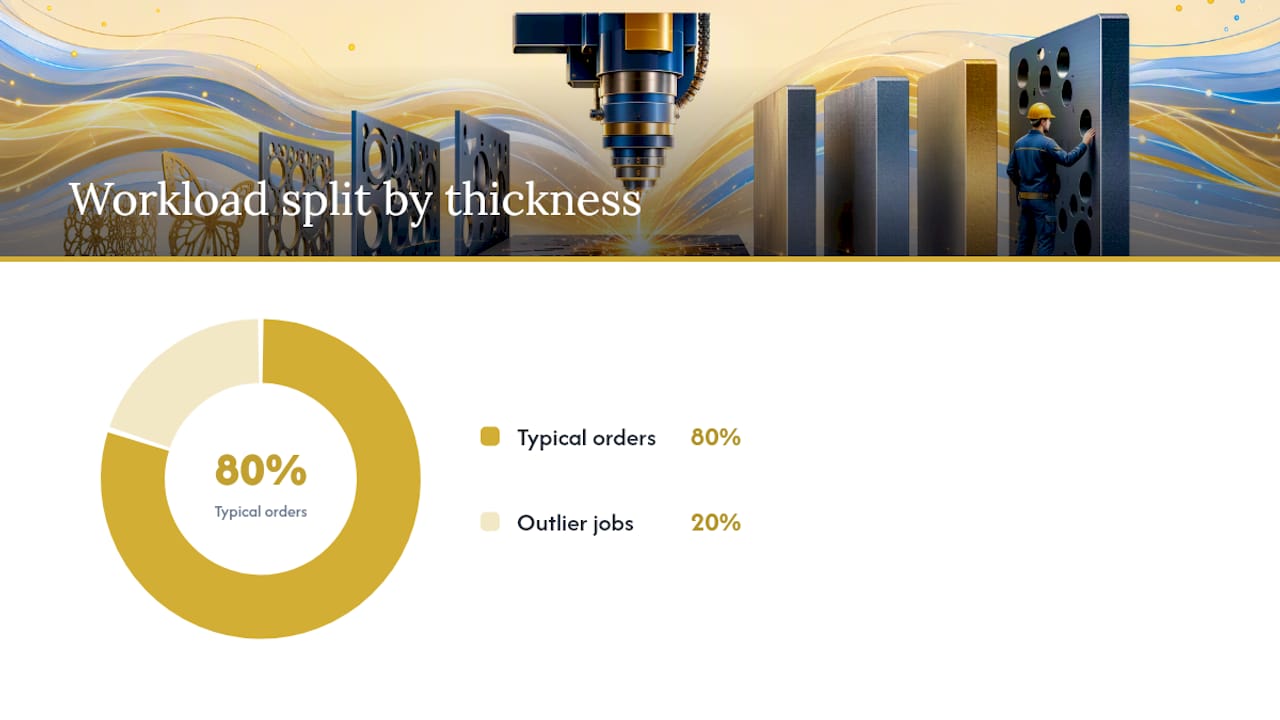
A shop mostly cutting 3 to 10 mm sheet metal doesn’t need a 12 kW machine sitting idle for years waiting on a 40 mm job that shows up twice a year. A 2 to 4 kW fibre laser covers that daily range comfortably, with the occasional thick plate outsourced.
Before committing to a thickness on a real order, run a short validation sequence:
- Cut a sample coupon at the target thickness and check edge squareness, dross, and kerf width against your acceptance criteria.
- Run a dedicated pierce test on the actual stock, not a generic reference sheet, especially if the material has scale or coating.
- Nest a small production run and time it, because cutting speed drops sharply as thickness climbs, and that changes your real cost per part.
- Confirm gas pressure and nozzle setup hold steady across the full nest, not just the first few cuts.
When you’re getting quotes from a fabrication shop for thick or tolerance-critical parts, ask directly what tolerance they hold at your specific thickness, what assist gas they’ll use, and whether they’ll run a sample cut before committing to the full order. A shop that hesitates on that last question is telling you something.
How tight are shop tolerances at different thicknesses?
Design numbers matter more than raw thickness capability once a part has to actually fit in an assembly. Manara Corp. holds production tolerances between ±0.13 mm and ±0.05 mm depending on thickness and material, figures that align with ISO 9013 thermal cutting quality standards used across the industry for grading cut edge accuracy and squareness.
±0.13 to ±0.05 mm is the working tolerance range you should design against for laser-cut parts destined for welding or bolted assembly.
Kerf width and bend allowance both shift with plate thickness, and getting them wrong in CAD is one of the more common reasons a part doesn’t fit at assembly. Manara Corp.’s design rules for kerf and bend allowances walk through the actual numbers to build into a drawing before it hits the cutting table.
A few practical tradeoffs worth flagging at the design stage:
- Thicker plate holds tighter tolerance percentage-wise but costs more in cycle time and gas.
- Bending after cutting shifts hole and edge positions slightly, so tolerance stack-up needs to account for the forming step, not just the cut.
- Tighter finish requirements on thick material usually mean slower cutting speed, which shows up directly in quoted price.
When does it make sense to outsource thick or precision cutting?
Outsourcing wins for most businesses handling a wide range of thicknesses, low to moderate volume, or parts where tolerance actually matters to fit and function. Buying a machine only pays off with steady, high-volume runs at a fairly consistent thickness, where the capital cost gets absorbed by throughput. Most designers and contractors fall into the first camp more often than they expect, especially once a job needs both thick structural steel and a tighter-tolerance bracket in the same order. A local fabricator that runs test cuts before committing to a full production quote takes the guesswork out of that decision.
— Ash
Get a test cut and production quote from Manara Corp.
Manara Corp. is a direct route to the exact work this guide covers: CNC laser cutting of carbon steel, stainless steel, aluminum, and copper, fabricated and installed on-site across Greater Montreal, the West Island, Laval, and the South Shore.

Ordering laser-cut parts online means shipping a design out, hoping the thickness and tolerance land right, and troubleshooting by email if they don’t. Working with a Montreal shop means someone looks at your drawing, flags a thickness or tolerance problem before it’s cut, and can run a sample piece on the same laser cutting equipment that will produce your full order, in either French or English. For railings, staircases, structural brackets, or custom fencing that has to fit an existing opening, that on-site check matters more than a lower unit price from a shop that never sees the part in person. If your project runs thicker stock or needs tighter tolerance than a standard chart suggests, request a production quote and Manara Corp. will confirm what’s achievable before cutting starts.
Where to verify machine specs and cutting standards
For deeper reference: RapidDirect’s thickness chart for fibre versus CO2 ranges, LaserSpecHub’s parameter database for focus and nozzle settings, and Signature Laser Designs’ guidance on thickness for data-plate style precision parts.
Sources
- Laser cutting thickness chart for fiber lasers and CO2 systems – RapidDirect
- How to choose laser power for your application | Remcor
- Laser cutting parameter database 2026 – LaserSpecHub
- Choosing the right metal thickness for laser cutting | Mingli
FAQ
What Is the Thickest Material a Laser Can Cut?
Ultra-high-power fibre systems in the 20 to 30 kW range can sever carbon steel around 50 mm and aluminum around 40 mm, though most shops treat thicknesses that high as achievable rather than production-standard for edge finish and speed.
What Thickness Can a 20 kW Laser Cut?
A 20 kW fibre laser typically handles carbon steel up to roughly 40 to 50 mm and stainless steel up to roughly 30 to 40 mm, with aluminum landing around 25 to 40 mm depending on setup and finish requirements.
How Thick of Steel Can a 1000 W Laser Cut?
A 500 W to 1 kW fibre laser generally cuts carbon steel in the 1 to 6 mm range for clean, production-quality work, with thinner gauges cutting faster and cleaner.
How Thick Can a 100 W Laser Cut?
A low-wattage laser, almost always a CO2 system, is suited to thin non-metals like acrylic, wood, and light composites in the thin gauge range, not structural metal cutting.
How Do I Know What Tolerance to Expect on Thick Parts?
Tolerance narrows as a percentage of thickness but the absolute range still shifts by material and setup; production tolerances between ±0.13 mm and ±0.05 mm on typical laser-cut work.