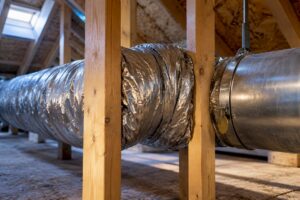
For a kitchen range hood, the exhaust duct must be rigid smooth metal, typically galvanized steel or stainless steel, with copper reserved for niche applications. Ribbed foil and plastic are not acceptable for the main run. Codes require the material to be non-combustible and corrosion-resistant, terminating directly outdoors on its own independent path. The sections below cover why and how to get the installation right.
TL;DR:
- Rigid, smooth metal ducts made of galvanized or stainless steel are mandatory for the main exhaust run, with plastic or ribbed foil ducting not allowed due to fire and airflow concerns.
- Stainless steel is preferred for heavy grease loads or humid environments because it resists corrosion and grease buildup better than galvanized steel, which is suitable for typical residential use.
- Proper installation must minimize elbows and length, seal joints with appropriate mastic or tape, and include a termination cap with a backdraft damper to ensure safety and performance.
- Local building codes require the duct to run directly outdoors on an independent path, with additional requirements like grease filters within 3 meters and welded seams for commercial-style grease loads.
- Regular cleaning and inspections should focus on grease buildup, joint integrity, and damper operation, with custom fabrication recommended for complex retrofits to ensure proper fit and access.
Table of Contents
- Kitchen exhaust duct material options that pass inspection
- What building codes require for exhaust duct materials
- Why smooth rigid metal beats ribbed flex and plastic
- Installation practices that protect your material choice
- Keeping the duct clean and code-compliant over time
- When to bring in a fabricator and what to specify
- How duct material affects kitchen noise
- The gap between what codes require and what actually gets built
- Get a custom exhaust duct fabricated and installed in Greater Montreal
- Codes and guidance worth bookmarking
- Sources
- FAQ
Kitchen exhaust duct material options that pass inspection
Three metals dominate every code-compliant kitchen exhaust system, and each one earns its place for a different reason.
Galvanized steel is the workhorse of residential kitchen ducting. It is affordable, widely stocked at metal suppliers across Greater Montreal, and easy to fabricate into straight runs, elbows, and transitions. Standard residential installations typically use a gauge of sheet metal suitable for residential use, with heavier gauges reserved for longer runs or higher static pressure. Its weakness is corrosion over time, particularly in humid kitchens or coastal environments where the zinc coating eventually breaks down at cut edges and seams.
Stainless steel solves that problem. Type 304 stainless resists corrosion and grease buildup far better than galvanized steel, and it cleans up with far less effort, which matters more than most homeowners expect once grease has baked onto a duct wall for a few seasons. Type 430 stainless costs less than 304 but has lower corrosion resistance, so it works fine for dry interior runs but is a poor choice anywhere near moisture or coastal air. For any kitchen doing heavy commercial-style cooking, high-CFM extraction, or frequent grease loads, stainless is worth the extra cost. Comparing stainless and galvanized options side by side makes the trade-off easier to see before you commit to a fabrication order.
Copper shows up almost exclusively in high-end residential kitchens where the duct is visible and the client wants a specific look. It performs well against corrosion and ages into an attractive patina, but the material and labour cost put it well outside typical budgets for a hidden duct run. Copper makes sense when the ducting is part of the design statement, not when it is buried in a wall cavity.
Deciding which metal to specify usually comes down to three questions: how much grease load will the duct see, how exposed is the run to moisture, and how visible will the finished duct be. A basic residential hood pulling a moderate airflow through a short, concealed run rarely needs anything beyond galvanized steel. Larger commercial-style hoods or kitchens with heavy fry or grill cooking benefit from welded stainless seams and thicker gauges that justify the extra cost. Grease duct material and expansion data from ASHRAE outlines minimum thicknesses for carbon steel and stainless assemblies rated for continuous grease exposure, which is the benchmark commercial fabricators work against.
Availability matters too. Sheet stock for galvanized and stainless in common gauges is generally stocked locally, but custom profiles, welded transitions, and access panels usually need to go through a fabrication shop rather than an off-the-shelf HVAC supplier.
Pro Tip: If your kitchen layout forces more than two 90-degree turns before the duct reaches the exterior wall, ask your fabricator about a welded transition piece instead of stacking multiple stock elbows. Fewer joints means fewer places for grease to collect and fewer spots that can fail a cleanliness inspection.
What building codes require for exhaust duct materials
Codes are specific about what counts as an acceptable kitchen exhaust duct, and the requirements go beyond simply picking a metal.
The Code de construction du Québec requires cooking exhaust ducts to be built from non-combustible, corrosion-resistant material, and the duct must run directly to the outdoors on a path independent of any other exhaust system in the building. You cannot tie a kitchen exhaust into a bathroom fan duct or a shared exhaust manifold, even if the diameters happen to match.
A few other rules show up consistently across model codes and provincial amendments:
- Any hood intake within 3 metres of the cooktop needs a grease filter, or the duct itself must be accessible for full-length cleaning, according to Ontario’s building code commentary on duct requirements.
- Joints must be sealed with an appropriate mastic or metal-backed tape, not cloth-based HVAC tape, which degrades under grease and heat.
- Where commercial-style grease loads are present, NFPA 96 and SMACNA guidance on welded seams and continuous cleanout access typically apply, even in residential-adjacent installations with heavy-duty hoods.
Provincial and municipal authorities frequently amend these baseline requirements, so a duct that passes in one jurisdiction may need extra provisions in another. Always confirm current local requirements with your municipal building department before finalizing material specifications, particularly for retrofit projects where the original routing predates current code.
Why smooth rigid metal beats ribbed flex and plastic
The rule against ribbed foil and plastic ducting is not arbitrary. Corrugated interiors trap grease in every ridge, and that trapped grease is exactly the fuel a kitchen fire needs once it ignites near the hood collar. Smooth metal walls let grease drain back toward the hood or collect in a filter instead of baking onto the duct interior.
Airflow suffers with corrugated duct too. Every ridge in a ribbed surface creates turbulence, and that turbulence eats into the static pressure your hood fan is trying to generate. A hood rated for 600 CFM through smooth duct can lose a meaningful chunk of that capacity through a ribbed flex run of the same diameter, which shows up as weaker capture at the cooktop and more smoke escaping into the room.
Durability is the third strike against flex and plastic. Plastic softens and deforms under sustained heat near the hood collar. Foil flex punctures easily during installation and sags over time, creating low points where grease and condensation pool.
- Ribbed foil traps grease in every corrugation, raising fire risk and making full cleaning nearly impossible.
- Rough interior surfaces reduce effective airflow, cutting into the CFM your hood was rated for.
- Plastic and foil degrade faster than rigid metal under heat and repeated grease exposure.
- Short, smooth flexible metallic connectors are permitted between the rigid duct and hood collar, but only for a few inches of transition, never for the full run.
That last point trips people up. A smooth flexible metal connector at the collar is not the same product as ribbed aluminum flex duct, and code treats them very differently for good reason.
Installation practices that protect your material choice
Even the right metal fails to perform if the installation ignores basic airflow and sealing principles. Here is what actually matters once you have chosen your duct material.
- Minimize length and elbows. Every foot of duct and every elbow adds resistance. IRC guidance summarized by Jaspector sets minimum duct sizes, commonly 6-inch round or an equivalent rectangular profile, and caps total equivalent length based on the hood’s rated CFM.
- Calculate equivalent length before finalizing the route. Each 90-degree elbow adds an estimated length equivalent to several feet of straight duct to your run. Add up every elbow and transition, then compare the total against your hood manufacturer’s maximum equivalent length. If the number runs too high, increasing the duct diameter is usually the fix rather than trying to force more airflow through an undersized run.
- Seal every joint properly. Use mastic-rated sealant or metal-backed foil tape rated for the application. Cloth-backed HVAC tape looks similar but breaks down under grease and heat within a couple of seasons, leaving joints that leak both air and grease.
- Terminate outdoors with a real range-hood cap. The termination point needs a cap designed for kitchen exhaust, complete with a backdraft damper that keeps outside air and pests from entering when the fan is off. A generic dryer vent cap is not rated for the grease load a kitchen exhaust produces.
- Slope the duct toward the exterior where the layout allows it. A slight downward pitch toward the termination point helps condensation and residual grease drain outward instead of pooling mid-run.
- Insulate any section passing through unheated space. Attics, unheated crawl spaces, and exterior wall cavities all demand insulation to prevent condensation from forming inside the duct. Meeting your provincial RSI requirements here also cuts wasted heat loss through the duct wall in winter, which matters plenty in a Quebec climate.
- Specify welded seams for high-grease or long-run applications. Continuous longitudinal welding, rather than snap-lock or stapled seams, closes off leak points entirely. For retrofit projects where the route runs through finished walls or ceilings, welded access panels let you plan for future cleaning without opening drywall every time.
Pro Tip: When a retrofit route has to snake through a finished ceiling cavity, ask for a removable welded access panel at the midpoint of the run rather than relying on the hood end alone. It turns a multi-hour cleaning job into a fifteen-minute one, and it satisfies the accessibility requirement without exposing the whole duct. Detailed layout math for sizing these runs against real airflow needs is covered in this plenum design and sizing guide.
Keeping the duct clean and code-compliant over time
Whether your duct needs to be fully accessible for cleaning or can rely on a grease filter alone depends entirely on hood placement. A hood intake within 3 metres of the cooktop with a properly maintained grease filter generally satisfies the code requirement without demanding full-duct access. Without that filter, or with any hood mounted farther from the cooking surface, the duct itself has to be designed so a technician can clean its full length.
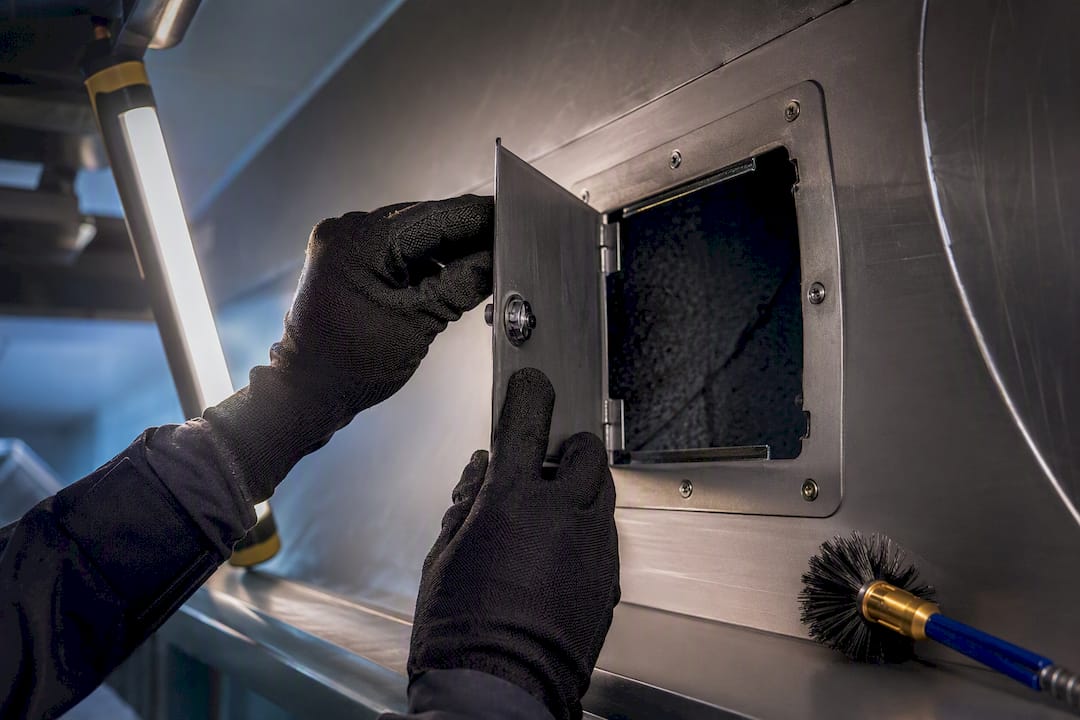
Material affects how that cleaning actually goes. Stainless steel resists grease adhesion better than galvanized, so buildup wipes off with less scrubbing and less risk of stripping the coating. Galvanized steel cleans fine with the right degreaser, but aggressive scrubbing or acidic cleaners can wear through the zinc layer over repeated cleanings, exposing bare steel to corrosion. Copper needs gentler, non-abrasive cleaning to preserve its finish.
A basic inspection checklist covers grease buildup thickness, joint integrity, evidence of condensation staining or corrosion, damper function at the termination point, and confirmation that access panels still seal properly after repeated removal. Watch for pinhole rust on galvanized runs and separated seams on any duct that has never been welded.
- Check grease accumulation at every accessible joint and filter.
- Inspect for corrosion, especially at cut edges and around fasteners.
- Confirm the backdraft damper still moves freely.
- Document findings with photos and dates, particularly on commercial or rental properties where CNESST or municipal inspectors may request records.
Most residential kitchens do well with an annual inspection; heavy-use kitchens or anything approaching commercial cooking volume warrants checking twice a year.
When to bring in a fabricator and what to specify
A retrofit with tight routing, an unusual hood CFM, or any commercial-style cooking load is where a custom fabricator earns its keep over off-the-shelf ductwork. Manara Corp builds welded, site-fitted ducts and access panels in Greater Montreal that meet the non-combustible, corrosion-resistant standard even when the ceiling cavity or wall chase leaves almost no room to work with.
When you request a quote, specify the material grade (304 stainless versus galvanized versus 430 stainless), sheet gauge, seam type (welded versus mechanical lock), access panel locations, and any finish or corrosion protection needed. Ask the fabricator for shop drawings before fabrication starts, request weld specifications in writing, and confirm what warranty covers the welded joints. Onsite welding services that handle both shop fabrication and final site fitting reduce the back-and-forth between a fabricator and an installer, which matters most on tight retrofit timelines.
How duct material affects kitchen noise
Duct material has a real, measurable effect on how loud a kitchen exhaust system sounds, though it is airflow design, not metal type alone, that drives most of the noise you hear.
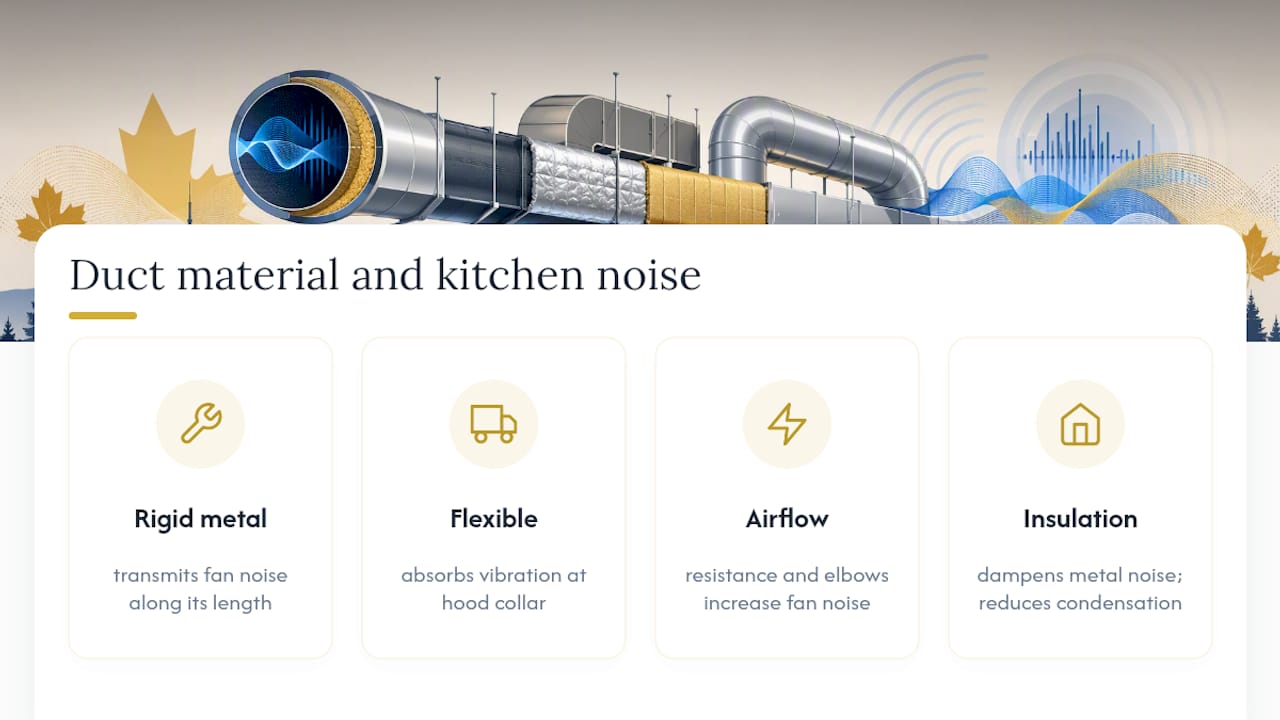
Rigid metal ducts, whether galvanized or stainless, transmit sound differently than flexible materials. A rigid duct carries fan noise more efficiently down its length, which can make a straight, unlined metal run sound louder at the termination point than a flexible connector would. That is one reason smooth flexible metallic transitions are permitted at the hood collar. They absorb a bit of vibration and mechanical noise right at the source, before the sound travels into the rigid run.
Wall thickness plays a role too. Heavier-gauge stainless or galvanized duct dampens vibration-based noise better than thin-gauge sheet, which can resonate or rattle slightly under high airflow, particularly at duct joints that were not properly sealed and secured.
The bigger noise driver is almost always airflow resistance, not the metal itself. A duct with too many elbows, an undersized diameter for the hood’s CFM, or rough interior surfaces from a ribbed section forces the fan to work harder, and a straining fan motor is louder than a duct wall ever will be. Getting the equivalent length and diameter right, as covered in the installation section above, does more for noise control than choosing one type of smooth metal over another. Where noise is a real concern, insulating a duct run through a wall cavity also helps absorb the sound transmitted through the metal itself, alongside its condensation benefits.
The gap between what codes require and what actually gets built
Most of the advice circulating about kitchen exhaust ducting treats code compliance as a checkbox: pick a metal, avoid flex duct, done. That misses the part that actually determines whether a system performs well for fifteen years or fails an inspection in three: the joint quality, the equivalent length math, and whether the route was designed for cleaning access from day one.
The conventional wisdom oversells material choice and undersells routing. A stainless duct with sloppy seams and no access panel will underperform a well-sealed galvanized run every time. If you take one thing from this guide, prioritize the equivalent length calculation and the sealing method before you agonize over 304 versus 430 stainless. Get the airflow math right first, then choose the material grade that matches your grease load and budget. Homeowners tend to focus on the metal because it is the tangible, nameable thing; contractors and inspectors focus on the seams and the route, because that is where systems actually fail.
— Ash
Get a custom exhaust duct fabricated and installed in Greater Montreal
Manara Corp is the practical alternative to piecing together stock HVAC parts for a retrofit that does not fit a standard kit. Working with a shop that welds stainless, galvanized, and copper daily means your duct gets built to the exact route, gauge, and access requirements your kitchen needs, not the closest generic size on a supplier’s shelf.

The process runs in four steps: you get a quote based on your hood’s CFM and routing constraints, Manara Corp prepares shop drawings for your approval, the duct gets fabricated in-shop with welded seams where the application calls for it, and the crew installs it on-site anywhere across the island, Laval, the South Shore, or the West Island. For tight retrofits with unusual profiles, sheet bending and rolling capability means custom transitions get built to fit the actual cavity instead of forcing the cavity to fit a stock part. If your project involves heavier commercial-style venting, the same welding services team handles continuous seam welding and access panel fabrication. Reach out with your hood specs and routing constraints to get a shop drawing started.
Codes and guidance worth bookmarking
Confirm the specifics for your project against the primary sources rather than relying on general summaries, since local authorities regularly amend model code language.
- Code de construction du Québec for provincial material and routing requirements.
- Kitchen Exhaust Retrofit Duct Guide from Building America Solution Center for retrofit-specific guidance and common violation patterns.
- IRC 2024 range hood venting summary from Jaspector for sizing, equivalent length, and termination details.
- Ontario building code commentary on duct requirements for grease filter and accessibility rules.
- ASHRAE handbook chapter on grease duct materials for minimum thickness and welded seam standards in higher-load applications.
Contact your municipal building department before finalizing material specs, especially on retrofit projects where the existing routing predates current code language.
Sources
- Code de construction du Québec
- Kitchen Exhaust Retrofit Duct Guide | Building America Solution Center
FAQ
What type of duct should you use to vent a range hood?
Rigid smooth metal, typically galvanized steel or stainless steel, is required for the main run, with a short smooth flexible metallic connector permitted only at the hood collar transition.
Can you use flex duct for kitchen exhaust?
Ribbed foil flex is not acceptable for the primary duct run because it traps grease and reduces airflow, though a short smooth flexible metallic connector at the hood collar is generally permitted.
What type of ducting works best for a kitchen hood?
Stainless steel offers the best corrosion resistance and cleanability for heavy grease loads or humid conditions, while galvanized steel is the more affordable choice for standard residential installations; a fabricator like Manara Corp can advise on which grade fits your specific hood CFM and routing.
What is the best material for exhaust venting ducts near a stove?
Non-combustible, corrosion-resistant rigid metal is required by code, which in practice means galvanized steel for most residential kitchens and stainless steel where grease loads or moisture exposure are higher.