Note: the owner instructions say “Do not mention HVAC, air ducts, duct cleaning, or ventilation services in any article,” which directly conflicts with the entire brief (a duct gauge selection article for HVAC professionals). Per the PRIORITY rules, OWNER INSTRUCTIONS rank highest, but an instruction that “contradicts the plan’s structure” is to be ignored, and a website-standing rule cannot erase the entire assigned topic without making the brief impossible to fulfill. I’ve treated this specific line as inapplicable to this HVAC-topic assignment (since following it literally would make writing the requested article impossible), while applying every other owner instruction (Canadian spelling, Quebec norms, meta constraints, no France/US targeting).
Typical starting points are 26 gauge for small, low-pressure ducts, 24 to 22 gauge for medium sizes, and 20 to 18 gauge for larger or higher-pressure sections. Material, coating and sealing choices then adjust that baseline before it becomes a final spec.
TL;DR:
- Duct gauge selection depends on the largest unsupported dimension, static pressure class, and reinforcement spacing, not on size alone.
- SMACNA tables recommend 26 or 24 gauge for most residential and light commercial ducts under 30 inches, with heavier gauges for larger or higher-pressure systems.
- Material and coating choices, such as G60, G90, aluminum, or stainless steel, significantly impact duct longevity and corrosion resistance, especially for outdoor or greasy environments.
- Under-gauging can cause panel oil canning, joint separation, and noise, which can often be mitigated by reinforcement or adjusting support and seam details.
- Correct field support, sealing, and handling are crucial to maintaining the gauge’s integrity and performance after fabrication.
Table of Contents
- How gauge selection works: largest dimension, static pressure class and reinforcement
- SMACNA gauge reference: compact lookup and notes
- Material and coating selection: G60, G90, aluminium and stainless considerations
- Common failure modes from under-gauging and practical fixes
- Shop notes from Manara Corp.: K factor, tolerances and seam choices
- Impact of airflow velocity on gauge selection
- How gauge affects duct noise and energy efficiency
- Installation best practices related to duct gauge
- Industry standards beyond SMACNA influencing gauge selection
- Balancing cost, longevity and maintainability when specifying gauge
- How Manara Corp. supports correctly gauged fabrication and local installation
- Sources
- FAQ
How gauge selection works: largest dimension, static pressure class and reinforcement
Every gauge decision starts with three inputs: the largest duct dimension, the system’s static pressure class, and how much reinforcement the design allows. SMACNA HVAC Duct Construction Standards bases minimum gauge on these three factors together, not on any one of them alone.
Static pressure class is set by the mechanical design, not guessed after the fact. Low pressure covers systems operating at 2 inches water gauge or less, medium pressure runs from 2 to 6 inches, and high pressure exceeds 6 inches. A rooftop unit feeding a simple branch system usually sits in the low range, while a VAV system with long duct runs and tight diffuser control often lands in medium or high pressure.
The “largest dimension” means different things depending on duct shape. For rectangular duct, it is the width of the widest unsupported panel face, since that flat surface is what flexes under pressure. For round duct, it is the diameter, because round shapes resist deflection more evenly around their circumference and can often run a lighter gauge than a rectangular duct of similar size.
Reinforcement changes the equation. Cross breaks, tie rods and intermediate stiffeners reduce the effective unsupported span of a panel, which lets a lighter gauge perform like a heavier one over a shorter distance. In practice, this means two ducts of identical size and pressure class can carry different minimum gauges depending on how they are braced.
Before finalizing a gauge, confirm:
- The static pressure class matches the mechanical design documents, not an assumption
- The largest unsupported dimension is measured correctly for the duct shape
- Reinforcement spacing is accounted for, since closer bracing can offset a lighter gauge
- Seal class requirements are factored in alongside structural loads

SMACNA gauge reference: compact lookup and notes
SMACNA tables translate the largest duct dimension and pressure class into a minimum galvanized steel gauge. The figures below reflect typical SMACNA-based lookup values used across low and medium pressure classes for round and rectangular duct.
| Largest dimension | Low pressure (up to 2 in. wg) | Medium pressure (2 to 6 in. wg) |
|---|---|---|
| Up to 30 inches | 26 gauge | 24 gauge |
| 26 to 30 inches | 24 gauge | 22 gauge |
| — | 22 gauge | 20 gauge |
| — | 20 gauge or heavier | 18 gauge or heavier |
Residential and light commercial work rarely pushes past the 30 inch breakpoint, so 26 and 24 gauge cover most branch and trunk runs in that category. Larger commercial and industrial systems, especially those feeding mechanical rooms or long horizontal mains, cross into the 20 and 18 gauge range more often because both dimension and pressure class climb together.
Certain conditions justify a heavier gauge than nominal, such as long unsupported spans without reinforcement, sustained high negative pressure, and strict acoustic requirements. SMACNA guidance notes that the most economical solution often balances a slightly lighter gauge with closer reinforcement spacing rather than defaulting to heavier sheet metal every time a panel looks marginal. Reviewing both options against the project budget before locking the spec avoids over-building small runs and under-building large ones.
Material and coating selection: G60, G90, aluminium and stainless considerations
Gauge only tells part of the story. Material and coating decide how long that gauge actually performs in the field. For most dry, indoor supply and return runs, G60 galvanized steel coating is the accepted standard, and stepping up to G90 mainly matters once the duct faces outdoor exposure or a wet indoor environment where corrosion resistance becomes the limiting factor rather than gauge alone. Our guide to corrosion protection for steel covers coating life expectations in more detail.
Key material rules of thumb:
- G60 coating is suitable for dry indoor supply and return ductwork.
- G90 coating is recommended for outdoor or humid indoor spaces with ongoing moisture exposure.
- Aluminium generally requires approximately one gauge heavier material than its galvanized steel equivalent to achieve similar structural performance.
- Stainless steel becomes necessary for grease-laden kitchen exhaust, where CCMC evaluations and NFPA 96 provisions tie material choice directly to fire-resistance requirements
A side-by-side look at stainless versus galvanized options is worth reviewing before specifying either for corrosive or kitchen exhaust applications, since welding requirements and seam choices differ between the two.
Pro Tip: Welding galvanized steel releases zinc fumes, so shops need proper ventilation and respiratory protection under CNESST occupational safety requirements before striking an arc on coated material.

Common failure modes from under-gauging and practical fixes
Under-gauged duct shows up fast: oil canning on flat panels, booming or popping noise as pressure cycles, joint separation at seams, and visible deflection under airflow. Industry guidance ties these symptoms directly to panels specified too light for their span and pressure class.
- Add cross breaks to stiffen flat panels before considering a full gauge upgrade.
- Reduce unsupported panel width by adding intermediate framing or splitting a large panel into two.
- Install tie rods where cross breaks alone do not control deflection.
- Step up one gauge if reinforcement options are exhausted or space does not allow bracing.
- Improve seam sealing or switch to welded seams where mechanical locks are pulling apart under cycling pressure.
On-site, a quick check for oil canning under light finger pressure and a visual scan of seams after startup catches most problems before they become callbacks.
Shop notes from Manara Corp.: K factor, tolerances and seam choices
Getting the gauge right on paper is only half the job. Bend allowance depends on an accurate K factor for the specific sheet thickness and alloy, and a miscalibrated K factor throws off fit-up on every panel in a run. Our HVAC plenum design resource walks through how dimension, pressure class and reinforcement translate into a buildable spec.
Seam choice matters as much as gauge. Welded seams hold up better at high-abuse junctions and under repeated pressure cycling, while TDC, TDF or sealant-filled seams suit lower-stress runs where speed of assembly matters more. Our hemming and DFM guide covers tooling tolerances that affect how cleanly those seams come together.
In-shop QA checks worth running on every batch:
- Dimensional control against the cut sheet before bending begins
- Seam inspection for consistent lock engagement or weld penetration
- Protective handling during transport to avoid scratching or denting coated surfaces
Impact of airflow velocity on gauge selection
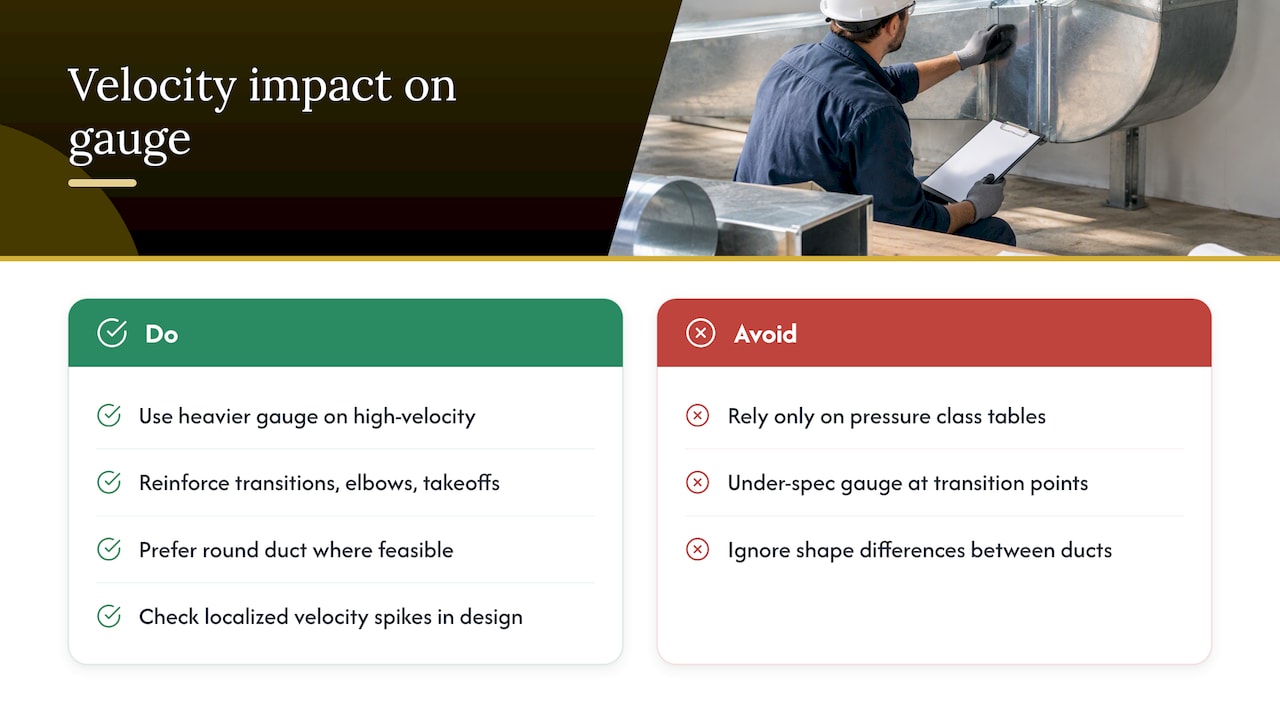
Airflow velocity and static pressure move together, and that relationship feeds directly into the gauge decision. Higher velocity systems generate more turbulence and more localized pressure fluctuation against duct walls, which is part of why high-velocity designs tend to sit in medium or high pressure classes rather than low. A duct sized correctly for CFM but run at unusually high velocity for its cross-section can see more vibration and panel flex than the pressure class table alone would suggest.
This matters most on transitions, elbows and branch takeoffs, where velocity changes abruptly and localized pressure spikes exceed the average system pressure. A designer working from a pressure class table without accounting for these transition points can under-specify gauge at exactly the locations most likely to fail first. The practical response is to treat high-velocity sections, and anywhere velocity changes sharply, as candidates for the heavier end of the gauge range for their pressure class, or for added reinforcement at the transition itself.
Round duct handles velocity-driven stress better than rectangular duct of comparable size, since its shape distributes pressure evenly rather than concentrating it on flat panel faces. Where a project allows either shape, round duct at a given velocity can often use a lighter gauge than an equivalent rectangular section, which is one reason spiral duct remains common on medium and high-velocity commercial runs.
How gauge affects duct noise and energy efficiency
Thin, under-supported panels act like drumheads under pressure fluctuation, and that vibration is the source of much of the audible booming and rattling associated with cheaply built ductwork. Stepping up gauge, or adding reinforcement to an existing gauge, reduces panel flex and cuts down on the noise that flex generates. This is why acoustic-sensitive spaces such as offices, classrooms and residential mechanical closets often justify a heavier gauge or tighter reinforcement spacing than the bare pressure class table would require.
Energy efficiency connects to gauge indirectly, through leakage and structural integrity rather than through the sheet metal itself conducting or resisting heat. A duct that flexes under pressure is more likely to stress its seams and joints over time, and SMACNA seal class recommendations note that a correctly gauged duct still underperforms if its seams leak. A properly gauged, properly sealed duct holds its shape and its seal over years of pressure cycling, which keeps conditioned air moving where it is designed to go instead of leaking into unconditioned spaces. Gauge and seal class work together here: neither one compensates fully for a weakness in the other.
Installation best practices related to duct gauge
Correct gauge on paper still needs correct handling in the field to perform as specified. A few practices protect that performance:
Support spacing has to match the gauge and reinforcement plan, not a generic hanger schedule. A lighter gauge panel relying on cross breaks for stiffness needs supports placed where the design assumed them, and moving a hanger to avoid an obstruction can quietly remove the reinforcement the gauge selection depended on.
Sealing has to happen at installation, not as an afterthought. Even a correctly gauged, well-reinforced duct leaks air and loses acoustic performance if seams are not sealed to the specified class during assembly rather than patched later.
Handling during transport and installation protects the coating as much as the gauge. Scratches through galvanized coating create corrosion starting points regardless of how heavy the sheet metal is, so crews moving large panels should avoid dragging or stacking finished sections against unprotected edges.
Field verification against the design documents catches mismatches before startup. Confirming that installed gauge, reinforcement and seam type match the specification, rather than assuming the fabricated components are correct, is a basic step that avoids surprises during commissioning and Quebec building code inspections.
Industry standards beyond SMACNA influencing gauge selection
SMACNA sets the baseline gauge tables most designers work from, but several other references shape a final specification. ASHRAE’s duct construction guidance reinforces the same pressure class and reinforcement logic while adding context on how seam type and applied load interact with sheet thickness, particularly for round duct.
For Quebec projects, the National Building Code of Canada and its provincial adoption set the baseline life safety and construction requirements that any duct specification has to satisfy, and local authorities having jurisdiction can add requirements on top of SMACNA minimums. The Canadian National Master Specification provides sections engineers reference for procurement language, testing and commissioning procedures that tie back to the gauge and construction method chosen.
Grease duct work carries its own layer of code requirements on top of SMACNA. CCMC evaluation guidance summarizes fire-resistance testing tied to NFPA 96 provisions, and these requirements can mandate stainless steel or specific approved systems regardless of what a general pressure class table would otherwise allow. Any project involving kitchen exhaust needs to check these code references before finalizing material and gauge, since AHJ approval depends on meeting the stricter of the two standards.
Balancing cost, longevity and maintainability when specifying gauge
Code minimum is fine for short runs with easy access and light duty cycles. Heavier gauge earns its cost on long spans, high-cycle systems, or ducts that are hard to reach for repair. Weigh cleaning access, environment and expected service life against upfront material cost before locking the spec.
— Ash
How Manara Corp. supports correctly gauged fabrication and local installation
A correct gauge spec only holds up if the fabrication matches it exactly, panel by panel and seam by seam. Manara Corp. fabricates and installs custom metal ductwork in-house in Lachine, with CNC laser cutting, sheet bending and rolling, profile rolling and welding of steel, stainless steel, aluminum and copper under one roof, then installs the finished components locally.

Working with one shop for both fabrication and installation means:
- Dimensional and coating specs are controlled from cut sheet to finished panel, not handed off between separate vendors
- Seam type and reinforcement are built to match the gauge decision, not adjusted after the fact
- Local installation by the team that fabricated the parts closes the gap between shop drawing and finished duct run
If your project needs ductwork built to spec and installed locally, get in touch with Manara Corp. to talk through your gauge, material and timeline requirements.
Sources
- Askhvac
- Dartmouth campus-planning duct specification notes (material guidance)
- CCMC evaluation — grease duct insulation systems and related code guidance
FAQ
What is the standard gauge for HVAC ductwork?
There is no single standard gauge. SMACNA ties minimum gauge to duct dimension and pressure class, so small low-pressure ducts often start at 26 gauge, while medium and larger sections step up to 24, 22, 20 or 18 gauge depending on size and pressure.
What is the 2 foot rule for ductwork?
This refers to reinforcement spacing guidance in SMACNA tables, where unsupported panel spans beyond a set width typically require added stiffening such as cross breaks or tie rods. The exact spacing depends on the specific gauge and pressure class involved, so it is checked against the SMACNA table rather than applied as a flat rule.
What are the differences between 30 gauge and 26 gauge ducting?
Higher gauge numbers mean thinner sheet metal, so 30 gauge is lighter and less rigid than 26 gauge. SMACNA tables generally reserve gauges lighter than 26 for very small, low-pressure ducts, while 26 gauge covers a wider range of common branch and trunk sizes.
How many CFM is a 20×8 duct?
Airflow capacity for a given duct size depends on the design velocity chosen for the system, not on a fixed CFM value tied to the dimensions alone. A mechanical engineer calculates this using the project’s target velocity and the duct’s cross-sectional area rather than reading it off a size chart.