Aluminum cuts cleanly on a fibre laser with nitrogen assist, provided the alloy, thickness, and tolerances match what the equipment can actually deliver. It’s the right call for intricate 2D parts in moderate volumes. It’s the wrong call for very thick sections or parts needing tolerances tighter than ±0.05 mm without secondary machining. Send a DXF or DWG file and expect a design-for-manufacturability (DFM) review before anyone quotes a firm price.
TL;DR:
- Laser cutting is ideal for aluminum sheets under 12 mm thick with complex curves, but waterjet or CNC is better for thicker parts or tight flatness demands.
- Fibre lasers with nitrogen assist produce cleaner edges suitable for welding or anodizing, while air creates oxidized edges that often require finishing.
- Choosing 5052 or 3003 alloys simplifies cutting and avoids unexpected costs, whereas aerospace alloys like 2024 and 7075 typically require alternative processes.
- Tolerance standards generally range from ±0.05 mm to ±0.1 mm, with tighter tolerances possible on critical features at higher costs.
- Sending clean, detailed files in DXF, DWG, or STEP formats and clarifying material, thickness, quantity, and tolerances prevent costly mis-specifications and delays.
Table of Contents
- When does custom aluminum laser cutting beat waterjet or CNC?
- Why fibre lasers and nitrogen assist gas matter
- Which aluminum alloys and tolerances should you specify?
- What file formats and DFM rules keep your quote accurate?
- Why parts warp and how shops keep edges clean
- What drives cost and lead time on a laser-cutting quote?
- Manara Corp: how we work with aluminum laser-cut parts
- What the guide gets right, and where buyers still go wrong
- Get a DFM review and firm quote from Manara Corp
- Sources
- FAQ
When does custom aluminum laser cutting beat waterjet or CNC?
Laser cutting wins when your part has intricate profiles, tight nesting requirements, and you need dozens or hundreds of identical pieces without paying machining rates. Thin-to-medium aluminum sheet is the sweet spot, especially where the geometry would take a mill hours to rough out. Waterjet or CNC machining takes over once thickness climbs past what a laser can cleanly punch through, or when the part demands zero heat-affected zone and dead-flat tolerances on every surface.
Run through this before you specify a process:
- Thickness under roughly 12 mm with complex curves or cutouts: laser cutting, almost every time.
- Thick plate, structural brackets, or anything needing a mirror-flat finish: waterjet cutting avoids the heat distortion a laser introduces.
- High volume, simple repeated shapes, low tolerance sensitivity: plasma or punching can undercut laser pricing.
- One-off prototypes with tight internal tolerances on a handful of features: CNC machining after a rough laser cut often nets the best result.
Why fibre lasers and nitrogen assist gas matter
Fibre lasers dominate custom metal cutting services for aluminum because their shorter wavelength gets absorbed by the metal far more efficiently than a CO2 beam does. Most shops running aluminum have already retired CO2 for this reason. CO2 lasers are rarely recommended for primary aluminum cutting because the beam reflects off the bright surface instead of melting through it cleanly, which chews through consumables and risks damaging the machine’s optics.
Assist gas is the other half of the equation:
- Nitrogen produces bright, oxide-free edges. This is what you want if the part gets welded or anodized afterward.
- Compressed air costs less to run but leaves an oxidized edge that usually needs finishing before it looks presentable.
- Oxygen, common on steel, sees almost no use on aluminum because it reacts unpredictably with the melt pool.
Pro Tip: If the part is visible or goes into a weld joint, specify nitrogen cutting in your RFQ up front. Shops sometimes default to air to save cost, and swapping gas mid-order means a second setup charge.
Higher-powered fibre lasers, in the multi-kilowatt class, cut thicker aluminum faster, but they also burn through more nitrogen per part. That tradeoff shows up directly in your quote.
Which aluminum alloys and tolerances should you specify?
Not every alloy behaves the same way under a laser, and the alloy you pick has more influence on your final quote than most designers expect, making custom marine aluminum fabrication insights especially useful when choosing alloys for marine applications. 5052 and 3003 cut cleanly and predictably, which makes them the default recommendation for brackets, panels, and enclosures. 6061 shows up constantly in structural and aerospace-adjacent work, but it demands tighter process control to avoid edge dross. Aerospace grades like 2024 and 7075 are usually poor laser-cutting candidates; their alloying elements react badly to the heat, and most shops will steer you toward sawing or machining instead unless you’ve already discussed it with them.
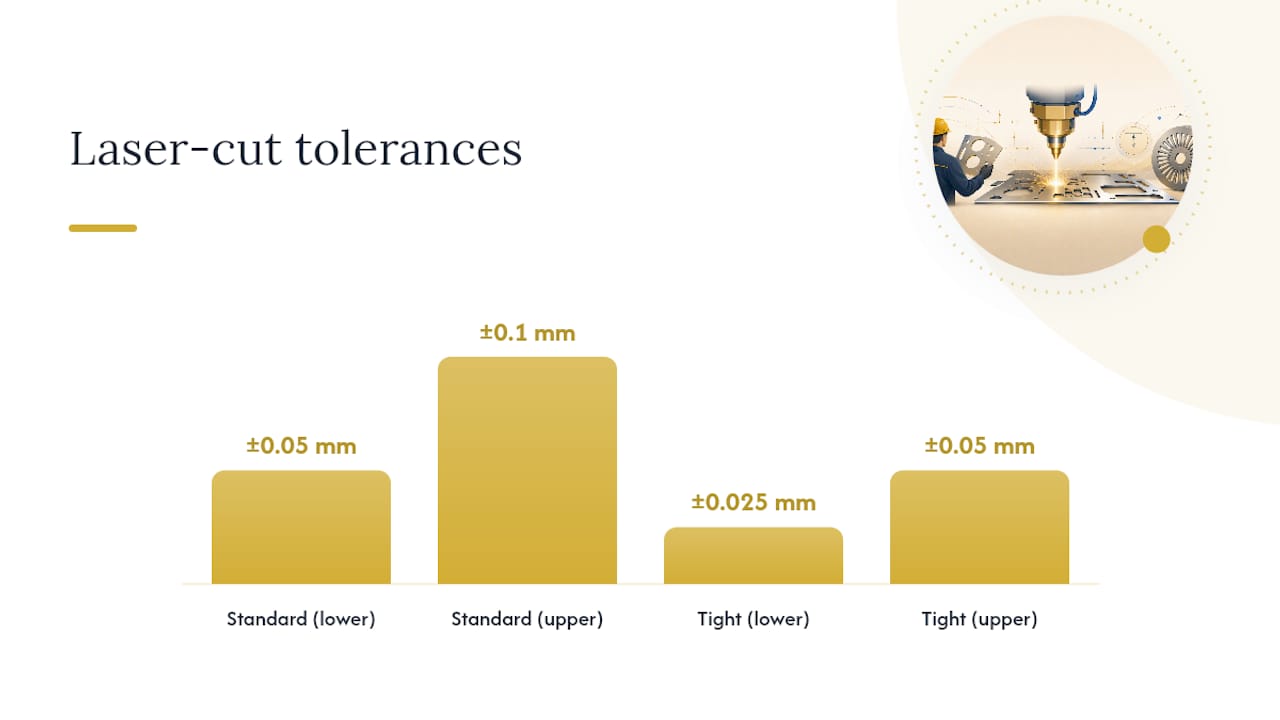
On tolerance: expect ±0.05 mm to ±0.1 mm as the practical standard across most fibre-laser shops. Tighter bands, down around ±0.025 mm to ±0.05 mm, are achievable on individual critical features, but they typically add cost or require a secondary machining pass.
A few things worth locking down before you send drawings:
- Confirm which alloy you actually need, not just “aluminum.”
- Ask what thickness range the shop’s laser handles reliably. Tolerance specs vary by machine and by material gauge.
- Reserve tight tolerances for the two or three features that truly need them, and leave the rest at general tolerance. Overspecifying the whole drawing is one of the fastest ways to inflate a quote.
What file formats and DFM rules keep your quote accurate?
Getting a fast, accurate quote on precision laser cutting aluminum parts comes down almost entirely to what you send. Shops need flat 2D cutting profiles in DXF or DWG format. If the part gets bent or welded into an assembly afterward, add a STEP file so the shop understands the finished geometry, not just the flat pattern.
- Export clean vector geometry. No overlapping lines, no open paths where a closed profile is expected.
- Respect minimum feature sizes. Hole diameters should generally sit at or above the material thickness, and feature spacing should run at least twice the thickness to avoid distortion around the cut.
- Add corner radii where possible. Sharp internal corners concentrate heat and stress; small radii solve this without changing the part’s function.
- Account for kerf. Note whether your dimensions are drawn to the finished edge or to the cutting path, and flag it in the file notes.
- List material, thickness, and quantity directly on the drawing, not just in an email.
A proper DFM review catches bend relief problems and misplaced holes before they become scrapped parts, which is exactly why most reputable shops won’t quote a firm price without one.
Why parts warp and how shops keep edges clean
Dross and burrs form when the laser’s focus, power, or gas pressure drifts out of the sweet spot for the material thickness in front of it. A shop running consistent parameters and fresh nozzles produces a clean, dross-free edge on nearly every cut. One running worn consumables on the wrong settings will hand you parts that need grinding before they’re usable.
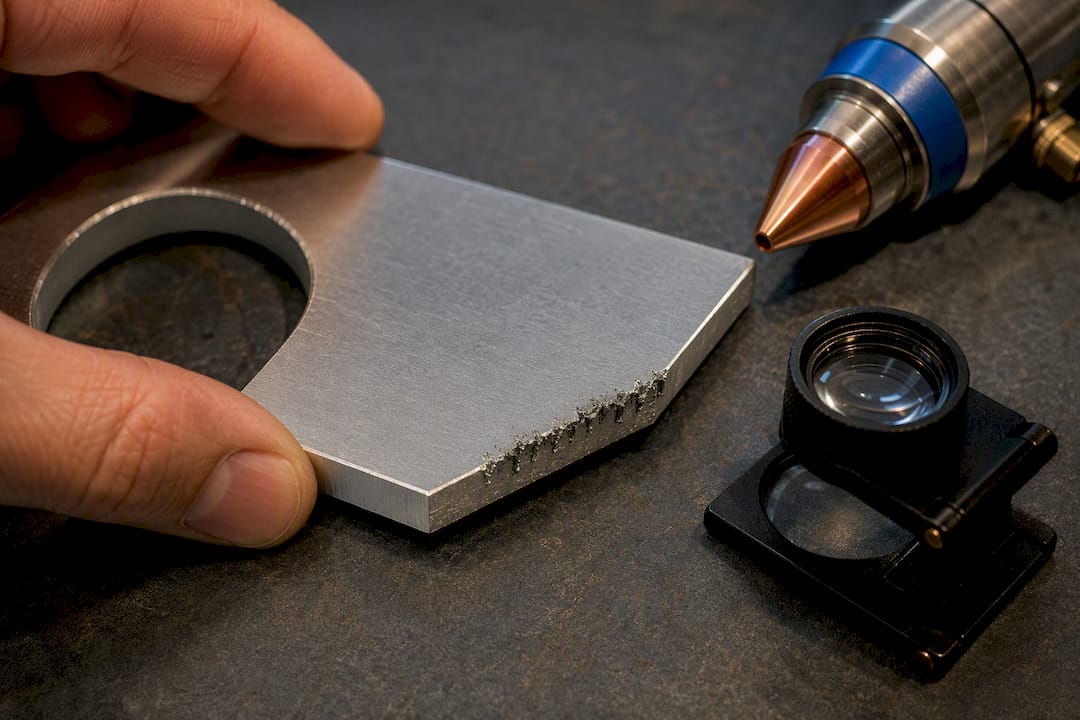
Warping is the other common complaint, and it’s almost always a heat problem. Thin sheet, long thin cuts, and parts with asymmetric geometry pull heat unevenly and bow as they cool. Shops manage this with fixturing during the cut, strategic cut-order sequencing, and, for parts that are especially heat-sensitive, a switch to waterjet instead of fighting the laser.
Standard finishing options worth asking about:
- Deburring, mechanical or manual, for edges going straight into assembly.
- Vibratory finishing, for a uniform surface across a batch of small parts.
- Anodize prep, which usually means specifying nitrogen-cut edges from the start so there’s no oxide layer to strip later.
What drives cost and lead time on a laser-cutting quote?
Nesting efficiency, meaning how tightly your parts pack onto a standard sheet, has more influence on unit price than most buyers realize. Poor nesting wastes material on every single run. Beyond that, machine power class and nitrogen consumption both scale directly with thickness, so a 6 mm part costs meaningfully more per cut than a 2 mm version of the same shape, even before labour is factored in.
Ask suppliers these questions before comparing bids:
- What’s the minimum order quantity, and does pricing break at specific volume thresholds?
- Is nitrogen or air assist included in the quoted price, or is nitrogen an upcharge?
- What’s the realistic lead time for a prototype run versus a production batch?
- Does the quote include deburring and finishing, or is that priced separately?
Send alloy, thickness, quantity, and target tolerance in your RFQ from the start. Vague requests get vague, padded quotes back.
Manara Corp: how we work with aluminum laser-cut parts
Manara Corp is a custom metal fabrication and welding shop in Lachine, running CNC laser cutting, sheet bending and rolling, profile rolling, and welding across steel, stainless steel, aluminum, and copper. Every part is cut, formed, and finished in-shop, then installed on-site across Greater Montreal, whether that’s the West Island, Laval, or the South Shore.
Beyond flat parts, Manara fabricates and installs custom railings, stairs, and fences for general contractors, architects, designers, and homeowners, served in both French and English. If you’re planning laser-cut aluminum components that eventually need bending or rolling into a final assembly, that work happens under one roof rather than bouncing between vendors.
Before requesting a quote, have these ready:
- Flat files in DXF, DWG, or STEP format
- Alloy and thickness confirmed, not just “aluminum sheet”
- Quantity and any critical tolerances flagged
- Desired finish: bright nitrogen-cut edge, deburred, or anodize-ready
What the guide gets right, and where buyers still go wrong
The technical advice floating around on aluminum laser cutting is mostly correct. Fibre lasers, nitrogen assist, and realistic tolerance bands are settled territory. Where buyers actually lose money isn’t the physics. It’s specification habits carried over from CNC machining, where every dimension gets a tight tolerance out of caution rather than need.
That habit is expensive on a laser-cut part in a way it isn’t on a milled one. A general tolerance band on 90% of your drawing, reserved tight tolerances on the two features that mate with something else, will usually cost less and arrive faster than a drawing where everything is called out to ±0.05 mm out of reflex.
The other place conventional advice underserves readers is alloy selection. Plenty of guides mention that 2024 and 7075 are difficult, then move on. What they skip is that switching to 5052 or 3003 early in the design phase, before tooling and fixturing decisions lock in, avoids a redesign later. If your part doesn’t have a metallurgical reason to use an aerospace alloy, don’t specify one and then discover mid-quote that it needs a different process entirely.
Prioritize the DFM conversation before the price conversation. A shop that reviews your file and flags problems before quoting is doing you a favour, not stalling you.
— Ash
Get a DFM review and firm quote from Manara Corp
Manara Corp is the alternative to sending your drawings to an out-of-province cutting service and hoping the finish matches what you actually need. Because every part is cut, formed, and installed locally across Greater Montreal, you get a DFM review from someone who can walk the shop floor and check the cut sample against your drawing, not a call centre reading specs off a screen.
Send your DXF, DWG, or STEP file along with the alloy, thickness, quantity, tolerances, and finish you need. You will get DFM feedback where it applies, a firm quote, and a realistic lead time, and installation across Greater Montreal if required. Start by requesting a quote through the laser cutting services page, or reach the shop directly through the contact page if your part also needs bending, rolling, or welding downstream.
Sources
- Laser Cutting Aluminum: Tips for Clean Edges (The 2026 Ultimate Fabrication Guide)
- When does laser cutting aluminum make sense?
- Laser Cutting Aluminum: A Comprehensive Guide
FAQ
Is it possible to laser cut aluminum?
Yes. A fibre laser with nitrogen assist gas cuts most aluminum alloys cleanly, though very thick sections or parts needing extreme flatness often do better on waterjet or CNC equipment.
Which material should you never cut on a laser cutter?
Materials that release toxic fumes or react dangerously to heat, such as PVC and certain coated plastics, should never go through a laser cutter. For aluminum specifically, alloys like 2024 and 7075 aren’t outright banned but are generally poor candidates without prior discussion with your shop.
Is aluminum harder to laser cut than steel?
Yes, in practical terms. Aluminum’s reflectivity and heat conductivity demand a fibre laser and higher gas pressure than steel needs, which raises consumable use and pushes shops toward nitrogen assist for a clean edge.
How thick can aluminum be laser cut?
Most fibre lasers handle aluminum reliably up to roughly 12 mm, depending on the machine’s power class, with thinner sheet cutting faster and holding tighter tolerances than thicker plate.
What tolerances should I expect on a laser-cut aluminum part?
Expect ±0.05 mm to ±0.1 mm as standard practice, with tighter bands available on select critical features at added cost. Manara Corp’s published tolerance guidance covers what to expect by thickness.