Choose the protection system that matches the service environment and the life-to-first-maintenance target you actually need. For long outdoor service, hot-dip galvanizing is the workhorse. For high-performance painted finishes on structural steel, a zinc-rich primer plus epoxy intermediate plus urethane topcoat is the industry default. Thermal spray earns its cost where shop access or complex geometry make dip galvanizing impractical.
The selection rule that governs everything else: classify the environment using ISO 12944, then pick a system rated for that durability band. Product names come second. Surface preparation, dry film thickness, and inspection criteria belong in the specification; brand names do not.
- Hot-dip galvanizing: long, low-maintenance life outdoors, marine-adjacent sites included.
- Thermal spray (zinc/aluminium): shop or field application on large or oddly shaped members.
- Zinc-rich primer + epoxy + urethane: the standard for structural steel needing colour, UV stability, and a strong barrier.
- Epoxy-only systems: indoor, low-UV exposure where cost matters more than gloss retention.
- Powder coating / e-coat: architectural and light industrial parts, not heavy marine or chemical exposure.
- Cathodic protection: buried and submerged steel, often paired with a coating.
- Temporary preventives (oils, waxes, VCIs): shipping and storage, never a substitute for a cured system.
Pro Tip: Specify the surface preparation standard and dry film thickness range in the contract, not the coating brand. A crew can hit a spec; they can’t hit a guess.
Key Takeaways
Matching the protection system to the ISO 12944 environment class and specifying surface preparation, film thickness, and inspection criteria by standard rather than brand name prevents the majority of premature coating failures.
| Point | Details |
|---|---|
| Classify before specifying | Use ISO 12944 (C1 to CX) to set the environment class and durability target first. |
| Galvanizing for long outdoor life | Hot-dip galvanizing suits 25-year-plus service with minimal maintenance in most outdoor settings. |
| Painted systems need three layers | Zinc primer, epoxy barrier coat, and urethane or polysiloxane topcoat form the standard structural stack. |
| Prep decides adhesion | Blast cleanliness, surface profile, and soluble salt limits matter more than paint chemistry choice. |
| Temporary isn’t permanent | Oils, waxes, and VCIs protect during transport and storage but require planned removal before coating or welding. |
Table of Contents
- What causes steel corrosion, and how does ISO 12944 classify the risk?
- How do galvanizing and thermal spray protect steel long term?
- Which paint system should you specify: zinc primer, epoxy, polysiloxane, or powder?
- Why does surface preparation determine coating success or failure?
- When should you use temporary rust preventives instead of a permanent coating?
- What design choices reduce corrosion risk before coating even begins?
- How often should coated steel be inspected and maintained?
- Fabrication and installation checklist for corrosion-ready steel
- Standards-first specifying: what the evidence actually supports
- Sources
- FAQ
What causes steel corrosion, and how does ISO 12944 classify the risk?
Steel corrodes because iron gives up electrons to oxygen in the presence of moisture, forming iron oxide. That’s the plain electrochemistry behind every rust stain you’ve ever seen. What varies enormously is the pattern of attack. Uniform corrosion eats away material evenly across a surface and is comparatively predictable. Localized attacks, including pitting, crevice corrosion, and galvanic corrosion between dissimilar metals, concentrate damage in small areas and can perforate a section long before the average thickness loss looks alarming.
This is why guessing at “how bad is the environment” doesn’t work as a specification method. ISO 12944 solves that by defining atmospheric corrosivity categories from C1 through CX:
- C1 (very low): heated interior spaces with clean, dry air. Rare in industrial contexts.
- C2 (low): unheated interiors with occasional condensation, rural exteriors with low pollution.
- C3 (medium): production areas with humidity, urban and coastal atmospheres with moderate salinity.
- C4 (high): chemical plants, coastal areas with moderate salt exposure, swimming pool halls.
- C5 (very high): industrial zones with high humidity and aggressive atmosphere, most marine zones.
- CX (extreme): offshore structures, splash zones, and areas with permanent condensation and chemical pollution.
Each category maps to a durability range: short (up to 7 years), medium (7 to 15), long (15 to 25), and very long (over 25 years). That range is the life-to-first-maintenance figure, the point at which the system needs its first major recoat rather than a spot repair. A C5 marine structure specified for “long” durability with a thin, single-coat system will fail its maintenance window early, and the rework cost dwarfs whatever was saved on the original coating budget. AMPP’s guidance on structural steel coatings makes the same point from the applicator’s side: match the system to the environment and stop treating durability as an afterthought.
How do galvanizing and thermal spray protect steel long term?
Hot-dip galvanizing works two ways at once. The zinc layer is a physical barrier that keeps moisture and oxygen off the steel, and where the coating gets scratched or damaged, the zinc corrodes preferentially and sacrifices itself to protect the exposed steel underneath. That sacrificial behaviour is why galvanized steel tolerates minor damage without immediate rusting, unlike a pure barrier coating.
Coating thickness dictates service life in a fairly linear way. A standard structural galvanizing run typically produces a zinc coating thickness that depends on steel thickness and immersion time, with thicker coatings providing proportionally longer life within a given exposure category, up to practical limits set by adhesion and brittleness.
Thermal spray applies molten zinc, aluminium, or a zinc-aluminium blend using a flame or arc gun, building coatings from roughly 100 to 300 micrometres depending on the application. It’s used where a component is too large for a dip tank, where field application is required, or where a structure needs metallizing after fabrication and welding are already complete. Because thermal spray coatings are applied without submersion, they suit repair work and large fixed structures like bridges and towers as well as new fabrication. Most specifications call for a sealer coat over thermal spray to fill the inherent porosity in the sprayed layer, which otherwise lets moisture creep through to the substrate.
A few design details separate a smooth galvanizing job from a headache:
- Drainage holes in enclosed sections prevent trapped acid and zinc buildup during the dip.
- Vent holes avoid pressure buildup that can crack welds during immersion.
- Dimensional tolerances shift slightly after coating, which matters on tight-fitting assemblies.
- Field welds after galvanizing need cold zinc-rich touch-up compound, not paint alone, to restore sacrificial protection at the weld.
For most outdoor structural steel with a 25-year-plus target and no exotic chemical exposure, galvanizing remains the most cost-effective long-life option available, largely because it needs no recoat cycle within that window.
Which paint system should you specify: zinc primer, epoxy, polysiloxane, or powder?
Painted systems earn their place where galvanizing isn’t practical, where colour and appearance matter, or where the structure is too large to dip. The standard high-performance stack has three layers, each doing a distinct job.
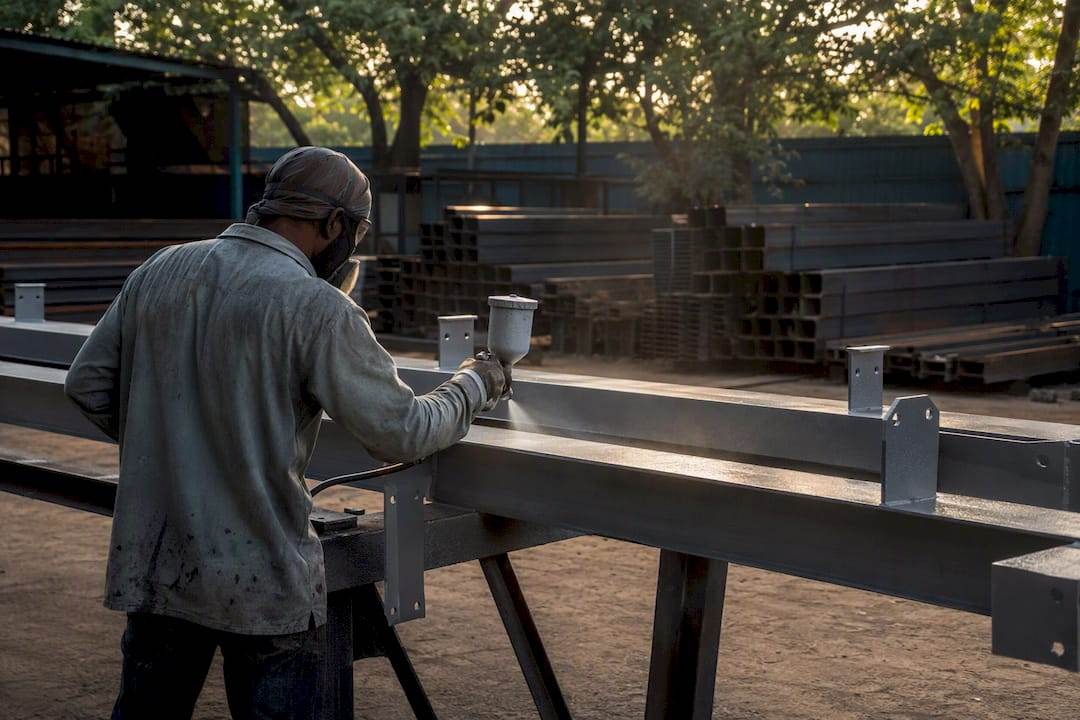
A zinc-rich primer provides the sacrificial protection that galvanizing gives metallically. Inorganic zinc silicate primers offer the best long-term performance and are the default for C4 and C5 environments but demand tighter application controls and near-white blast cleanliness. Organic zinc-rich epoxy primers are more forgiving to apply and tolerate slightly less rigorous surface prep, at some cost to long-term performance.
The epoxy intermediate coat is pure barrier protection: thick, low-permeability film that blocks moisture and oxygen from reaching the primer. It has poor UV resistance on its own, which is why it never goes on as the final coat outdoors.
The topcoat decides UV stability, colour retention, and gloss life. Aliphatic urethanes are the standard choice and hold colour well for years. Polysiloxane topcoats cost more but resist chalking and fading even longer, which matters on architectural steel or anything with high visual exposure.
Powder coating and e-coat both deliver excellent uniform coverage and hard, attractive finishes, but neither carries the film build or sacrificial zinc that heavy exposure demands. They’re right for railings, brackets, and equipment housings in benign environments, not for tank exteriors or coastal structural steel. Recent coating research also points to specialized options, including duplex enamel-epoxy and electroless nickel systems, for niche applications like rebar or submerged fittings, though these trade added cost and process complexity for narrow performance gains.
Why does surface preparation determine coating success or failure?
No topcoat chemistry compensates for a poorly prepared surface. Adhesion failure, the single most common cause of premature coating breakdown, almost always traces back to mill scale, oil residue, or soluble salts left on the steel before the first coat went on.
- Blast to the specified standard. SSPC-SP 10 (near-white) or NACE No. 2 equivalent is standard for C4 and C5 systems; SSPC-SP 6 (commercial blast) suffices for milder exposures.
- Control the surface profile. Most high-build systems need 40 to 75 micrometres of anchor pattern, measured with a profile comparator or replica tape, so the primer has something to grip.
- Test for soluble salt contamination. Chloride and sulphate residues left after blasting cause blistering under the coating even when everything else was done right; Bresle patch testing catches this before paint goes on.
- Hold environmental limits during application. Steel surface temperature at least 3°C above dew point, humidity generally under 85%, and adequate ventilation for solvent-based systems.
- Document QA at every stage. Dry film thickness readings, holiday (pinhole) detection on immersion or buried service, and adhesion pull tests all belong in the inspection record, not just the spec sheet.
Industry sources consistently point to surface preparation as the decisive variable in coating longevity, ahead of which specific paint chemistry gets chosen. A premium three-coat system over a poorly blasted surface will underperform a cheaper system applied to a properly prepared one, almost every time.
When should you use temporary rust preventives instead of a permanent coating?
Temporary protection buys time between fabrication and final coating, or between shipping and installation, without committing to a cured film. It’s a different category from permanent systems, and treating the two interchangeably causes problems downstream.
- Oil and wax films offer weeks to months of protection and wipe off easily with solvent before painting or welding.
- Solvent-cutback films dry to a thin waxy layer, giving moderate protection with straightforward removal.
- Strippable coatings form a peelable membrane, useful for masking finished surfaces during transport or storage.
- Vapour corrosion inhibitors (VCIs) protect enclosed or stacked parts by releasing an inhibiting vapour inside packaging, without leaving an oily residue.
Temporary rust preventives are not a substitute for a coating system, and some films interfere with weld quality or paint adhesion if not fully removed first. Choosing a preventive that’s compatible with whatever process comes next, whether that’s welding, painting, or forming, avoids costly rework. Clean, dry, properly wrapped parts hold their surface condition far longer than parts left exposed on a yard.
What design choices reduce corrosion risk before coating even begins?
Good design does half the work before a single coat gets sprayed. Shed water instead of trapping it: avoid horizontal ledges, cap open tube ends, and slope surfaces so moisture runs off rather than pooling. Eliminate crevices wherever possible, since tight gaps hold moisture and concentrate localized attack even under an otherwise sound coating. Isolate dissimilar metals, particularly steel against stainless or aluminium fasteners, with washers or coatings to prevent galvanic corrosion at the contact point.
For genuinely aggressive service, sometimes upgrading the base material beats upgrading the coating. Higher-alloy stainless grades or weathering steel can outperform a coated carbon steel section over decades, though the upfront material cost is higher.
A specification checklist worth keeping on hand:
- Environment class per ISO 12944 (C1 through CX)
- Life-to-first-maintenance target (short, medium, long, very long)
- Surface prep standard (SSPC/NACE grade)
- Full system build with per-coat and total DFT
- Acceptable soluble salt and adhesion limits
- Inspection and repair method, documented in the contract
Pro Tip: Reference the specific ISO 12944 part number in the contract rather than a brand name. It shifts the risk of underperformance onto measurable criteria, not marketing claims.
How often should coated steel be inspected and maintained?
Inspection cadence should track the durability band you specified, not a fixed calendar. C5 and CX structures, marine and heavy industrial, warrant annual visual checks with closer inspection every 3 to 5 years. C2 and C3 environments can often stretch to 5 to 10 year intervals for a full assessment.
- Chalking and colour fade: usually cosmetic; schedule a topcoat refresh before it becomes a barrier issue.
- Rust bleeding at edges or fasteners: signals a breach at a high-stress point; spot-repair before it spreads.
- Blistering: often traces to soluble salts trapped at application; usually needs local removal down to bare metal.
- Chalky, powdery zinc primer showing through: the sacrificial layer is depleting; plan a recoat within the current maintenance window.
For buried pipe or submerged structural steel, coatings alone rarely carry the full service life. Pairing a coating with cathodic protection handles pinholes and coating damage that would otherwise become active corrosion sites, and it’s standard practice on pipelines, tank bottoms, and marine piling.
Fabrication and installation checklist for corrosion-ready steel
The best specification on paper still fails if shop practices work against it. How steel gets cut, formed, and welded shapes what happens to the coating later.
- Laser-cut edges need deburring before blasting; sharp edges hold less film thickness and fail first.
- Bent and rolled sections can trap moisture at seams if drainage isn’t designed in from the start, a detail worth checking during the sheet bending and rolling stage rather than after assembly.
- Weld spatter and heat-affected zones need cleanup before any preventive or primer goes on; residue there is a common blister origin.
- Stack fabricated parts with spacers and VCI paper for transport, never bare metal on bare metal.
- On-site, treat cut fasteners and field welds with matching touch-up compound before they sit exposed overnight.
Coating performance is decided as much on the shop floor as in the spec sheet. A clean laser-cut edge and a properly drained bent seam do more for long-term corrosion resistance than an extra coat of paint slapped over a poorly prepped joint.
Manara Corp fabricates steel, stainless, and aluminum components in-shop across Greater Montreal, from laser-cut brackets to structural railings, with edge treatment and handling built into the process rather than bolted on afterward. For expert advice on protecting such components in HVAC applications, see Cooling Systems Archives – HVAC Prime.
If your project involves steel components headed for outdoor exposure or industrial service, getting the fabrication details right before coating even starts saves real money over the structure’s life. Manara Corp’s welding services cover field touch-up and repair work alongside new fabrication, and the laser cutting process is set up to leave clean, coatable edges from the first pass. For custom railings, stairs, fences, or HVAC ductwork fabricated and installed locally across Montreal, Laval, the South Shore, and the West Island, reach out before the design is finalized. Getting the surface prep and edge treatment specified correctly at the fabrication stage is far cheaper than fixing adhesion failures after installation.
Standards-first specifying: what the evidence actually supports
Most corrosion failures traced back through a claims file share one root cause: someone specified a coating brand instead of a performance outcome. That’s the uncomfortable truth the standards keep pointing to. ISO 12944 exists precisely because “use a good epoxy” isn’t a specification, it’s a hope.
The conventional advice, pick a well-known coating brand and trust the manufacturer’s data sheet, undersells how much surface preparation and design detailing actually decide outcomes. A mid-tier system over a properly blasted, well-drained, crevice-free structure will consistently outlast a premium system over rushed prep work. That’s not a popular thing to say to someone who just paid for the expensive paint, but the failure patterns back it up.
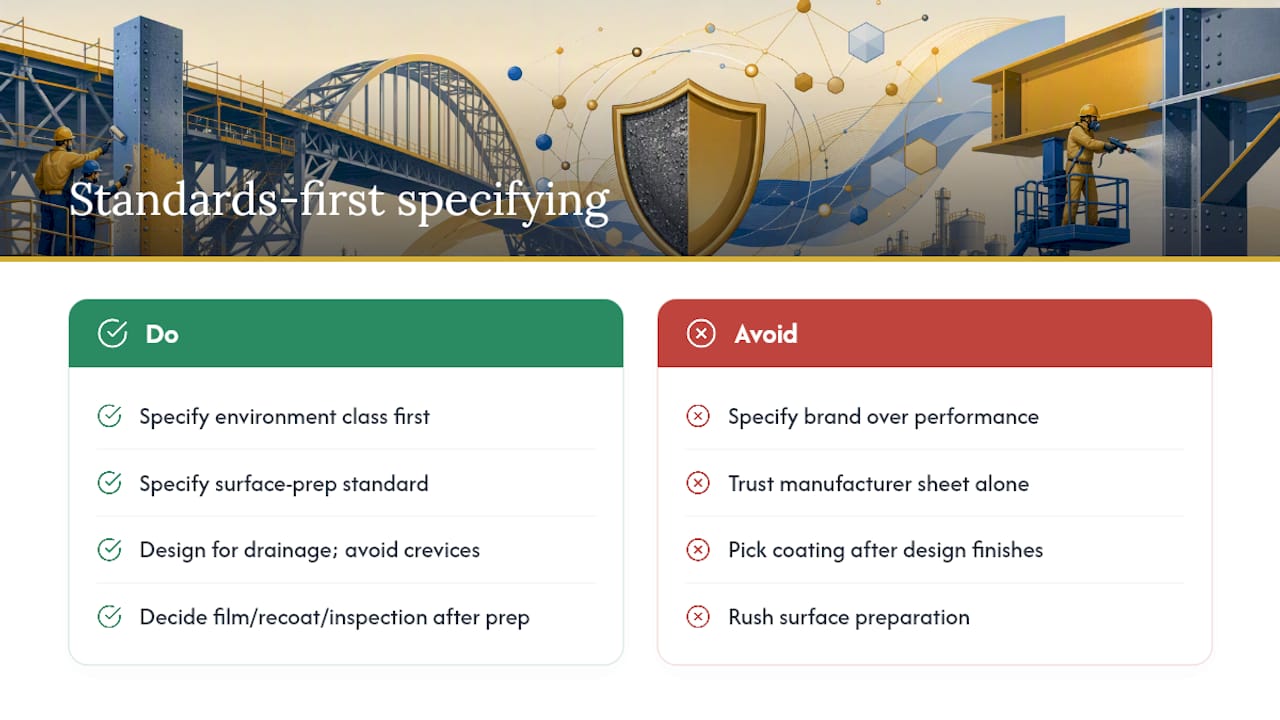
If you specify one thing carefully, make it the environment class and the surface prep standard, not the topcoat chemistry. Everything else, film build, recoat intervals, inspection cadence, follows logically once those two decisions are locked in. Engineers who treat coating selection as a checklist item after the design is finished are the ones fielding warranty calls five years later.
Sources
- ISO 12944-8:2017 – Paints and varnishes — Corrosion protection of steel structures by protective paint systems — Part 8
- Fundamentals of rust preventives used for temporary corrosion protection
- Review Article Methods of corrosion prevention for steel in …
FAQ
How can you protect steel from corrosion?
Match the protection system to the site’s ISO 12944 corrosivity class: galvanizing or a zinc-primer/epoxy/urethane paint system for outdoor exposure, epoxy-only systems indoors, and cathodic protection added for buried or submerged steel.
What is corrosion-resistant steel, and does it eliminate the need for coatings?
Weathering steel and higher-alloy stainless grades resist corrosion better than plain carbon steel but aren’t immune, particularly in chloride-heavy or crevice-prone conditions, so coatings or design controls are still often warranted in aggressive environments.
What can you coat metal with to prevent rust?
For permanent protection, use hot-dip galvanizing, thermal spray, or a multi-coat paint system with a zinc-rich primer, epoxy intermediate, and urethane or polysiloxane topcoat. For temporary protection during shipping or storage, oils, waxes, or VCIs work without committing to a cured coating.
Which steel is most corrosion-resistant?
Among common structural options, duplex and higher-molybdenum stainless grades resist corrosion better than standard carbon steel or weathering steel, though the right choice depends on the specific chlorides, chemicals, and mechanical demands of the service environment.
What does life-to-first-maintenance actually mean?
It’s the ISO 12944 durability band, short, medium, long, or very long, indicating how many years a specified coating system is expected to perform before its first major recoat, based on the assigned corrosivity class.