For commercial and industrial applications, the safest default is an engineered serrated metal tread or an extruded aluminium tread with abrasive inserts, paired with a 40 to 60 mm high-contrast nosing. Material choice should follow site exposure: aluminium or 316 stainless for wet or corrosive locations, galvanized or 304 stainless for heavier structural loads. Every specification also has to satisfy Canadian accessibility and building-code requirements, which is not optional on public-access stairs.
TL;DR:
- Open-bar or serrated grating are ideal for exterior or industrial stairs that need drainage and heavy load capacity, while lightweight aluminium with replaceable inserts suits interior and less demanding environments.
- Aluminium, especially marine-grade or anodized, resists corrosion in coastal or outdoor settings but is less suitable for heavy point loads, whereas 316 stainless steel offers superior resistance near de-icing salts and chemicals.
- Proper fastening with stainless or compatible fasteners is critical; under-specification or incorrect material pairing significantly increases the risk of fastener failure and reduces stair longevity.
- Canadian accessibility codes require nosing strips to be 40 to 60 mm deep with high luminance contrast, and tactile indicators are necessary at key points for low-vision users.
- Routine maintenance, prompt snow and ice removal, and regular inspection logs are essential to maintain slip resistance, especially during winter when de-icers and drainage are most effective.
Table of Contents
- Overview of anti-slip metal stair solutions
- Materials and corrosion resistance: choosing aluminium, stainless or galvanized steel
- Leading-edge nosing, visibility and dimensional requirements
- Installation and fastening best practices for metal stair treads and nosings
- Maintenance, winter management and housekeeping to preserve slip resistance
- How to choose the right anti-slip solution for your environment
- Practical fabrication and installation notes from Manara Corp.
- How Manara Corp. can help with anti-slip metal stairs
- Author’s note and recommended next steps
- Sources
- FAQ
Overview of anti-slip metal stair solutions
Metal stair safety comes down to choosing the right tread geometry for the traffic, moisture and load a stair will see over its service life. Four categories cover almost every commercial and industrial job.
Bar and plank grating remains the workhorse for exterior and industrial platforms because open bars let water, snow and debris fall through instead of pooling on the walking surface. It handles heavy point loads well, which makes it common on loading docks and mezzanine stairs, though its coarse surface is not always ideal where foot traffic is constant and fine control matters.
Serrated or engineered patterned treads take grating a step further by adding raised, angled ridges that bite into a boot sole even when the surface is coated in oil, ice or grease. Industry guidance points to serrated or engineered patterns as the stronger choice for extreme winter or oily industrial environments, since the mechanical bite works even when a smooth surface would fail.
Extruded aluminium treads with embedded abrasive inserts trade some of that raw grip for weight savings and corrosion resistance. The aluminium extrusion carries the load while a silicon carbide or aluminium oxide insert channel does the gripping, and the insert can usually be replaced once it wears down rather than requiring the whole tread to be swapped.
Retrofit options fill the gap when a full tread replacement is not in the budget or timeline:
- Abrasive strips: adhesive-backed grit tape applied directly to an existing tread, a low-cost fix with a shorter service life.
- Adhesive nosings: pre-formed nosing profiles bonded to the leading edge to restore contrast and grip without disturbing the tread body.
- Bolted aluminium nosings: mechanically fastened nosing caps that outlast adhesive versions and can be swapped individually when worn.
Choosing between these categories usually starts with exposure. A dry indoor mezzanine has very different needs than an unheated exterior fire stair, and getting that assessment right upfront avoids specifying a solution that fails within a season.
Materials and corrosion resistance: choosing aluminium, stainless or galvanized steel
Material selection is where a lot of anti-slip stair specifications quietly go wrong. A tread that grips perfectly on day one is not much use if it corrodes, pits or delaminates within a couple of winters.
Aluminium, particularly marine-grade or anodized aluminium, resists corrosion well in most outdoor and coastal-adjacent environments and is light enough to simplify installation on existing structures. It does not hold up as well under sustained heavy point loading compared with steel, so it tends to suit pedestrian and light commercial traffic better than forklift ramps or industrial catwalks.
Stainless steel comes in two grades worth distinguishing. 304 stainless handles general commercial exposure, humidity and typical washdown environments. 316 stainless includes molybdenum, which gives it stronger resistance to chlorides, making it the better call near de-icing salt exposure, coastal air or process environments with corrosive chemicals. CCMC evaluation guidance notes that in corrosive or marine-exposed sites, specifying 316 stainless or a properly sealed aluminium system with periodic inspection reduces lifecycle cost compared with repeatedly replacing galvanized components.
Hot-dip galvanized steel offers the best strength-to-cost ratio for heavy structural loads and is common on industrial stairs, but the zinc coating degrades faster than stainless or aluminium finishes once it is scratched or exposed to road salt and standing water.
Fastener compatibility matters as much as the tread material itself:
- Never pair aluminium treads with plain carbon steel fasteners: the contact creates galvanic corrosion that eats the softer metal.
- Match fastener material to the tread, or isolate dissimilar metals with a nylon or neoprene washer.
- Specify stainless fasteners on galvanized structures where the coating has already been cut or drilled.
Pro Tip: Ask your fabricator for a fastener schedule alongside the tread spec sheet. A tread rated for 25 years of service can fail in three if the bolts holding it are the wrong alloy.
Leading-edge nosing, visibility and dimensional requirements
The leading edge of a stair tread is where most slips actually start, which is why Canadian accessibility rules treat it as a dimensioned, tested component rather than a cosmetic strip. Accessibility Standards Canada specifies that leading-edge nosing strips must sit between 40 mm and 60 mm in depth and provide at least 70% luminance contrast against the surrounding tread and riser.
High luminance contrast is required on nosing strips so the edge remains visible under varied lighting and to people with low vision, as specified by Accessibility Standards Canada.
On the building-code side, Ontario’s building code requires that surfaces of ramps and treads have a slip-resistant finish, and that public-access stairs carry colour contrast or a distinctive visual pattern to mark the leading edge. Quebec projects follow similar CNB-based provisions under the Construction Code, applying the same contrast and slip-resistance principles even if the clause numbering differs.
A few practical points contractors should carry into the fabrication order:
- Confirm nosing depth against the finished tread, not the raw casting, since coatings and inserts change the effective dimension.
- Tactile indicators are generally required at the top and bottom of exterior egress stairs and at changes in level on public-access routes.
- Custom-fabricated nosing can be formed to the exact depth and contrast band needed, which is easier to control than retrofitting a stock nosing profile after the fact.
Installation and fastening best practices for metal stair treads and nosings
A well-specified tread still fails if it is installed with the wrong fasteners or too few of them. CCMC evaluations note that products used as stair treads must be fastened per manufacturer specification with corrosion-resistant fasteners, and that support spacing has to match the documented test conditions to achieve the rated slip-resistance and structural performance.
- Confirm fastener material matches or is isolated from the tread and stringer alloy to avoid galvanic corrosion.
- Specify a minimum of two fasteners per support point on standard commercial treads, increasing to four on high-vibration or heavy-load industrial stairs.
- Choose hidden fastener systems for pedestrian and architectural stairs where appearance matters, and exposed bolted connections for industrial platforms where field serviceability matters more.
- Reserve welding for permanent structural connections, such as stringer-to-landing joints, rather than tread attachment, since welded treads are difficult to replace when worn.
- Torque fasteners to the manufacturer’s specified value and re-check after the first freeze-thaw cycle, since thermal movement can loosen initial installations.
Retrofitting an existing stair adds a layer of assessment before any fastener goes in. A short checklist keeps that survey consistent across sites:
- Measure tread flatness and check for warping or corrosion pitting that would prevent a new nosing from seating flush.
- Verify existing stringer thickness can accept new fastener holes without compromising structural capacity.
- Check that the retrofit nosing depth still falls within the 40 to 60 mm range once applied over the existing tread.
- Document current luminance contrast with a simple light meter reading before and after installation to confirm the upgrade actually meets the requirement.
Anchor failures are almost always traced back to inadequate backing or undersized fasteners, so specifying embedment length and corrosion rating up front, and double-fastening where vibration is expected, is worth the extra line item on the quote.
Maintenance, winter management and housekeeping to preserve slip resistance
Even the best tread loses its grip if nobody maintains it. CCOHS fall-prevention guidance frames this as a layered problem: engineered treads and nosing contrast handle design, but maintenance and housekeeping are just as essential, since debris, grease or ice can defeat even a well-specified surface.
Routine care should include a monthly visual inspection on high-traffic commercial stairs and a quarterly deeper check on lower-traffic industrial stairs, using a cleaner matched to the finish: mild detergent for anodized aluminium, non-chloride cleaners for stainless to avoid pitting, and a soft brush rather than a wire brush on galvanized surfaces to protect the zinc coating.
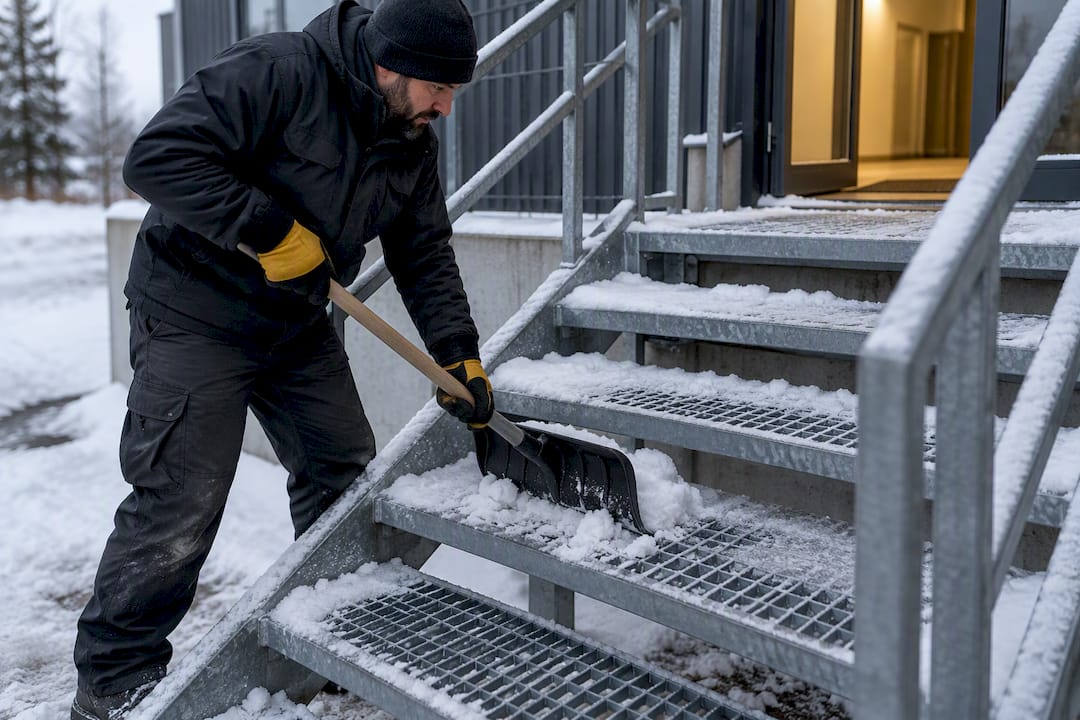
Winter introduces its own risks. Prompt snow and ice clearing matters more than the tread pattern itself, and open-bar grating or slotted treads that let meltwater drain through reduce refreeze compared with solid pan treads. Calcium magnesium acetate or similar less-corrosive de-icers are a better long-term choice than straight rock salt on stairs with aluminium or coated steel components, since chloride exposure accelerates pitting and coating breakdown.
Pro Tip: Keep a simple inspection log per stair: date, wear observed, and fastener condition. It turns a subjective “looks fine” walk-through into a paper trail that supports both safety audits and warranty claims.
Inspection items worth flagging every time:
- Visible abrasion wear on the tread’s high-contact zone, usually the centre third of each step.
- Loss of abrasive aggregate from insert channels, which shows up as a smoother, shinier strip where grit has worn away.
- Loose, missing or corroded fasteners at tread supports and nosing attachment points.
- Fading or dirt buildup that reduces the nosing’s luminance contrast below the visible threshold.
How to choose the right anti-slip solution for your environment
Matching the product to the site conditions is the single decision that determines whether an anti-slip stair performs for ten years or fails within two.
Wet, splash-prone areas such as loading docks and rooftop access favour open-bar or serrated grating in aluminium or 316 stainless, since drainage and corrosion resistance both matter. Oily or greasy industrial floors call specifically for serrated or engineered patterns, because smooth abrasive strips clog and lose bite once contaminated. Frozen exterior stairs do best with drainage-friendly geometry and a finish that tolerates de-icer exposure. High-traffic interior commercial stairs can often use lighter aluminium treads with replaceable abrasive inserts since load and corrosion risk are both lower.
Lifecycle cost deserves as much weight as the upfront quote. A cheaper galvanized tread that needs replacement in eight years can cost more over twenty years than a stainless or aluminium tread installed once, particularly once labour and stair downtime are factored in.
Before signing off on a supplier, a short survey checklist keeps the comparison honest:
- Ask for documented slip-resistance test data, not just a marketing claim of “anti-slip.”
- Confirm the corrosion treatment specified for your exact environment, not a generic finish description.
- Get a firm lead time for fabrication and delivery, especially for custom nosing depths.
- Clarify what the warranty actually covers: coating failure, structural defect, or both.
| Environment | Recommended tread type | Preferred material |
|---|---|---|
| Wet or splash-prone exterior | Open-bar or serrated grating | Aluminium or 316 stainless |
| Oily or greasy industrial floor | Serrated or engineered pattern | Galvanized or 304 stainless |
| Frozen exterior egress stairs | Drainage grating with abrasive insert | Aluminium or 316 stainless |
| High-traffic interior commercial stairs | Extruded aluminium with abrasive insert | Anodized aluminium |
Practical fabrication and installation notes from Manara Corp.
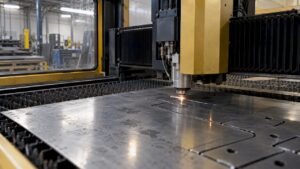
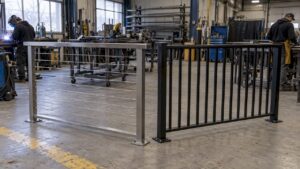
Custom metal stairs are fabricated and installed locally, allowing finish, tread pattern and nosing dimensions to be controlled in-house before installation. That matters most on the details that are hardest to fix after installation: nosing depth, luminance contrast and fastener placement.
Shop-prefabrication of tread assemblies lets a fabricator hold tight tolerances on nosing depth and finish application, which reduces site rework and keeps contrast consistent across an entire flight rather than varying step to step. On-site problems most often show up as anchor failures traced to undersized fasteners or inadequate backing, something careful anchoring and embedment specification at the shop stage largely prevents.
A few practical habits worth requesting from any fabricator:
- Ask for shop drawings before fabrication begins, so nosing depth and fastener layout are confirmed on paper first.
- Request a mock-up or site template on larger flights to catch dimensional mismatches before the full run is cut.
- Confirm finish and coating specifications match the exposure conditions discussed in the material section above.
How Manara Corp. can help with anti-slip metal stairs
Custom metal staircases are designed and fabricated in-house, then installed on site locally, ensuring consistent control over nosing depth and contrast finish through to installation.
That single point of accountability is the practical advantage over ordering stock treads from a catalogue and hoping they fit: fabrication, finish and installation are handled by one crew, with corrosion-resistant materials and fastening matched to your site from the start. Whether the project is a single exterior fire stair or a full industrial platform, Manara’s custom metal staircase service can produce serrated, aluminium or stainless tread assemblies built to the nosing and contrast specifications your project requires. Contact Manara Corp. to arrange a site survey or request a quote for your next stair project.
Author’s note and recommended next steps
If there is one thing worth prioritizing, it is engineered treads matched to your worst seasonal condition, not your average one. A stair that performs fine in September but ices over in January was never really specified for its environment. Pair that tread choice with a scheduled inspection routine, not a one-time installation checklist, and most slip failures never happen. Request a site survey or a specification drawing before you order anything.
— Ash
Sources
Specifying anti-slip metal stairs correctly means checking a handful of primary sources rather than relying on a supplier’s marketing sheet.
- 14. Stairs – Accessibility Standards Canada (CAN‑ASC 282025)
- Stairways – Fall prevention | CCOHS
- Canadian Construction Materials Centre evaluations and guidance (CCMC)
For a broader look at how these pieces fit together on a single project, Manara’s guide to industrial stair standards walks through the crosswalk between accessibility and safety requirements.
FAQ
How do I make metal steps less slippery?
Adding a serrated tread pattern, an abrasive insert strip or a bolted aluminium nosing to existing steps restores grip without replacing the whole stair. CCOHS guidance also recommends pairing that surface fix with better lighting and prompt ice and debris removal, since no surface treatment alone eliminates the hazard.
What is the best anti-slip material for stairs?
There is no single best material: aluminium and 316 stainless suit wet or corrosive exterior sites, while galvanized or 304 stainless steel suits heavier industrial loads. The right choice depends on exposure, load and how much de-icing salt or moisture the stair will see.
What are effective anti-slip options for stairs?
Serrated metal treads, extruded aluminium treads with abrasive inserts, and open-bar grating are the main engineered options, while abrasive strips and adhesive or bolted nosings work well as retrofits. Ontario’s building code requires public-access stairs to combine a slip-resistant finish with visible contrast at the leading edge.
What can I put on my stairs so I don’t slip?
Adhesive grit tape or a bolted aluminium nosing cap are the quickest fixes for an existing stair, and both can be matched to a 40 to 60 mm nosing depth for accessibility compliance. For a permanent solution, replacing the tread with a serrated or abrasive-insert design lasts longer than any surface-applied product.