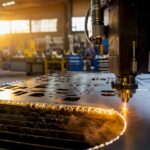
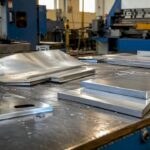
Stainless steel finishes describe the surface condition of stainless steel as it leaves the mill or after additional mechanical, chemical, or electrolytic processing. That condition determines how a component looks, how easily it cleans, and how well it resists corrosion in service. The practical selection rule is simple: specify the minimum finish that meets your functional requirement, and apply it only where it is actually needed.
For most projects, that breaks down like this:
- Architectural and visible surfaces (cladding, railings, countertops): specify No.4 brushed or better, with a signed swatch and a written Ra limit.
- Hygienic installations (food processing, pharmaceutical): specify electropolished or mechanically polished to Ra ≤ 0.8 µm for food, Ra ≤ 0.5 µm for pharma.
- Structural and hidden components: 2B mill finish is almost always sufficient and costs the least.
Pro Tip: Never specify a mirror finish for a structural bracket or a hidden weld zone. You pay for the polish and then grind it off during fabrication.
Key takeaways
Specifying stainless steel finishes correctly requires matching the finish to a functional requirement, defining it with a measurable Ra limit, and locking it in with a signed swatch before production begins.
| Point | Details |
|---|---|
| Match finish to function | Use 2B for hidden/structural, No.4 for architectural, electropolished for hygienic applications. |
| Ra is the acceptance metric | Food installations target Ra ≤ 0.8 µm; pharmaceutical systems typically require Ra ≤ 0.5 µm. |
| Standards to reference | BS EN 10088-2 for flat product codes, ASTM A480 for North American supply, ISO 15730 for electropolishing. |
| Swatch plus written spec | Agree a signed physical swatch and a written polishing specification before production to prevent delivery disputes. |
| Manaracorp for Montreal projects | Local fabrication, in-person swatch sign-offs, and on-site installation across Greater Montreal. |
Table of Contents
- What are the standard stainless steel finishes from the mill?
- Architectural and special finishes: brushed, mirror, satin, and patterned
- How are stainless steel finishes produced?
- What Ra value should you specify, and why does it matter?
- How does finish choice affect corrosion resistance, hygiene, and durability?
- How to write an unambiguous finish specification for Canadian projects
- Cleaning and maintaining stainless steel finishes
- Which finish should you choose? A quick decision guide
- What to ask your Canadian fabricator before signing off on a finish
- Why precise finish specifications matter more than most people think
- Manaracorp’s stainless fabrication services in Greater Montreal
- Authoritative standards and supplier resources
- Sources
- FAQ
What are the standard stainless steel finishes from the mill?
Mill finishes are the surface conditions produced during rolling and annealing at the steel mill, before any secondary processing. BS EN 10088-2 (Table 6) is the primary European designation standard for flat products and defines these finishes with process-based codes and guide Ra values. ASTM A480 provides the parallel North American designations, which Canadian fabricators and procurement teams also reference.
The three finishes you will encounter most often on Canadian mill orders:
| Finish code | Process route | Typical Ra (µm) | Common applications |
|---|---|---|---|
| 2D | Hot rolled, annealed, pickled, cold rolled, annealed, pickled | 0.4–0.5 | Deep drawing, forming, industrial |
| 2B | 2D route plus light cold-roll skin pass | 0.1–0.5 | General fabrication, kitchen equipment, base for polishing |
| 2R (BA) | Cold rolled, bright annealed in controlled atmosphere | 0.1 | Appliances, reflective surfaces, base for mirror finish |
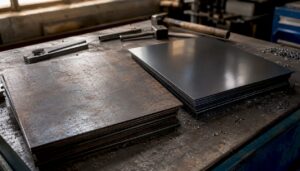
2B is by far the most common supply condition in Canada. The skin-pass roll gives it a smooth, slightly reflective surface that accepts most secondary finishing processes without excessive pre-work. 2R (bright annealed) is the smoothest mill finish, produced in a hydrogen or nitrogen atmosphere to prevent oxidation, and it is the natural starting point for mirror polishing. 2D is rougher and better suited to deep-draw forming where the rougher surface holds lubricant.
Choosing the closest mill finish to your final required surface reduces post-processing and overall cost. If your end requirement is a No.4 brushed finish, starting from 2B rather than 2D saves one or two grinding passes.
Architectural and special finishes: brushed, mirror, satin, and patterned
Beyond the mill, a range of mechanically produced and patterned finishes serve architectural, decorative, and functional applications. These are also defined in BS EN 10088-2 and in supplier documentation such as the Outokumpu surface finishes brochure, which lists finishes including 2B, 2BB, BA, 2R, Supermatt, and Deco Matt alongside written polishing specifications and swatch requirements.
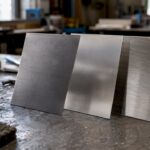
No.4 (brushed) is the workhorse of architectural stainless. Produced by belt or pad grinding with 150–180 grit abrasives, it has a visible unidirectional grain and an Ra typically in the 0.2–0.8 µm range. It hides fingerprints and minor scratches well, which is why you see it on elevator panels, kitchen equipment, and custom metal railings across Montreal.
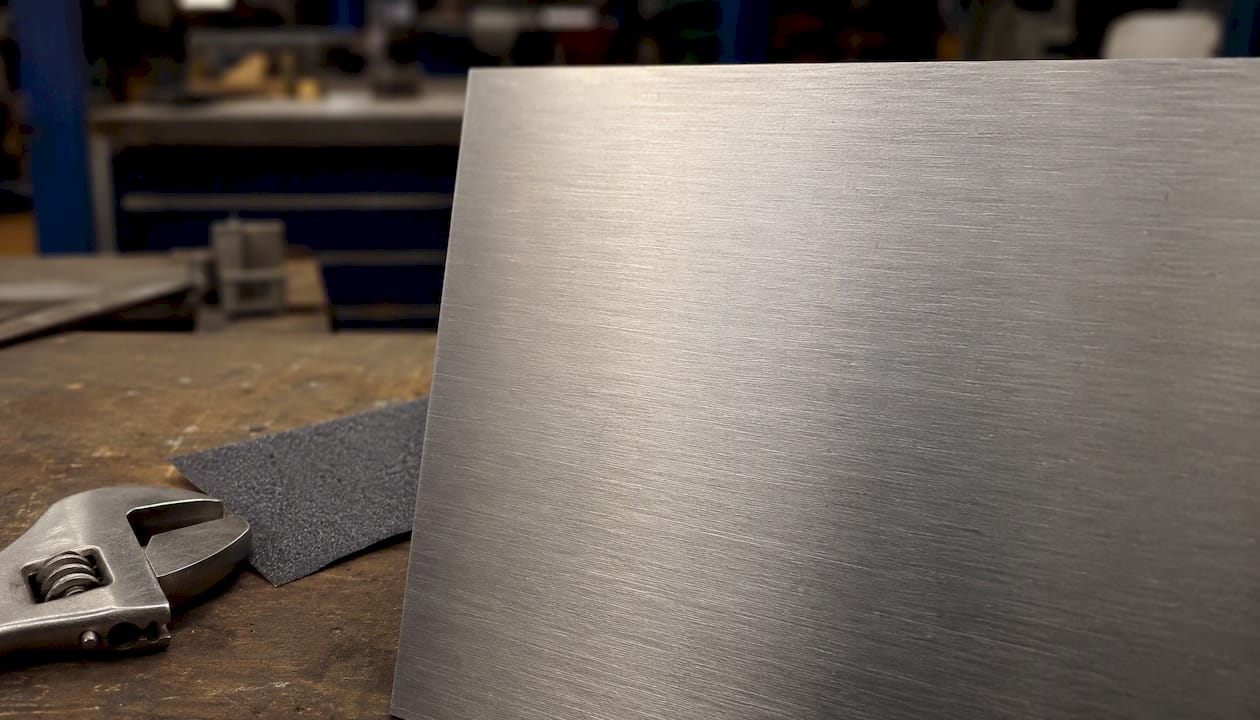
No.6, No.7, and No.8 represent progressively finer polishing steps. No.6 uses a Tampico brush with abrasive compound; No.7 is a high-lustre finish with some reflectivity but still visible polishing lines; No.8 (mirror) is produced by progressively finer mechanical polishing and buffing. A No.8 finish commonly achieves Ra ≤ 0.2–0.4 µm, making it suitable for pharmaceutical equipment and premium decorative applications where maximum reflectivity is required.
1K and 2K satin finishes are produced by cross-brushing or orbital finishing to create a non-directional texture. They are popular in contemporary architecture because they look consistent from any viewing angle, unlike directional No.4 which changes appearance as light shifts.
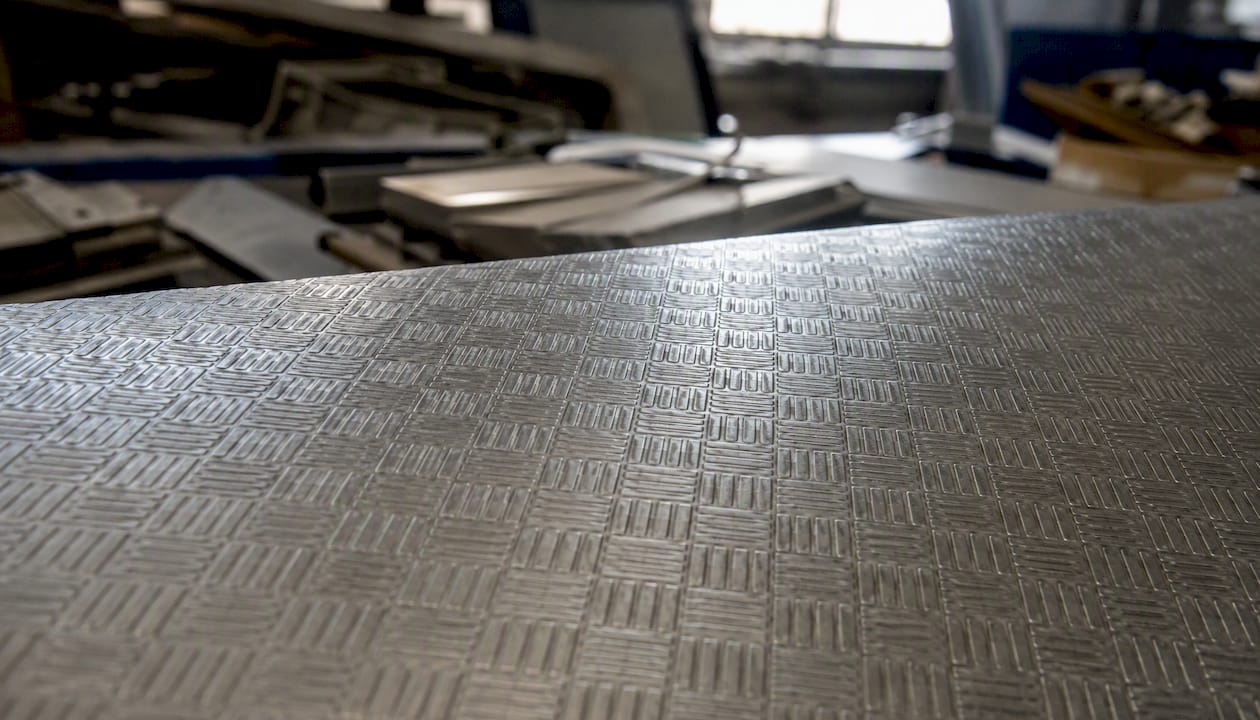
Patterned finishes (2M) are rolled with a textured roll to emboss a repeating pattern into the surface. Beyond aesthetics, patterned finishes stiffen thin-gauge cladding and reduce optical distortions such as oil-canning, often permitting thinner gauge use and lower system weight. Corrugated or traction finishes (2W) serve anti-slip applications on stairs and walkways, including custom metal staircases in commercial and industrial settings.
The directional vs. non-directional distinction matters for maintenance: directional finishes (No.4) should always be cleaned along the grain to avoid cross-scratching, while non-directional finishes (1K, 2K, bead-blasted) tolerate multi-directional wiping.
How are stainless steel finishes produced?
Understanding the production route helps you anticipate cost, lead time, and fabrication sequencing.
Mechanical polishing and grinding progress through abrasive grits: coarse grinding (60–80 grit) removes weld scale and deep scratches; intermediate passes (120–150 grit) approach a No.3 or No.4 result; fine polishing (240–320 grit and finer) reaches No.6 and No.7; buffing compounds on cloth wheels produce No.8. Each step must remove the scratch pattern from the previous one, so skipping grits costs time rather than saving it.
Electropolishing works by immersing the component in an electrolytic bath and removing surface peaks electrochemically, leaving a smoother, more passive surface. It improves cleanability and corrosion resistance, aids passivation, and removes embedded surface inclusions. ISO 15730 covers electropolishing guidance and is the standard to reference when specifying it for medical or pharmaceutical equipment. Critically, electropolishing works on complex geometries and internal passageways where mechanical polishing cannot reach.
Bead blasting uses glass beads or ceramic media to produce a uniform, non-directional, low-reflective surface. It is popular for architectural panels and equipment housings. One important caution: never use iron shot on stainless steel. Iron contamination embeds in the surface and causes rust spots that look like the stainless itself is corroding. Bead blasting can also alter surface stress and work hardening, so specialist finishers and relevant standards should be consulted for structural components.
Passivation (typically nitric or citric acid treatment) removes free iron from the surface and strengthens the chromium oxide passive layer. It is not a finishing process in the aesthetic sense but is often specified after mechanical finishing or welding to restore corrosion resistance.
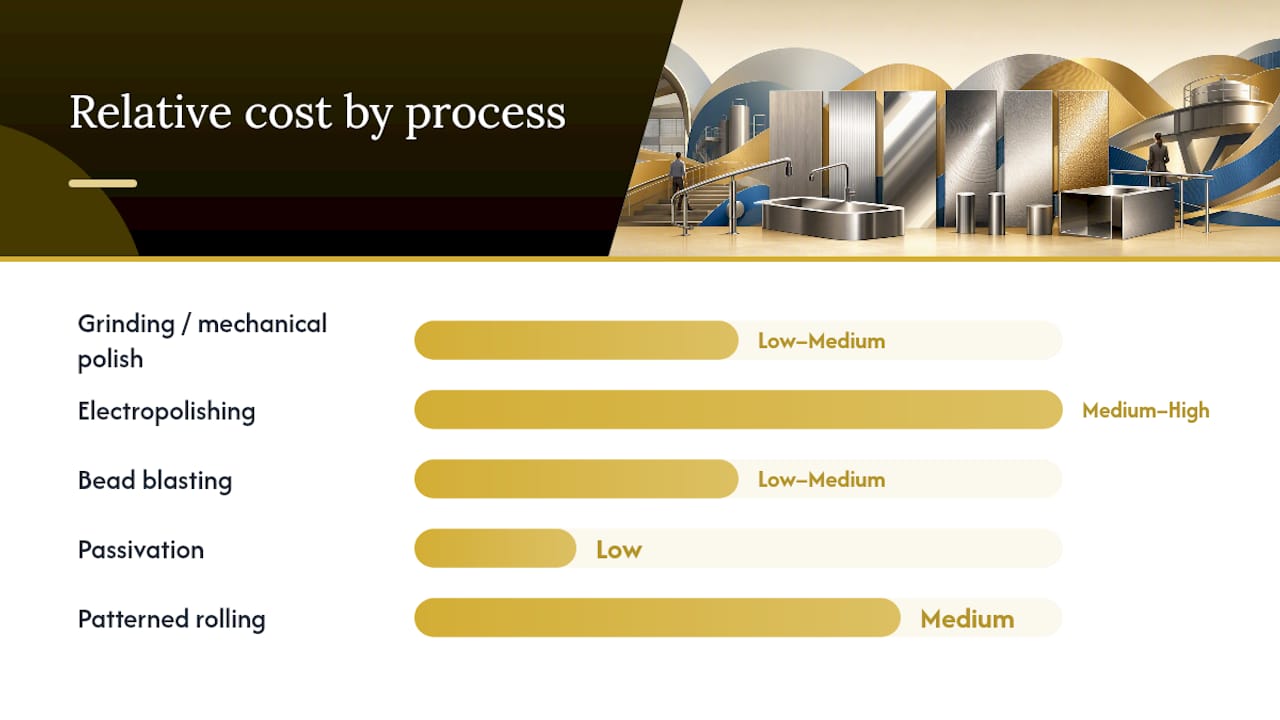
| Process | Appearance | Ra effect | Hygiene | Fabrication risk | Relative cost |
|---|---|---|---|---|---|
| Grinding / mechanical polish | Directional grain | Reduces Ra progressively | Good at fine grits | Low if done post-weld | Low–Medium |
| Electropolishing | Bright, non-directional | Reduces Ra by removing peaks | Excellent | Requires post-fab sequencing | Medium–High |
| Bead blasting | Matte, non-directional | Increases Ra slightly | Moderate | Iron contamination risk | Low–Medium |
| Passivation | No visual change | No change | Improves corrosion resistance | Low | Low |
| Patterned rolling | Textured, repeating | Defined by roll | Moderate | Forming only | Medium |
Pro Tip: For components that require both welding and a fine cosmetic finish, fabricate and weld in 2B mill finish first, then apply the final polish or electropolish after all hot work is complete. Protecting a polished surface through heavy fabrication is expensive and rarely successful.
What Ra value should you specify, and why does it matter?
Ra (arithmetic mean roughness) is the single most useful measurable parameter for finish acceptance. It quantifies the average deviation of the surface profile from a mean line, measured in micrometres (µm). A lower Ra means a smoother surface, which translates directly to fewer crevices for bacteria or corrosive media to accumulate.
Typical Ra ranges by finish:
- 2B mill finish: Ra 0.1–0.5 µm
- No.4 brushed: Ra 0.2–0.8 µm
- mirror: Ra ≤ 0.2–0.4 µm
- Electropolished: Ra typically ≤ 0.5 µm, often lower depending on starting surface
For hygienic applications, food and beverage installations target Ra ≤ 0.8 µm while pharmaceutical and bioprocessing systems often require Ra ≤ 0.5 µm. These thresholds are not arbitrary: surfaces rougher than 0.8 µm harbour biofilm that standard cleaning-in-place (CIP) protocols cannot reliably remove.
Practical acceptance language for a specification document should include:
- Maximum Ra value (e.g., Ra ≤ 0.5 µm)
- Measurement standard and instrument type (e.g., contact profilometer per ISO 4287)
- Measurement locations and number of readings per component
- Reporting requirement (certificate with readings, or third-party inspection)
- Disposition for non-conforming surfaces (rework, reject, or concession)
Ra alone does not capture everything. Rz (mean peak-to-valley height) is sometimes specified alongside Ra for hygienic applications because a surface can have a low Ra average but still contain isolated deep valleys that trap contamination.
How does finish choice affect corrosion resistance, hygiene, and durability?
Finish is not just cosmetic. The surface condition affects how stainless steel performs in service, sometimes dramatically.
Smoother finishes have fewer surface defects where chloride ions can concentrate and initiate pitting corrosion. In marine or coastal environments, a No.4 or finer finish on grade 316 performs measurably better than a 2D mill finish on the same grade. Electropolishing goes further by removing the surface layer entirely and leaving a chromium-enriched passive film.
The trade-off with mirror finishes is visibility. A No.8 surface shows every fingerprint, scratch, and weld repair. Restoring a mirror finish after field welding requires the full grit progression from scratch, which is expensive and time-consuming on an installed component. Brushed No.4 finishes hide wear and minor scratches far better, and a light re-brush with the correct grit pad can blend most field damage invisibly.
For outdoor applications in Canada, the combination of road salt, freeze-thaw cycling, and industrial pollution creates a demanding environment:
- Urban or coastal exposure: grade 316 with No.4 or finer finish; avoid 304 in direct salt spray zones.
- Industrial or chemical exposure: consider 2205 duplex or 316L with electropolished finish.
- Sheltered architectural cladding: 304 with 2B or No.4 is generally adequate in most Canadian cities.
Bead-blasted surfaces, while attractive, have slightly higher Ra than a polished surface and can trap particulate in outdoor settings. Regular cleaning is more critical for bead-blasted panels than for brushed or polished ones.
How to write an unambiguous finish specification for Canadian projects
Vague finish specifications cause the most common disputes between specifiers and fabricators. “Brushed stainless” is not a specification. Here is a practical procurement checklist:
- Select the base mill finish: specify 2B for most applications; 2R/BA if the final finish is No.8 or electropolished.
- Define the post-mill process: reference BS EN 10088-2 finish code (e.g., 1G, 1J, 2J) or ASTM A480 designation, plus the process (mechanical polish, electropolish, bead blast).
- Set a measurable Ra acceptance limit: state the maximum Ra in µm, the measurement method, and the number of test locations per piece.
- Produce and sign off a physical swatch: exchange a signed reference sample with the fabricator before production begins. Outokumpu’s guidance specifically recommends agreeing written polishing specifications and signed swatches to avoid batch variation.
- Specify grain direction: for directional finishes, state whether grain runs vertically, horizontally, or follows the long axis of the component.
- Include inspection and MTC requirements: state whether a Mill Test Certificate (MTC) is required, whether third-party inspection applies, and the acceptable percentage of surface area with minor variations.
- Define handling and protection: specify whether protective film is required and when it is to be removed.
For electropolishing, reference ISO 15730 alongside your Ra target. For flat product finishes generally, BS EN 10088-2 is the primary reference; ASTM A480 covers the same ground for North American supply chains. Both are available through the Standards Council of Canada.
Cleaning and maintaining stainless steel finishes
The right cleaning method depends on the finish. Using the wrong one damages the passive layer or scratches the surface permanently.
Mirror (No.8) finishes:
- Clean with a soft microfibre cloth and a mild detergent or dedicated stainless cleaner.
- Rinse thoroughly and dry to prevent water spotting.
- Never use abrasive pads, steel wool, or chloride-based bleach. Chlorides attack the passive layer and cause pitting.
Brushed (No.4) finishes:
- Wipe along the grain direction only. Cross-grain wiping leaves visible scratches that cannot be removed without re-brushing.
- For light soiling, warm water and a soft cloth suffice. For grease or fingerprints, a small amount of isopropyl alcohol or a pH-neutral cleaner works well.
- Avoid leaving carbon steel tools or wire brushes in contact with the surface. Iron contamination causes rust spots.
Mill finishes (2B, 2D) on structural or hidden components:
- These require less care but should be wiped down after installation to remove cutting oils, handling marks, and iron particles from fabrication.
- In food or pharmaceutical environments, even hidden surfaces should be passivated after fabrication.
After welding or heavy fabrication:
- Remove weld scale by pickling (nitric/hydrofluoric acid paste or gel) or mechanical grinding, followed by passivation.
- For hygienic installations, re-electropolish after all weld work is complete to restore the Ra target and passive layer.
Pro Tip: For high-hygiene installations, set a documented cleaning frequency and inspection schedule at commissioning. A surface that passes Ra acceptance at installation can degrade through improper cleaning over time. Periodic re-measurement is the only way to confirm it still meets the specification.
Which finish should you choose? A quick decision guide
| Application | Recommended finish | Production route | Typical Ra (µm) | Cost indicator | Fabrication note |
|---|---|---|---|---|---|
| Structural / hidden | 2B mill | Mill (cold roll + skin pass) | 0.1–0.5 | Low | Weld and form freely |
| Architectural cladding | No.4 brushed | Mechanical polish, 150–180 grit | 0.2–0.8 | Medium | Finish after forming; protect during transit |
| Kitchen / food prep | No.4 or electropolished | Mechanical or electrolytic | ≤ 0.8 | Medium | Passivate after welding |
| Pharmaceutical / bioprocess | Electropolished | Electrolytic (ISO 15730) | ≤ 0.5 | High | Finish post-fabrication; certify Ra |
| Decorative / premium | mirror | Progressive polish + buff | ≤ 0.2–0.4 | High | Avoid field welding; protect aggressively |
| Anti-slip / traction | 2W corrugated or patterned | Patterned rolling | Defined by pattern | Medium | Confirm slip rating with engineer |
Three quick selection examples:
- Kitchen bench (commercial): 2B base, mechanically polished to No.4, Ra ≤ 0.8 µm, passivated. Grade 304 for dry areas, 316 near dishwashers or salt.
- Exterior cladding, Montreal urban environment: 2B base, No.4 brushed, grade 316, protective film during installation. Agree grain direction in writing before fabrication.
- Pharmaceutical tank: 2R base, electropolished to Ra ≤ 0.5 µm per ISO 15730, MTC and Ra certificate required, no field welding after finishing.
What to ask your Canadian fabricator before signing off on a finish
Getting the finish right starts with the right conversation before any steel is cut. Here is a practical checklist for specifiers and purchasing managers working with local fabricators.
Questions to ask:
- Can you produce (or subcontract) the specified finish, and do you have Ra measurement capability in-house?
- What is your process for controlling batch-to-batch consistency on brushed or polished finishes?
- Do you retain signed swatch samples and written polishing specifications for each project?
- How do you handle weld-affected zones on a polished component? Can you blend and re-polish to match?
- What protective film and packaging do you use for finished components during transit and on-site storage?
Sample handoff and sign-off process:
- Fabricator produces a sample panel or offcut in the specified finish.
- Specifier and fabricator inspect the sample together and agree it matches the swatch.
- Both parties sign the swatch and retain a copy. The signed swatch becomes the acceptance standard for the production run.
- Ra is measured on the sample and recorded. That reading sets the acceptance floor.
- Production components are inspected against the signed swatch and Ra record at delivery.
On-site considerations:
- Keep protective film on finished surfaces until the last possible moment before handover.
- Never drag finished panels across concrete or steel surfaces. Even a brief contact leaves scratches that require re-polishing.
- If field welding is unavoidable on a polished component, mask adjacent finished areas with heat-resistant tape and plan for post-weld blending.
Pro Tip: The most cost-effective sequence for complex fabricated components is always: cut and form in mill finish, weld, clean welds, then apply the final cosmetic or hygienic finish. Sheet bending and rolling in 2B before polishing protects your finishing investment and avoids expensive rework on damaged polished surfaces.
Why precise finish specifications matter more than most people think
Most finish disputes I have seen come down to one thing: a specifier who wrote “brushed stainless” and a fabricator who delivered exactly that, just not the brushed stainless the specifier had in mind. The grain was too coarse, or the Ra was 1.2 µm when the hygienic requirement was 0.8 µm, or the grain ran horizontally on a vertical panel. All of it technically “brushed stainless.”
The swatch-plus-Ra approach is not bureaucratic overhead. It is the only way to make a subjective visual target into something both parties can agree on before money changes hands. A signed physical sample costs almost nothing to produce. Reworking a production run of cladding panels or re-electropolishing a pharmaceutical vessel after delivery costs a great deal more.
The selection rule holds across every project type: finish where it matters, specify it measurably, and protect it through fabrication. Everything else is detail.
Manaracorp’s stainless fabrication services in Greater Montreal
Manaracorp fabricates custom stainless steel components from its shop in Lachine, Quebec, serving the island of Montreal, Laval, the South Shore, and the West Island. The practical advantage of a local fabricator is straightforward: swatch sign-offs happen in person, rework turnaround is measured in days rather than weeks, and on-site welding and installation are handled by the same team that built the component.
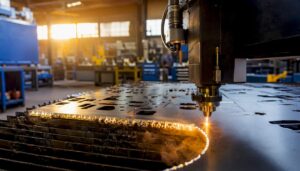
Services directly relevant to finish selection include CNC laser cutting (clean edges that require minimal post-cut dressing), sheet bending and rolling in mill finish before final polishing, profile rolling, and welding of stainless steel, aluminum, steel, and copper. Manaracorp fabricates custom railings, stairs, fences, and HVAC ductwork for architects, contractors, industrial manufacturers, and homeowners.
To discuss finish requirements, request a sample sign-off, or get a quote for a stainless fabrication project in Greater Montreal, contact Manaracorp directly through the website.
Authoritative standards and supplier resources
Specifiers working on Canadian projects should keep these references on hand:
- BS EN 10088-2 (Table 6): the primary standard for flat stainless steel product finishes; defines mill and special finish codes with guide Ra values. Available through the Standards Council of Canada (SCC).
- ASTM A480: the North American parallel for flat-rolled stainless; widely used in Canadian procurement and fabrication contracts.
- ISO 15730: covers electropolishing of metallic materials; the reference to cite when specifying electropolished finishes for medical, pharmaceutical, or food equipment.
- WorldStainless (worldstainless.org): publishes free technical modules on surface treatment and finishing, including Ra guidance and process descriptions.
- Outokumpu surface finishes brochure: documents a broad range of mill and proprietary finishes with Ra examples and procurement guidance; available from Outokumpu’s website.
- Metal Supermarkets (Canada): a practical Canadian supplier reference for standard mill finishes and cut-to-size stainless; useful for confirming available supply conditions and lead times.
Retain MTCs and signed swatch samples as part of your contract documentation. If a finish dispute arises after delivery, these are the documents that resolve it.
Sources
- World Stainless — surface treatment overview
- Specifying finishes for stainless steel flat products (sheet and plate) — BSSA
- Stainless steel surface finishes explained — DraMetal blog
- Outokumpu — surface finishes brochure
- Comprehensive guide to stainless steel surface finishes — Mill Steel
FAQ
What are the different finishes available for stainless steel?
Stainless steel finishes range from mill conditions (2D, 2B, 2R/BA) through mechanically polished finishes (No.4 brushed, No.6, No.7, mirror) to electrolytic finishes (electropolished) and patterned or bead-blasted surfaces. BS EN 10088-2 and ASTM A480 define the standard designations.
What is the difference between a 2B and a No.4 finish?
2B is a mill finish produced by a light cold-roll skin pass, with a typical Ra of 0.1–0.5 µm and a smooth, slightly reflective appearance. No.4 is a mechanically brushed finish produced by belt grinding at 150–180 grit, with a visible directional grain and Ra typically in the 0.2–0.8 µm range; it is the standard choice for architectural and kitchen applications.
What does “304 2B finish” mean?
It means the sheet is made from grade 304 stainless steel and supplied in the 2B mill condition: cold rolled, annealed, pickled, and given a final light skin-pass roll. It is the most common supply condition for general fabrication in Canada.
What is a No.4 finish on stainless steel?
No.4 is a unidirectional brushed finish produced by mechanical abrasive polishing, typically with 150–180 grit belts or pads. It is the standard architectural and food-equipment finish, recognisable by its fine parallel grain lines.
Which stainless finish is best for outdoor use in Canada?
For urban or coastal Canadian environments, grade 316 with a No.4 or finer finish is the standard recommendation. The smoother surface reduces crevice sites for chloride attack, and 316’s molybdenum content provides additional resistance to road salt and marine exposure.