There is no single maximum thickness for plate rolling. The thickness you can roll depends on the plate width, the diameter you need, the steel grade and its real yield strength, and the machine’s configuration. A published figure such as “1/2 in” is a rating under stated conditions, and your part may sit outside those conditions. This guide explains how to read those ratings and what a fabricator needs from you to confirm that a given plate can be rolled to a given radius. It is written for contractors, engineers, architects and manufacturers in Greater Montreal.
TL;DR
- A capacity rating is conditional. It names a thickness for a given width, material strength and finished diameter, and changes when any of those change.
- Pre-bending the plate edges is rated lower than ordinary rolling, so the ends of a cylinder are the limiting factor.
- Tight diameters, wide plates, high-strength grades and cones all reduce the thickness a machine can handle.
- Send the drawing, the grade with its mill certificate, the width, the inside or outside diameter and the quantity. That is enough for a shop to assess feasibility.
- Plate rolled in Greater Montreal can be fabricated and installed by one local team, which keeps the questions about fit short.
Table of Contents
- What “maximum thickness” really means
- Rolling capacity versus pre-bending capacity
- Diameter changes the answer
- Width matters as much as thickness
- Steel grade and real yield strength
- Cones, configuration and technique
- Our perspective
- What to send a shop to assess your plate
- Thin plate, sheet and where plate rolling ends
- Rolled metal in railings and stairs
- Work with us in Greater Montreal
- FAQ
- Sources
What “maximum thickness” really means
When machine suppliers list plate rolls, they list a range. One Canadian supplier shows Akyapak models covering thicknesses from 2 mm to 200 mm, and heavier models from 85 mm to 260 mm, depending on the model. That tells you the industry spans very thin to very heavy plate. It does not tell you whether your 12 mm plate can be rolled to a 300 mm diameter.
The reason is that every rating is a package. A useful rating states the material it was calculated on, the working width, the thickness and the diameter condition. Rise Tek’s training guide makes this point and adds that rolling and prebending ratings may differ. A buying guide from RMT treats the number the same way: width, diameter, material chemistry and ductility must accompany the thickness figure.
In practice, read a rating as a sentence, not a number. “10 ft × 1/2 in” means a machine with a 10-foot working width that is rated to 1/2 in plate, in a stated grade, to a stated diameter, usually with several passes. Change a word in that sentence and the answer changes.
Rolling capacity versus pre-bending capacity
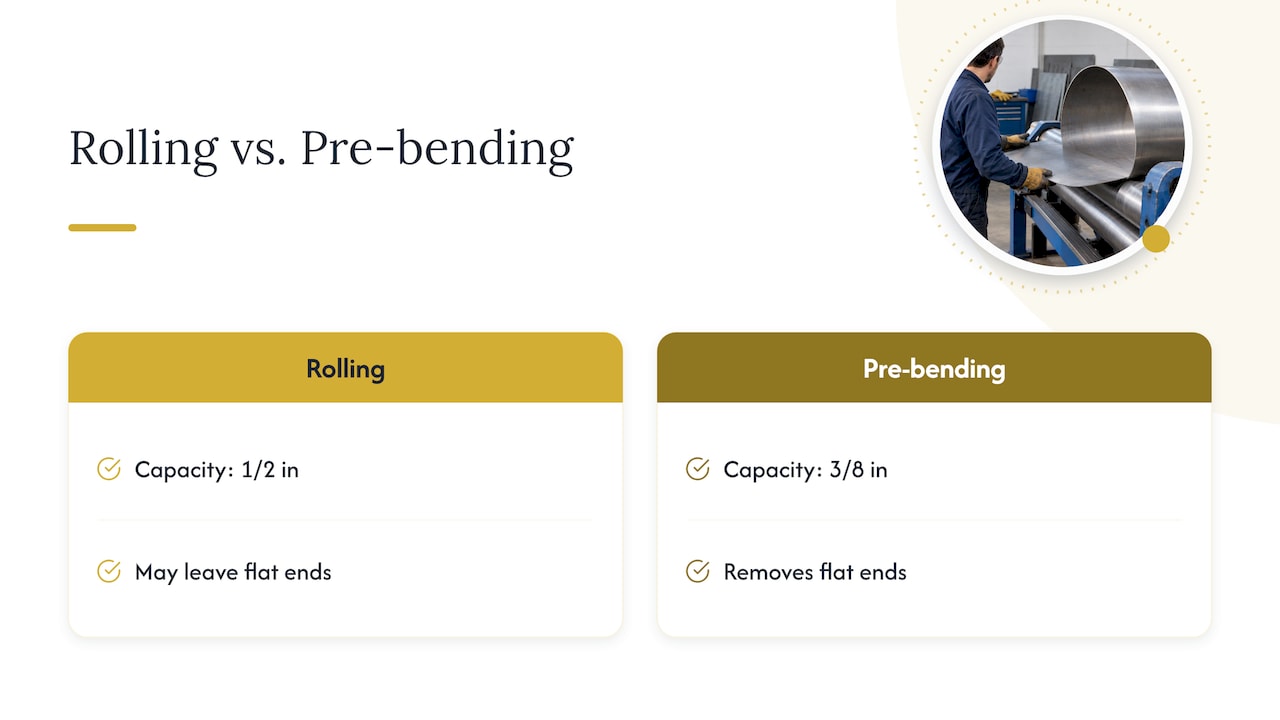
A plate that goes through the rolls does not curve all the way to its edges. The leading and trailing ends stay flat unless you pre-bend them, and pre-bending needs more force because it concentrates load on one side of the machine.
That is why a rating is often given twice. Garant Machinery’s 2023 guide explains that a 10 ft × 1/2 in rating commonly means 1/2 in rolling capacity and 3/8 in pre-rolling capacity. RMT says the same: prebending capacity is lower, and it must be considered because prebending is what removes the flat sections at the cylinder ends. The GlenRoss rolling guide explains why: pre-bending the edges takes more power, so its rating is lower than the ordinary rolling rating.
For your project, this means a closed cylinder or a ring with no flat spots is governed by the lower number. If the part is a curved panel where a flat tail is acceptable or will be trimmed off, the higher rolling number may apply. Say which one you need when you ask for a quote.
The unbent flat at the ends
Even with pre-bending, a plate cannot be bent perfectly to its edge. The same GlenRoss guide notes that an unbent flat of at least about 1.5 times the thickness remains, and often 2.5 to 3.5 times the thickness for heavier plate.
A quick example: on a 10 mm plate, an unbent flat of 15 mm is the best case, and 25 to 35 mm is plausible in heavier work. If your drawing needs a true circle, plan to leave extra length that is trimmed after rolling, or to have the ends handled in a second operation. This is a detail to settle at the drawing stage, not at the shop floor.

Diameter changes the answer
The tighter the curve, the more load the machine needs. That is why capacity is often listed at several finished diameters rather than one.
RMT gives an example: a 4 ft machine with a 6 in top roll might roll 1/4 in plate at three times the top-roll diameter, 5/16 in plate at five times, but only 3/16 in plate at 1.5 times. Read that carefully. The same machine handles plate of three different thicknesses depending on how tight the part is.
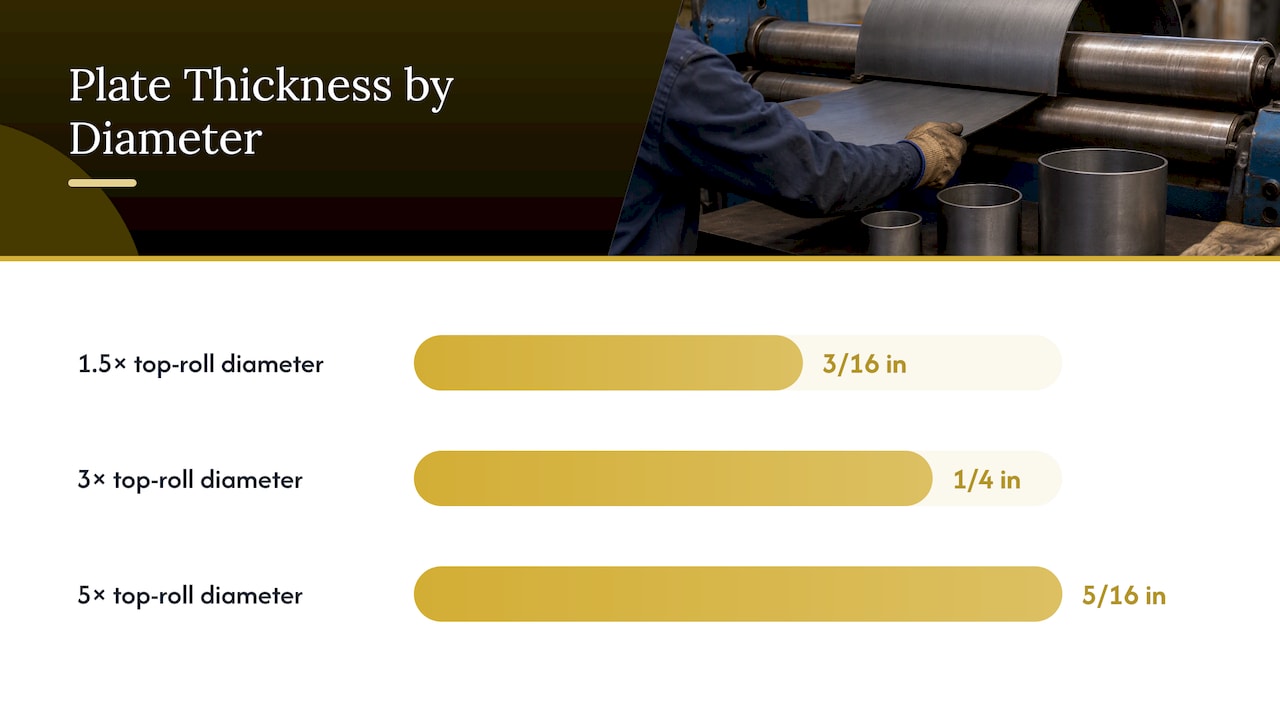
There is also a trap in the multiple itself. Garant Machinery warns that manufacturers may define capacity at three or five times the upper-roll diameter. A 10 ft × 1/2 in machine with an 11 in top roll could therefore be rated for a 33 in or a 55 in diameter, depending on the manufacturer’s criterion. Two machines with the same headline rating may not be equal.
And there is no shortcut. Rise Tek says minimum diameter cannot be safely derived from a universal multiple of the top-roll diameter. The approved capacity must be checked against the material grade, thickness, width and the inside or outside diameter you require.
| Factor you change | What usually happens to the thickness that can be rolled |
|---|---|
| Tighter finished diameter | Lower thickness capacity |
| Wider plate | Lower thickness capacity at the same machine |
| Narrower plate | Thicker material can be bent |
| Higher yield strength | Lower thickness capacity |
| Pre-bending the edges | Lower than the ordinary rolling rating |
| Cone instead of cylinder | Substantially lower capacity |
Width matters as much as thickness
Width works against thickness. The plate roller capacity guide states that the maximum bending width is the width at maximum thickness, and that as the plate becomes narrower, the rolls can bend thicker material. Longer rolls also need a larger roll diameter to resist deflection.
For a buyer, the takeaway is simple. A strip 300 mm wide and a sheet 2.4 m wide are different jobs even in the same thickness. If your design lets you split a wide panel into narrower sections joined by welding, it may open up thickness or diameter options. That trade-off is worth discussing before the drawing is final. Our welding page describes the joining side of that conversation.
Steel grade and real yield strength
Thickness figures are calculated on a reference material, and your steel may not match it. RMT notes that more ductile metals generally need less load, while higher-yield or higher-carbon materials may call for a more powerful machine.
The gap can be larger than people expect. The GlenRoss guide says many machines are rated around 36,000 to 38,000 psi yield, while steel that looks like ordinary mild steel may actually test at 48,000 to 58,000 psi. A machine’s nominal thickness therefore cannot be carried over to a stronger grade without a capacity table or a recalculation.
This is why the mill certificate matters. It records the actual yield of the plate you are buying, not the grade name on the invoice. If you are sourcing plate yourself, keep the certificate with the order. If you are asking a shop to supply the plate, ask which grade and yield are being quoted. For stainless steel, aluminum and copper, the same logic holds: the metal’s strength and ductility, not just its thickness, set what is feasible.
Cones, configuration and technique
A cylinder is the easy case. Cones taper, so one edge of the plate has to travel further than the other. Garant Machinery says cone rolling substantially reduces maximum forming capacity, and that four-roll, double-pinch machines can make cone rolling easier than other configurations.
So a plate you could roll into a cylinder may be too thick for a cone at the same diameter. If your part is a cone, a hopper, a transition or a segment, say so at the first request.
Sizing a machine, or checking a job against one, also involves factors beyond the table: roll diameter, machine type and operator proficiency. The GlenRoss guide recommends checking mill certificates and the manufacturer’s capacity-versus-yield tables rather than relying on a single headline figure.
Our perspective
Most rolling problems we see start with a drawing that gives a thickness and a radius but not the rest. A plate is never just a thickness. It is a grade, a width, a diameter, a tolerance and an end condition.
We fabricate and weld in-house in Lachine and install across Greater Montreal. That means the person who reviews your drawing is close to the person who rolls, welds and installs the piece. Questions about flats at the ends, a split seam or a tighter radius get answered before steel is cut, not after.
For us the right approach is to treat every capacity number as conditional, and to confirm the job against the actual material and geometry. Small jobs and large ones get the same questions. That is how we keep quality, code compliance and timelines under direct control.
Ash
What to send a shop to assess your plate
The question of whether a plate can be rolled to a specified thickness and radius comes down to a short list of inputs. The machine side of the answer is in a capacity table; your side is the following information.
- A drawing or sketch with the finished shape: cylinder, partial arc, cone or segment.
- Material and grade, with the mill certificate if you already have the plate. Yield strength is the number that counts.
- Thickness and plate width in the same unit throughout, metric or imperial.
- Inside or outside diameter, and which one controls. A railing curve or a tank shell may be dimensioned differently.
- End condition: whether flats are acceptable, whether the part must close into a full ring, and where the seam goes.
- Tolerance on diameter, roundness and fit-up with neighbouring parts.
- Quantity and timing, including whether this is a prototype or a production run.
- Finish and installation: painted, galvanized, brushed stainless, and whether the work is installed on site.
With those eight items, a fabricator can say yes, yes with changes, or suggest another process. For thin gauges and tubular or structural sections, the better route may be profile rolling versus forming, which is a different question from plate.
A worked reading of a rating
Suppose a supplier’s sheet says 10 ft × 1/2 in, with an 11 in top roll. Here is what that sentence implies, using the figures above.
- Rolling capacity is 1/2 in, and pre-rolling is commonly 3/8 in (Garant). A closed ring with no flats is closer to 3/8 in.
- Depending on the maker’s criterion, the rated diameter could be 33 in or 55 in.
- Both numbers assume the reference yield. A plate at 50,000 psi rather than 36,000 psi may not reach them.
- The 10 ft width is the width at maximum thickness. A narrower plate may do better.
So a 1/2 in plate to a 30 in diameter in a 50,000 psi grade is not a safe yes on the headline alone. It is a job to check against the table. That is the habit to build, whoever rolls your steel.
Thin plate, sheet and where plate rolling ends
Plate rolling is generally discussed for heavier material. One ranking article puts it at roughly 6 mm and up for plate, though the line between sheet and plate is a convention, not a law. Thinner material is handled as sheet bending and rolling, and its limits depend on the same variables: width, diameter, metal and tooling.
If your part is thin enough to be cut on a CNC laser and then formed, the sequence matters. Cutting first and rolling second affects where the flats fall and how the edges behave. Our laser cutting page and the guide to what drives laser cutting cost in Montreal explain the cutting side, so that the blank you cut is the blank you can roll.
Rolled metal in railings and stairs
In Greater Montreal, rolled metal shows up most often in curved railings, stair stringers, guards and architectural features. These are governed by building rules, so the rolling decision cannot be separated from the design. Quebec’s construction requirements follow the National Building Code framework (the CNB, as the Quebec chapter adopts it), and a guard’s strength and geometry are part of what an installer must satisfy. Our guide on architectural metal specifications for railings and stairs covers what to put on the drawing, and the guide to condo railing rules in Montreal is useful for owners and boards.
A curved guard also needs accurate site dimensions before anything is rolled. A radius that is off by a few millimetres shows at the wall. See what to record on site for railings before ordering curved work.
Work with us in Greater Montreal
Manara Corp. is a custom metal fabrication and welding shop in Lachine, Quebec. We do CNC laser cutting, sheet bending and rolling, profile rolling and welding of steel, stainless steel, aluminum and copper, and we make and install railings, stairs and fences across the island, Laval, the South Shore and the West Island. We serve contractors, architects, manufacturers, property managers and homeowners in French and English.
If you have a curved part and are unsure about thickness, send us the drawing and the details listed above. See our sheet bending and rolling services or profile rolling, or start from our main page to request a quote. We do not ship fabricated parts outside Greater Montreal.

Prices are set per project, so we do not publish a rate. The quote reflects the material, the geometry and whether installation is included.
FAQ
What is the maximum plate thickness that can be rolled?
There is no universal maximum. Machines range from a few millimetres to well over 200 mm, as one supplier’s range shows, but each rating depends on width, diameter and material strength. Your own job is confirmed against the machine’s capacity table for your exact grade and geometry.
Why is pre-bending capacity lower than rolling capacity?
Pre-bending the leading and trailing edges concentrates force on one side of the machine, so it takes more power than ordinary rolling. A common example is a 1/2 in rolling rating with a 3/8 in pre-rolling rating, according to Garant Machinery. Closed cylinders are governed by the lower figure.
Does a tighter radius mean thinner plate?
Generally yes. The tighter the finished diameter, the lower the thickness a given machine can roll. RMT’s example shows one machine rated for 3/16 in plate at 1.5 times the top-roll diameter and 5/16 in at five times. Always give the inside or outside diameter when you ask.
Can I use the same thickness for mild steel and high-strength steel?
Not safely without checking. Ratings are based on a reference yield strength, and steel sold as mild may test higher, as the GlenRoss guide explains. The mill certificate shows the real yield, and a capacity table or recalculation settles the thickness.
What should I send to get a rolling quote in Montreal?
Send a drawing, the material grade, thickness, plate width, the controlling diameter, the end condition, tolerances and quantity. If installation is needed, include the site address. With that, we can tell you whether the part is feasible as drawn or needs a change.
Sources
- Plate Rolls, AC Machinery Canada
- How to choose a plate rolling machine, Garant Machinery
- Plate Rolls & Angle Rolls: Training Guides, Rise Tek
- Plate Roll Buying Guide, RMT
- Guide to Plate Rolling, GlenRoss
- Pre bending and rolling capacities of the plate rolling machine