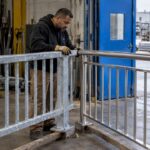
For most exterior stairs in Greater Montreal, the answer is hot-dip galvanized steel, with aluminum as the lighter alternative and stainless steel for specific architectural or food-service settings. The right pick depends on span, load, how much salt and moisture the stair sees, and the look you want. Finish, tread design and upkeep matter nearly as much as the metal itself.
This guide walks through each material, the conditions a Montreal stair has to survive, the finishes that protect it, and what the Quebec rules expect. It is written for homeowners, condo boards, contractors and architects who are specifying or replacing an outdoor stair.
TL;DR
- Galvanized steel is the strongest, most common choice for long runs, second-storey landings and heavy traffic. Quebec guidance calls for hot-dip galvanizing on steel exposed to the elements.
- Aluminum weighs about a third as much as steel and forms its own protective oxide layer. It suits short runs, porches and prefabricated installations.
- Stainless steel is a design choice, not a guarantee against corrosion. Grade, finish and rinsing all matter in salted winter conditions.
- Treads must be slip resistant under the Quebec code. Open or serrated treads shed snow and water better than smooth plate.
- Maintenance is simple: rinse off de-icing salt, inspect coatings, and touch up chips early.
Table of Contents
- What an exterior stair in Montreal has to survive
- Steel: the structural default
- Aluminum: light, self-protecting, more flexible
- Stainless steel: attractive, but grade and finish decide the result
- Material comparison at a glance
- Finishes and coatings: where durability is decided
- Tread design: grip matters as much as metal
- Quebec details that shape the design
- Maintenance that extends the life of an exterior stair
- A note from our shop floor
- Have us build your exterior stair
- FAQ
- Sources
What an exterior stair in Montreal has to survive
An outdoor stair in Montreal does not face one problem. It faces several, in sequence. Spring rain and snowmelt keep surfaces wet for weeks. Freeze-thaw cycles open small cracks in paint and coatings, and water sits in them. Winter adds de-icing salt, tracked onto treads by boots and splashed up by traffic. Summer sun then bakes the surface, which stresses coatings again.
So the question is not which metal is strongest on paper. It is which material, with which finish and which details, keeps its structure and its grip through twenty or thirty winters. Water traps, such as flat ledges, closed tubes with no drainage and tight joints, shorten the life of any material. Good fabrication avoids them before the first coat of finish goes on.
Steel: the structural default
Steel is the workhorse of exterior stairs. It is stiff, so stringers can be slim and spans can be long. It welds cleanly, which lets a fabricator build a stair as one rigid assembly rather than a kit of parts. It takes almost any shape: straight flights, L and U configurations, spiral and curved stairs made with profile rolling.
The catch is that bare carbon steel rusts outdoors, so the coating system is part of the material choice. Quebec’s own construction guidance for social housing projects states that all steel exposed to the elements must be hot-dip galvanized, according to the SHQ construction guide. That guide is written for a specific program, but it reflects a sensible standard for any exposed steel stair in this climate.
Steel is the right fit when:
- the stair is long or serves a second-storey or higher landing;
- traffic is heavy, as in a multi-unit building, a commercial entrance or an industrial access;
- you want a heavy, architectural look with thick plates and substantial stringers;
- you need the stair welded to an existing steel frame or embedded plates.
For a deeper comparison with its main rival, see our guide to steel versus aluminum stairs in Montreal weather.
Choosing the steel shape
Stringers and framing are usually built from plate, channel, angle or hollow structural sections. Each sheds water and takes coating differently. If you are weighing options, our note on HSS versus angle iron explains how the shape affects strength, appearance and how well the member drains.
Aluminum: light, self-protecting, more flexible
Aluminum forms a thin oxide layer that stops further corrosion on its own, so a scratch does not turn into a rust streak, as one outdoor stair material comparison explains. The same source notes that aluminum is more flexible than steel of the same size, so stringers are deeper and long spans need intermediate support.
That makes aluminum a good match for:
- short porch and entry stairs;
- stairs that must be lifted into place, since aluminum weighs roughly a third as much as steel;
- cases where a painted or powder-coated finish is wanted without a galvanizing step;
- locations near water, where its natural resistance helps.
One detail deserves attention. Aluminum should not sit directly against pressure-treated lumber or bare steel, because the copper in treated wood and contact between dissimilar metals can cause galvanic corrosion. Isolation pads or suitable stainless fasteners solve this, as the same comparison points out. On a renovation where an aluminum stair meets an old wood deck or steel anchor, this is worth planning at the drawing stage.

Stainless steel: attractive, but grade and finish decide the result
Stainless steel suits restaurants, retail entrances and contemporary homes where a clean, bright look matters. It is also easy to keep looking sharp with regular rinsing. But it is not stain-proof. A Construction Specifier article on stainless failures describes an exterior Type 304 stair assembly in a tropical ocean environment that showed widespread surface corrosion and pitting after only 10 years, and says Type 316 would probably have performed better in that severe exposure. The same piece stresses that the right alloy depends on exposure, finish, orientation and how often the surface is rinsed by rain or cleaned.
The lesson for Montreal is practical. Road salt and coastal air are different environments, but both are chloride-rich. Where a stainless stair will take salt spray, specify a grade suited to it, choose a finish that sheds contaminants, and plan to rinse it. Our comparison of brushed and mirror stainless finishes covers how finish changes both the look and the upkeep.
Material comparison at a glance
| Criterion | Hot-dip galvanized steel | Aluminum | Stainless steel |
|---|---|---|---|
| Stiffness and span | Highest, suits long runs | Lower, needs deeper stringers or support | High, similar to steel |
| Weight | Heaviest | About a third of steel | Heavy, similar to steel |
| Corrosion behaviour | Zinc coating protects the steel | Self-forming oxide layer | Depends on grade, finish and rinsing |
| Best uses | Long flights, upper landings, heavy traffic | Short stairs, porches, light installations | Architectural entrances, food-service and retail |
| Watch for | Chips in the coating, salt build-up | Contact with treated wood or bare steel | Chloride exposure, surface staining |
| Finish options | Galvanized alone or with paint or powder coat | Powder coat, anodized or mill finish | Brushed, mirror and other finishes |
Finishes and coatings: where durability is decided
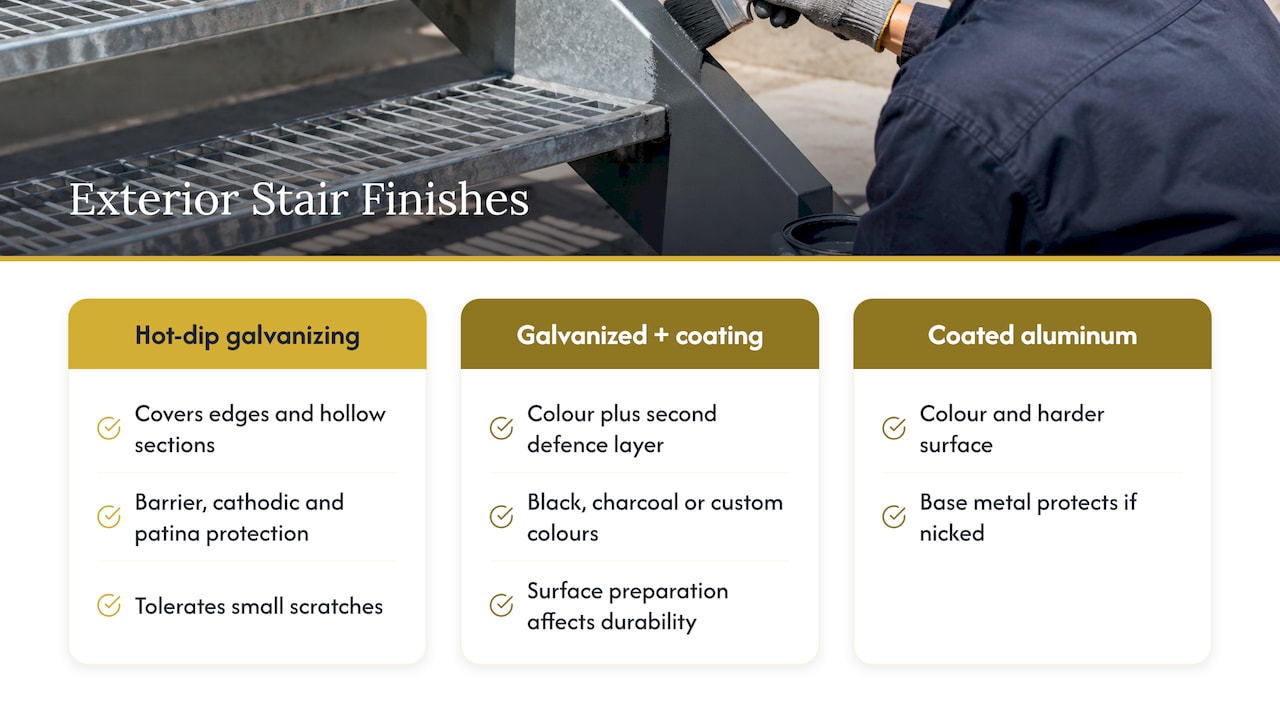
Two stairs built from the same steel can age very differently, depending on the coating. Three finish approaches cover most exterior work.
Hot-dip galvanizing. The steel is dipped in molten zinc, so the coating covers corners, edges and the inside of hollow sections. According to the American Galvanizers Association specifier’s guide, the coating protects in three ways: a barrier that isolates the steel from moisture, cathodic protection, and a zinc patina that forms on the surface over time. This is why galvanizing tolerates small scratches better than paint alone.
Galvanized plus paint or powder coat. A duplex system adds colour and a second layer of defence. It is a common choice for visible residential and commercial stairs where the owner wants a black, charcoal or custom colour. Surface preparation before coating is what makes it last, so it is worth asking how the fabricator prepares the galvanized surface.
Powder coat or anodizing on aluminum. These give colour and a harder surface. The metal still protects itself underneath if the coating is nicked.
For railings and guards attached to the stair, the same logic applies. Our guide to rust prevention for steel railings in Montreal goes deeper on coatings, drainage details and the points where rust usually starts.
Tread design: grip matters as much as metal
In Quebec, grip is a code matter, not only a comfort one. A guide to the 2020 Quebec edition of the National Building Code states that exterior stair wear surfaces must be anti-slip, or carry anti-slip bands, and gives the example that those bands must not exceed 1 mm, according to Plans et Architecture. Confirm the exact requirement for your project with the municipality or your architect, since it depends on the building type and the code edition that applies.
Metal needs thought here. A guide to deck stairs notes that metal stairs handle winter well and add a contemporary touch, but can be very slippery when wet, so extra caution is needed (ARGA). Design answers include:
- Serrated or grip-surface planks. One manufacturer’s product data describes a diamond-grip plank with serrated edges around diamond-shaped openings intended to provide slip resistance in snow and ice, offered in galvanized steel, aluminum and 316L stainless (AMICO product data). It shows the principle: open patterns let snow and water fall through rather than sit on the tread.
- Perforated or laser-cut treads. Slots and holes can be cut precisely with CNC laser cutting, then formed with a nosing for a visible edge.
- Folded checkered or grip-pattern plate. A formed tread built on sheet bending and rolling gives a solid surface with texture and a stiff profile.
- Visible nosings. A contrasting edge helps users see each step in snow or low light.
Smooth plate is the least forgiving choice outdoors. If a design calls for a clean, flat look, add texture or anti-slip strips rather than leaving it bare.
Quebec details that shape the design
The material is only part of a compliant stair. A few Quebec points come up often:
- Anti-slip surfaces. As above, exterior stair treads must resist slipping under the 2020 Quebec code edition cited by the guide.
- Drainage and location. The SHQ construction guide sets a drainage slope of at least 1:50 for balconies after differential settlement, and adds that no exterior stair should be placed in front of a bedroom window (SHQ guide). It is written for a specific program, so treat it as a design reference unless your project falls under it.
- Handrails and guards. Heights, graspable profiles and openings are governed by the Quebec Construction Code, based on the National Building Code (CNB). We summarize the grip diameter question in handrail diameter code in Montreal, and condo owners will find the rules for shared buildings in our condo railing guide.
- Worksite safety. Contractors installing stairs on site work under CNESST rules for fall protection and work at height.
The Quebec code and your municipality’s requirements apply to your specific project, so have the drawings checked against the current code edition before fabrication. An architect or an engineer can confirm what applies to a given building.
Maintenance that extends the life of an exterior stair
Most exterior metal stairs do not fail suddenly. They age where water and salt linger. A simple routine covers nearly every material.
- Rinse in spring. Wash off the winter’s salt residue with clean water and mild soap, paying attention to the underside of treads, the base of posts and the joints.
- Look at the coatings once a year. Check for chips, scratches and bubbling, especially at welds, edges and the bottom of stringers.
- Touch up early. A small chip dealt with this fall is a much smaller job than a rust patch in three years. Use a repair product compatible with the original coating.
- Mind the winter habits. Salt speeds corrosion on steel and on many finishes. Sand or traction grit is gentler on the metal, and a shovel before ice forms beats chemicals after.
- Keep drainage open. Clear leaves and debris from drain holes, tread slots and the places where the stair meets the ground.
- Isolate dissimilar metals. On any repair, keep aluminum away from bare steel or treated wood, as noted above.
These steps are routine for homeowners and condo boards, and they cost little compared with premature replacement.
A note from our shop floor
We build exterior stairs in Lachine and install them across Greater Montreal, so we see how these materials behave after real winters, not just in a catalogue.
Our view is simple. Choose the material for the job: galvanized steel for long runs, upper landings and heavy traffic; aluminum where weight and a light structure matter; stainless steel where the design and the setting call for it. Then put your effort into the details that decide durability: drainage, weld quality, surface preparation, coating and tread grip.
That is where in-house fabrication makes a difference. Because cutting, forming, welding and finishing all happen in our shop, and our own team installs the stair, one crew is accountable for the result from the first measurement to the last bolt. It lets us build to the code, keep the schedule honest, and handle small residential stairs and large commercial ones with the same care.
Ash
Have us build your exterior stair
Manara Corp. fabricates metal staircases and custom railings in steel, stainless steel, aluminum and copper. We cut, bend, roll and weld everything in-house in Lachine, and we install for homeowners, contractors, architects, property managers and commercial owners across the island of Montreal, Laval, the South Shore and the West Island. We work in French and in English.
To get an accurate quote, have the site dimensions ready. Our guide to site measurement for railings lists what to record, and our architectural metal specifications page helps architects and designers write the stair into their documents. You can reach us through manaracorp.com.
FAQ
What is the best material for exterior metal stairs in Montreal?
For most projects, hot-dip galvanized steel is the best starting point, especially for long runs, upper landings and heavy use. Aluminum is a good option for short, light installations, and stainless steel suits architectural settings with the right grade and finish. A site visit lets us match the material to your span, exposure and budget.
Does galvanized steel need to be painted?
Not necessarily. Galvanizing protects the steel by itself through a zinc barrier and a developing patina. Painting or powder coating over it adds colour and an extra layer of protection, which many owners choose for visible stairs. The coating system should be agreed on before fabrication.
Will aluminum stairs rust?
Aluminum does not rust the way steel does, because it forms a thin oxide layer that protects the surface. It can still suffer galvanic corrosion if it touches pressure-treated lumber or bare steel, so isolation pads or suitable fasteners are needed at those contact points.
How do I make a metal stair less slippery in winter?
Start with the tread: serrated, perforated or grip-pattern surfaces shed snow and water better than smooth plate, and the Quebec code requires anti-slip exterior wear surfaces. Add visible nosings, keep the stair shovelled, and use sand rather than salt on steel.
Can Manara build and install a stair outside Greater Montreal?
Our fabrication and installation work is local to Greater Montreal: the island, Laval, the South Shore and the West Island. We do not ship fabricated parts outside the area.
Sources
- Outdoor Metal Stairs: Steel vs Aluminum Steps
- Stain-less is not stain-zero, The Construction Specifier
- SHQ AccèsLogis construction guide, annex 5
- Hot-dip galvanizing for corrosion protection: a specifier’s guide
- Norme escalier extérieur au Québec : guide CNB 2020
- Deck Stairs: A Guide to Materials, Costs, and Standards
- Safety Grating Product Data