Profile rolling curves a finished section (a bar, tube, angle or channel) into an arc, ring or spiral. Forming, in the sense most people mean, bends flat sheet or strip into a shape with folds. Roll forming is the high-volume version of that, and press brake forming is the low-volume version. If your part is curved along its length, such as a railing, a ring or a curved beam, you want profile rolling. If it is a long, straight part with a repeating cross-section, such as a channel or a rail, you are looking at forming. This guide explains how to tell which one you need, what each costs you in setup and tooling, and what to check before a Greater Montreal job goes to a shop.
TL;DR
- Profile rolling (also called section bending or angle rolling) curves an existing profile along its length. It suits custom curves, one-offs and small batches.
- Roll forming turns a coil into a constant cross-section through a series of roll stations. It pays off only at high volumes, because each profile needs its own tooling.
- Press brake forming makes folded parts from sheet with standard tooling, which makes it the usual choice for short runs and varied parts.
- Most real projects, including railings and stairs, combine two or three of these processes with cutting and welding.
- In Quebec, curved guards and stairs still have to meet the Construction Code, so confirm opening sizes and heights before the shape is fixed.
Table of Contents
- What the two terms actually mean
- Profile rolling vs roll forming at a glance
- When profile rolling is the right call
- When roll forming or sheet forming wins
- The hidden costs people miss
- A worked example: a curved exterior stair guard
- Quebec codes shape the geometry
- How to choose: five questions
- Our perspective
- Working with Manara Corp
- FAQ
- Sources
What the two terms actually mean
People use “forming” loosely, and the confusion is the reason this keyword exists. Three different operations hide behind the words.
Profile rolling takes a section that already has its shape, such as flat bar, square tube, round pipe, angle or channel, and passes it between rollers. Section bending, also called angle rolling or profile bending, is a cold-forming process that curves the profile along its length by feeding it between three rolls. The cross-section stays what it was. Only the path changes: the part becomes an arc, a full ring or a spiral.
Roll forming starts from a flat strip or coil. The strip is shaped incrementally by a series of rolls in a continuous process, and it comes out with a constant cross-section, such as a U-profile rail, a building frame member or a tube. The length is straight, and it can be very long.
Press brake forming (sheet bending) folds flat blanks along straight lines using a punch and a die. It makes brackets, enclosures, trays, channels and cladding pieces. Stainless producers group these methods together: bending and roll bending, spinning, roll forming and press forming are all described as different ways of shaping the same material, each suited to a different geometry.
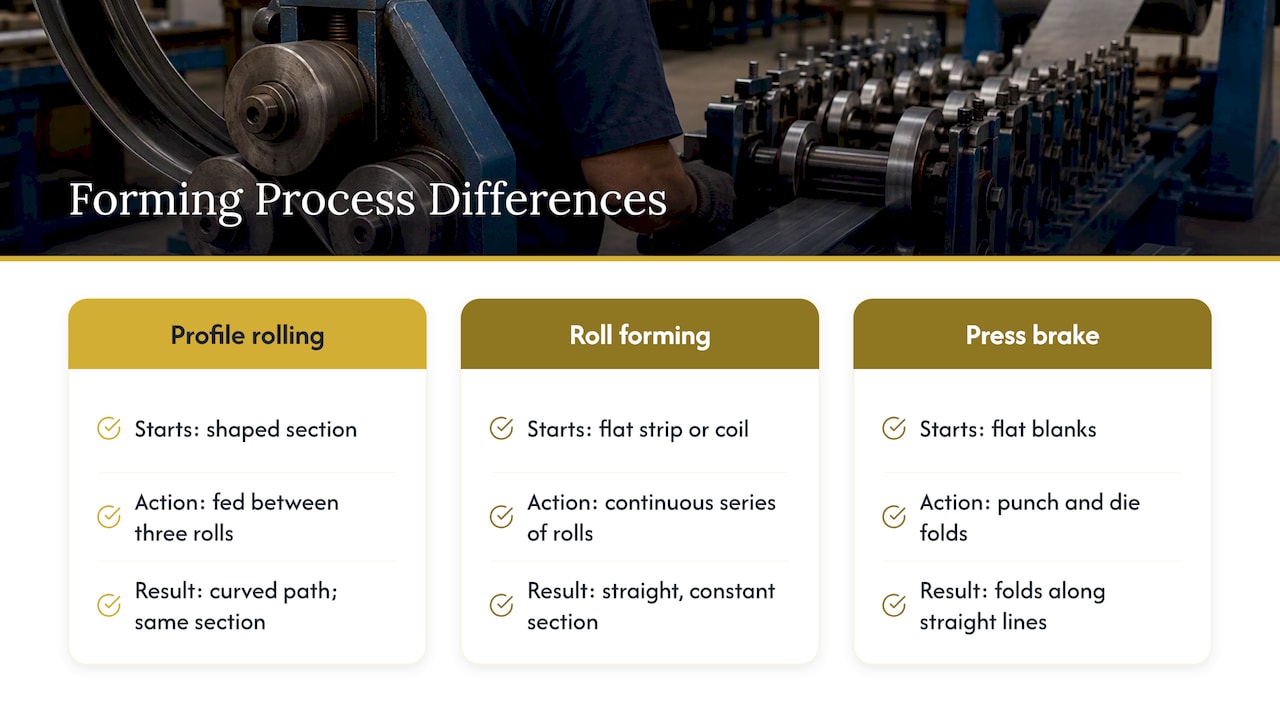
So the honest comparison is not two processes but a question: does your part need a curve along its length, a repeating profile along its length, or folds in a flat piece?
Profile rolling vs roll forming at a glance
| Criterion | Profile rolling | Roll forming | Press brake forming |
|---|---|---|---|
| Starting material | Finished bar, tube, angle, channel | Flat coil or strip | Flat sheet blank |
| What changes | The path of the part (arcs, rings, spirals) | The cross-section (folds along the length) | Straight fold lines |
| Typical result | Curved railings, rings, arches, curved frames | Long straight profiles | Brackets, panels, enclosures, channels |
| Tooling | Roll sets, adaptable to many sizes | Dedicated roll stations per profile | Standard punches and dies |
| Best volume | One-offs to small batches | High volume, long runs | One-offs to medium batches |
| Design flexibility | High: radius changes between jobs | Low once tooling is built | High |
When profile rolling is the right call
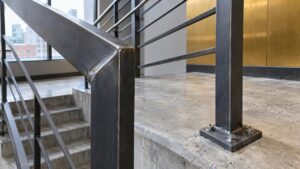
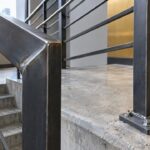
Choose profile rolling when the part is curved and the section is something you can buy off the shelf. Architectural metalwork is the classic case. Section bending is the primary technique for curved structural elements, including custom curved railings. A curved handrail on a commercial staircase, a round guard around a mezzanine opening, a ring for a planter or a rolled steel arch over a restaurant entrance all fit.
Three practical reasons make it a good fit for small and custom work:
- No dedicated tooling per profile. The same roll machine handles different radii and different sections, so changing the job means changing the setup, not building new rolls.
- The section keeps its strength. You start with a structural profile and keep it. You are not folding it up from sheet.
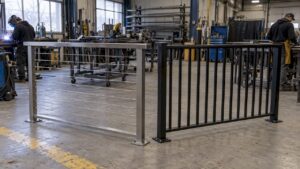
- It pairs naturally with welding. Rolled sections are cut to length, joined and finished, which is how most railings and stair stringers come together.
The trade-off is skill. There is a difference between simply rolling and the work of a master bender: managing twists, scrolls and multiple-radius bends without damaging the material. The same source notes that projects often go wrong because designers underestimate how hard a precise radius is, which is why fabricators prefer an early design review.
We do this work in-house in Lachine. If you have a curved section to produce, see our profile rolling service, or read how we handle fast industrial profile rolling quotes for contractors.
When roll forming or sheet forming wins
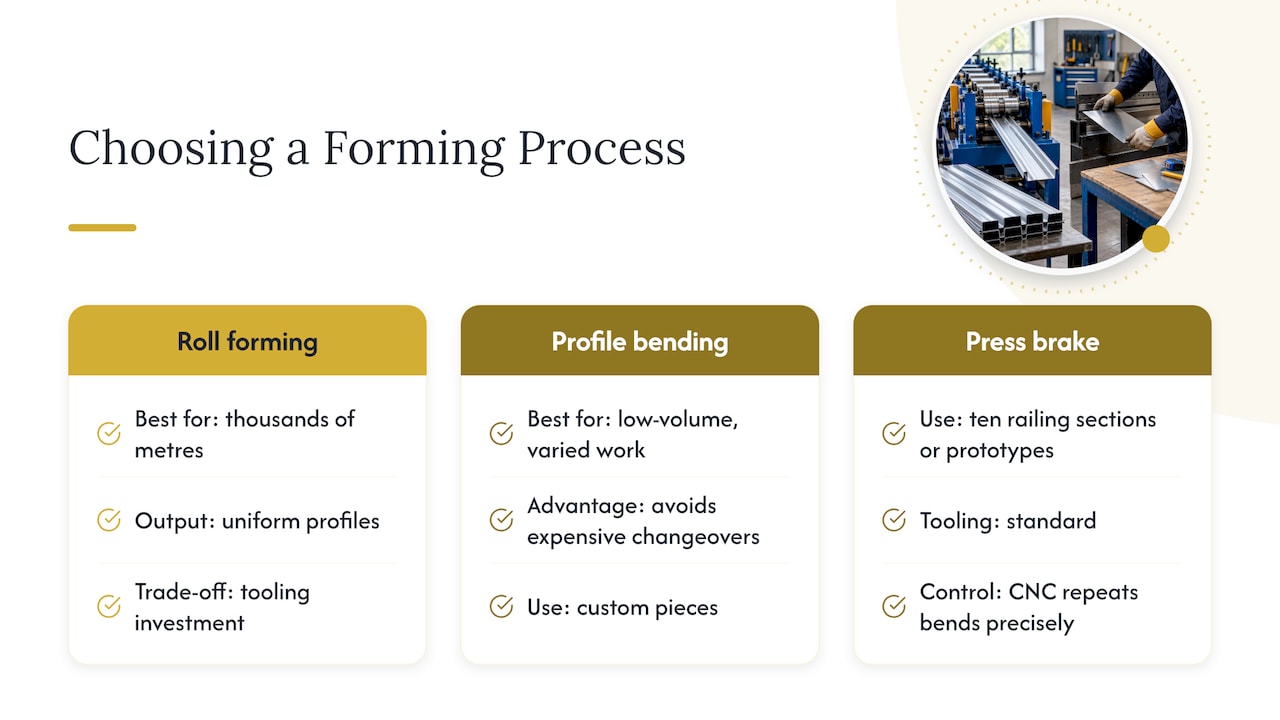
Roll forming earns its place when you need thousands of metres of the same shape. It is favoured for high-speed, mass production of uniform profiles, such as U-profile rails, building frames and tubes. Each roll station adds a little more of the bend, so the material is never asked to do too much at once.
The catch is economics. A Swedish cost-model thesis found that roll forming reaches cost leadership only after high volume and batch thresholds are passed, because of the tooling investment. For low-volume, high-variance work, profile bending avoids the expensive changeovers. The same research notes that many fabricators run a hybrid strategy: roll forming for standard long runs, flexible bending for custom pieces.
For most Montreal-area projects, a contractor ordering ten railing sections or a manufacturer prototyping a housing, the volume never reaches that threshold. The sensible “forming” process is then the press brake. It uses standard tooling, handles different thicknesses and angles, and a CNC controller can repeat a bend precisely. Our sheet bending and rolling service covers this, and we explain the setup side in our note on CNC press brake trial bends.
The hidden costs people miss
Industry guidance warns about one mistake in particular. Choosing a process by unit cost alone ignores tooling, setup and inventory. A roll forming handbook advises that the choice should rest on volume, product geometry and material properties. Here is how that plays out for a small-batch buyer.
- Tooling. A roll-formed profile needs a roll set made for it. If your design changes after the first order, that tooling may be wasted.
- Setup and changeover. Every new size or section means machine time before the first good part. On short runs, setup is often a bigger share of the price than the material.
- Inventory. High-volume processes tempt you to order more than you need, tying up cash and storage.
- Rework from springback. Every metal tries to return partly to its original shape after bending. Springback is a significant hurdle in both processes, especially with high-strength steels and duplex stainless grades, and it usually takes iterative adjustments to get right. A good shop allows for this and tests on offcuts first.
Material choice matters here too. Aluminum, stainless steel, carbon steel and copper all behave differently under load, and even within aluminum, the temper changes how the metal responds to work. If you want to see how much that alone can shift a manufacturing decision, this comparison of aluminum tempers and how they behave shows why the alloy and condition belong in your first conversation with a fabricator. On steel, the supply condition matters as well, and we cover it in hot rolled vs cold rolled steel.
A worked example: a curved exterior stair guard
Imagine a condo board in the West Island replacing a curved balcony guard on an exterior stair. Which process fits?
- The curve is created by profile rolling the top rail and the bottom rail, usually from tube or flat bar, to the radius on the drawings.
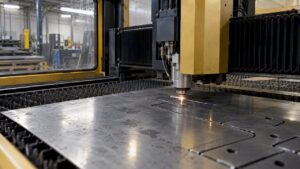
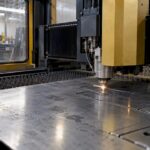
- The balusters are straight bars or tubes. They are cut to length, often by laser cutting when they need holes, tabs or a decorative pattern.
- Brackets and base plates are formed on the press brake from sheet.
- Assembly is welded, then finished and installed. Our welding service handles steel, stainless steel, aluminum and copper.
No roll forming appears anywhere. Nothing in this job repeats at a scale that would justify dedicated roll tooling. That is typical of architectural and renovation work, and it is why the question “which one is better” usually has a plain answer: the one that matches the geometry and the quantity.
Quebec codes shape the geometry
A railing is a safety device, so the curve you roll cannot override the code. Custom fabrications such as balcony guardrails and stairs must comply with the Quebec Construction Code, which that source lists as based on NBC 2020 and mandatory from 17 October 2026. It also gives a maximum opening of 100 mm between balusters wherever a fall of more than 600 mm is possible. Guard and handrail heights differ by building type and use, so have them confirmed against the current code for your project rather than relying on a general figure.
There is a permit side as well. The City of Montreal states that you must obtain a permit before building, enlarging, modifying or replacing a terrace, balcony, gallery or porch, with rare exceptions. Other boroughs and municipalities set their own requirements, so check yours. For condo boards and property managers, the practical step is to ask your architect or engineer to confirm what is needed before fabrication begins.
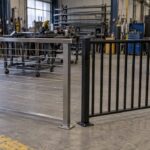
Curved guards add a specific wrinkle: on a rolled rail, the gap between balusters should be checked at the widest point of the curve, not only on the straight runs. Share the drawings with your fabricator before the radius is final. For more on outdoor rails, see our guide to custom outdoor handrails and our railings and metal staircases pages.
How to choose: five questions
- Is the part curved along its length? If yes, profile rolling is almost certainly involved.
- Is the cross-section made of folds from flat stock? If yes, press brake forming handles it at small volumes, and roll forming only at large ones.
- How many will you need over the next year? Tens or hundreds point to flexible processes. Many thousands of a fixed profile are the only case where roll tooling pays back.
- Might the design change? If it might, avoid tooling that is built for one shape.
- Does it need to meet a code or be installed on site? Then the fabricator’s ability to measure, install and answer to an inspector counts as much as the machine.
On the second-to-last point, early collaboration is worth repeating. Experienced fabricators stress that the most important factor is early collaboration between designer and fabricator, so the shape can be built reliably without excess waste. Our short guide on files to send for faster design quotes lists what helps most: drawings, material and thickness, quantities and the finish required.
Our perspective
We get asked “rolling or forming?” often, and the question usually hides a different one: what is the cheapest way to get a good result without paying for tooling I will not reuse? Our answer comes from how we work. Everything is fabricated and welded in our Lachine shop and installed by our own team across Greater Montreal, so the person who rolls the section is accountable for how it fits on site.
That changes how we advise. When a customer brings a curved railing, we look at the radius, the section and the opening sizes together, because a good curve that fails an inspection is worth nothing. When a manufacturer brings a bracket, we price the press brake and the laser, not a roll set it does not need. We do not make parts for shipment outside Greater Montreal, which keeps us focused on jobs we can see through from drawing to installation.
Our practical advice: bring the drawing early, even if it is rough, and tell us what the part must do. Most expensive mistakes in custom metalwork are decided in the first conversation, long before any metal is cut.
— Ash
Working with Manara Corp
If your project involves curved sections, folded sheet parts, laser-cut components, or a full railing or stair, we can fabricate and install it in Greater Montreal, in French or English. Start with our profile rolling page or contact us through the main site. Not sure how to compare shops? Our three filters for vetting metal fabricators is a good starting point.
FAQ
What is the difference between profile rolling and roll forming?
Profile rolling curves an existing section, such as a tube, bar or angle, into an arc or ring. Roll forming shapes flat coil into a straight profile with a constant cross-section. One changes the path of the part, the other changes its cross-section.
Is roll forming cheaper than bending?
Only at high volume. Roll forming needs dedicated tooling, so the per-part price falls only once a large run spreads that cost. For short runs and varied parts, press brake bending or profile rolling is normally cheaper overall.
What is the difference between forming and bending metal?
Bending is one kind of forming: it creates an angle or curve without removing material. Forming is the wider term and includes roll forming, press forming, spinning and roll bending. In a shop, people often use the two words interchangeably for sheet work.
Can you roll stainless steel or aluminum profiles?
Yes, both can be rolled, though they respond differently. Stainless steel springs back more than mild steel, and aluminum depends on alloy and temper, so test bends and a clear material specification matter. We work with steel, stainless steel, aluminum and copper.
Do curved railings need to follow the Quebec code?
Yes. Guards and stairs must meet the Quebec Construction Code, including the 100 mm maximum opening where a fall of more than 600 mm is possible. Confirm the permit and plan requirements with your borough or municipality before fabrication.
Sources
- Section Bending & Angle Rolling: Method & Machines
- Design of Roll-Forming Process for U-Profile Rail
- A Comparative Cost Model for Sheet Metal Profile Manufacturing Strategy
- Forming | Outokumpu Stainless Steel
- Enhancing angle roll operations
- Roll forming handbook: Practical Knowledge for Immediate Implementation
- Québec Construction Code: Stairs & Guards
- Construire ou remplacer une terrasse, un balcon, une galerie ou un perron, Ville de Montréal