Expect to pay roughly $100 to $180 per linear foot for aluminum railings, $130 to $220 for welded steel, and about $200 to $400 per linear foot for a tempered glass system with aluminum framing. Most installations also need a borough permit and a Régie du bâtiment du Québec licensed contractor. The next step is simple: book an on site visit so a contractor can measure your balcony and give you a written, code compliant quote.
TL;DR:
- Montreal requires guardrails on platforms more than 60 centimeters above ground, with a 90 centimeter minimum height, rising to 107 centimeters above 180 centimeters.
- Replacing a railing in the same location and at the same height may count as minor work, but changing its height, layout, or attachment typically prompts borough review.
- Small projects can run from the low hundreds to around $1,000, medium installations often cost $1,200 to $2,500, and complex projects can exceed $4,000.
- Cracked concrete, rotted ledgers, multiple corners, and difficult upper floor access can add repair or equipment costs, so inspect the anchoring before finalizing a quote.
- Compare itemized quotes that separate materials, labor, permit fees, and access charges, and check warranties for materials and workmanship before signing.
Table of Contents
- Cost ranges by material and installation type
- Montreal permits and RBQ licence rules that affect cost
- Primary cost drivers and site conditions that change the quote
- Example budgets for common Montreal balcony sizes
- How to get accurate, code ready quotes in Montreal
- Why local fabrication matters for Montreal balcony railings
- Warranty and maintenance costs you should budget for
- How custom design features change the price
- Labour versus materials in the Greater Montreal market
- Prefabricated kits versus fully custom railings
- Code compliance and what it adds to your budget
- What actually matters when budgeting for a balcony railing
- Get a free on site estimate for your Montreal balcony railing
- FAQ
- Sources
Cost ranges by material and installation type
Material choice drives most of what you’ll pay, but the finish and hardware matter almost as much as the metal itself.
Aluminum stays the most common choice for Montreal balconies because it resists corrosion without the upkeep steel demands. A basic powder coated aluminum railing with straight balusters sits at the lower end of the range, while custom post spacing, decorative balusters, or a two tone finish pushes the price toward the top of the band.
Steel and other welded metal railings cost more per foot because the fabrication involves more welding time and a protective coating against Quebec’s freeze thaw cycles. Wrought iron style designs, scrollwork, or custom brackets add labour hours that show up directly on the invoice.
Tempered glass guardrails command the highest price band of the three common systems.
A typical installed tempered glass balcony railing system in Montreal runs about $200 to $400 per linear foot, depending on glass thickness and the complexity of the aluminum frame. Glass preserves sightlines and reads as a premium upgrade, which is why condo boards often reserve it for front facing balconies rather than every unit in a building.
What tends to move the price within each material band:
- Post spacing and the number of corners, since more posts mean more anchoring work.
- Glass thickness and whether panels are clamped or framed on all sides.
- Powder coat colour matching or a custom finish instead of a standard stock colour.
- Hardware grade, since stainless fasteners cost more than standard galvanized ones but last longer outdoors.
Montreal permits and RBQ licence rules that affect cost
Before any railing goes up, two regulatory questions decide how the project unfolds.
The first is whether your balcony needs a guardrail at all. Under City of Montreal rules, a platform more than 60 centimetres above the ground requires a guardrail, with a minimum height of 90 centimetres, rising to 107 centimetres where the platform sits higher than 180 centimetres. Replacing an existing railing in the same location and height sometimes qualifies as minor work, but any change in height, layout, or structural attachment typically triggers a review from your borough.
The second question is who can legally do the work. Installation that goes beyond strict maintenance generally requires a contractor holding an RBQ licence, which protects you through financial guarantees if something goes wrong on site.
What this means for your budget and schedule:
- Borough permit review can add days to weeks before fabrication starts.
- A licensed contractor may charge differently than an unlicensed one, but you gain recourse if the installation fails inspection.
- Heritage buildings or balconies that encroach on a right of way often need extra documentation, which can lengthen the timeline further.
Primary cost drivers and site conditions that change the quote
Two balconies with the same linear footage can still land on very different invoices once a contractor accounts for site conditions.
- Length, height, and corner count. A straight ten foot run costs less per foot than a railing wrapping two corners, since each corner needs extra posts and precise angle cuts.
- Structural condition underneath. If the concrete slab or wood ledger is cracked or rotted, reinforcement work gets added before the railing itself goes in, and that inspection step is where most surprise costs originate.
- Access to the work area. A ground floor balcony with a clear driveway is far easier to service than a sixth floor unit facing an inner courtyard, where scaffolding or a small crane may be necessary.
- Finish and hardware grade. Stainless steel components and marine grade fasteners cost more upfront but hold up better against Montreal winters than standard galvanized hardware.
Pro Tip: Ask your contractor to inspect the substructure before finalizing your quote, since fixing anchorage problems after fabrication starts almost always costs more than catching them early.
Example budgets for common Montreal balcony sizes
Here’s how these cost drivers play out across three realistic project sizes.
- Small balcony, 2 to 6 feet: A single aluminum panel with two posts typically lands in the low hundreds to around $1,000 installed, and this size often qualifies as a straightforward permit case if the height and layout stay unchanged.
- Medium balcony, 8 to 12 feet: A steel or aluminum railing spanning one straight run with a corner post commonly falls between roughly $1,200 and $2,500 depending on material and finish, with glass systems running higher given the per foot premium.
- Large or complex balcony, 20 feet or more: Projects wrapping multiple corners, requiring structural reinforcement, or needing scaffolding for upper floor access can push total costs well beyond $4,000, since labour and access fees compound on top of material costs.
These figures are illustrative starting points, not fixed quotes. Your exact number depends on the material, the site conditions, and whether permitting adds steps to the project.
How to get accurate, code ready quotes in Montreal
A comparable quote starts with good information on both sides.
- Measure your balcony and photograph the site, including the attachment points, any existing damage, and nearby obstructions like drainpipes or neighbouring balconies.
- Gather your permit documents, if you have them, or note whether your building has a location certificate on file with the borough.
- Ask for the contractor’s RBQ licence number and verify it directly before signing anything.
- Request a written warranty covering both materials and workmanship, along with confirmation that the contractor will handle permit paperwork.
- Review the itemized quote to confirm it separates materials, labour, permit fees, and any scaffold or crane charges, so you can compare offers on the same basis.
Why local fabrication matters for Montreal balcony railings
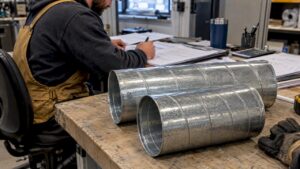
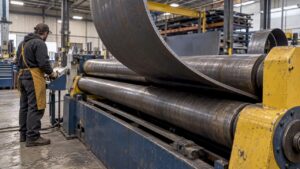
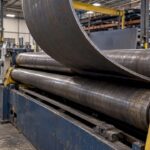
We fabricate every railing in our Lachine shop using CNC laser cutting, sheet bending, and welding, then install the finished piece ourselves across Greater Montreal, from the island to Laval, the South Shore, and the West Island.
Working this way means the same team that cuts and welds your railing also measures your balcony and installs it, which cuts down on the fit problems that come from ordering a prefabricated kit sized for a generic opening. It also keeps code compliance in house: we know the City of Montreal’s guardrail height rules and the RBQ licensing requirements that apply to this kind of work, so those details get built into the fabrication plan rather than discovered on installation day.
If you’re comparing quotes, ask any contractor for an on site measurement visit and a written, RBQ compliant quote before you commit.
Warranty and maintenance costs you should budget for
A railing’s upfront price is only part of the real cost. Powder coated aluminum generally needs little beyond occasional washing, but steel and iron systems benefit from periodic inspection of the protective coating, since any exposed metal can corrode through a Montreal winter. Choosing corrosion resistant materials and professional installation tends to cost less over the life of the railing than saving money on lower grade materials upfront.
Ask any contractor what warranty covers, both materials and workmanship, and for how long. A railing that fails a weld inspection or loosens at the anchor points within a year or two usually points to a workmanship issue rather than a design flaw, which is exactly what a written warranty should address. Glass systems add one more consideration: clamped panels need their gaskets checked periodically, since a failed gasket can let moisture reach the aluminum frame underneath.
Budgeting a small annual allowance for inspection and touch up work, rather than waiting for a visible problem, keeps long term costs predictable and avoids a larger repair bill later.
How custom design features change the price
A straight run of standard balusters is the cheapest way to meet code, but most Montreal balconies end up with at least one custom element that adds to the quote.
Curved or angled sections cost more than straight runs because each piece needs individual measurement and cutting rather than a repeated template. Decorative elements, scrollwork, custom bracket shapes, or a mixed material design combining glass panels with metal framing, add fabrication hours on top of the base material cost. Colour matching a specific powder coat shade to existing building trim, rather than choosing a standard stock colour, also adds a line item, since custom batches cost more than bulk standard finishes.
None of these additions are necessary to meet code, but they’re often what separates a railing that looks built for the building from one that looks like a generic replacement. If budget is tight, a straightforward design in a quality material, properly finished, meets every safety requirement without the custom premium.
Labour versus materials in the Greater Montreal market
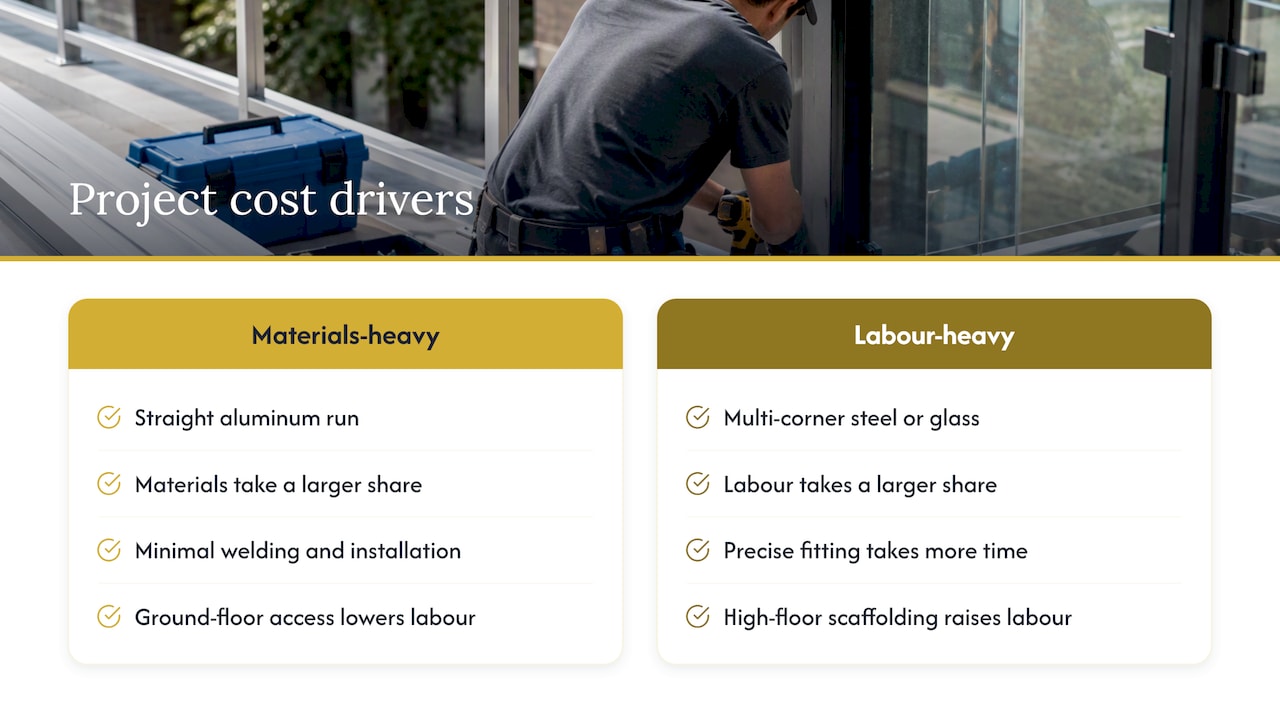
On a typical railing project, materials and labour split roughly evenly, though the exact ratio shifts with complexity. A simple straight aluminum run leans toward materials cost, since the welding and installation time is minimal. A multi corner steel railing or a tempered glass system shifts the balance toward labour, because precise fabrication, careful handling of glass panels, and exact on site fitting all take more time than running straight aluminum stock through a brake.
Access conditions also move labour costs independently of the railing itself. A ground floor installation with easy equipment access costs less in labour than a high floor unit requiring scaffolding, even when the railing material and length are identical. This is one reason two quotes for seemingly similar balconies can differ meaningfully: the material estimate might be close, but the labour line reflects very different site realities.
Understanding this split helps when comparing quotes. A lower total price built on cheaper materials isn’t automatically a better deal if the labour estimate looks unrealistically thin for the access conditions on your building.
Prefabricated kits versus fully custom railings
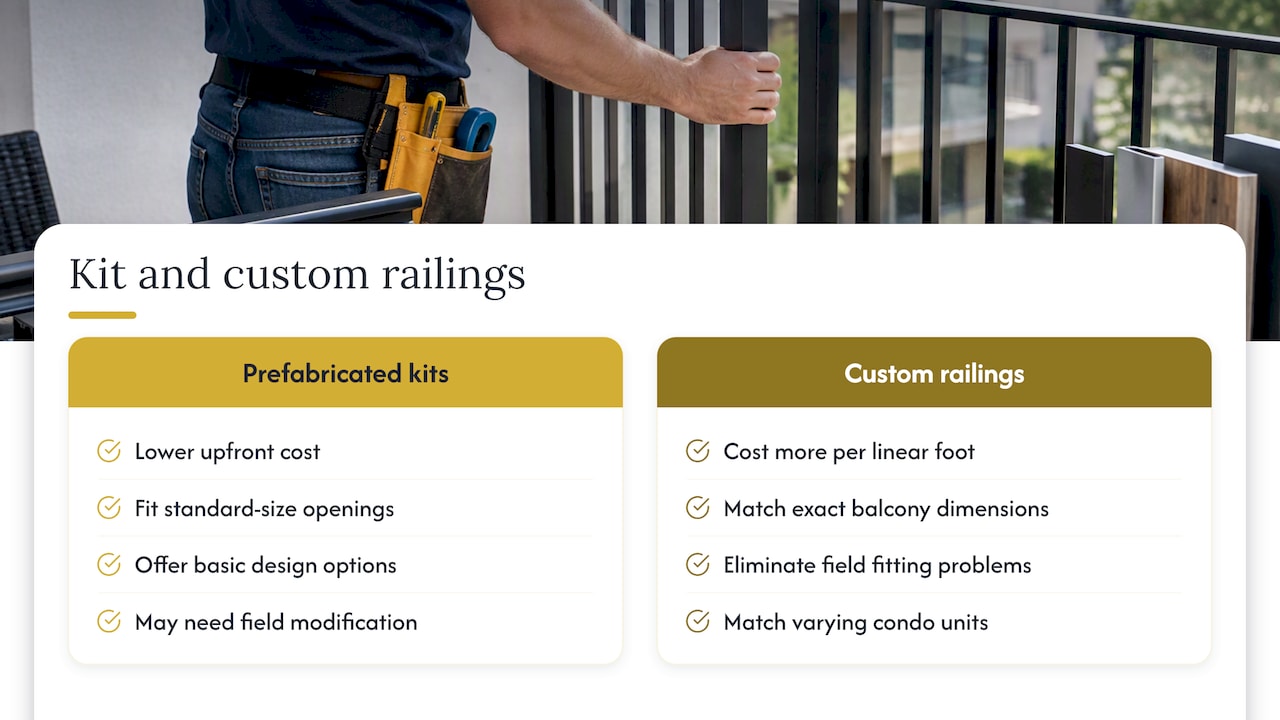
Prefabricated railing kits, sized to standard dimensions and sold through big box retailers, cost less upfront than a fully custom fabricated railing. They work reasonably well when a balcony opening matches a standard size and the owner is comfortable with basic design options.
The tradeoff shows up during installation. A prefabricated kit built for a generic opening often needs field modification to fit an actual Montreal balcony, since older buildings in particular rarely have perfectly standard dimensions. That modification work can eat into the upfront savings, and in some cases introduces gaps or fit issues that affect both appearance and code compliance.
A fully custom fabricated railing, measured and built to the exact dimensions of your balcony, generally costs more per linear foot but eliminates field fitting problems. For condo boards managing several units with varying dimensions, custom fabrication also means every balcony gets a railing that matches rather than a mix of kits and workarounds. The right choice depends on how standard your balcony’s dimensions actually are and how much tolerance you have for on site adjustments.
Code compliance and what it adds to your budget
Meeting Quebec’s building code requirements isn’t an optional add on, it’s the baseline every quote should already include. The guardrail height rules set by the City of Montreal, 90 centimetres minimum and 107 centimetres where the platform exceeds 180 centimetres, determine the post height and bracing a fabricator needs to build in from the start.
Compliance costs show up mainly in two places: correct anchoring strong enough to meet load requirements, and baluster spacing narrow enough to meet safety standards for preventing falls. Cutting corners on either one isn’t a way to save money, since a railing that fails inspection has to be corrected anyway, usually at greater expense than building it right the first time.
Hiring a contractor who holds a valid RBQ licence is the practical way to confirm the work will meet these standards without having to verify every detail yourself. The licence requirement exists specifically because guardrail work affects occupant safety, and it gives you recourse if the installation doesn’t hold up.
What actually matters when budgeting for a balcony railing
The conventional advice treats balcony railing cost as a single number you can look up and apply to any project, when in Montreal it’s really a function of three things most guides skip: your borough’s permit process, your building’s structural condition underneath the old railing, and whether your balcony’s dimensions match anything standard. A generic national estimate misses all three.
What’s overrated is chasing the lowest per foot price before confirming RBQ licensing and permit handling. A cheap quote that skips either one often costs more once a failed inspection or a safety issue forces a redo. What’s underrated is the site visit itself: a contractor who measures your balcony and inspects the substructure before quoting gives you a number you can actually trust, rather than a range pulled from a price list.
If you take one thing from this guide, prioritize verifying the licence and getting an on site assessment before comparing dollar figures. The price only means something once you know it’s attached to a compliant, accurately measured plan.
— Ash
Get a free on site estimate for your Montreal balcony railing
We fabricate every railing in our own Lachine shop and install it ourselves across Greater Montreal, so the quote you get reflects your actual balcony, not a generic price list.
- Book a site visit and we’ll measure your balcony and walk you through material options.
- We handle RBQ compliant installation and can speak to the permit steps your borough requires.
- Get a written quote itemizing materials, labour, and any access costs before you commit.
Reach out through our residential and commercial railings page to arrange your estimate.
FAQ
What is the price of a 20 foot steel railing?
A 20 foot welded steel railing typically costs from about $130 to $220 per linear foot installed. The final price depends on the number of corners, the finish, and whether the substructure needs reinforcement before installation.
How much do iron railings cost?
Wrought iron style railings generally price similarly to welded steel, since both involve comparable fabrication and welding time, typically landing around $130 to $220 per linear foot installed. Decorative scrollwork or custom bracket designs push costs toward the higher end of that range.
What is the average cost of a metal railing?
Metal railing costs in Montreal vary by material, with aluminum typically running $100 to $180 per linear foot and steel running $130 to $220 per linear foot installed. The exact price depends on length, finish, access conditions, and whether structural repairs are needed first.
How much does a glass railing for a balcony cost?
A tempered glass balcony railing with an aluminum frame typically costs $200 to $400 per linear foot installed. Glass thickness and the complexity of the framing system are the main factors that move the price within that range.
Sources
- Balcons, escaliers et autres éléments en saillie | Ville de Montréal
- Travaux nécessitant une licence – Régie du bâtiment du Québec