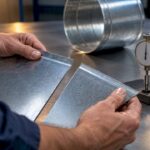
Bolting is the generally preferred method for standard field structural connections, chosen for installation speed, predictable pretension and simpler inspection. Field welding earns its place where bolts cannot physically work: skewed geometry, hollow structural sections or tight tolerances. CSA S16 and site safety rules shape the final call on both.
TL;DR:
- Bolted connections are generally faster and easier to inspect, but they may be vulnerable in fatigue-critical or vibration-heavy applications without proper detailing.
- Field welding is necessary for complex geometries like skewed angles, hollow sections, and embedded plates that bolts cannot accommodate.
- Proper quality assurance for field welds requires certified welders, documented procedures, and non-destructive testing for critical joints.
- In practice, combining shop welding with on-site bolting often offers the best balance of control, speed, and adjustability depending on site conditions.
- The choice between bolting and welding should prioritize site control, inspection reliability, and code compliance rather than strength alone.
Table of Contents
- Pros and cons at a glance: bolting vs field welding
- When bolting or welding wins the job
- What CSA S16, W47.1 and the NBC require
- Field welding: certified welders, testing and site controls
- Bolting on site: selection, installation and inspection
- Why ductility and stiffness differences matter in design
- A decision checklist for bidding and erection
- Notes from the shop floor on railings, stairs and fences
- The real question is not which method is stronger
- Getting your connection fabricated and installed right
- Sources
- FAQ
Pros and cons at a glance: bolting vs field welding
Bolting wins on speed and predictability. High-strength bolts go in with standard tools, the connection is adjustable until the last turn, and inspection is a matter of checking torque or rotation against a known standard. CSA S16 supports this approach for standard wide-flange beam-to-column connections because installation and inspection stay consistent from one site to the next.
Field welding carries more variables: weather, fit-up, welder skill and access all affect the result, and verifying quality often means non-destructive testing rather than a visual check.
- Bolting: fast installation, reusable tools, easy field adjustment, straightforward inspection.
- Bolting: weaker in fatigue-critical or vibration-heavy connections without careful detailing.
- Field welding: handles skewed angles, embedded plates and odd geometry that bolts cannot reach.
- Field welding: needs certified welders, controlled conditions and formal acceptance criteria.
- Field welding: schedule risk rises with poor weather, confined access or multiple weld passes.
- Cost and time: bolting generally moves faster and costs less in labour; welding can add inspection and rework time.
When bolting or welding wins the job
Connection type and site conditions usually point to one method before cost even enters the conversation.
- Standard wide-flange to wide-flange connections: shop-welded clip angles or plates, then field-bolted, following the approach the CISC primer on high-strength bolting describes for modern fabrication shops.
- Skewed connections, hollow structural sections and embedded plates: field welding often becomes the only practical option once geometry rules out a bolted fit.
- Confined spaces or awkward access: welding adapts to irregular joints better than a bolt pattern that needs clearance for a wrench or impact tool.
- Hybrid sequencing: shop weld the parts that tolerate controlled conditions, then field bolt the final connection when alignment or erection sequence demands adjustability.
What CSA S16, W47.1 and the NBC require
CSA S16 sets the limit-states design rules for both bolted and welded steel connections in Canada and spells out differing inspection and installation expectations for each. CSA S16 treats bolts and welds as equally valid under limit states design, but the quality assurance path diverges: bolted joints rely on manufactured fasteners and simple field checks, while welded joints need documented procedures and testing.
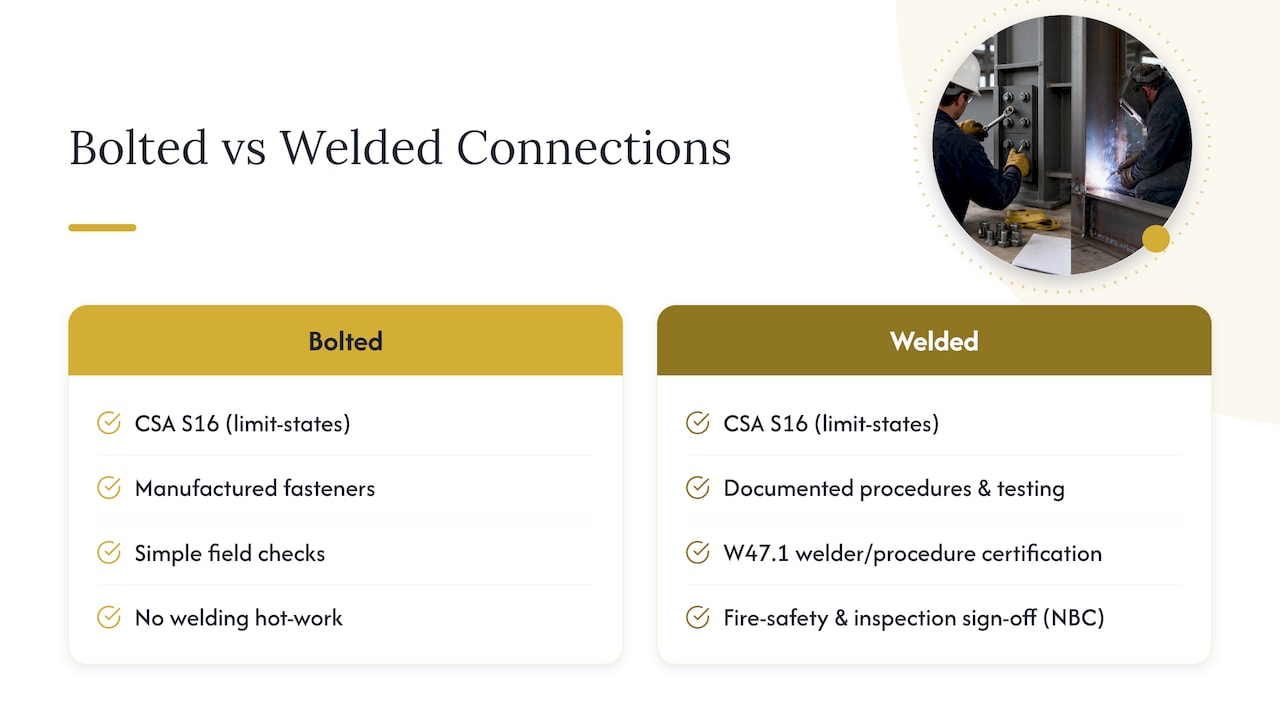
CSA W47.1 governs welder and procedure certification. A shop certified under W47.1 for a given process is not automatically certified for field work in different positions or conditions, so engineers should confirm the contractor’s certification scope matches the job before specifying field welds.
The National Building Code adds construction-stage obligations around fire safety and inspection sign-off, which matter when welding introduces open flame or hot work near occupied or partially finished structures.
Field welding: certified welders, testing and site controls
Field welding is only as good as the controls around it. The welding procedure specification (WPS) and a qualified welder record come first, then non-destructive testing confirms the result once the joint is made.
- Visual inspection catches surface defects on every weld; ultrasonic or radiographic testing is reserved for critical or fracture-sensitive joints where subsurface flaws matter.
- A written exposure control plan is required for welding operations, covering fume and gas hazards, per federal workplace welding guidance.
- Local exhaust or on-torch extraction is the preferred fume control, and detailed hazard guidance notes that outdoor welding can still need ventilation or respiratory protection depending on how long the task runs and how enclosed the space is.
- Qualified welder records and a documented WPS should accompany every field weld on a structural connection, not just critical ones.
Pro Tip: Confirm a welder’s certification covers the specific position and process called for on site, not just the process listed on a shop card.
Bolting on site: selection, installation and inspection
High-strength bolts dominate Canadian structural practice, with tension-control bolts such as ASTM F1852 common where torque wrenching is impractical or inspection needs to be fast and repeatable, a preference CISC’s bolting primer ties to shop capability and modern fastener availability.
- Turn-of-nut and tension-control methods both give a repeatable, documentable pretension without a calibrated torque wrench on every bolt.
- Slip-critical connections need faying surfaces prepared to a specified condition; bearing connections are more forgiving on surface finish.
- Installation records, whether a spun-off splined collar or a witnessed turn count, should be kept as the acceptance documentation for the connection.
Tolerance handling favours bolting: holes can be reamed slightly oversize, and plates can shift a few millimetres before the bolt goes in, which welding cannot easily replicate once a joint is tacked.
Why ductility and stiffness differences matter in design
Bolts and welds do not share load the same way. Welds are stiffer and reach their ultimate capacity at a smaller deformation than bolts do, which means a connection combining both in the same shear plane will not simply add their rated capacities together.
Research into combined bolted-welded shear joints found that transverse fillet welds behave poorly alongside bolts sharing the same shear plane, because the weld’s limited ductility causes it to fail before the bolts take their expected share of the load. Detailing guidance for moment and shear connections shows how field-welded flange connections and shop-bolted webs are typically detailed separately rather than forced to share a load path. When a design genuinely needs both methods on one joint, treat it as a case for a specialist review or physical test evidence rather than a straightforward capacity sum.
A decision checklist for bidding and erection
Run through this order before locking in a connection method:
- Geometry and fit: does the joint allow standard bolt clearance, or does the angle demand a weld?
- Code and design capacity: confirm the connection satisfies CSA S16 limit states for the chosen method.
- Site access and weather: welding needs shelter and ventilation; bolting tolerates more exposure.
- Certified labour availability: does the crew hold current W47.1 certification for the specific weld position required?
- QA and NDT plan: decide what testing the connection needs before work starts, not after.
- Schedule and cost check: compare labour hours and inspection time between the two methods.
- Final sign-offs: engineer approves design, fabricator confirms shop work, erector confirms field conditions, QA confirms acceptance.
The engineer owns item two, the fabricator owns one and six, and the erector owns three and seven, with QA closing the loop on five.
Industry primers note that properly specified high-strength bolting, installed and inspected correctly, reduces project risk compared with field welding carried out under adverse site conditions, a pattern consistent with why bolting remains the default for standard connections.
Notes from the shop floor on railings, stairs and fences
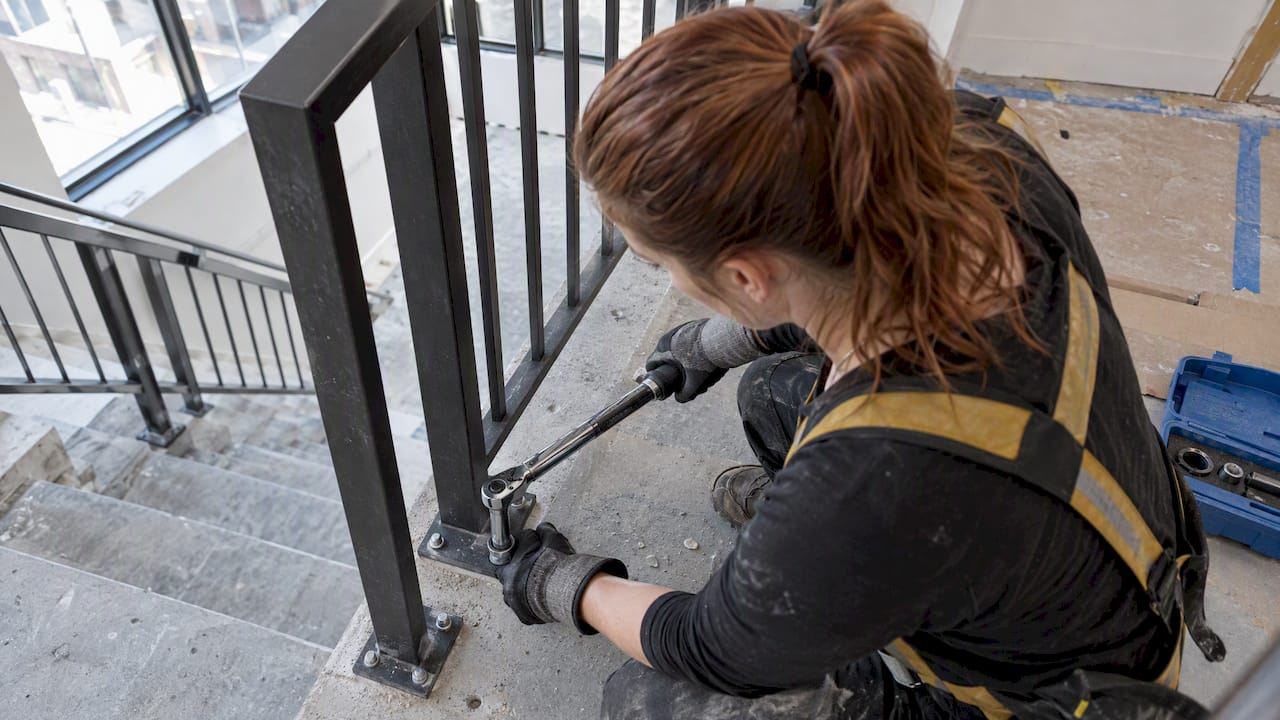
On railing and stair projects, shop-weld the main structural joints under controlled conditions, then field-bolt the final connections to the building, which keeps alignment adjustable right up to installation day. Pure field welding gets reserved for site-specific fixes, awkward embedded plates or repairs where a bolted fit is not practical.
When field welding is unavoidable, we treat the same controls as standard practice: certified welders, a written exposure control plan and ventilation suited to the space, with non-destructive testing called in where the connection demands it, following essential industrial roof safety tips to ensure safe work on elevated structures. Our welding services page and stair fabrication work reflect that same shop-first, bolt-on-site sequence.
The real question is not which method is stronger
Most arguments about bolting versus welding chase the wrong question. Neither method is inherently stronger: the standard allows both under limit states design, and a properly designed bolted connection and a properly designed welded connection can carry the same load. The real variable is execution risk, and that is where the conventional advice falls short by treating the choice as a strength contest instead of a quality control problem.
Welding concentrates risk at the moment of fabrication: a bad weld on a cold, windy site is a bad weld forever, and catching it depends entirely on inspection discipline. Bolting spreads that risk out: a loose bolt is visible, measurable and fixable on the spot. That is the real argument for defaulting to bolting on standard connections, and it is also why field welding deserves more procedural scrutiny than many project teams give it, not less. Prioritize matching the method to what the site can actually control, not to which one sounds more permanent.
— Ash
Getting your connection fabricated and installed right
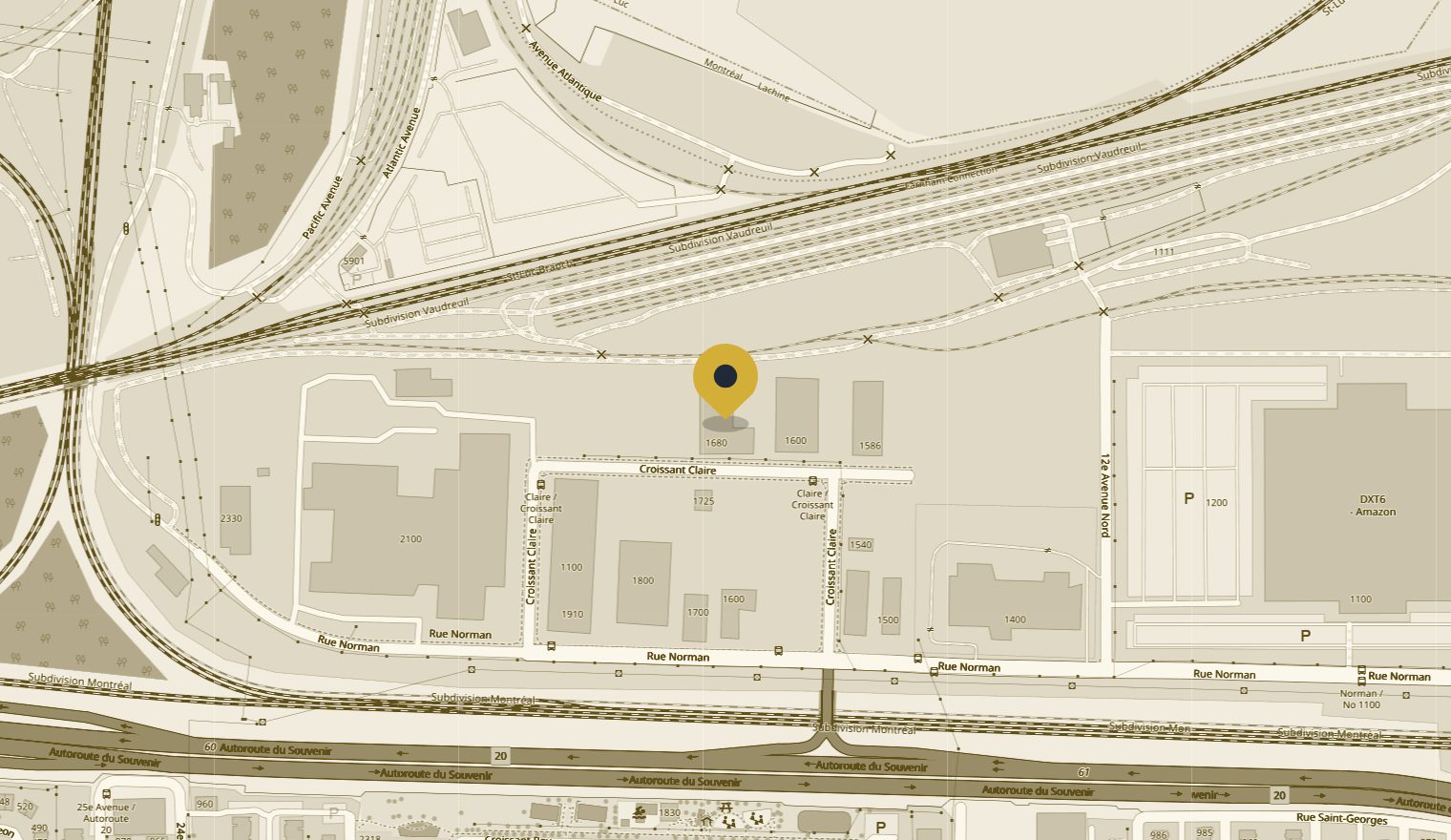
Working through this decision gets easier with a fabricator who handles both sides under one roof. Manara Corp fabricates and welds steel, stainless steel and aluminum in our Lachine shop, then installs on site across Greater Montreal, covering custom metal fabrication and welding, shop and onsite welding, and high-strength bolted installation for railings, stairs and fences.

To get a quote, send us your drawings, site photos and any known alignment tolerances so we can recommend shop-welded, field-bolted or a mix of both for your project. Reach out through our contact page to start the conversation.
Sources
- CSA S16 — Design and construction of steel structures (webstore listing)
- Welding and allied processes: guidance (Employment and Social Development Canada)
- High strength bolting (CISC primer PDF)
- Strength of joints that combine bolts and welds (Engineering Journal, AISC)
FAQ
Which is stronger, bolting or welding?
Neither is inherently stronger: both are designed to carry calculated loads under CSA S16 limit states, and a properly engineered connection of either type meets its design capacity. The practical difference lies in execution risk and inspection, not raw strength.
Which is better, welding or bolting?
Bolting is generally better for standard field connections because it installs faster, adjusts on site and inspects easily, a preference the CISC bolting primer ties to shop fabrication trends. Field welding is better suited to skewed joints, hollow structural sections and embedded plates where a bolted fit is not possible.
What are the four types of welds?
Common structural weld types include fillet, groove, plug and slot welds, each suited to different joint geometries and load paths. The choice between them depends on plate thickness, access and the load the connection needs to transfer.
What are the disadvantages of a bolted connection?
Bolted connections can struggle in fatigue-critical or high-vibration applications without careful detailing, and they rely on correctly prepared faying surfaces for slip-critical designs. They also need documented pretension records to confirm acceptance, which adds a step beyond simple visual inspection.
When should I choose field welding over bolting?
Choose field welding when geometry rules out a bolted fit, such as skewed connections, hollow structural sections or embedded plates in confined spaces. It also suits repairs or site-specific fixes where shop fabrication was not possible ahead of installation.