If you want unobstructed views and a clean modern look, laminated glass wins. If budget, low maintenance, or fast repairs matter more, aluminum or steel railing takes it. Manara Corp. builds both, and the choice usually comes down to the glazing standard you specify (laminated versus tempered) and whether you’re paying for a view or paying for durability.
TL;DR:
- Laminated glass is the industry standard for guard applications because it remains in its frame after cracking and offers superior retention performance.
- Metal railings like aluminum or steel are less costly, easier to maintain, and better suited for non-view areas or budget-conscious projects, often saving up to 50 percent.
- Exterior glazing requires regular cleaning every 2 to 4 weeks, and hardware exposed to salt or salt spray should be specified in stainless steel to prevent corrosion.
- Cost estimates vary widely, with aluminum picket railings costing $50 to $150 per linear foot, while frameless glass can range from $200 to $400 per linear foot, depending on specifications.
- The choice between glass and metal generally relies on whether unobstructed views or long-term low maintenance are the primary priority.
Table of Contents
- Glass railing vs metal railing: aesthetic differences and best uses
- How durable is glass compared to metal, and what does code require?
- Which lasts longer: glass or metal railings?
- How much does a glass or metal railing cost installed?
- Does climate change which railing you should choose?
- What should you check before choosing between glass and metal?
- What a Montreal fabricator sees during railing quotes
- Choosing between glass and metal in the real world
- Get a railing quote built around your exposure and your budget
- Sources
- FAQ
Glass railing vs metal railing: aesthetic differences and best uses
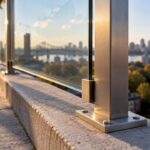
Glass comes in three basic styles. Framed glass sits inside a visible metal channel top and bottom, which is the most affordable glass option. Semi-frameless drops the top rail but keeps a base shoe. Frameless glass uses standoff hardware or a structural base shoe with nothing interrupting the view at all, favoured on decks and balconies where the whole point is looking past the railing rather than at it.
Metal covers more visual ground. Aluminum picket railing reads as classic and suits traditional or transitional homes. Cable railing, usually stainless steel wire strung between posts, gives a partial view with an industrial or contemporary edge. Solid stainless panels sit somewhere between the two, offering privacy without fully blocking light.
A lot of homeowners split the difference:
- Glass panels along the section facing the view (a backyard, a pool, a skyline)
- Aluminum or steel on side runs, stair railings, or anywhere sightlines matter less
- This hybrid approach commonly saves 30 to 50 percent versus running glass the entire perimeter, while keeping the view where it counts
How durable is glass compared to metal, and what does code require?
Not all glass is equal. Fully tempered glass is strong but shatters into small pieces on impact and provides zero retention once broken, meaning nothing holds the barrier in place. Heat-strengthened glass sits in between. Laminated glass, tempered panes bonded around a plastic interlayer (PVB or SGP), is the one that stays in its frame even after cracking. That’s why laminated glass is the standard choice for guard applications, and industry guidance from the Glass Association specifically recommends laminated or laminated-tempered glazing over monolithic tempered for guards.
Building code sets the non-negotiables: guard height, top-rail loading, and infill loading are all spelled out in the structural design sections of the national building code, and recent code revisions have raised some guard heights and tightened continuity rules for handrails on stairs, so confirm which edition your municipality has adopted before you sign a quote. Canada also has its own glazing test-method standard that classifies laminated and fully tempered glazing and sets minimum performance thresholds to limit injury risk.
Post-breakage retention is the number that actually matters. A panel labelled “tempered” tells you nothing about whether it stays in place if it fails. Ask your fabricator for retention performance, not just a glazing category.
Which lasts longer: glass or metal railings?
Glass panels themselves don’t wear out fast, but the system around them does. Exterior glazing needs regular washing to prevent mineral buildup and hard water etching, and the sealant bedding laminated panels needs periodic inspection because incompatible sealants can degrade the PVB interlayer over time, a point glazing guidance flags directly for exterior use.
Metal’s failure points are different: corrosion at welds and fasteners, and loosening hardware at anchor points.
- Clean glass panels every 2 to 4 weeks in wet or coastal climates, less often inland
- Inspect gaskets and sealant beads annually; replace at the first sign of cracking
- Check metal fasteners and welds yearly for rust, especially near ground contact
- Specify stainless hardware anywhere the railing faces salt spray or road de-icing
Pro Tip: Ask your fabricator whether they use 304 or 316 stainless for exposed hardware. The extra molybdenum in 316 resists chloride pitting far better, which matters if you’re near the water or a heavily salted road.
How much does a glass or metal railing cost installed?
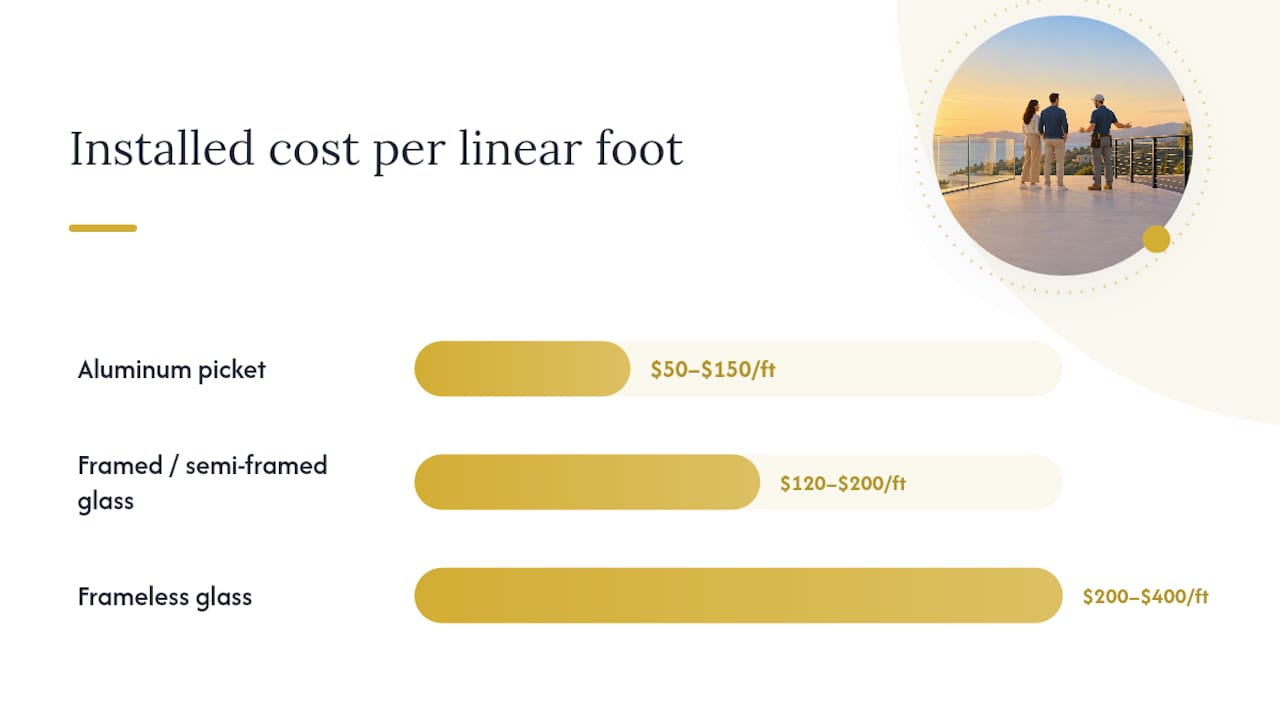
Installed pricing swings widely by system type. Reported ranges for Ontario put aluminum picket railing at $50 to $150 per linear foot, framed or semi-frameless glass at $120 to $200 per linear foot, and frameless glass at $200 to $400 per linear foot.
What actually drives the number on your quote:
- Glass thickness and interlayer type (laminated costs more than monolithic tempered)
- Hardware grade, standoffs, and base shoes, especially in stainless
- Engineering and stamped drawings for anything beyond a standard low-rise application
- Core drilling into concrete versus attaching to a wood-framed rim joist
- Substrate reinforcement if the existing deck or balcony wasn’t built for glass loads
Frameless glass tends to add resale appeal on view lots and pool decks where buyers notice the sightline. On a standard suburban deck with no particular view, aluminum picket usually gives you better return per dollar spent.
Does climate change which railing you should choose?
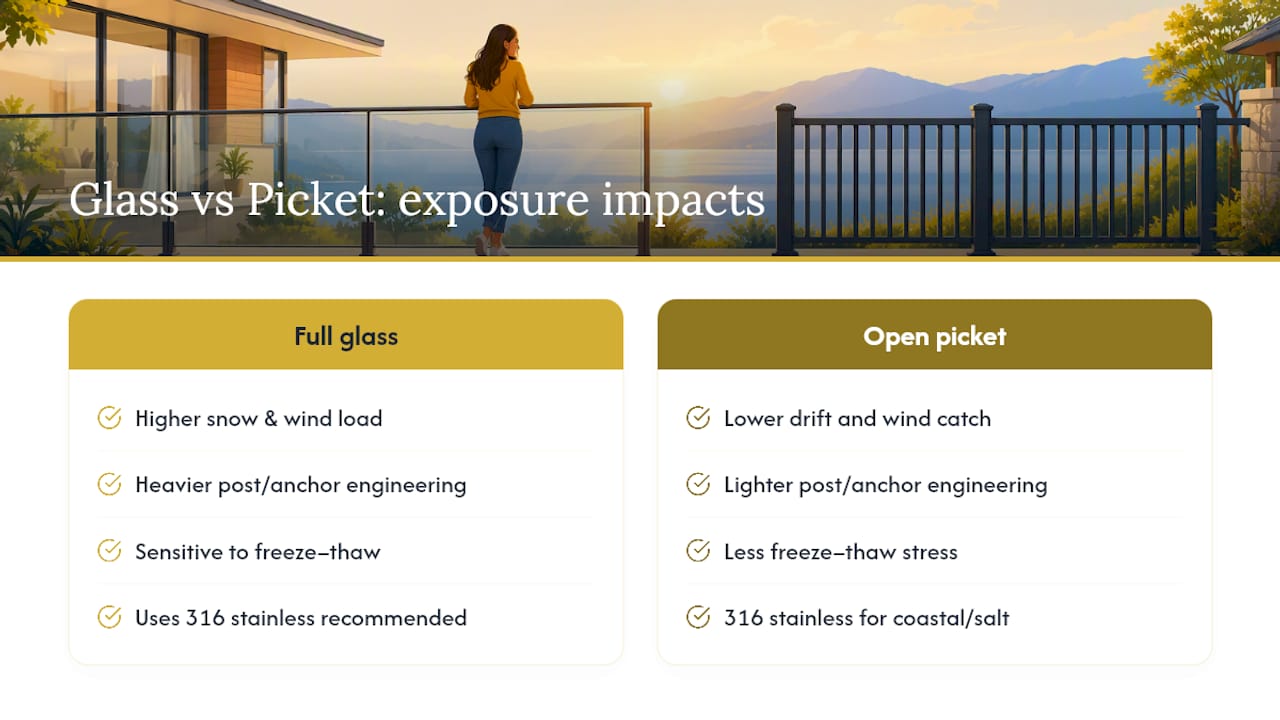
Exposure changes the spec more than it changes the material choice. Coastal air and winter road salt both accelerate corrosion on fasteners and brackets, which is why 316 stainless hardware is worth the upgrade cost in those conditions rather than standard 304 or galvanized steel.
Solid glass panels also catch more snow and wind load than open picket or cable infill, since there’s no gap for drift to pass through. That means posts and anchors on a full-glass run may need heavier engineering than the same run in aluminum picket. Freeze-thaw cycling stresses anchor points too. Core-drilled connections into concrete should include proper sealant and expansion allowance, and wood-frame anchoring needs solid blocking behind the rim joist, not just lag bolts into siding.
What should you check before choosing between glass and metal?
Start by ranking your own priorities, because the “right” answer changes person to person:
- If unobstructed view matters most, prioritize frameless or semi-frameless laminated glass.
- If budget or fast turnaround matters most, prioritize aluminum picket or cable metal railing.
- If low maintenance matters most, lean metal, and specify stainless hardware in exposed sites.
- If privacy matters, consider solid stainless panels or frosted/laminated glass with an interlayer tint.
Whichever direction you lean, ask every fabricator the same questions before comparing prices: What glass type and interlayer are specified, and can they show post-breakage retention data? What anchor method will they use for your substrate? What finish and hardware grade is included? Are stamped engineering drawings part of the quote?
Treat a very low price with no glass spec, no hardware grade, and no mention of engineering as a red flag, not a deal.
What a Montreal fabricator sees during railing quotes
Fabricating railings in-shop and installing them locally, rather than shipping prefabricated parts in from elsewhere, gives tighter control over fit, finish match, and schedule. That matters most on retrofit balconies where existing dimensions are rarely square and engineering has to account for whatever substrate is already there.
Material specification is where quotes diverge the most. Galvanized steel costs less upfront but its zinc coating degrades faster in salted, high-traffic entryways than stainless steel, and weld quality on visible joints is one of the easiest ways to spot a rushed fabrication job before installation even starts.
Choosing between glass and metal in the real world
Picking glass or metal usually comes down to one honest question: are you buying a view, or are you buying twenty years of low maintenance? For a pool deck or a lot of backing onto green space, laminated glass earns its cost. For a front stair or a side yard nobody lingers in, aluminum or a custom handrail in steel does the job for less money and less upkeep. Most renovation budgets end up landing on a hybrid, and that compromise is usually the smart one, not a consolation prize.
— Ash
Get a railing quote built around your exposure and your budget
Custom metal, glass, and hybrid railings are designed and fabricated in-house in Lachine, then installed onsite locally, allowing the same team that welds posts to anchor them to your deck.
Requesting a quote gets you an onsite measure, a walkthrough of glazing and metal options suited to your exposure (including stainless versus galvanized hardware for salted or coastal sites), and a local install crew who can also handle matching metal stairs if your project includes them. If you’re comparing quotes and want to know what a properly engineered, code-compliant railing should actually cost for your property, start with Manara’s residential railings page and request a quote directly.
Sources
- National Standard of Canada on glazing materials (2026)
- Glass Association guidance: glass use in guardrails (2023)
- NRC publication: structural requirements for guards and handrails
- Aluminum vs glass railing cost (Ontario) 2026
FAQ
What are the downsides of glass railings?
Glass costs more per linear foot than aluminum or steel, needs more frequent cleaning to avoid water spots and mineral buildup, and requires careful sealant compatibility around the interlayer in laminated panels. It also collects more snow and wind load than open picket systems, which can mean heavier engineering at the posts.
Which railing is better, glass or steel?
Neither wins outright. Glass gives you an unobstructed view and a modern look but costs more and needs closer maintenance attention, while steel and aluminum cost less, resist weather better with the right hardware grade, and are easier to repair or replace section by section.
Are glass railings worth it?
They’re worth it on view lots, pool decks, and modern architectural styles where sightlines matter, since laminated glass with proper post-breakage retention stays safe even after cracking. On a standard deck with no view to protect, aluminum picket typically delivers better value for the same budget.
What is the best material for an outdoor handrail?
Stainless steel is generally the most durable choice for an exposed outdoor handrail, especially in coastal or salted climates where 316-grade hardware resists corrosion better than galvanized steel. Manara Corp. fabricates custom outdoor handrails in stainless, aluminum, and steel, matched to your site’s exposure and code requirements.