For most homes, aluminum wins because it resists corrosion without a maintenance schedule and costs less to buy and install. Steel earns its keep only when you need serious impact resistance or a heavier security-grade perimeter. Aluminum fences generally last over two decades, and steel fences often last up to two decades when well finished, though actual lifespan depends on coating quality. Workmanship, not the metal itself, decides which number you actually get.
TL;DR:
- Aluminum fences generally last over twenty years and require minimal upkeep, mainly occasional washing and fastener checks.
- Steel fences can last up to twenty years but depend heavily on high-quality coatings and are more susceptible to rust in harsh climates.
- The initial cost of aluminum is usually lower, with significantly reduced maintenance costs over its lifespan compared to steel.
- Steel is ideal for security, impact resistance, and heavy gate applications, but requires ongoing coating maintenance to prevent rust.
- Proper fabrication practices and quality fasteners are more crucial than material choice in determining long-term fence durability.
Table of Contents
- Aluminum fence vs steel: the core differences at a glance
- Durability and corrosion resistance in Canadian conditions
- Strength and impact resistance: when it actually matters
- What maintenance really looks like over 10 to 25 years
- Aluminum vs steel fence cost: upfront price versus lifetime cost
- Installation differences: weight, crew size, and timing
- When steel is genuinely the better choice
- When aluminum is the practical default
- A local fabricator’s take on finish and fabrication choices
- The bottom line on choosing between aluminum and steel
- Why workmanship beats the material argument
- Get a custom fence built and installed in Greater Montreal
- Sources
- FAQ
Aluminum fence vs steel: the core differences at a glance
Both metals can look nearly identical once painted black and mounted between posts. The differences show up in how they age, what they cost to own, and how much attention they demand.
- Corrosion behaviour: aluminum forms a natural oxide layer and doesn’t rust; steel needs a multi-stage coating system to avoid it.
- Weight: aluminum panels are noticeably lighter, which speeds up handling on-site.
- Upfront cost: aluminum generally costs less to buy and install than comparable steel panels, according to buyer guides.
- Maintenance: aluminum needs occasional washing; steel needs periodic inspection and touch-up.
- Lifespan: aluminum tends to outlast steel when both are properly finished, mainly because it has no coating to fail.
For a front yard, pool enclosure, or standard driveway gate, aluminum covers nearly every case. Steel earns its place around commercial-grade security gates or where a vehicle impact is a real possibility.
Durability and corrosion resistance in Canadian conditions
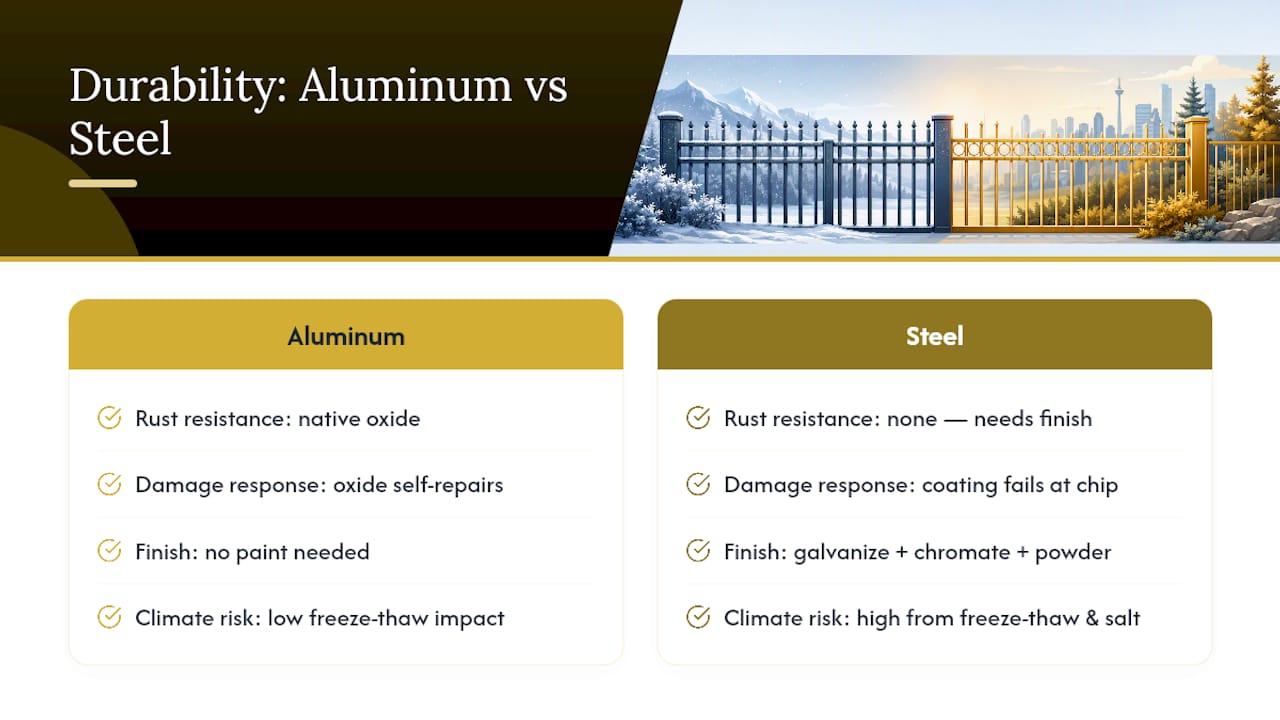
Aluminum doesn’t rust because it can’t. Once exposed to air, it forms a thin oxide layer on its surface that self-repairs if scratched, which is why the Aluminum Association calls corrosion resistance one of the metal’s defining traits for outdoor architectural use. Scratch a bare aluminum picket and the exposed metal simply oxidizes again within hours. No paint required, no rust bleed, no problem.
Steel plays a different game entirely. It has no built-in defence, so every steel fence depends on what’s layered onto it: usually hot-dip galvanization or a zinc-rich primer, followed by a chromate conversion coating, then a UV-stable polyester powder coat on top. That’s not overengineering. It’s the minimum system most fabricators consider necessary for steel to survive outdoors long-term. The catch is that the whole system only works while it’s intact. A chip from a lawnmower, a scratch from a snowblower, or a weld joint that wasn’t sealed properly gives rust a foothold, and once it starts under a coating, it spreads from the inside out where you can’t see it.
That vulnerability matters more here than in milder climates. Canada’s freeze-thaw cycles and seasonal extremes put outdoor metalwork through repeated expansion and contraction, and road salt drifting off nearby streets accelerates any corrosion that’s already started. In practice, this means the finish system on a steel fence often determines its real lifespan more than the steel itself does.
Strength and impact resistance: when it actually matters
Steel is the stronger metal, full stop. Its tensile strength lets it absorb impacts, resist bending under load, and hold up against attempted forced entry in ways aluminum can’t match. That advantage matters for security fencing, commercial perimeters, or any gate that takes regular vehicle contact, like a driveway entrance on a busy corner lot.
Aluminum deforms differently. A hard impact, say a car bumper clipping a corner post, will bend an aluminum picket rather than snap it outright. That’s actually good news for homeowners: a bent picket is often easier and cheaper to straighten or swap out than a cracked weld on a heavier steel panel, and residential aluminum fencing rarely faces impact forces severe enough to matter in the first place.
Gate hardware is where this plays out most concretely. Heavier automated gates, especially those with motorized operators, put more torque on hinges and posts than a standard swing gate. If you’re specifying a large automated driveway gate, the operator manufacturer’s weight limits will often push the decision toward steel regardless of your other preferences.
What maintenance really looks like over 10 to 25 years
Aluminum’s maintenance list is short. A yearly rinse with a hose, an occasional check that fasteners haven’t loosened, and that’s largely it. Good powder-coating practice combined with the metal’s natural oxide layer means most aluminum fences hold their finish for two decades or more with essentially no intervention.
Steel asks for more attention:
- An annual walk-around looking for chips, rust spots, or coating failure at welds
- Spot-treatment with a wire brush and rust converter the moment surface rust appears
- Reapplication of primer and topcoat on any area where the original finish has broken down
Skip that inspection for a couple of seasons and small rust spots become structural weak points, because a compromised finish system defeats steel’s strength advantage entirely.
One fabrication detail causes more premature failures than people expect: mixing incompatible metals at the fastener level. Plain steel screws driven into aluminum posts create a galvanic reaction that eats away at the aluminum around the contact point, and unsealed cut or welded edges left exposed after installation invite rust from day one.
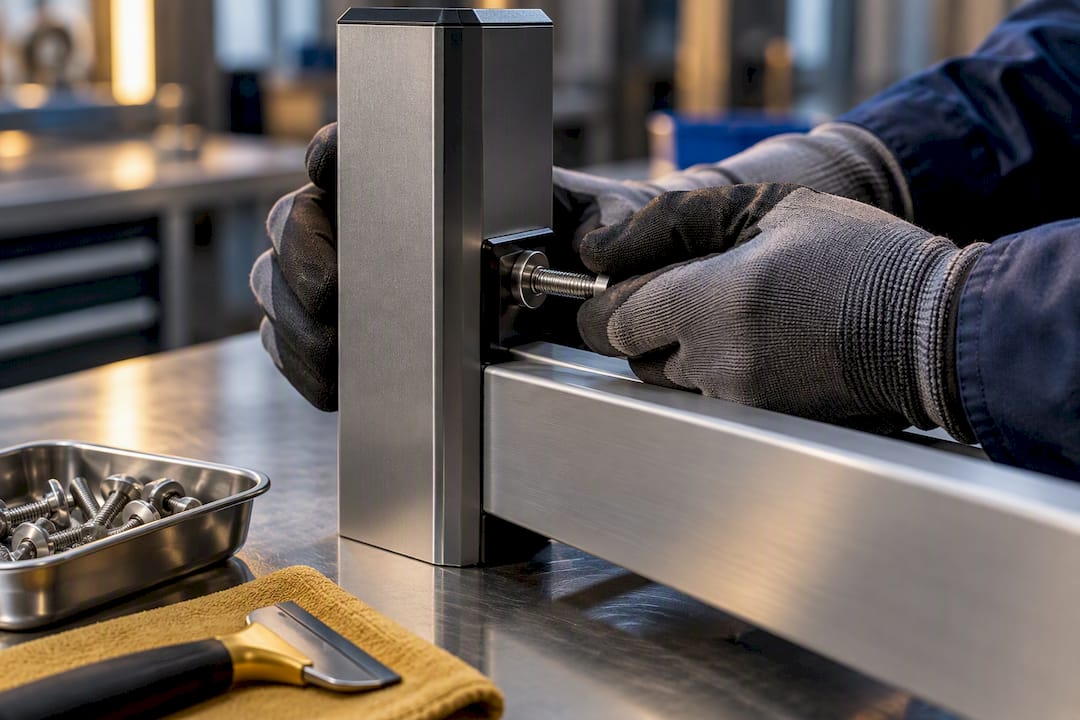
Pro Tip: Ask your fabricator whether they use stainless steel or specially coated fasteners on aluminum components, and whether every cut edge gets sealed before the finish coat goes on. That single question separates a fence that looks fine at year three from one that’s still tight at year twenty.
Aluminum vs steel fence cost: upfront price versus lifetime cost
Aluminum almost always wins on the initial invoice. Lighter material, simpler installation, and less labour per linear foot add up to a lower purchase price, a pattern confirmed across buyer-facing cost comparisons. Steel’s higher price tag comes from the raw material itself plus the added labour of applying and maintaining its coating system.
The real comparison happens over 20 to 25 years, not at checkout. Aluminum’s low upkeep keeps its lifecycle cost close to its purchase price. Steel’s total cost climbs with every maintenance cycle: primer touch-ups, occasional repainting, and the labour to do it properly rather than just cosmetically.
Two scenarios illustrate where steel’s higher cost pays off. A commercial property needing a security-rated perimeter fence justifies steel’s premium through impact resistance alone, regardless of upkeep. A homeowner installing a heavy automated driveway gate with a motorized operator may also need steel purely for the structural demands of the hardware, even though a standard side-yard fence on the same property makes more financial sense in aluminum.
Installation differences: weight, crew size, and timing
Panel weight changes almost everything about how a fence goes in; for practical insights and scheduling details, check out fence installation in Redmond, WA. Aluminum’s lighter sections mean smaller crews can move and set panels faster, and field experience across fence installers consistently shows quicker turnaround compared with steel panels of similar visual scale, simply because there’s less material to lift and align.
Steel’s added weight pushes footing requirements up too. Heavier panels and posts need larger, deeper concrete footings to resist frost heave and wind load, which means more excavation and cure time before the fence can even go up.
That timing difference matters more in Canada than in warmer markets. Short construction seasons compress the window for footings to cure properly before ground freeze, so a faster aluminum install can mean the difference between finishing this fall or waiting until spring. For homeowners coordinating a fence alongside other exterior work, that scheduling flexibility often outweighs the material cost gap.
When steel is genuinely the better choice
Steel earns its premium in specific situations, not as a general upgrade. Security-sensitive perimeters around commercial sites, properties bordering busy roads with real vehicle-impact risk, and heavy automated gates that exceed lighter-duty operator specifications all point toward steel.
In each case, the trade-off is worth stating plainly: you’re paying more upfront and committing to ongoing coating maintenance in exchange for strength aluminum can’t match. That trade only pays off if the finish specification is right. A steel fence with a thin single-coat paint job in a Quebec winter will rust faster than a properly galvanized and powder-coated one lasts trouble-free, so the coating spec matters as much as the decision to use steel at all.
When aluminum is the practical default
For the overwhelming majority of residential properties, aluminum is simply the sensible pick. Pool fences benefit from its rust-proof nature near chlorinated water, front-yard ornamental fencing looks sharp with minimal upkeep, and properties anywhere near winter road salt avoid the corrosion risk that plagues under-coated steel.
A couple of specification choices keep aluminum performing well long-term: ask for a heavier picket gauge rather than the thinnest option available, and favour fully welded panels over bolt-together kits, since welded construction has fewer failure points over time. Confirm the powder coat is a UV-stable formulation rated for exterior use, not a lighter-duty finish meant for indoor components.
A local fabricator’s take on finish and fabrication choices
The material debate matters less than most homeowners assume once you factor in fabrication quality. A steel fence with a proper zinc primer, chromate pretreatment, and UV-stable powder coat will outlast an aluminum fence with a rushed finish job, and vice versa. Alloy choice matters too. Fabricators typically choose between 6061 and 5052 aluminum depending on whether a panel needs to be bent, welded, or exposed to harsher conditions, since each alloy trades off formability against corrosion performance differently.
Fastener compatibility deserves the same attention as the finish itself. Mixing plain steel hardware with aluminum framing sets up galvanic corrosion at every contact point, which is why proper welding practices and correctly matched fasteners matter as much as the metal you start with. Fully welded panels, done right, remove entire categories of future failure that bolted assemblies can’t avoid. Anyone comparing fence options locally should ask a fabricator directly about alloy choice and coating spec before comparing prices.
The bottom line on choosing between aluminum and steel
Aluminum remains the right default for most residential fences: lower cost, less upkeep, and a corrosion resistance that steel simply can’t match without ongoing maintenance. Steel earns its spot only where security, impact resistance, or heavy gate hardware genuinely demand it, and even then, only with a proper coating system behind it.
Before requesting quotes, run through this short checklist with any installer or fabricator:
- What’s the site’s exposure to road salt, wind, and direct sun?
- What exact coating or powder-coat system is specified, and is it UV-rated?
- What fastener type will be used where aluminum and steel components meet?
- Is the gate hardware or operator compatible with the panel weight and material?
- What warranty applies to the finish specifically, not just the structure?
- What’s the realistic installation timeline given the current season?
If you’re ready to move forward, getting a local quote with these questions answered upfront saves you from surprises after installation.
Why workmanship beats the material argument
Homeowners spend a lot of energy debating aluminum versus steel when the bigger variable is almost always who fabricated the fence. A mediocre weld or a rushed powder coat undoes whatever advantage the “better” metal was supposed to give you, and a well-executed finish on either metal will outperform a poorly executed one nearly every time. If there’s one thing worth prioritizing over the material spec sheet, it’s confirming the welds are fully sealed and the fabrication happened somewhere the team stands behind its own work rather than subcontracting it out. That’s the detail that actually shows up twenty years later.
— Ash
Get a custom fence built and installed in Greater Montreal
The fences are fabricated in-house at a local shop in Lachine, then installed locally across the island, Laval, the South Shore, and the West Island, so the crew that welds the panels is the same one setting the posts. That in-house control means finish quality and fastener compatibility, the details that determine whether a fence lasts fifteen years or thirty, are handled by one team instead of getting lost between a manufacturer and a subcontractor.
Requesting a quote typically starts with a site visit to assess exposure and gate requirements, followed by a conversation about finish specification, whether that’s a powder-coated steel system or a welded aluminum panel, and a realistic installation timeline built around the season. The fabricator serves both French and English-speaking clients throughout Greater Montreal and takes on projects of any size, from a single gate repair to a full residential perimeter. Reach out through the contact page to get a custom fence quote started, or browse the fence services page for more on what’s available.
Sources
- Canada
- The Aluminum Association — The aluminum advantage
- Chainlinkfencing
- Lowe’s buying guide — Aluminum vs steel fence
- Medallion Fence — Steel vs. aluminum ornamental fencing (specification guide)
FAQ
What are the downsides of aluminum fences?
Aluminum fences dent or bend under a hard impact, since the metal is softer than steel, and they offer less resistance against forced entry or heavy vehicle contact. They’re also not the right choice for security-rated perimeters or heavy automated gates that exceed lighter-duty operator specifications.
How much does 100 feet of aluminum fence cost?
Exact pricing depends on picket gauge, panel height, gate hardware, and site conditions, so it’s best confirmed with a local quote rather than a flat figure. In general, aluminum costs less to buy and install than a comparable steel fence of the same length, according to buyer cost comparisons.
Is aluminum fencing cheaper than steel?
Yes, aluminum is typically cheaper both to purchase and install because it’s lighter and requires less labour to handle and set. Over the fence’s lifespan, aluminum also tends to cost less overall since it skips the recurring coating maintenance steel needs.
What is the best material for a backyard fence?
For most backyards, including pool enclosures and standard privacy fencing, aluminum is the practical default thanks to its corrosion resistance and minimal upkeep. Steel makes more sense only if the fence needs to withstand heavy impact or support a large automated gate.