Simple, prototype-style sheet-metal packages ship in roughly 3 to 7 business days, moderate packages run 7 to 21 business days, and complex, multi-fitting packages can take two to six weeks. The clock only starts once shop drawings or a BIM model get approved, so the single biggest lever you control is engaging your fabricator early enough to lock that approval down before you need metal on site.
TL;DR:
- Simple duct packages usually ship within 3 to 7 business days after drawings are approved, while complex projects can take up to six weeks including inspections.
- The most significant schedule delays occur during drawing approval and RFQ stages, often consuming 5 to 12 days before fabrication even begins.
- Engaging fabricators early, delivering fabrication-ready drawings, and planning delivery sequencing can substantially reduce overall lead times.
- Material availability, shop capacity, incomplete RFQs, and unresolved RFIs are common bottlenecks that affect fabrication speed.
- Requesting current shop loading from fabricators and obtaining detailed breakdowns of schedule stages help manage expectations and avoid surprises.
Table of Contents
- What is a realistic ductwork fabrication lead time?
- What actually drives your fabrication schedule?
- How can you compress ductwork fabrication delivery?
- What should your planning checklist and timeline look like?
- A local fabricator’s view on lead time
- When is paying for speed worth it?
- Get a lead-time estimate before you’re locked into a schedule
- Sources
- FAQ
What is a realistic ductwork fabrication lead time?
Lead time depends entirely on scope, and treating every job as a single number is where schedules fall apart. A simple, low-volume run with straight lengths and standard fittings behaves like a prototype job: it moves fast because there’s little engineering back-and-forth and few finishing steps.
Mid-volume packages take longer because welding, transitions, and multiple fitting types stack up. Large or geometrically complex packages, especially anything requiring a first-article check before full production, need the most buffer.
Rough windows worth pasting into a schedule:
- Simple / short-run packages: 3 to 7 business days once drawings are approved, covering cutting, forming, and light assembly.
- Moderate packages: 7 to 21 business days, factoring in welded joints, multiple fitting types, and standard finishing.
- Complex or large packages: 2 to 6 weeks, especially when first-article inspection and fixture setup add 1 to 3 weeks. Repeat units then move through faster.
- Specialty materials or finishes: add several days to a couple of weeks for heavier gauges, stainless steel, or powder coating, since those steps queue separately from standard carbon steel work.
None of these windows include transit time to site or the RFQ and drawing-approval phase that happens before the fabrication clock even starts.
What actually drives your fabrication schedule?
Drawing and submittal status is usually the single biggest cause of delay, more than raw volume or even material choice. A breakdown of duct lead time into drawing approval, procurement, fabrication, finishing, inspection, and dispatch shows that the earliest stage, getting shop drawings signed off, is where most schedules quietly slip.
Complexity multiplies hours faster than volume does. A run of fifty identical straight sections moves through a shop quickly. Fifty pieces with transitions, offsets, and mixed gauges take considerably longer per unit, because each fitting needs its own layout and check.
Statistic to watch: RFQ and engineering review stages alone commonly consume 5 to 12 business days before a single cut is made. That’s before procurement or shop queueing even enter the picture.
Other drivers worth diagnosing on any given job:
- Material availability. Heavy gauges, stainless steel, and specialty finishes often sit on longer supplier lead times than standard galvanized stock.
- Shop loading. A fabricator running near capacity will queue your job behind others already released, regardless of how fast your drawings move.
- Incomplete RFQs. Missing dimensions, unclear finish specs, or unresolved fitting counts routinely add several days of clarification emails before a job even enters the queue.
- Open RFIs. Unanswered field questions stall shop-drawing sign-off, which stalls everything downstream of it.
Knowing which of these is your actual bottleneck, rather than assuming it’s always “the shop is slow,” changes what you negotiate for.
How can you compress ductwork fabrication delivery?
You can’t eliminate the physics of cutting and welding metal, but you can compress the soft time around it, which is often where the real waste sits.
- Engage your fabricator at bid or pre-construction. Reserving shop capacity before award means your job doesn’t wait behind someone else’s release.
- Deliver fabrication-ready drawings. Resolving clashes in a BIM model before fabrication cuts rework and unpredictability that would otherwise surface mid-run.
- Favour prefabricated kits over piecemeal releases. Kits fabricated to a known field sequence reduce both shop confusion and site congestion.
- Sequence deliveries just-in-time. Fabricating and tagging spools by install ID, matched to the following week’s field sequence, avoids laydown problems and damage to staged material.
- Use blanket orders for repeat items. Stocking agreements let a fabricator pre-position material and reserve capacity ahead of your actual release date.
- Ask for a staged breakdown, not one date. Request the split between engineering review, material procurement, fabrication, finishing, and dispatch so you can see exactly where your schedule risk sits.
Pro Tip: Ask your fabricator for their current shop loading, not just a quoted lead time. A shop quoting “10 days” when it’s already backed up two weeks is telling you something different than the number implies.
What should your planning checklist and timeline look like?
Before releasing any package, confirm drawings are approved, materials are sourced (including specialty gauges or finishes), and delivery sequencing matches your install schedule.
- Shop drawings or BIM model signed off, with RFIs closed
- Material availability confirmed for any non-stock gauge or finish
- Finish requirements (powder coat, stainless polish) scheduled separately from base fabrication
- Delivery sequence matched to install order, not just fabrication order
- Buffer added for first-article or specialty-material items
A sample timeline template, in business days, for a moderate-complexity package:
When quoting, ask fabricators three things directly: what triggers the start of their clock, whether their quote already accounts for current shop loading, and what happens to your slot if drawing approval slips by a week.
A local fabricator’s view on lead time
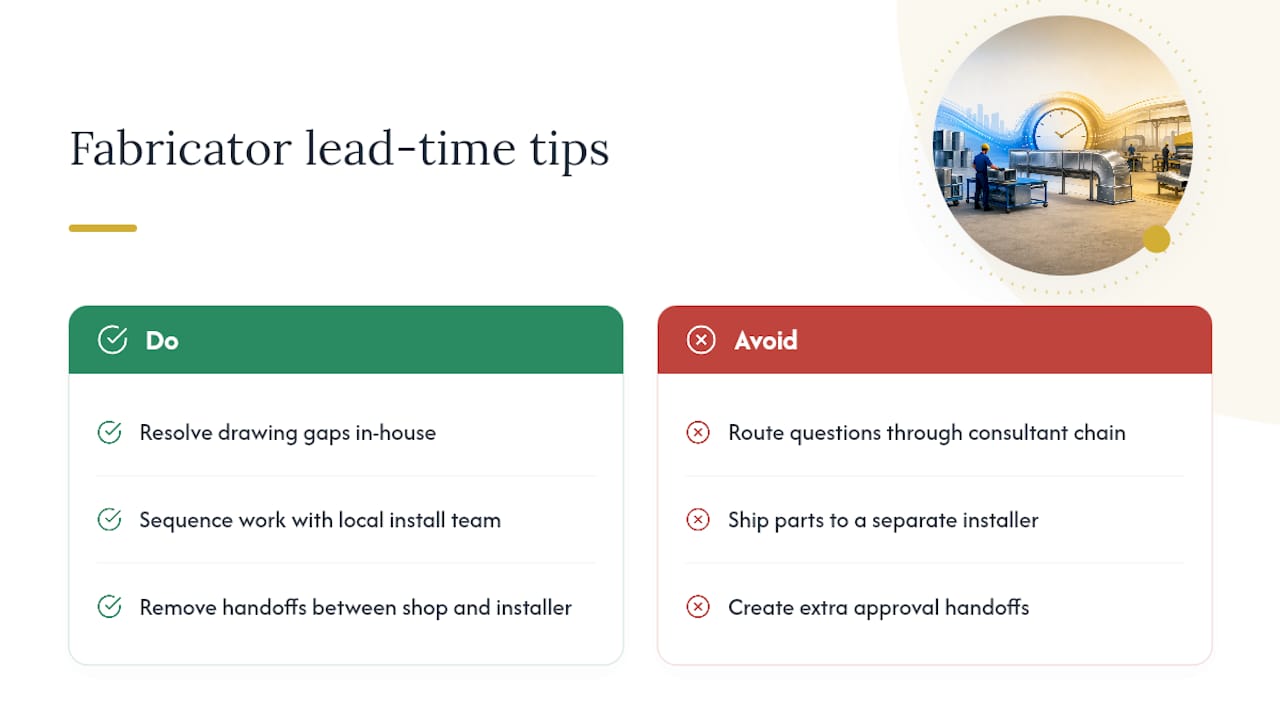
I’m Ash, and this guidance draws on how shops like Manaracorp actually run jobs, not on theory. In-house engineering matters here: a fabricator who can resolve a drawing gap directly, instead of routing every question back through a consultant chain, shortens the schedule measurably. Pairing that with sequencing and local installation, rather than shipping parts off to a separate installer, removes a handoff that otherwise adds days to every complex release.
When is paying for speed worth it?
Reserving shop capacity or stocking material costs more upfront, but it’s justified on fast-track projects where a slipped delivery date cascades into labour standby costs. Local shops tend to hold schedule commitments more reliably on tight windows, since coordination happens directly rather than through a shipping intermediary. Push for blanket orders whenever you have repeat releases; keep single releases for one-off scopes only.
— Ash
Get a lead-time estimate before you’re locked into a schedule
A local fabricator fabricates and installs in-shop, serving the Greater Montreal area, so your drawings, fabrication, and installation stay under one roof instead of bouncing between separate vendors.

That matters most when a schedule is tight: one team resolving a drawing question directly cuts out the delay of routing it through a shipping fabricator and a separate installer. The fabricator offers CNC laser cutting, sheet bending and rolling, profile rolling, and welding of steel, stainless steel, aluminum, and copper, for general contractors, architects, industrial manufacturers, and homeowners alike, in French or English. If you’re planning release dates for an upcoming project, request a lead-time estimate for your fabrication scope before you lock your schedule, or look at onsite welding capacity in Montreal if your package needs field welding as part of the sequence.
Sources
- Commercial Duct Fabrication Lead Times: What Drives Them and How to Compress Them | JMC Fabrication
- Custom Metal Fabrication Lead Times: Prototype Vs Production – Paragon Metal Fabricators
- Sheet metal fabrication lead time guide – RapidDirect
FAQ
How long does ductwork fabrication actually take?
Simple packages typically ship in 3 to 7 business days once drawings are approved, moderate packages run 7 to 21 business days, and complex packages take 2 to 6 weeks including finishing and first-article checks.
What is the 2-foot rule for ductwork?
This is a field-installation spacing guideline for hanger and support placement rather than a fabrication-scheduling rule, and it varies by local code and engineering spec, so confirm the exact requirement with your project’s mechanical drawings before fabrication.
How much does it cost to replace ductwork in a 2,000-square-foot house?
Costs vary widely by material, run length, fitting count, and finish requirements, and no single figure applies across markets, so get a project-specific quote based on your drawings rather than relying on a general estimate.
How long does it take to become a metal fabricator?
Trade training and apprenticeship timelines vary by province and program; in Quebec, sheet-metal and welding trades typically combine vocational training with supervised on-the-job hours tracked under CNESST-recognized apprenticeship rules.
Should I replace 20-year-old ductwork?
Ductwork that old often has corrosion, poor seams, or outdated sizing, and a local fabricator can assess whether repair or full replacement makes more sense once existing dimensions and condition are reviewed.