Two quotes can look identical on a Quebec balcony, but the difference is often whether the package includes anchors, base plates, welded and passivated joints, and the right stainless grade for winter chloride exposure. On a job like that, you're not really buying tube and finish, you're buying how long the railing will stay tight, clean, and safe.
A stainless steel railing usually wins in Greater Montreal because the service-life question matters more than the cosmetic one. The right system can outlast a cheap lookalike by a wide margin when the grade, weld prep, substrate, and fasteners are matched to the site instead of the brochure.
Table of Contents
- Why Stainless Steel Railing Has Become the Default in Commercial and Residential Builds
- What Makes Stainless Steel Different from Regular Steel
- Choosing Between 304 and 316 for Canadian Conditions
- Finishes, Shapes, and How the Visual Choice Affects Maintenance
- Fabrication Choices That Decide Whether the Railing Lasts
- Reading a Railing Quote Like a Fabricator, Not a Buyer
- Maintenance Habits and Cost Over the Life of the Railing
Why Stainless Steel Railing Has Become the Default in Commercial and Residential Builds
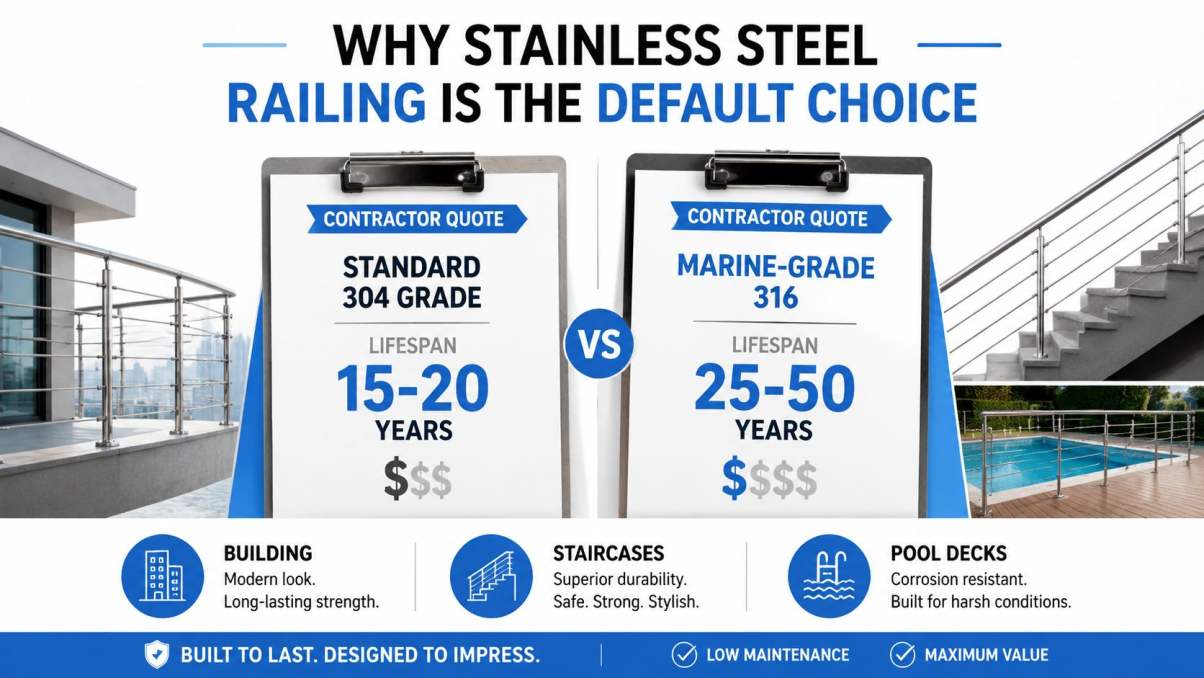
A contractor on a Montreal balcony usually gets two stainless steel railing quotes that look close on paper. One line item covers the visible tube and a polished finish. The other includes base plates, anchors, welded joints, cleaning, and finish work. That gap is where projects are won or lost. The railing you see is only part of the job, the connection package is what survives salt, freeze-thaw, and repeated load after the first winter.
The default came from service life, not fashion
Stainless moved into architecture because it solved a durability problem. Harry Brearley is credited with the first true stainless steel in 1913, using an alloy with 12.8% chromium, and industry history records its early exterior and building use in the late 1920s World Stainless. That background matters on railings, because the material was adopted for corrosion resistance, not for a showroom look.
In Canadian work, that origin lines up with field reality. Winter exposure, salt runoff, and repeated freeze-thaw cycles punish painted steel and make maintenance-heavy systems expensive to own. Stainless steel railing systems hold their appearance longer and do not need the same repainting cycle, which is why they show up on public stairs, commercial landings, apartment balconies, and exterior guards. For projects that need a local supplier and installation support, Manara Corp railings sit in the same conversation as the rest of the trade, because the bid still rises or falls on details, not on the brochure photo.
Practical rule: if the railing is hard to reach after installation, specify the material and connection details as if maintenance will be delayed, because that is usually how the building gets used.
What contractors are really paying for
The market movement follows the same logic. World Stainless reports that demand has increased 10-fold since 1970 and that long-term growth remains above 6% World Stainless. That does not help a site foreman torque an anchor, but it does explain why stainless is now treated as a standard option rather than a specialty upgrade.
For a contractor, the questions are direct. Is the railing for a sheltered lobby or an open balcony. Are the fasteners matching the frame, or will mixed metals sit in contact. Are the welds being cleaned and passivated after fabrication. Are the substrate conditions understood, or is the crew expected to make a poor base look acceptable with extra sealant. If those answers are vague, the quote is usually low for the wrong reason.
The simplest way to judge stainless is as a life-cycle decision. If the system is specified and detailed properly, you get less maintenance, a cleaner look over time, and fewer callbacks after the first winter.
What Makes Stainless Steel Different from Regular Steel
A railing can look polished on day one and still be the wrong material for the job. The difference between stainless steel and regular steel starts in the alloy itself, not the finish. Chromium gives stainless its self-protecting surface, so when the metal is scratched or exposed to oxygen and moisture, the passive layer can rebuild instead of letting corrosion spread the way it does on painted carbon steel.
The three elements that matter in the field
Chromium is the main reason stainless resists corrosion. On a railing, a scratch does not automatically turn into a rust streak the way it often does on regular steel. The passive layer is invisible, but it is the part doing the work every day.
Nickel helps stabilise the austenitic structure. In practical terms, that gives fabricators better formability and more predictable behaviour when they bend, weld, and assemble posts, rails, and brackets. That matters in the shop and on site, because a railing system with clean joints and consistent fit-up is easier to finish properly.
Molybdenum matters when chloride exposure enters the picture. It improves resistance to pitting and crevice attack, the kind of local damage that starts at a fastener, a weld toe, or a pocket where water sits. In Greater Montreal, that detail matters fast, because winter salt and meltwater tend to collect where the railing is hardest to inspect.
What the onsite crew notices
The field difference shows up in how each material ages. Regular steel depends on coatings to stay presentable, and once those coatings fail, rust spreads from the damaged area. Stainless behaves differently. It can still stain, especially if salt is left on the surface or contaminated tools are used during fabrication, but the corrosion resistance is built into the alloy itself.
Stainless is stain less, not stain proof. Owners who hear “maintenance-free” need to know what that means before they compare bids.
AZoM describes the early chromium breakthrough that made stainless practical, but the trade on a railing project is simpler than the history. Chromium forms the protective layer, nickel helps the structure behave well during fabrication, and molybdenum gives more resistance where salt and moisture try to attack the surface.
That is why stainless railing can keep serving in places where regular steel would be chasing coating repairs, and why the joints, fasteners, and substrate details matter more than the tube and finish on the cut sheet.
Choosing Between 304 and 316 for Canadian Conditions
The 304 versus 316 question gets answered badly all the time because people turn it into a price comparison instead of an exposure comparison. In Greater Montreal, the issue is chloride, winter runoff, and how much chance the railing has to dry out. A protected interior stair doesn't need the same alloy as a balcony edge that sees de-icing spray and snowmelt.
Where 304 is the right call
304 stainless is usually the correct lower-cost choice for interior guardrails, protected commercial lobbies, and dry residential stairs. In those environments, the railing sees normal handling, cleaning, and occasional moisture, but not constant chloride attack. If the installation is indoors and the substrate is stable, 304 can make sense without over-specifying the job.
That said, 304 is only a good value when the environment stays mild. If a balcony catches blowing snow, a stair sits near an exit where boots bring in salt, or a connection zone traps water, the price gap can disappear fast in maintenance work. The material isn't failing because it's stainless, it's failing because the exposure doesn't match the grade.
Where 316 is the safer technical choice
For exterior railings, waterfront-adjacent sites, pool areas, and anything exposed to de-icing salts, Type 316 is the dominant structural choice in railing documents because its molybdenum-bearing chemistry gives better pitting resistance than 304 TriTech Handrails. Public-project standards in Hong Kong also explicitly require Grade 1.4401 (316) for railing works, which shows how common that specification is in chloride-prone settings TriTech Handrails. In practical terms, 316 is the safer bet when the railing is outside, wet, or hard to inspect closely.
Mixed-metal contact matters too. If a lower-grade fastener sits against a 304 component in a salt-prone site, the connection can become the first place corrosion shows up. That's why the grade discussion has to include anchors, brackets, and hardware, not just the visible tube.
The spec language that avoids confusion
A drawing should say more than “stainless steel railing.” It should identify the grade by exposure zone. Use 304 where conditions are protected and dry. Use 316 where chloride exposure is expected, where washdown is irregular, or where future maintenance access is limited.
If the site gets winter salt, assume water will sit in a crevice longer than you expect. That's usually where the grade decision gets proven.
For Montreal contractors, that's the cleanest way to avoid the false economy. The upfront delta is easier to justify than a call-back after the first winter stain pattern shows up on the posts.
Finishes, Shapes, and How the Visual Choice Affects Maintenance
A lot of railing choices are framed as style decisions, but the finish changes how the system ages. The wrong surface shows every fingerprint, every scuff, and every bit of winter grime. The right one makes maintenance boring, which is exactly what you want on an exterior stair or balcony.
Which finish suits which job
A brushed finish, often called satin or number 4, is usually the most forgiving option for high-traffic stairs and balconies. It hides minor scratches better than mirror polish and doesn't glare the way a high-reflective surface can in direct sun. On a public exterior, that matters because people touch the rail constantly and crews clean it less perfectly than they'd like.
A mirror finish, often called number 8, looks sharp in a controlled lobby or a showpiece interior, but it punishes dust, fingerprints, and salt marks. It's a finish for managed environments, not for open Quebec weather.
A mill finish is more utilitarian. It can be acceptable where the surface will be coated, hidden, or further processed, but it doesn't give the same finished appearance on exposed architectural work. A bead-blasted finish can read modern and uniform, but the texture can hold grime in the surface pattern over time, especially where runoff carries dirt across the rail.
Shapes and infill change the cleaning burden
Tube railings are the simplest to wipe down, and they stay predictable when the design is straightforward. Flat-bar infill looks clean in drawings, but it can collect more staining at edges and weld transitions if the fabrication isn't neat. Cable changes the maintenance profile again, because the tension hardware needs inspection and the lines can trap dirt where they pass through fittings.
If the project includes forming, the shop also has to keep the look consistent across bends and transitions. That's where a service like sheet bending and rolling becomes relevant, because bracket and trim geometry affects how clean the finished assembly reads once it's bolted to the structure.
Brushed stainless is usually the safest default for Canadian exterior work because it balances appearance, scratch tolerance, and day-to-day cleaning.
The visual choice should follow the job type. Use brushed satin where people will touch the railing often. Use mirror only where the space is controlled. Treat bead-blast and mill finish as deliberate fabrication choices, not automatic upgrades.
Fabrication Choices That Decide Whether the Railing Lasts
The rail that looks good on day one can still stain early if the shop took shortcuts. Most failures start before installation, at the cut edge, the weld toe, or the part that was handled with the wrong tools. That's why fabrication is not a back-end detail, it's the difference between a railing that matures well and one that starts to look tired after a single season.
Clean cutting and clean edges set the tone
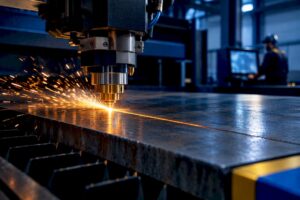
Laser cutting gives the shop a precise starting point for tube, plate, and bracket work. On stainless, the edge quality matters because rough cut zones are harder to prep for welding and more likely to hold contamination. Nitrogen-assisted cutting is valuable because it helps produce cleaner, less discoloured edges, which reduces post-cut cleanup before assembly.
CNC press-brake forming is just as important for brackets, base plates, and special transitions. A well-formed plate sits flat, lands where it should, and gives anchors a better starting surface. Poor forming can leave a twist or a lip that turns into a fitting problem on site.
Welding order matters more than people think
Austenitic stainless needs a disciplined welding sequence. If the shop overheats the material or welds out of order, the part can warp, pull out of alignment, or show more surface discolouration than it should. The welder also has to keep carbon steel contamination away from the stainless work area, because tiny transfers from the wrong tools or benches can show up later as rust staining.
Passivation and pickling are not optional extras
Post-weld passivation and pickling are where a proper stainless railing earns its long service life. Unpassivated weld zones are one of the most common reasons otherwise correct installations stain early. The surface around a weld needs to be cleaned, chemically restored, and left free of iron contamination so the passive layer can do its job again.
A quality control checklist should show the following before sign-off:
- Cut quality: edges are clean and ready for weld prep, not rough or heat-marked.
- Weld finish: beads are even, fully cleaned, and visually consistent with the rest of the assembly.
- Surface restoration: passivation or equivalent post-weld treatment has been completed where required.
- Hardware compatibility: anchors, bolts, and fittings match the specified grade and environment.
- Fit-up: posts, base plates, and handrail joints sit plumb, level, and properly aligned.
The practical takeaway is simple. If the shop is proud of the fabrication, it should be able to show you the prep, the weld cleanup, and the finishing steps, not just the final polish.
For Montreal work, that process is exactly where a local fabricator earns the job. A shop like Manara Corp can cut, form, and weld stainless components in-house, which helps keep the sequence controlled from part layout to final finish.
Reading a Railing Quote Like a Fabricator, Not a Buyer
A stainless quote should read like a scope sheet, not a guess. If it only lists “railings” and a linear footage price, you're not looking at a complete comparison. Two bids can name the same material and still leave out enough scope to make one look cheaper for the wrong reason.
The items that should be explicit
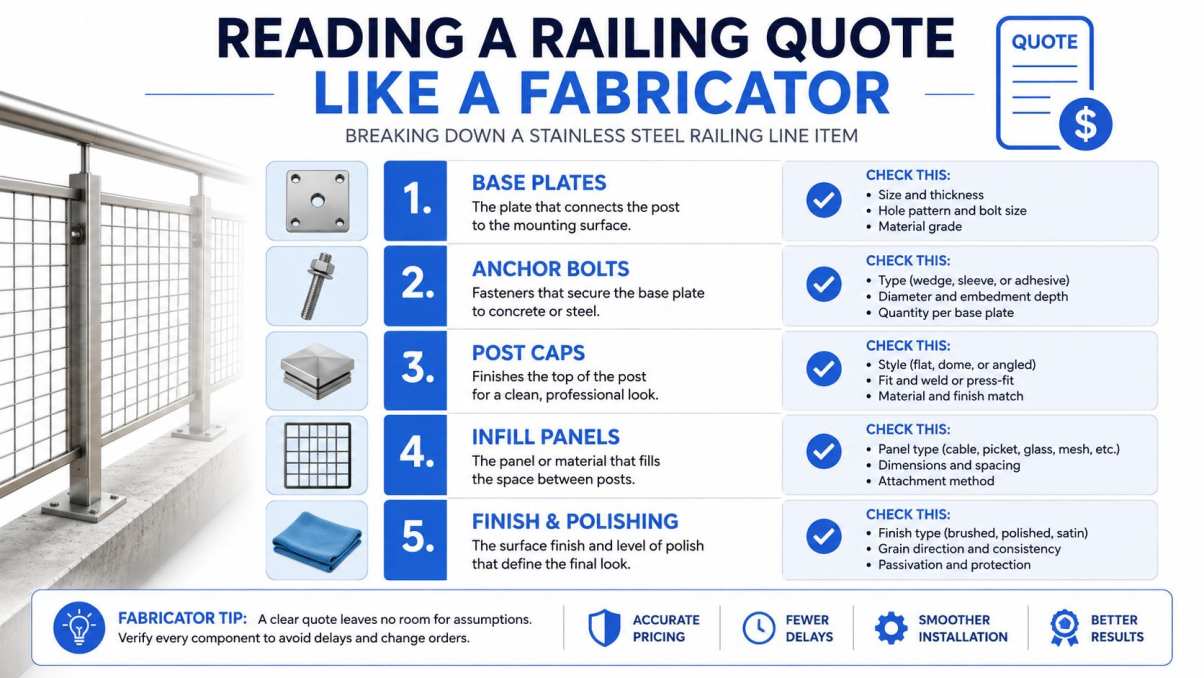
A usable quote should spell out the pieces that make the system work. If any of these are missing, ask whether they're included or excluded.
- Base plates: These determine how posts land on the substrate and how loads transfer into concrete, steel, or wood framing.
- Anchor bolts: These are part of the structural package, not an accessory.
- Post caps and end caps: They affect both finish quality and moisture entry at open tube ends.
- Infill panels or cables: If the railing uses glass, cable, or another infill, that scope has to be clear.
- Finish and polishing: “Stainless” is not the same as “finished stainless.”
- Site measurement and layout: If the fabricator is not confirming field dimensions, the quote is incomplete.
A bid can also hide scope by omitting connectors, brackets, or handrail-to-post details. That's where comparison shopping goes off the rails, because the visible line item sounds the same even when the actual deliverable isn't.
Handrails and guardrails are not interchangeable
Many project teams lose time here. A graspable handrail on a stair has different geometric and continuity requirements than a guardrail that's meant to resist lateral load. One protects the user's grip, the other protects the edge. If a quote prices only one of those systems and the architect assumes the other, the low bid isn't comparable.
The cheapest stainless quote is often the one that leaves out the hardware, the finish cleanup, or the field measuring that turns a drawing into a fit assembly.
The safest way to review a quote is to compare scope against scope, not price against price. If one contractor includes anchors, base plates, welded finishing, and passivation while the other doesn't, the second number is only cheaper on paper.
Maintenance Habits and Cost Over the Life of the Railing
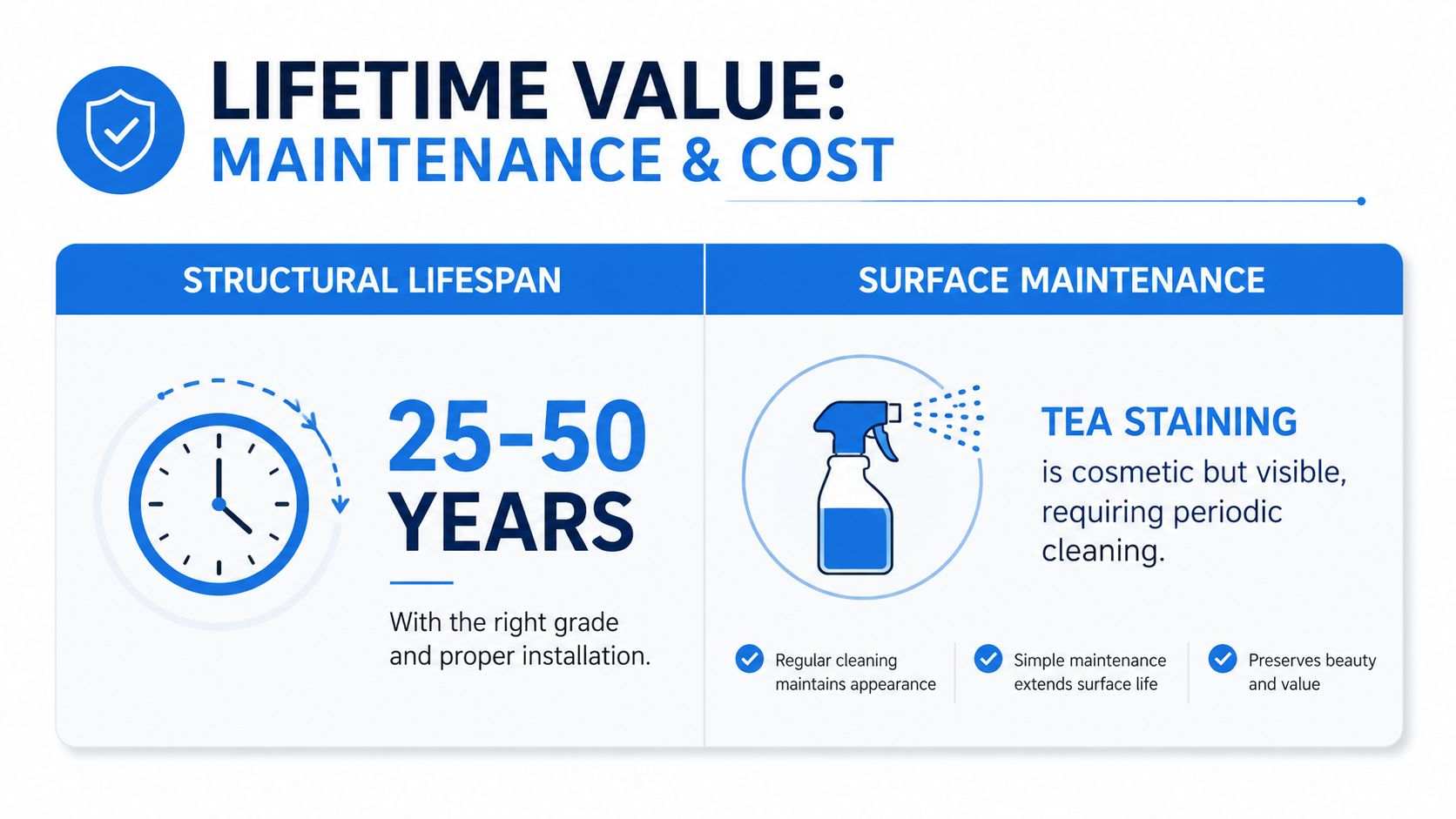
A stainless railing doesn't ask for much, but it does ask for the right kind of care. Owners usually call when they see tea staining, not when the structure itself is in trouble. That distinction matters because cosmetic staining can be cleaned, while neglected crevices and fasteners can turn into real corrosion problems later.
What tea staining actually means
Tea staining is surface discolouration, not an automatic structural failure. It usually shows up where salt, grime, or moisture sit too long on the metal, especially around welds, fasteners, and sheltered corners that don't dry quickly. People often mistake it for deep rust because it looks ugly, but the fix is usually cleaning, not replacement.
Maintenance mistake is assuming stainless can be ignored after installation. It can't. It just needs less intervention than painted steel or wood.
A practical cleaning rhythm for Montreal conditions
For interior railings, a light wipe with a mild cleaner and soft cloth is usually enough, with a more thorough check a few times a year. For exterior railings, especially on balconies and exposed stairs, rinse away winter residue after heavy salt exposure and give the surface a proper wash when the season changes. For pool-adjacent installations, rinse more often because chlorides and splash residue sit on the surface and in joints.
Use clean water, mild detergent, and a soft cloth or non-abrasive pad. Avoid steel wool, harsh bleach, and aggressive abrasives, because they can scratch the surface or contaminate it with iron. Pay special attention to welded zones, fasteners, and connection pockets where buildup hides.
Why the higher spec can cost less over time
The higher-grade choice and the cleaner maintenance habit usually win over a cheap install when you look at the whole ownership cycle. A better grade in the right exposure zone, plus regular washdown and spot inspection, reduces staining, delays repair work, and keeps the rail looking intentional instead of tired. That's especially true in Greater Montreal, where winter salt and trapped moisture are part of the environment, not an exception.
If you're comparing options for a stair, balcony, or custom guard in Greater Montreal, talk to Manara Corp about stainless fabrication, welding, and custom metal railings that are built around the actual site conditions. Visit Manara Corp to review your drawing set, ask the right scope questions, and get a railing package that's specified for the substrate, the exposure, and the winter reality.
Produced via Outrank