You're standing on a back stair in Montreal with a tape measure in one hand and a railing drawing in the other, and the problem isn't the look. The problem is that the posts, returns, and wall clearance you ordered don't quite match the landing you built, and the inspector is coming before the snow does. That's where custom handrails outdoor stops being a finish choice and starts being a fabrication decision, because the wrong geometry, the wrong metal, or the wrong mount turns into a costly rework fast.
For contractors, property managers, and homeowners, the question is simple. What will pass inspection, survive a Quebec winter, and fit the site without forcing a second visit? A good railing answer starts with code numbers, then material choice, then mounting, then finish, because that's the order that protects the job.
Table of Contents
- Why Outdoor Handrails Are a Bigger Decision Than They Look
- What a Custom Outdoor Handrail Actually Has to Do
- Choosing the Right Metal for a Montreal Winter
- Code Numbers That Decide the Design
- Mounting Methods and How the Shop Builds Around Them
- Finishes That Actually Hold Up Outdoors
- Two Custom Handrail Projects and How They Came Together
- A Short Checklist Before You Call the Shop
Why Outdoor Handrails Are a Bigger Decision Than They Look
The job usually goes sideways at the end. A contractor finishes the concrete, sets the stairs, and then discovers the railing that looked fine on paper won't clear the wall, won't match the rise, or won't satisfy inspection. That's the moment custom fabrication earns its keep, because the railing is no longer a decorative add-on, it's the last structural part the permit file depends on.
The mistake most people make
Most buyers start with style. They ask about colour, pick a profile, and assume the rest will sort itself out in the field. In reality, outdoor handrails are regulated structural components, and the shop has to fabricate to the site, not to a catalogue photo.
For projects in Montreal and the wider Quebec market, that matters even more because exterior stairs and ramps are unforgiving. The platform edge, post spacing, wall offset, and return detail all have to line up with the finished structure, not the drawing you started with. If the stairs are already poured and framed, off-the-shelf parts often force compromises that show up during inspection or after the first hard winter.
Practical rule: if the railing is tied to permit approval, measure the site first and pick the material second.
That is also why a shop's ability to fabricate and fit around real dimensions matters as much as the rail profile itself. A custom rail can be bent, welded, and anchored to suit the actual run, and for jobs that need custom metalwork beyond a straight standard section, a local shop like Manara Corp's railing work can build to spec instead of making the site conform to the part.
What this guide is really about
This isn't a style gallery. It's a field guide for the decisions that affect code compliance, corrosion resistance, and installation accuracy. The order matters, because the wrong material can be maintained, but the wrong geometry or bad fit-up usually means rework.
Outdoor railing work also lives in the gap between visible and invisible. People notice the finish, but inspectors and experienced builders notice the welds, the attachment points, the end returns, and whether the system was made for the actual stair run. Those details decide whether the job is tidy, durable, and sign-off ready.
What a Custom Outdoor Handrail Actually Has to Do
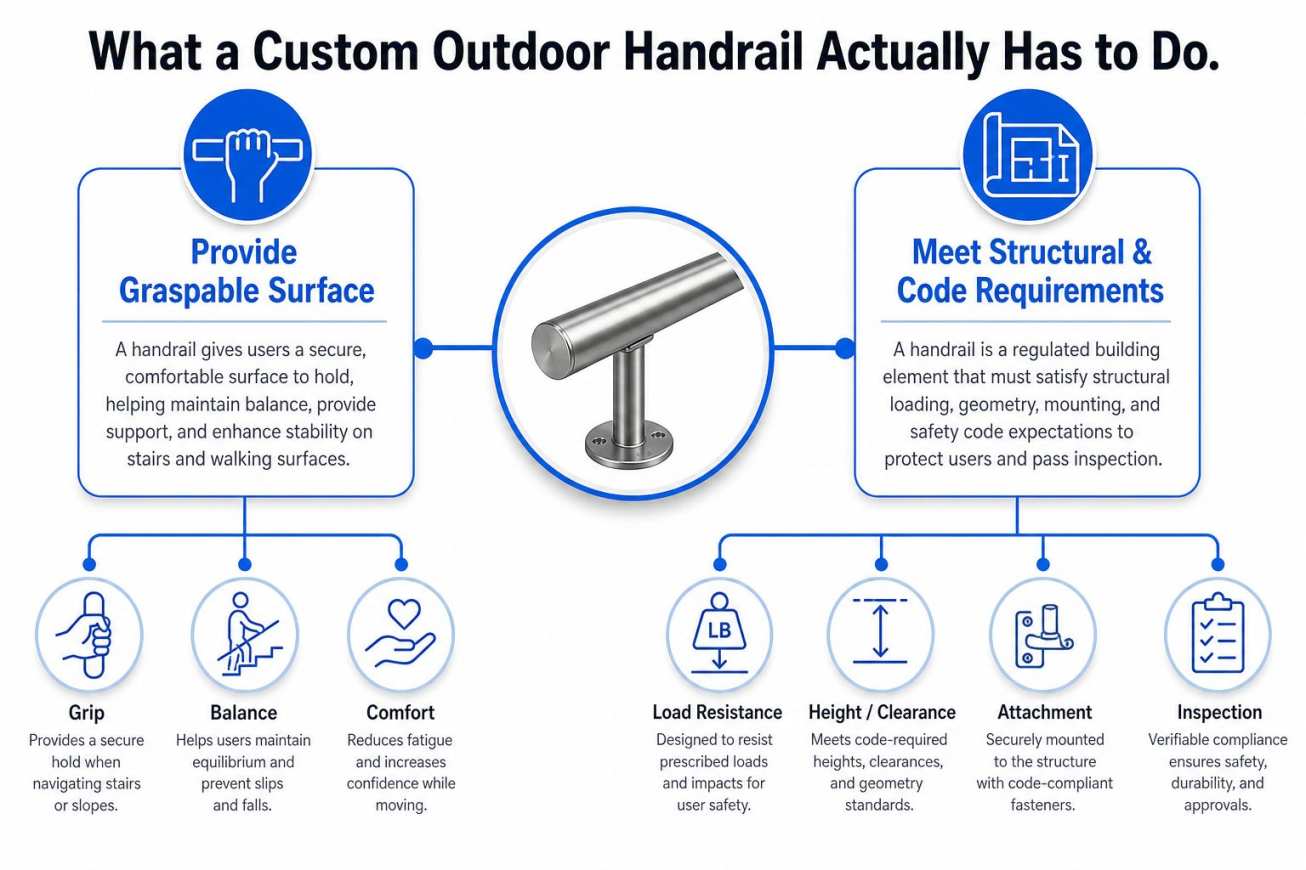
A custom exterior rail has two jobs at once. It has to give a person something secure to hold, and it has to act as a regulated barrier where a fall is possible. Those are related jobs, but they're not the same thing, and the fabrication details change depending on which role is carrying the load on a given stair or landing.
Graspable rail and guard rail are not interchangeable
The graspable handrail is the part your hand closes around on stairs or ramps. It needs to feel natural in the hand, stay continuous where required, and remain usable in wet or cold weather. The guard rail is the taller protective element that keeps people from stepping or falling off an edge.
On many outdoor assemblies, one built system has to satisfy both. A stair rail can serve as the graspable handhold while the same framework, or a connected upper rail, works as the guard at the landing or open edge. That's why shop drawings matter. The fabricator has to show which member does what, because inspection questions usually come from that split.
Why custom fabrication matters here
Stock railing sections are made for repeatable dimensions. Site-built exterior stairs are not. A poured landing, a stepped retaining wall, or a narrow side yard can push the rail line into a shape that needs custom posts, cut-to-length rails, and return details that line up with the building envelope.
A railing that looks right from the driveway can still fail if the handhold isn't continuous where the code expects it to be.
That's where custom fabrication beats off-the-shelf pieces. The shop can adjust post centres, bend or weld returns, and set the rail to the actual stair geometry. It also lets the installer preserve the hand clearance and post spacing the code asks for, instead of forcing the project into whatever comes in the box.
For Montreal jobs, that flexibility is more than convenience. It's the difference between a rail that fits the site cleanly and one that needs field trimming, extra brackets, or a second trip to make it pass.
Choosing the Right Metal for a Montreal Winter
The metal choice is really a maintenance choice. In Southern Quebec, the rail has to deal with freeze-thaw cycles, wet snow, road salt, and long periods where moisture sits on joints and fasteners. That means the cheapest material at purchase can become the most expensive system to own if the finish fails early or the touch-up cycle never ends.
Carbon steel, stainless, aluminum, and wrought iron
Carbon steel is usually the budget-friendly fabrication option, and it welds predictably. It's a solid choice when the project is going to be fully protected by galvanizing and coating, but raw carbon steel outdoors without a real corrosion strategy is a short-life decision. If the coating gets chipped and the steel is exposed, rust starts at the damage point and works outward.
Stainless steel costs more upfront, but it's the cleanest answer when the site has heavy weather exposure or salt. In exterior service, 304 is commonly used for general conditions, while 316 is the better call where chlorides are a bigger issue, including de-icing zones. Stainless still needs maintenance, but it gives you a much better starting point for long service life.
Aluminum makes sense when weight matters, when the project needs a cleaner modern look, or when the client wants less maintenance than painted steel. It doesn't rust the way carbon steel does, and it's a strong fit for many residential exterior stairs. The trade-off is that it needs the right detailing, because the whole system has to be built around its lighter weight and different weld and finish behaviour.
Wrought iron is still requested on some decorative jobs, especially where a more traditional profile is wanted. It can look excellent, but in a Montreal climate it usually asks more of the owner over time. The paint system has to be maintained, and once the finish breaks down, the rail needs attention quickly.
| Metal | Corrosion Behaviour | Typical Use | Finish Compatibility |
|---|---|---|---|
| Carbon steel | Needs protection, rusts if coating fails | Budget-driven custom work, fully coated systems | Galvanizing, powder coat over galvanizing, liquid paint |
| Stainless steel | Strong resistance, especially 316 in harsher exposure | Commercial stairs, salt-exposed sites, low-maintenance projects | Brushed, mill, or polished finish |
| Aluminum | Naturally corrosion resistant, light weight | Residential exteriors, modern profiles, lower-maintenance jobs | Powder coat, anodizing |
| Wrought iron | Decorative, but finish upkeep matters | Traditional residential and heritage-style work | Paint systems, sometimes powder coat |
What actually drives lifecycle cost
The headline price only tells part of the story. The cost includes repainting, touch-up visits, and early replacement if the finish fails. A rail that can be welded and coated accurately in the shop often saves more than a slightly cheaper system that needs constant field repair.
For commercial stairs and exposed residential entrances, I usually push clients to think in terms of service life, not just material taste. If the site is near salt, gets hard winter traffic, or has to look presentable without annual fuss, stainless steel or properly protected aluminum is usually easier to live with than decorative steel that depends on perfect maintenance.
Code Numbers That Decide the Design
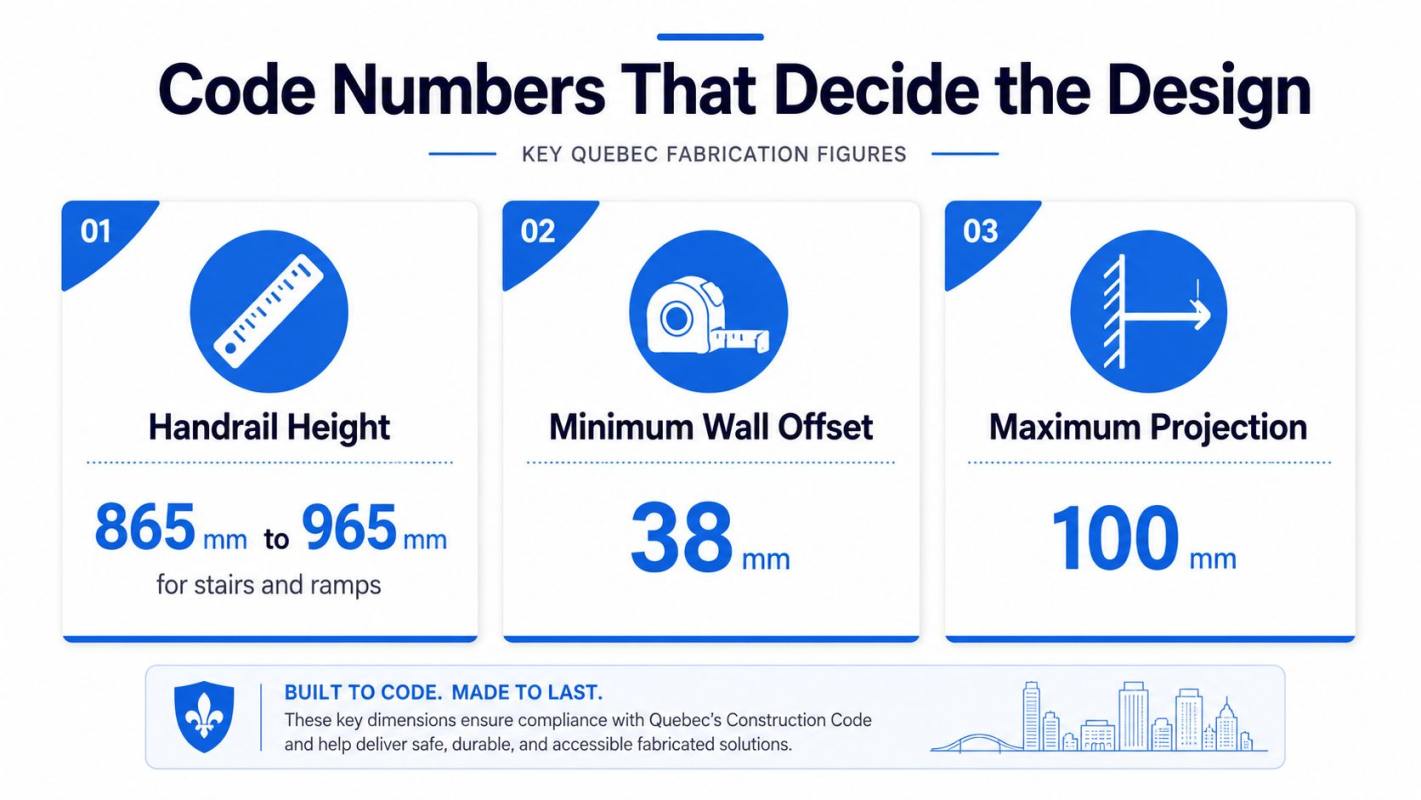
The code is where the design gets real. For Canadian accessibility guidance, handrails on stairs and ramps are typically required to sit between 865 mm and 965 mm high, with a 38 mm clear wall offset and a circular graspable profile usually limited to 32 mm to 51 mm outside diameter. Outdoor railing systems also need to resist a 200-pound concentrated load and a 50 pounds per linear foot uniform load in the California reference data, which reinforces the larger point, these are structural components, not trim pieces. The Montreal takeaway is the same, measure the field carefully and fabricate to the numbers the inspection will check. Canadian handrail geometry guidance and load-focused railing specification context both point to the same reality, detail drives approval.
Why the geometry matters more than the finish
A rectangular or plate-welded rail can still pass, but only if the grab area lands inside the allowed envelope. That's the part many non-fabricators miss. A pretty custom profile that feels comfortable in the hand can still fail if it doesn't meet the graspability requirement or leaves too little clearance at the wall.
The 38 mm offset is not a cosmetic dimension. It keeps knuckles clear of the wall and gives the hand enough room to use the rail. In winter, that clearance also helps with gloves and with the little drifts of snow and ice that collect where a rail is too tight to the wall.
Where retrofit costs start
Most expensive railing problems come from measurements taken too early or too casually. A slab edge that looked square, a finish grade that changed after backfill, or a landing that ended up slightly higher than planned can all move the rail out of tolerance. Once posts are welded and coated, correction takes cutting, rewelding, and refinishing.
Field rule: if the stair is not fully built, treat every dimension as provisional until the final measure is taken.
That's why end returns, continuity, and graspable shape have to be considered in the shop drawing, not patched on-site. The more exact the measure, the less the installer has to force the rail into compliance after the fact.
Mounting Methods and How the Shop Builds Around Them
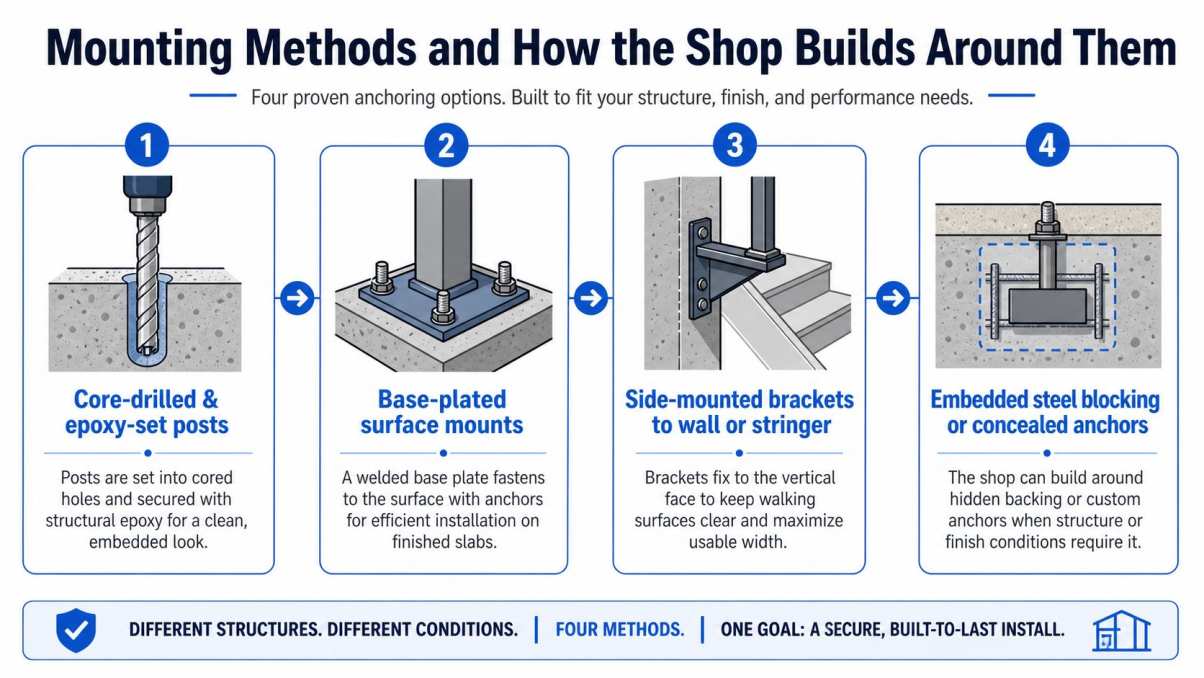
Manara Corp's welding services matter here because the attachment method changes the fabrication detail, not just the install day. A rail shop doesn't only cut and weld the visible parts, it also builds the base plates, brackets, sleeves, and reinforcement points that let the system anchor cleanly to the substrate.
The four mounting patterns that come up most
Core-drilled and epoxy-set posts fit concrete work where the slab or landing is sound enough to accept embedded posts without visible base plates. This is common on new construction and on heavier commercial jobs. The risk is poor hole prep or weak concrete at the edge, which can compromise the anchor zone.
Base-plated surface mounts are the most familiar option. The post lands on a plate, the plate is fastened to concrete or framing, and the whole system stays visible and serviceable. The downside is that exposed plates can trap moisture if they're not detailed well, so finish and drainage matter.
Side-mounted brackets work when the post can't land on top of the structure, or when the stair stringer or wall gives a better fixing point. They're efficient in the right layout, but they're unforgiving if the substrate isn't strong enough. Pull-out or flex usually shows up when the installer treats a side mount like a universal fix.
Embedded posts are cast into concrete or set in grout. They're strong when done well and protected from movement, but they need careful planning because frost, drainage, and alignment all affect long-term performance. If the post is trapped in the wrong detail, winter movement can telegraph into the rail line.
How the shop decides what to build
Mounting isn't an afterthought. It changes hole pattern, plate size, weld location, and sometimes the chosen metal. A lighter aluminum rail might work beautifully on a surface mount, while a heavier steel or stainless system can suit a commercial stair with drilled anchors or embedded supports.
For a Montreal-area job, the right anchor method depends on the substrate you have, not the one on the drawing. Concrete, wood framing, masonry, and steel stringers each ask for different bracket geometry and different tolerance control. If the shop doesn't know the substrate, the job is still in rough draft.
The strongest handrail is the one that matches the structure it's fixed to.
Finishes That Actually Hold Up Outdoors
Finish choice is not about colour first. It's about whether the rail can keep its surface intact after repeated wetting, drying, salt exposure, and winter abrasion. In Montreal, that means the finish has to work with the metal, not just cover it.
What tends to hold up and what tends to fail
Hot-dip galvanizing is the baseline protection many steel projects need. It gives the carbon steel a sacrificial barrier, which is far more useful outdoors than paint alone. If the rail will be powder coated after galvanizing, the coating has a better foundation and is less likely to fail from the inside out.
That matters because powder coating over raw carbon steel is a common mistake. Once moisture gets under the coating through a chip or edge defect, corrosion can start below the film, and the bubble you see later is usually a symptom, not the cause.
Liquid paint systems can work on the right project, but they depend heavily on prep and on how often the owner expects to maintain them. They're useful where touch-up is expected, but they're not as forgiving as a well-executed metal protection system.
Anodizing on aluminum fits the material well and keeps the finish integrated with the metal. It's a practical option when the project wants a cleaner architectural look and stable exterior performance.
Mill finish stainless means the metal is left with its factory surface rather than covered in a coloured coating. It's common because stainless is already doing the corrosion-management work, and in service the owner is maintaining the surface, not rebuilding the protective skin.
What to ask for on the quote
If the quote says powder coat, ask what's underneath it. If it says stainless, ask whether the exposure level calls for 304 or 316. If it says painted steel, ask how the finish will be repaired when winter chips the edge at the base plate.
For buyers who want one shop to handle the part flow, a local fabrication house such as Manara Corp can cut, bend, weld, and form the rail components in-house, which helps keep the attachment details and the finish sequence aligned with the design.
Two Custom Handrail Projects and How They Came Together
One residential job in the West Island started with a tight rear stair and a narrow property line. The owner wanted a clean modern look, but the constraint was getting the rail to fit the landing without crowding the walk space. Aluminum with a powder-coat finish made sense because the rail needed to stay light, keep maintenance low, and present a neat profile against the house.
A residential stair that needed geometry first
The mount was surface-plated because the concrete landing was sound and the installer needed predictable alignment. The shop built the posts to suit the actual stair rise and guard height, then matched the returns so the handhold stayed continuous. The finish was chosen after the structure was solved, not before.
That order mattered. If the aesthetic had been locked in first, the rail could have ended up too bulky for the space or too tight to the edge to satisfy the finished line. The site won, and the design followed.
The commercial entrance in Laval pushed the other way. Salt exposure, public traffic, and accessibility concerns made stainless the more sensible call. In that case, a brushed stainless system with core-drilled posts and continuous welded returns gave the owner a rail that looked deliberate and held up to the weather.
A small commercial entrance with less room for error
The commercial stair also demanded cleaner shop control, because the installation had to look finished on day one and stay that way. The fabricator had to manage the welds, the alignment, and the returns so the accessible grip stayed consistent from bottom to top. That's where profile work and formed parts matter, because the rail has to read as one system, not a handful of attached bits.
For a shop that handles custom metal shaping as part of the job flow, sheet bending and rolling work can support the same kind of accuracy the rail needs in bends, returns, and transition pieces. The lesson on both projects was the same. Material changed, but the checklist didn't.
A Short Checklist Before You Call the Shop
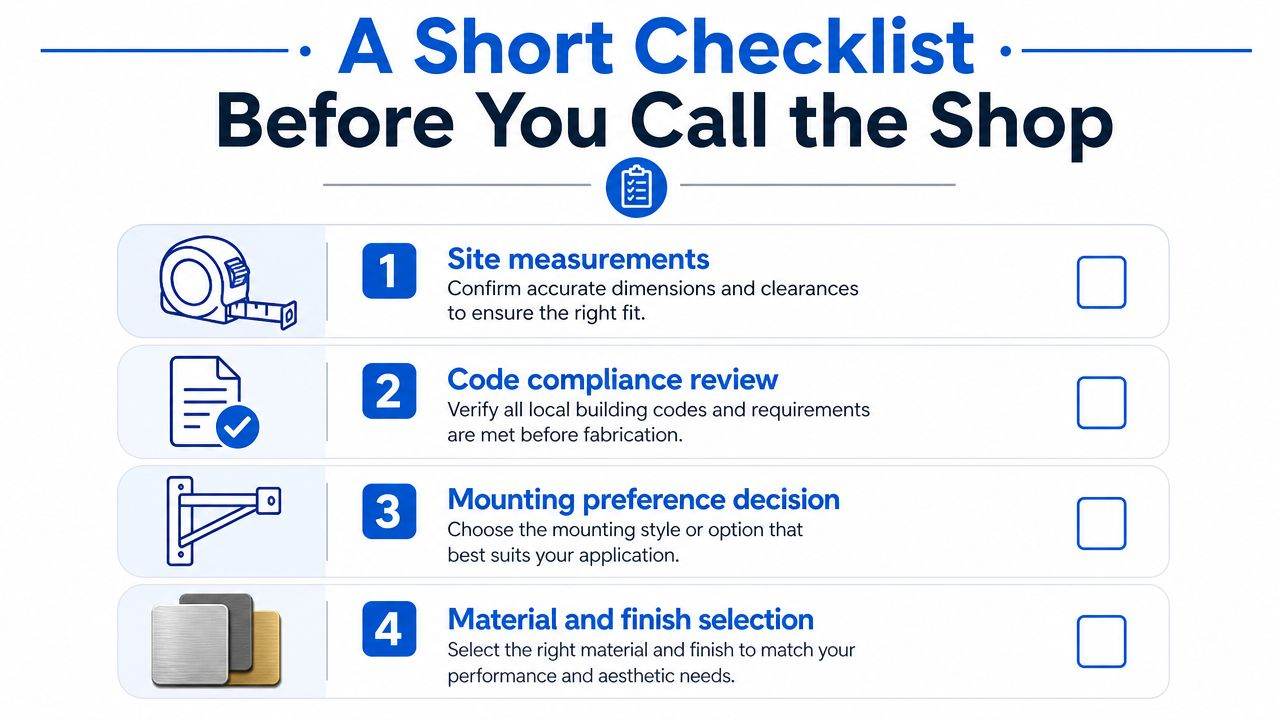
Before you call for a quote, have the site and the code questions answered. The best custom handrails outdoor project starts with measurements, substrate photos, and a clear idea of what the railing has to do, not with a colour sample.
- Site measurements: bring stair width, landing size, rise, run, and clear photos of the install area.
- Code use case: say whether the rail is residential, commercial, or mixed-use, because the geometry and load expectations change.
- Mounting preference: note whether the substrate can take core drilling, surface plates, side brackets, or embedded posts.
- Material and finish: decide based on exposure, maintenance tolerance, and whether the site sees salt, snow, or heavy public traffic.
If you can answer those four points, the first shop visit gets much easier. It also prevents the common problem where the rail is ordered before the site is fully known and then has to be rebuilt around the dimensions later.
If you need a Montreal shop to build custom rail components, fit them to the site, and keep the fabrication tied to the actual stair geometry, Manara Corp can help with made-to-spec metalwork for railings, stairs, and related assemblies. Visit Manara Corp to discuss your project, share your site measurements, and get a fabrication plan that's built around code, climate, and install reality.
Enhanced by the Outrank app