You're standing at the quote screen with three jobs open and none of them forgiving the wrong choice. One is 16-gauge galvanized ductwork that needs to nest cleanly and fit first time. One is a brass architectural panel with tight cut-outs that the client will inspect under good lighting. One is a thick mild steel plate where the buyer cares less about polish and more about getting it out the door. That's the laser cutting vs plasma cutting decision in Greater Montreal, not a lab comparison, a quoting problem.
| Criterion | Fiber Laser | Plasma |
|---|---|---|
| Upfront capital | Higher | 2–5× less than fibre laser, typically, according to Hypertherm, source |
| Hourly operating cost | About $20/hour in Xometry's estimate | About $15/hour in Xometry's estimate, and some industry sources put plasma around 44% cheaper per hour in certain scenarios, source |
| Precision | Tight tolerances and narrow kerf | Good enough for rougher work, wider kerf |
| Edge finish | Clean, weld-ready, less secondary finishing | Rougher edge, more finishing |
| Thick plate | Strong on modern high-power systems | Still useful where raw penetration matters |
| Materials | Conductive metals plus copper and brass | Only electrically conductive metals |
Table of Contents
- The Two-Minute Decision a Fabricator Faces Every Week
- How Laser and Plasma Cutting Work
- Precision, Edge Quality, and the Heat-Affected Zone
- Thickness Limits, Speed, and Material Capability
- Cost Breakdown Beyond the Sticker Price
- Material-Specific Decisions for Stainless, Aluminum, Copper, and Brass
- Matching the Process to the Project Type
- A One-Glance Decision Framework for the Quote Screen
The Two-Minute Decision a Fabricator Faces Every Week
A contractor in Lachine drops off drawings and wants a fast answer. The duct job is straightforward, the railing job is fussy, and the plate job is heavy enough that everybody in the shop knows it'll chew up time if the process is wrong. That's the moment where a good estimator stops thinking in terms of machine loyalty and starts thinking in terms of total job cost.
Three jobs, three answers
For rectangular HVAC ductwork in galvanized sheet, the answer is usually laser. The parts need to nest tightly, the edges need to fold and seal cleanly, and nobody wants to spend labour fixing sloppy cut lines. For a brass railing with decorative cut-outs, the choice is even clearer, because finish quality is part of the sale.
The industrial plate job is different. If the buyer wants thick mild steel and doesn't care about cosmetic finish, plasma still makes sense in plenty of shops. That doesn't make plasma obsolete, it just means the job has to justify the trade-off.
Shop-floor rule: if the part will be seen, welded, powder-coated, or installed without much hand work, the cut quality matters more than the hourly machine rate.
The mistake most shops make is treating laser cutting vs plasma cutting like a single yes-or-no question. It isn't. Thickness, material, edge appearance, nesting efficiency, and downstream labour all push the answer one way or the other.
In Greater Montreal, that matters because the work mix is broad. You're not quoting only structural plate or only ornamental metal. You're quoting all of it, often in the same week, and the wrong cutting process can make a job look cheap on paper and expensive in the shop.
How Laser and Plasma Cutting Work
Fibre laser cutting in plain language
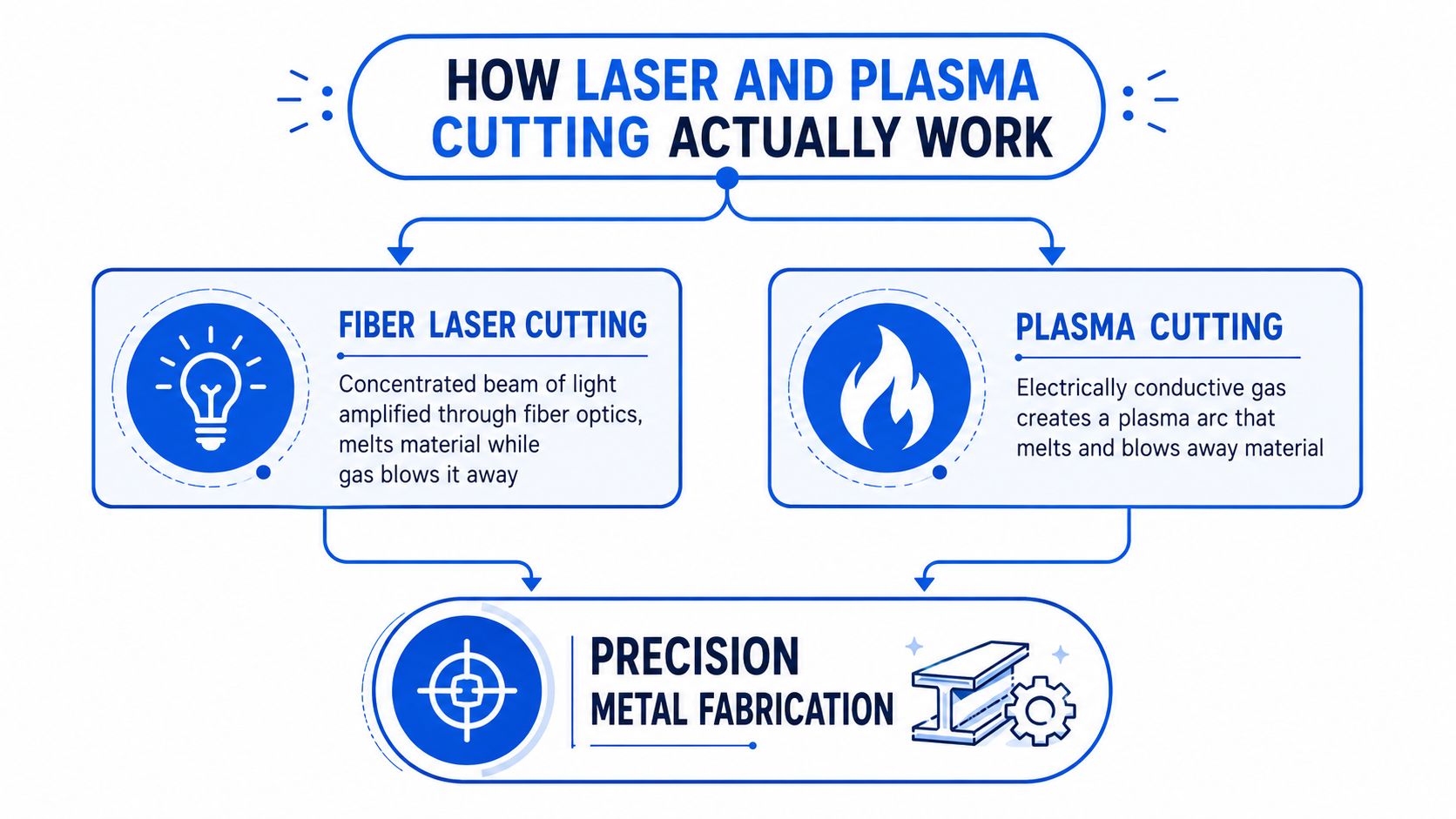
A fibre laser sends a concentrated beam of light through fibre optics, then focuses it onto a tiny spot on the metal. That energy melts or vaporises the material, and assist gas blows the cut material out of the kerf. When nitrogen is used, the edge stays cleaner and oxidation is reduced, which is why laser cut parts often go straight into welding or assembly.
That setup gives you a cut that is controlled from the top down. The beam is narrow, the heat stays concentrated, and the wall of the cut stays far more predictable than with a rough thermal process. On shop floors around Greater Montreal, that difference shows up in fit-up first, then in the labour line when parts need less touch-up before assembly.
A fibre laser is the right tool when the part has to come off the table ready for the next operation. If you are quoting brackets, enclosures, ductwork, stainless trim, or any part where the finish is visible, the cleaner cut reduces rework and protects margin. For a closer look at high-precision laser cutting services, see Manara Corp's laser cutting overview.
Plasma cutting in plain language
Plasma cutting uses an ionised gas jet, a very hot electrically driven arc that melts the metal and pushes it away from the cut path. It only works on electrically conductive metals, and it is built for speed through thicker, rougher work. The process is less delicate, and that is exactly why it still has a place in heavy fabrication.
The result is a wider cut and a rougher edge. For jobs where the edge gets ground, painted, or hidden, that is acceptable. For parts that need to fit cleanly without extra labour, it creates a real cost problem.
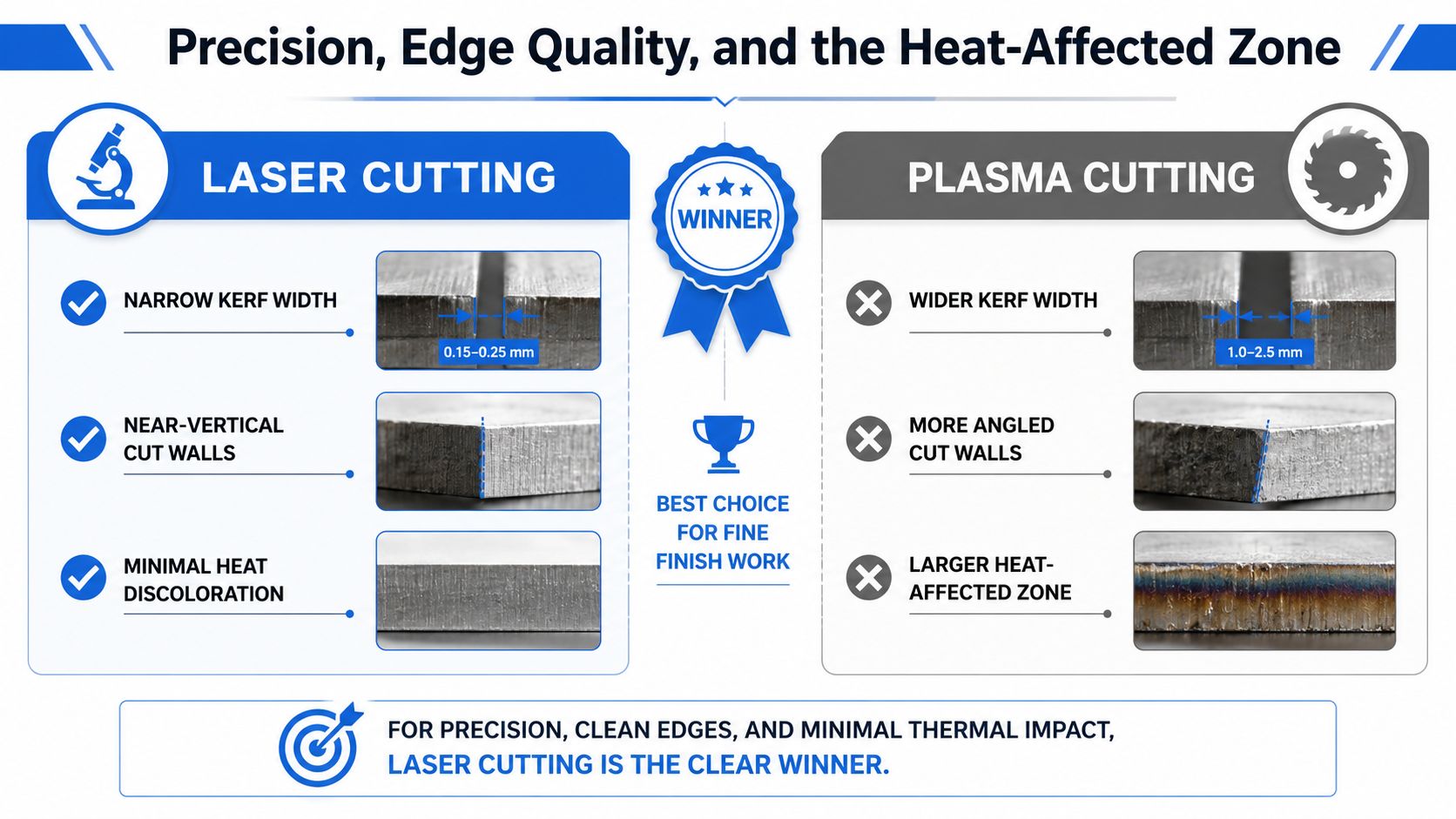
A technical comparison from Inside Metal Fab shows the practical result clearly, linear tolerance of ±0.025 mm to ±0.125 mm for precision fibre laser versus ±0.5 mm to ±1.25 mm for HD plasma, and kerf width of 0.12 mm to 0.38 mm versus 1.5 mm to 3.8 mm, respectively, source. That difference shows up in every fit-up, every weld prep, and every time someone tries to assemble a part without rework.
In practice, that means laser usually saves money on parts that need accuracy, clean edges, or a good finish straight off the machine. Plasma usually wins on heavy plate where the customer is paying for throughput, not cosmetic quality, and where extra cleanup does not wreck the quote.
Precision, Edge Quality, and the Heat-Affected Zone
What the cut leaves behind
The edge is where the quote turns into labour. Laser leaves a narrow kerf, a straighter wall, and less cleanup when the machine is dialled in properly. Plasma leaves a wider cut path, more dross risk, and more heat spread around the edge, so the part usually needs more finishing if it has to look right or fit tightly.
That difference is not cosmetic. It changes how long a part sits at the bench before it is ready for welding, painting, or assembly. On a welded assembly, a cleaner edge means faster tack-up, less grinding, and fewer fit corrections before the welder starts.
Why edge quality changes the real cost
For the estimator, the cut quality matters because it controls the hidden labour after the cut. A clean laser part can go straight to fit-up on a lot of work, while a plasma part often needs deburring, edge cleanup, or extra handling before anyone trusts the dimensions.
That is why finish-sensitive work gets expensive fast when the process is wrong. Stainless shows it clearly. Discolouration and edge oxidation cost money because somebody has to remove them, hide them, or explain them away. That is also why finish-sensitive jobs usually land on laser, not because the cut looks nicer in a brochure, but because the part costs less to finish in the shop.
The practical takeaway for Greater Montreal contractors is simple. If the part will be seen, bolted, or welded with minimal touch-up, laser is the safer estimate. If the edge will disappear into a rough structure, plasma can still be the better business decision.
For higher-fit work, Manara Corp's high-precision laser cutting service fits the job because the process is built around tight edge control, not just raw throughput.
A technical comparison from Inside Metal Fab shows the practical result clearly, source. The point is not just tighter numbers on paper. It is how those differences show up in fit-up, weld prep, and whether a part needs a second pass before it can move on.
Thickness Limits, Speed, and Material Capability
Where laser now beats the old plasma assumptions
A shop quote gets messy fast when the plate gets thicker and the old rulebook stops holding. Plasma still has a place on heavy cut work, but the old habit of sending anything thick to plasma by default is outdated. High-power fibre lasers now cut a much wider range of mild steel and stainless than most shops used to assume, and on those materials the speed gap has shifted hard in laser's favour. IPG Photonics says that at 10 mm to 40 mm thickness, high-power fibre lasers consistently outperform plasma cutters on mild steel and stainless steel, and at 40 mm, a 60 kW laser cuts mild steel about 2.5× faster than a 460 A plasma cutter and stainless steel about 3.2× faster source.
That matters because the crossover is no longer where a lot of estimators still think it is. The laser side has moved into plate ranges that used to belong to plasma by habit, and that changes how you quote real jobs in Greater Montreal, especially when the part has to be fit, welded, or finished without a pile of cleanup.
Laser vs Plasma at a Glance
| Criterion | Fiber Laser | Plasma |
|---|---|---|
| Thin sheet | Excellent | Usable, but less clean |
| Medium plate | Strong, especially with high power | Still competitive on rough work |
| Very thick plate | Depends on machine power | Often the practical choice |
| Materials | Stainless, aluminium, copper, brass, and steel | Only electrically conductive metals |
| Assist and edge quality | Clean cut, especially with nitrogen | Rougher edge, more finishing |
For a shop that prices by real labour, the table matters less than the downstream work it implies. Laser keeps the edge tighter and the kerf narrower, which helps on nesting and on parts that need to fit the first time. Plasma still makes sense when the part can tolerate a rougher edge and a wider heat-affected zone, because the job is going into a structure where finish does not drive the cost.
What that means on the shop floor
A plasma table still earns its keep on heavy conductive plate where rough finish is acceptable and penetration speed matters more than cosmetic quality. That is a real business case, especially on thick structural parts, repair work, and components that will be burned, welded, or ground anyway. For sheet, medium plate, and a lot of work that used to be handed to plasma without much thought, laser is the better production choice.
If you are quoting a part that has to land cleanly and stay consistent, use laser by default. If the part is thick, conductive, and forgiving, plasma can still be the cheaper machine choice. For contractors who want a tighter look at the process side, Manara Corp's laser cutting metal fabrication service fits that kind of work because it is built for controlled cut quality, not just raw burn speed.
For Greater Montreal work, I would price laser first for most precision sheet and medium-plate jobs. Plasma only moves to the front when the part is thick enough, the material is conductive, and the edge can be left rough without creating extra labour later.
Cost Breakdown Beyond the Sticker Price
Upfront price is only the first line
Plasma usually wins the purchase-order fight first. Hypertherm says the initial investment for plasma is typically 2–5× less than for a fibre laser system, which explains why plasma still shows up in so many shops, source. That lower entry price matters, but it does not decide the job. A cheaper machine that creates more grinding, drilling, rework, or scrap can become the expensive choice by the end of the month.
The core question is not what the machine costs. It is what the cut costs after the cut is finished, the part is handled again, and the shop sends it out the door.
The hidden labour line
The labour after the cut is where plasma often loses the quote. A rough edge adds grinding. A wider kerf removes more material on nested layouts. A larger heat-affected zone means more attention before welding, coating, or fit-up. None of that shows up on the machine invoice, but it shows up on payroll and in missed schedule time.
On stainless, the downstream hit is even clearer. A cut that needs edge cleanup can wipe out the savings from the lower machine rate fast, especially on visible parts, brackets, trim, and anything that has to move straight into assembly. On thick plate, kerf waste also matters more than buyers expect, because a wide cut steals real stock from every part on the sheet. That is where plasma can look cheap on paper and expensive in the nest.
For a Greater Montreal contractor, the right question is simple. Does the part need one clean cut and a quick move to the next operation, or does it need a second pass with a grinder, a drill, or a fitter? If the answer is the second one, laser usually pays for itself in labour reduction even when the machine rate is higher.
Estimator's rule: do not compare machine time by itself. Compare machine time plus finishing time, scrap, and rework.
That is the line item most buyers miss. In mixed-job shops, the process that leaves fewer hands touching the part after the cut is usually the cheaper quote in the end.
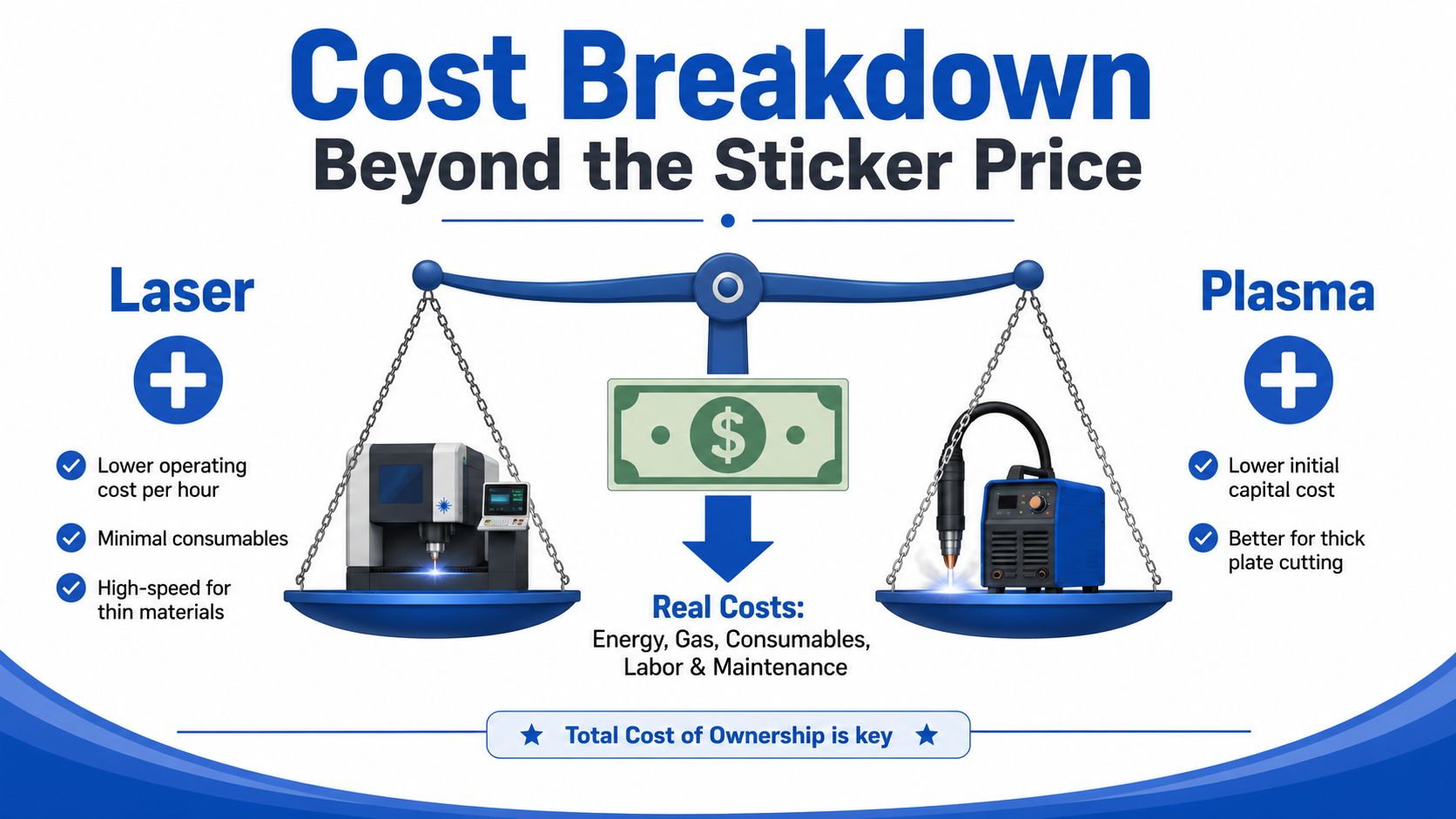
Manara Corp's laser cutting metal fabrication capability sits in that reality. The point is not marketing polish, it is fewer finishing steps, less material waste, and less labour tied up after the cut. Hypertherm's plasma versus laser comparison supports the same basic conclusion, once you look past the purchase price and into the work that follows.
Material-Specific Decisions for Stainless, Aluminum, Copper, and Brass
Stainless is a finish question first
Stainless is where plasma gets exposed fast. The problem isn't just the cut, it's what the cut does to the edge appearance and what comes after. If the part is architectural, food-related, or visually exposed, laser with nitrogen assist is the practical answer because it gives you a cleaner edge and reduces the finishing burden.
That's why stainless railings, trim pieces, enclosures, and visible brackets usually belong on laser. The shop isn't just selling a cut, it's selling a result that can move to the next operation without a lot of hand work.
Copper, brass, and aluminium change the calculus
Plasma only works on electrically conductive metals, and that limitation narrows the field immediately. Fibre lasers open the door wider for copper and brass, and they also handle steel and aluminium in the same workflow, which matters in architectural metalwork and custom fabrication. Those materials tend to punish sloppy edges more than mild steel does.
For decorative work, finish-sensitive work, and parts that have to fit tightly in the field, the narrow kerf is the money saver. Tight nesting matters because expensive sheet stock leaves less room for waste, and clean edges matter because nobody wants to pay twice, once to cut it and again to clean it up.
The practical Montreal answer
Manara Corp's fibre laser setup with nitrogen assist is a good example of the kind of equipment that changes the answer on these materials. It's not about branding, it's about the fact that a shop can cut carbon steel, stainless steel, aluminium, copper, and brass in one environment and keep the edge quality high enough to avoid extra finishing.
If the part has to look right on day one, laser is the safe call.
For HVAC contractors, designers, and architectural fabricators in Greater Montreal, that means stainless trims, copper details, brass accents, and aluminium components should be quoted with laser first. Plasma still has a role, but not on finish-sensitive work where the edge is part of the product.
Matching the Process to the Project Type
Quote the job, not the machine
For HVAC ductwork and fittings, I'd put laser first almost every time. Rectangular sections, transitions, and fittings depend on nesting efficiency and clean fold lines, and the downstream fit-up matters more than saving a little on the cut itself.
For architectural railings and stairs, laser is the default again. The drawing usually includes visual details, and clients notice edge quality, symmetry, and clean internal corners long before they care about machine type. That's where Manara Corp's laser cutting advantages for precision metal fabrication line up with real project demands.
For industrial laser-cut parts, the decision depends on tolerance and volume. If the part has bolt holes, mating faces, or downstream assembly, laser wins because it reduces rework. If it's a thick, rough structural plate and speed beats finish, plasma can still be the right production choice.
For heavy structural work, plasma still has a place. Thick, conductive plate with loose cosmetic requirements is where the lower-cost process can make sense, especially if the shop already has the workflow built around cleanup and secondary ops.
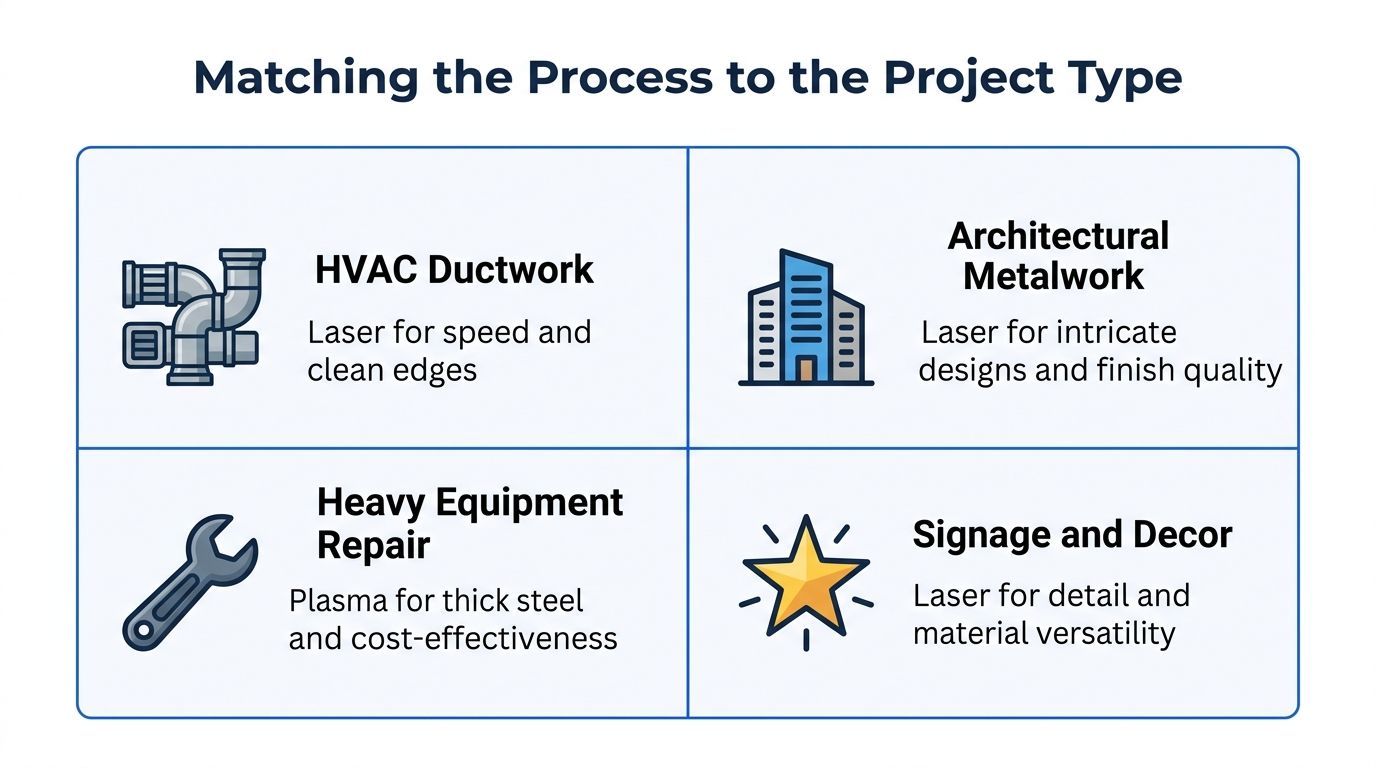
The rule I use is blunt. If the job is seen, welded, coated, or installed with little hand work, laser is the cleaner quote. If the job is thick, conductive, and function-first, plasma can still be the lower-risk choice on the estimating sheet.
A One-Glance Decision Framework for the Quote Screen
At the quote screen, start with material, then thickness, then finish, then volume. Stainless, aluminium, copper, brass, and visible architectural work point to laser. Thick conductive plate with a rough finish tolerance points to plasma. High mix, high detail, or low tolerance for post-processing points to laser too.
The crossover is no longer “laser for thin, plasma for thick.” Modern high-power laser systems have pushed the boundary upward, so the answer is what the drawing asks for and what the part needs after the cut.
If the cut is only the first operation, laser usually earns back its cost in saved labour, less grinding, and fewer finish problems. If the job is brute-force plate cutting and a rough edge is acceptable, plasma still belongs on the floor.
A Montreal shop quoting a staircase stringer, a stainless panel, or a bracket set for final assembly should default to laser. A shop quoting thick structural plate for a job that will be welded, cleaned up, and hidden on site should price plasma without apologizing for it. The mistake is paying for laser precision on parts that will be ground anyway, or accepting plasma on parts where kerf waste, edge cleanup, and finish loss will eat the margin.
For the quote sheet, I keep it simple. If the part is seen, fitted, coated, or installed with little handwork, laser is the cleaner number. If the part is thick, conductive, and judged on function more than appearance, plasma is still the practical call. That is the screen check that keeps a bid honest before the job ever hits the floor.
If you're quoting ductwork, architectural metal, or production parts in Greater Montreal, talk to Manara Corp about laser cutting, forming, welding, and custom fabrication on one shop floor. Bring the drawing, the material list, and the finish requirement, and let the process follow the job instead of the other way around.
Drafted with Outrank