For most Montreal projects, steel is the better choice when the stair has to carry heavy loads, span a long distance or stay slim. Aluminum is the better choice when weight, low upkeep and a long life in salt and moisture matter most. Neither metal wins everywhere. The right answer depends on where the stair sits, how it is used, how long you want it to last and who will maintain it.
This guide compares the two on strength, winter performance, maintenance, cost and code. It ends with a short method for choosing, written for homeowners, contractors, property managers and designers across the island, Laval, the South Shore and the West Island.
TL;DR
- Steel is stronger and stiffer, handles long spans and wide treads with modest stringer depths, and suits heavy-use or structural stairs.
- Aluminum is much lighter, resists rust by nature and needs little upkeep, which helps on balconies, rooftop access and tight sites.
- Road salt and freeze-thaw cycles decide outdoor lifespan. Steel needs a protective coating and regular checks. Aluminum needs mainly cleaning.
- Aluminum usually costs more up front, while steel can cost more over time in repainting. Get the installed price of both for your exact stair.
- Code applies to both metals. Treads, guards and loads must meet Quebec’s construction requirements, so involve your fabricator early.
Table of Contents
- Steel vs aluminum stairs at a glance
- Strength, stiffness and weight
- How each metal handles Montreal winters
- Maintenance: what you will actually do each year
- Cost: upfront price versus lifetime price
- Code and engineering requirements in Quebec
- What about stainless steel?
- How to choose: a short decision guide
- Perspective
- Get your stair quoted in both metals
- FAQ
- Sources
Steel vs aluminum stairs at a glance
The table sums up the differences that matter on a real job. The sections below explain each row.
| Factor | Steel | Aluminum |
|---|---|---|
| Strength and stiffness | Higher. Slim stringers can span far | Lower. Needs deeper or heavier sections for the same span |
| Weight | Heavy, which often means a crane or more hands on site | Much lighter, easier to handle and install |
| Rust | Rusts unless protected (galvanizing, paint) | Does not rust. Forms a thin oxide layer |
| Winter upkeep | Inspect coatings yearly, touch up chips, repaint over time | Rinse off salt, clean in spring |
| Typical upfront cost | Lower | Higher |
| Best for | Long spans, heavy traffic, industrial and multi-family stairs, floating designs | Balconies, exterior stairs, tight access, low-maintenance buildings |
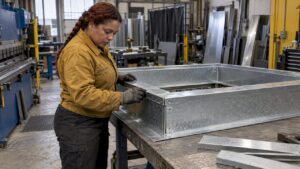
| Welding and fabrication | Forgiving, widely done | Needs aluminum-specific welding skill and filler |
Strength, stiffness and weight
Steel is stronger and stiffer than aluminum. That is the main reason it is the default for demanding stairs. A professional manual from the National Association of Architectural Metal Manufacturers notes that steel is often the usual choice for multi-family buildings, deck access and second-floor entries because it handles long spans and wide treads with relatively modest stringer depths compared with aluminum.
In practice, this shows up in three ways:
- Span. If your stair has to run a long way between supports, a steel stringer stays slimmer. An aluminum stringer carrying the same load usually has to be deeper.
- Feel underfoot. Stiffness affects bounce. A light, slender stair in any metal can feel lively if it is under-designed, but aluminum has less reserve, so the design needs more care.
- Design looks. Floating treads, single-stringer stairs and thin sightlines are easier to achieve in steel.
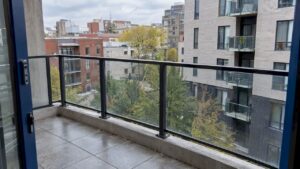
Aluminum answers with weight. It is far lighter, so it is easier to carry up a narrow side lane, bolt to an existing balcony or lift into place without heavy equipment. In dense Montreal neighbourhoods where a truck cannot always park beside the building, that matters. A lighter stair also puts less load on the structure it attaches to, which is useful when you are adding an exterior stair to an older building.
One point often missed: handrail loads. Engineers discussing stair design point out that, with aluminum, the issue is often the top flange of the stringer bending under handrail loading. The guard is not an accessory. It is a structural element. Our guide to guardrail load requirements in Montreal explains what the guard has to resist, and that applies whichever metal you choose.
How each metal handles Montreal winters
Outdoor stairs here face snow, ice, rain, wide temperature swings and de-icing salt. Salt is the biggest enemy. Heavy use of de-icing road salts is believed to be the main cause of Canada’s corrosion problem, and steps, landings and railing bases are exactly where salt water collects and sits.
Steel outdoors
Bare steel rusts. Outdoors it needs a protective system. Construction guidance for exterior metalwork says exterior steel should be protected with hot-dip galvanized coatings and, where appropriate, painted finishes. Galvanizing puts a zinc layer on the steel that protects it even where the surface is scratched, and paint on top adds colour and a second barrier.
What decides how long a steel stair lasts is the details:
- Drainage, so water does not pool in channels, tread pans or post bases.
- Weld quality and sealed joints, so moisture cannot creep inside hollow sections.
- Post bases lifted slightly off the slab, or sealed, where salt water sits.
- Prompt touch-up of chips and scrapes before rust starts under the coating.
For planning purposes, Quebec’s housing corporation gives a theoretical service life. Its building health guide lists 25 years for steel stairs and ramps, and 30 years for steel and galvanized steel balconies. These are planning values for building owners, not guarantees. A well-coated, well-drained stair that is inspected can do better, and a neglected one can do worse. If you want more detail on protecting steel here, read our piece on rust prevention for steel railings in Montreal, which applies equally to stair stringers and guards.
Aluminum outdoors
Aluminum does not rust. Left bare, it forms a thin, stable oxide layer on its surface that slows further attack. That is why it is popular for exterior stairs, balconies and railings in wet or coastal climates. Anodized or powder-coated finishes add colour and surface hardness.
Aluminum is not immune to everything. Salt-laden slush can leave white deposits and pitting if it is never rinsed off, and contact with certain other metals can cause galvanic corrosion. A fabricator who isolates dissimilar metals and chooses suitable fasteners avoids this. In general, though, aluminum is the lower-worry material for exposed locations.
Ice, snow and traction
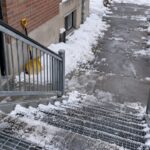
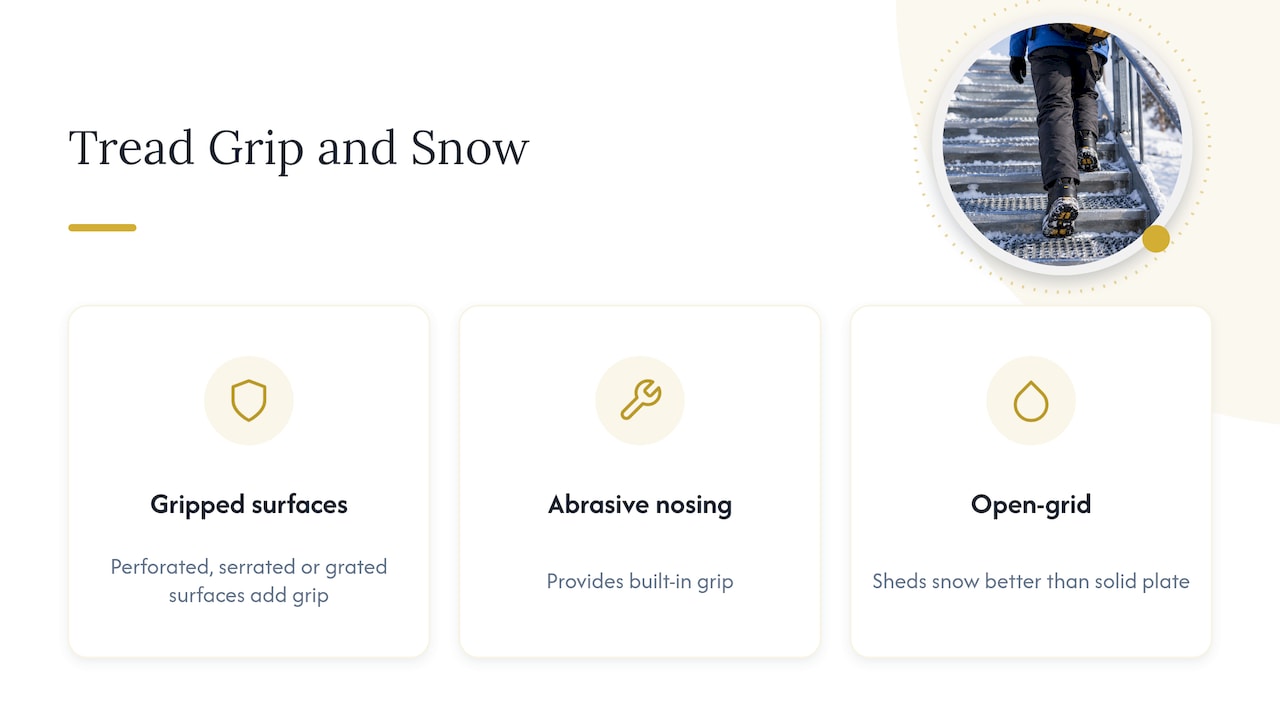
Neither metal is slippery by nature, but smooth metal treads get slick when wet or iced. Choose a tread with built-in grip, such as a perforated, serrated or grated surface, or a tread with an abrasive nosing. Building owners also have to keep stairs clear in winter: a sample outdoor checklist from CCOHS asks whether stairs, treads, handrails and guards are secure and in good condition, and whether stairs, stairwells and landings are kept clear of ice and snow in winter. Open-grid treads shed snow better than solid plate, which helps with that job.
Maintenance: what you will actually do each year
Maintenance is where the two metals feel most different to the person who owns the stair.
Steel asks for a routine:
- Walk the stair each spring after the salt season and look at welds, post bases and the underside of treads.
- Wash off salt residue.
- Sand and touch up any chip or scratch down to bare metal before rust spreads.
- Plan a repaint cycle for painted steel. The interval depends on exposure and the coating system, so ask your fabricator what applies to your finish.
Aluminum asks for less. A rinse in spring and an occasional wash are usually enough, plus a check that fasteners and anchors are tight. There is no repainting cycle to budget for unless you chose a painted look.
For a condo board or property manager with dozens of stairs and balconies, this difference is a real operating cost: fewer inspections of coatings, fewer touch-ups, fewer contractor visits. For a homeowner who likes to maintain their own property, a painted steel stair is perfectly manageable. Match the material to the person who will look after it.
Cost: upfront price versus lifetime price
Aluminum generally costs more than steel up front. Aluminum raw material is pricier, and welding it takes specific skill and equipment. Steel is cheaper to buy and easy to fabricate, but you add the cost of galvanizing and paint, and you pay for repainting over the years.
That is why the honest comparison is total cost of ownership, not the first quote. Ask for both options priced for the same stair, with the same treads, guard and finish. Then compare:
- The installed price of each metal.
- The finish: galvanizing, paint system or anodizing.
- Expected maintenance over 15 to 25 years.
- Access and installation: a lighter aluminum stair may cut lifting and labour time on a hard-to-reach site.
- Structural needs: a stair that needs a deeper aluminum section or extra supports can erase some of the savings.
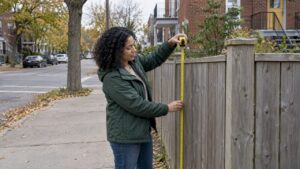
We do not publish fixed prices because each stair is custom: height, number of risers, landings, tread type, guard style and site access all change the figure. Send us drawings or a few photos and measurements and we will quote both metals side by side.
Code and engineering requirements in Quebec
The code does not favour one metal over the other. It sets what the stair must achieve: riser and tread dimensions, headroom, landings, handrails, guard height and the loads the guard must resist. In Quebec, new work and renovations fall under the Loi sur le bâtiment and the Construction Code, which builds on the National Building Code of Canada (CNB) with Quebec amendments. Quebec’s housing corporation, for example, requires its subsidized projects to comply with the Loi sur le bâtiment and the latest editions of the construction and safety codes.
What this means in practice:
- Check the requirements for your building type. A single-family balcony stair, a multi-unit building and an industrial platform do not face identical rules. Confirm with your municipality, architect or engineer.
- Design the guard as part of the stair. Our pages on architectural metal specifications for railings and stairs and guard loads cover the details we work to.
- Involve the fabricator early. The NAAMM manual advises that architects and fabricators collaborate early in the design stage to ensure structural adequacy and code compliance. Changing a stringer depth after drawings are stamped costs time.
- Mind the connection details. Whether a guard is welded or bolted affects strength and appearance. See welded vs bolted railings.
- Respect site safety. Crews working on stairs and balconies on a Quebec site fall under CNESST rules, so access, fall protection and delivery planning should be settled before installation day.
Where an engineer’s stamp is required, the engineer, not the supplier, confirms the final sections for the loads. We fabricate to the drawings and specifications you give us.
What about stainless steel?
Stainless is a third option and it sits between the two. It is a steel, so it is strong and stiff, but it resists corrosion far better than carbon steel, and it needs no galvanizing or paint. It is more expensive than both carbon steel and, usually, aluminum. It makes sense for restaurants, retail entrances, interior feature stairs and handrails, where appearance and hygiene count and the exposure to salt is lower. For a long exterior stair in a salt-heavy setting, stainless can still pit if neglected, so rinse it and check it as you would the others. We weld stainless, steel, aluminum and copper in-house, so we can price all of them for you.
How to choose: a short decision guide
Go through these questions in order.
- How long is the span and how heavy is the use? Long spans, wide treads, public or industrial traffic: lean toward steel.
- Is the stair exposed to salt and snow? Exterior and salt-exposed: aluminum is easiest, galvanized and painted steel works with upkeep.
- Who will maintain it? If nobody will inspect it each spring, choose aluminum or a high-grade protective system.
- How hard is access? A narrow lane, a rooftop or a fragile existing structure favours lighter aluminum.
- What look do you want? Slim floating treads and fine profiles favour steel or stainless.
- What is your budget horizon? Lowest purchase price points to steel. Lowest upkeep points to aluminum.
A few typical outcomes:
- Condo balcony stair, salt-exposed, board wants minimal upkeep: aluminum.
- Warehouse mezzanine or industrial platform stair: steel.
- Residential rear stair, long run, owner will repaint: galvanized and painted steel.
- Commercial entrance stair with a design feature: steel or stainless, with a tread chosen for traction.
Perspective
We build stairs and railings in our Lachine shop and install them ourselves across Greater Montreal, so we see how each metal behaves after a few winters rather than only on a drawing.
Our view is simple: there is no universally better metal, but there is a better metal for each stair. Steel gives you strength, slim profiles and fabrication that is straightforward and flexible, which is why we reach for it on long spans, heavy use and design-led stairs. Aluminum gives you light weight and a naturally corrosion-resistant surface, which is why it earns its place on exposed balconies and hard-to-reach sites.
What we ask of every project is that the metal be chosen with the details: drainage, finish, tread grip, guard loads and connections. A well-detailed stair in either metal will outlast a poorly detailed one in the “better” metal. Because fabrication, welding and installation are all done by our own team, we can keep quality, code compliance and timelines under one roof and adjust the design with you before anything is cut.
Bring us your site, your budget and your maintenance expectations, and we will recommend the metal we would put on our own building.
Ash
Get your stair quoted in both metals
We design, fabricate, weld and install custom metal staircases and residential and commercial railings throughout Greater Montreal, the island, Laval, the South Shore and the West Island. Contractors, architects, property managers and homeowners can send us a sketch, drawings or photos, and we will price steel and aluminum options for the same stair so you can compare like for like. Our service is in French and English.
For welded parts and structural details, see our welding services, or contact us through our site to start the conversation. We install only within Greater Montreal and do not ship fabricated parts elsewhere.
FAQ
Which is better for outdoor stairs in Quebec, steel or aluminum?
Aluminum is the easier choice outdoors because it does not rust and needs mainly rinsing and cleaning. Galvanized and painted steel also performs well if it is detailed for drainage and inspected each spring. Choose steel when you need the strength or slim profile, and aluminum when you want low upkeep.
Is aluminum strong enough for a staircase?
Yes, when it is properly engineered. Aluminum stairs are common on balconies, decks and light-traffic exteriors. It is less stiff than steel, so it needs deeper or heavier sections for long spans, and the guard and top flange must be designed for handrail loads.
Which is better, aluminum or stainless steel?
It depends on location and budget. Stainless is stronger and gives a refined look, so it suits entrances, restaurants and interior features, but it usually costs more. Aluminum is lighter and typically cheaper than stainless, and it works well on exposed exterior stairs.
How long do steel stairs last in Montreal?
Quebec’s housing corporation uses a theoretical service life of 25 years for steel stairs and ramps in its building health guide. Real life depends on the coating, drainage, salt exposure and how quickly chips are touched up.
Do I need a permit or an engineer for a new exterior stair?
Often you do, especially for multi-unit, commercial or structural stairs. Requirements vary by building type and municipality, so check with your borough or city and your architect or engineer before ordering. We can work from their drawings.
Sources
- NAAMM metal stair manual
- Canada’s cost of corrosion, ConstructConnect
- Exterior metals guidance, University of Kansas
- SHQ building health inventory guide
- CCOHS outdoor areas inspection checklist
- SHQ project guide, Loi sur le bâtiment compliance