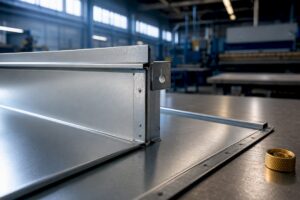
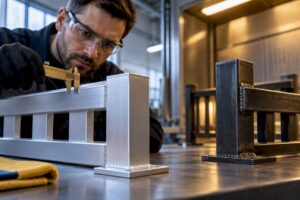
Steel, stainless steel, aluminum, and copper are the four metals routinely cut on CNC laser systems, and each behaves differently under the beam. Thickness and reflectivity are the two factors that decide whether a laser is even the right tool. Shops calibrate around Health Canada’s laser classification rules, CWB welding standards, and their own machine limits, and material specs are set before a single sheet gets loaded.
TL;DR:
- Laser cutting is most effective on metals under 3 mm thick, offering the fastest cuts and best edge quality, while thicker plates require high-power systems or alternative methods.
- Stainless steel requires nitrogen assist gas to prevent oxidation, and heat management becomes critical for thin gauges to reduce warping and HAZ issues.
- Copper and aluminum are highly reflective and conductive, limiting practical thickness and often requiring specialized, high-wattage laser equipment for clean cuts.
- Tolerance levels generally range from ±0.13 mm to ±0.05 mm, with precise preparation of files, consistent tooling, and sample testing enabling better quality control.
- Canadian regulations mandate hazard classification labeling, plume control, and potentially NPRI reporting for high-volume copper cutting, influencing shop compliance and safety procedures.
Table of Contents
- What metals can be laser cut, and how does each behave?
- What thickness works best for laser cutting metal?
- How precise is laser cutting, and what design rules apply?
- What safety and reporting rules apply to laser cutting in Canada?
- How do you prepare files for a laser cutting shop?
- How do you choose a fabricator for laser-cut metal parts?
- A fabricator’s perspective on precision versus speed
- Get a laser cutting quote from a Montreal-area shop
- Sources
- FAQ
What metals can be laser cut, and how does each behave?
Not every metal reacts to a laser beam the same way, and knowing the quirks up front saves you from a redesign after the fact.
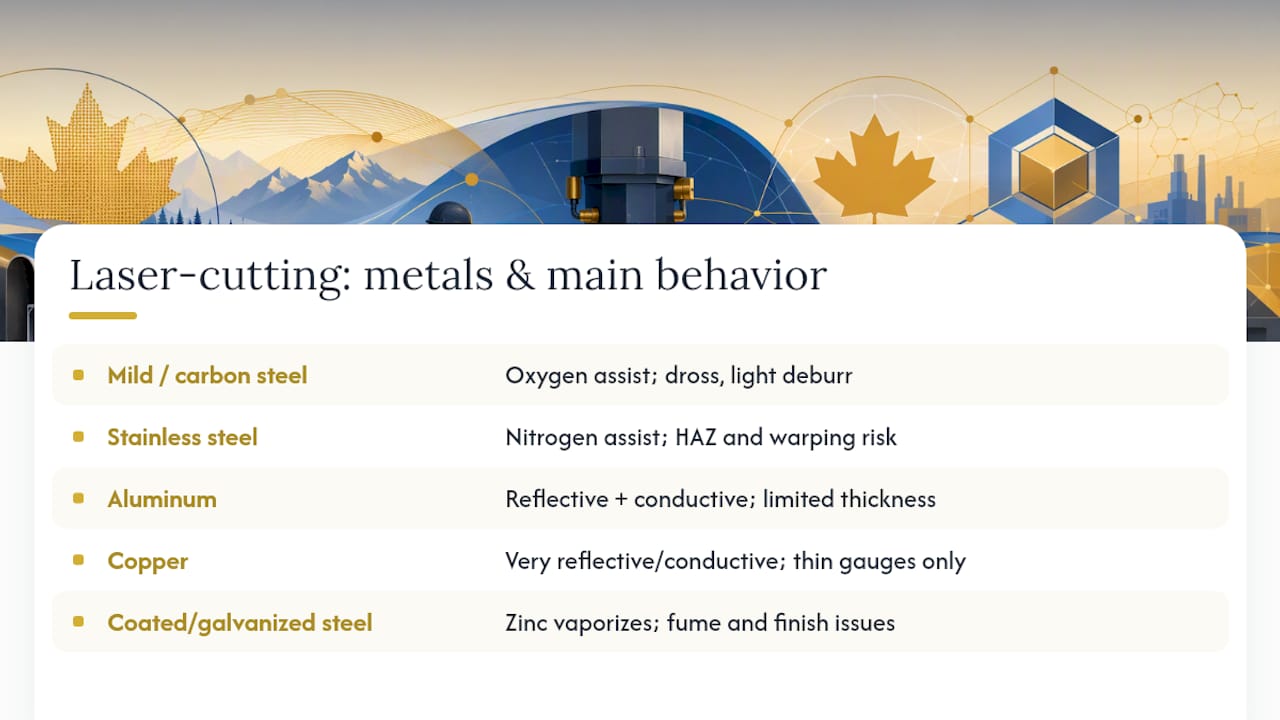
Mild and carbon steel is the workhorse. It cuts cleanly with an oxygen assist gas, which reacts exothermically and helps the laser push through thicker plate. The trade-off is dross, a thin layer of resolidified slag that clings to the bottom edge, and it usually needs a light deburring pass afterward.
Stainless steel demands nitrogen instead of oxygen. Nitrogen is inert, so it prevents the oxidation that would otherwise discolour the cut edge and compromise corrosion resistance, an important detail for anything installed near salt-treated winter roads or coastal-style exposure. Heat-affected zone (HAZ) and warping become bigger concerns on thinner stainless gauges, so shops often slow the feed rate or adjust nesting to manage heat buildup.
Aluminum is where reflectivity becomes the story. Its surface bounces back a meaningful portion of the laser energy, and its high thermal conductivity pulls heat away from the cut zone almost as fast as the laser delivers it. That combination limits practical cutting thickness on many fibre laser systems and often calls for higher wattage machines or specialized settings to get a clean edge without excessive heat distortion.
Copper pushes reflectivity and conductivity even further. It is one of the toughest metals to laser cut cleanly, and most shops keep copper work to thinner gauges or route it through fibre lasers built to handle reflective materials without damaging the cutting head.
Coated and galvanized steel bring a separate issue: the zinc coating vaporizes during cutting and changes both the fume profile and the finish quality. Depending on the application, a shop may strip the coating first or plan for post-cut galvanizing to avoid trapping fumes and pitting the cut edge.
Laser processing across all four metals shares one advantage: a small heat-affected zone that produces smooth edges, which is precisely why designers lean on it instead of older thermal cutting methods when edge quality matters.
What thickness works best for laser cutting metal?
Thickness dictates method more than almost anything else in a fabrication quote. Here’s how it typically breaks down:
- Thin sheet (under roughly 3 mm): this is where lasers perform at their best. Cut speed is fastest, edge quality is finest, and HAZ is negligible on steel and stainless alike.
- Mid-thickness plate (roughly 3 mm to 12 mm): still very workable, but HAZ and warping start to matter, especially on stainless and aluminum. Slower feed rates and careful nesting keep parts flat.
- Heavy plate (above 12 mm, varying by metal and machine): laser cutting needs high-power systems to stay efficient here, and copper or thick aluminum may hit a practical wall well before steel does.
- Alloy and temper effects: hardened tool steels or high-strength aluminum alloys cut slower than their thickness alone would suggest, since alloy composition changes how the material absorbs and conducts heat.
If edge finish and dimensional control are the priority, laser is usually the right call. If you’re roughing out very thick plate or removing bulk material fast, plasma or waterjet cutting often makes more sense, sometimes even combined with a laser finishing pass on the features that need precision. That hybrid approach, rough mechanical removal followed by laser finishing, keeps machine hours down on thick parts without sacrificing accuracy where it counts.
How precise is laser cutting, and what design rules apply?
Kerf, the width of material the laser actually removes as it cuts, typically runs in the range of 0.1 mm to 0.3 mm depending on material and thickness. CAD files need to compensate for kerf on tight-fitting parts, or holes and slots come out undersized once the cut is made.
A few rules keep parts shop-ready:
- Minimum hole diameter should generally match or exceed material thickness, smaller holes risk distortion or incomplete piercing.
- Hole-to-edge clearance needs enough margin, usually at least the material thickness, to avoid warping the surrounding material.
- Expect tolerances in the ±0.13 mm to ±0.05 mm range on well-controlled jobs, but always confirm with the shop rather than assuming a blanket number applies to every alloy and thickness.
- Use tabs to hold small or intricate parts in place during nesting, and label parts directly in the file to prevent mix-ups during handling.
Cut quality also depends on tooling condition. Worn optics or poor beam alignment produce oversized holes and rough edges regardless of how good the file is.
Pro Tip: Request a sample cut on your actual material and thickness before committing to a full production run. It’s the fastest way to confirm tolerance, edge finish, and dross levels match what your project needs.
What safety and reporting rules apply to laser cutting in Canada?
Regulatory compliance shapes what equipment a shop can run and how it documents its process, and it’s worth understanding before you assume any shop can handle your material.
Health Canada’s Radiation Emitting Devices Regulations require laser products sold or imported into Canada to carry an IEC-based hazard classification (Class 1 through 4) along with bilingual labelling and documentation. These rules matter for any shop modifying or repurposing older laser equipment, since reused machines still need to demonstrate compliance.
- If a job calls for filler wire on laser-welded joints, the Canadian Welding Bureau requires CWB-certified filler and a registered Welding Procedure Data Sheet (WPDS) under CSA W47.1.
- Plume from cutting metal isn’t just smoke. CCOHS identifies metal oxides, particulates, and toxic by-products as genuine respiratory hazards, and stainless or galvanized coatings change what’s actually in that plume, with chromium, nickel, or zinc fumes depending on the base metal.
- Local exhaust ventilation positioned close to the cut, not general shop ventilation, is the control CCOHS recommends for pulling contaminants out of the worker’s breathing zone.
- Under NPRI reporting rules, facilities track active cutting hours and calculate time-averaged mass fractions for listed elements. Copper crosses a 10-tonne annual threshold that can trigger mandatory reporting, so high-volume copper shops need to keep records.
How do you prepare files for a laser cutting shop?
Getting a quote that matches the finished part starts with what you hand over.
- Submit vector outlines in DXF or DWG format, with cut and engrave elements on separate layers so the machine reads intent correctly.
- Provide the exact material spec, alloy grade, gauge, and coating type, along with the SDS where the shop’s NPRI tracking or weldability assessment depends on trace elements.
- Label each part with an ID, quantity, and finish requirement, and flag any tapped holes, inserts, or secondary features the laser won’t produce on its own.
- Expect your quote to break down material cost, machine time, kerf allowance, fixturing, finishing, and, for anything staying in Greater Montreal, local installation.
How do you choose a fabricator for laser-cut metal parts?
Ask about laser type, maximum sheet size, and thickness range before sending a drawing, and request a sample cut to check tolerance and edge finish firsthand.
- Confirm the shop can show evidence of plume control and proper ventilation, not just a general statement that it’s “handled.”
- If welding is part of the job, ask whether the shop holds current CWB qualifications and can register a WPDS for the process.
- Get a line-itemized quote covering material, cutting time, finishing, and installation, plus a realistic lead time rather than a rough estimate.
A fabricator’s perspective on precision versus speed
Every laser job trades precision against throughput somewhere. Getting material certification and a sample cut locked in early removes most of that guesswork, and finishing plus installation under one roof cuts out the coordination gaps where projects usually slip.
— Ash
Get a laser cutting quote from a Montreal-area shop
Manara Corp. runs CNC laser cutting, sheet bending and rolling, profile rolling, and welding on steel, stainless steel, aluminum, and copper, all fabricated in-house in Lachine and installed on site across Greater Montreal, the island, Laval, the South Shore, and the West Island. That means one shop handles your cut parts from raw sheet to installed railing, stair, or fence, without shipping delays or a second contractor coordinating the install.
When you request a quote through the laser cutting services page, include your material spec and gauge, a DXF or DWG file with cut layers separated, part quantities, and any finish or installation requirements. If bending or welding is part of the project, mention it upfront so the quote reflects the full scope, from sheet forming through to welding.
Sources
- Canada
- Canadian Welding Bureau guidance on laser beam welding
- CCOHS guidance on lasers and related hazards
FAQ
Can you laser cut copper and aluminum reliably?
Yes, but both metals are highly reflective and conductive, which limits practical thickness compared to steel. Fibre laser systems built to handle reflective materials get the cleanest results, particularly on copper.
What thickness of steel can a laser cut?
Thin steel under roughly 3 mm cuts fastest with the finest edge quality, while mid-thickness plate up to about 12 mm still works well with slower feed rates. Beyond that, high-power laser systems or alternate methods like plasma become more practical.
Does Manara Corp. handle both laser cutting and installation?
Yes, Manara Corp. fabricates parts in-house in Lachine and installs them locally across Greater Montreal, so cutting, forming, welding, and installation stay under one contract. Current pricing depends on material and project scope, so quotes are handled directly through the laser cutting services page.
What tolerance can I expect from laser-cut metal parts?
Well-controlled laser cutting typically achieves tolerances between ±0.13 mm and ±0.05 mm, though the exact figure depends on material and thickness. Always confirm expected tolerance with the shop before finalizing a design.
Do I need special permits for laser cutting metal in Canada?
Laser equipment sold or imported into Canada must meet Health Canada’s classification and labelling requirements under the Radiation Emitting Devices Regulations. Shops cutting high volumes of certain metals, like copper past the 10 tonne annual mark, may also face NPRI reporting obligations.