Use elastomeric closed-cell foam where condensation control matters most, fibreglass board or liner for general thermal and acoustic performance, mineral wool where temperatures run high, and reflective foil only as a supplementary layer. Foamed plastics work in limited spots but face strict National Building Code (NCB) constraints. Match the material to the duct’s location and temperature difference before worrying about brand names.
TL;DR:
- Elastomeric closed-cell foam is essential for cold ducts and refrigerant lines to prevent surface condensation without a separate vapour barrier.
- Mineral wool performs better than fibreglass near heat sources and in high-temperature or high-cycling environments due to its durability.
- R-value requirements depend on the duct’s operating temperature and environment, with higher resistance needed for unconditioned or cold spaces, and performance-based codes mean simple thickness options may be insufficient.
- Fire safety rules restrict foamed plastics’ use to specific conditions, requiring flame-spread and smoke ratings compliance and careful separation from heat sources.
- Proper installation with sealed joints, correct orientation of vapour barriers, and tailored insulation thickness prevents moisture issues and maximizes insulation lifespan.
Table of Contents
- Duct insulation types HVAC systems commonly use
- Matching the material to the application
- R-value, thickness, and the R4 versus R6 question
- Fire safety rules that limit your material options
- Installing wrap, board, and liner without creating problems
- How long duct insulation lasts and when to replace it
- What fabrication teams see that insulation guides miss
- Getting insulated ductwork built and installed right
- Sources
- FAQ
Duct insulation types HVAC systems commonly use
Every duct insulation material on the market falls into one of six families, and each behaves differently once it’s wrapped around metal ductwork carrying air at a different temperature than the room around it.
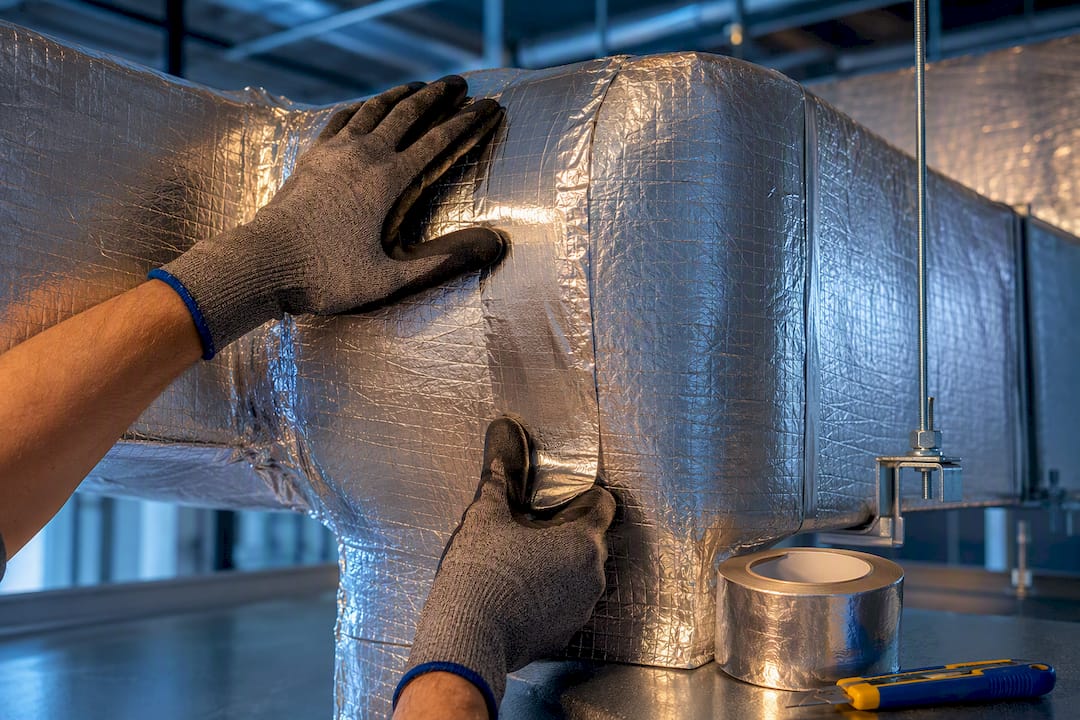
Fibreglass comes in board, blanket, and liner forms, and it remains the default choice for general-purpose duct wrapping. Board products are rigid enough to hold their shape on rectangular trunks, while blanket wrap flexes around irregular fittings. Fibreglass duct board, blanket, and liner are widely used for both thermal and acoustic control, and board products are commonly available with FSK (foil-scrim-kraft) or ASJ (all-service jacket) facings that double as a vapour retarder.
Mineral wool (rock wool) handles higher temperatures than fibreglass without degrading, and it holds up better under repeated thermal cycling. It costs more, but on hot supply runs near heating equipment, that durability pays for itself.
Elastomeric closed-cell foam is vapour-impermeable on its own, which makes it the go-to for cold ducts and refrigerant lines where surface condensation is the real enemy. No separate vapour barrier is needed because the closed-cell structure blocks moisture migration outright.
Foamed plastics (polyisocyanurate, polyurethane, polystyrene) deliver strong thermal resistance per inch, but Canadian code treats them cautiously around ductwork because of flame-spread and smoke concerns.
Reflective/bubble insulation relies on a radiant air gap rather than mass, so it helps mostly with radiant heat gain in attics or crawl spaces, and rarely performs as a standalone solution on ducts.
- Fibreglass: general thermal and acoustic control, widely available in board, blanket, and liner
- Mineral wool: high-temperature and high-durability applications
- Elastomeric foam: cold ducts and condensation-prone runs
- Foamed plastics: limited, code-restricted uses with real R-value payoff
- Reflective/bubble: supplementary radiant barrier, not a primary insulator
Matching the material to the application
The right material depends less on marketing claims and more on where the duct sits and what’s moving through it. TIAC’s guidance backs this up directly: selection should be driven by operating temperature, environmental exposure, and mechanical stress, not by whichever product happens to be on the shelf, and the insulation should always be treated as a system with its jacket and sealant rather than a standalone layer.
- Supply ducts carrying heated air: fibreglass board or liner usually suffices, since the risk is heat loss, not condensation.
- Return ducts and unconditioned-space runs: elastomeric foam or a faced fibreglass with a continuous vapour barrier prevents sweating when the duct surface drops below the dewpoint.
- Cold ducts (air conditioning supply, refrigerant lines): closed-cell elastomeric foam is close to mandatory, given its built-in vapour resistance.
- Plenums near heat sources: mineral wool tends to outlast fibreglass here because of its higher temperature tolerance.
Acoustic performance varies too. Fibreglass and mineral wool both absorb sound well because of their fibrous structure, while elastomeric foam and foamed plastics do little for noise control on their own.
Pro Tip: If a duct run passes through a mechanical room with high ambient humidity, don’t rely on insulation thickness alone to stop condensation. Check that the vapour barrier is genuinely continuous at every seam, elbow, and hanger point, because a single gap defeats the whole system.
R-value, thickness, and the R4 versus R6 question
R-value measures resistance to heat flow, and for ducts it determines how much energy you lose (or gain) between the air handler and the register. Higher isn’t automatically better. It’s about matching the number to the actual temperature difference the duct experiences.
Most fibreglass products typically reach an R-value corresponding to a moderate thickness and higher thermal resistance requires a greater thickness, depending on density. Mineral wool and elastomeric foam achieve similar resistance at slightly different thicknesses because of their different fibre or cell structures.
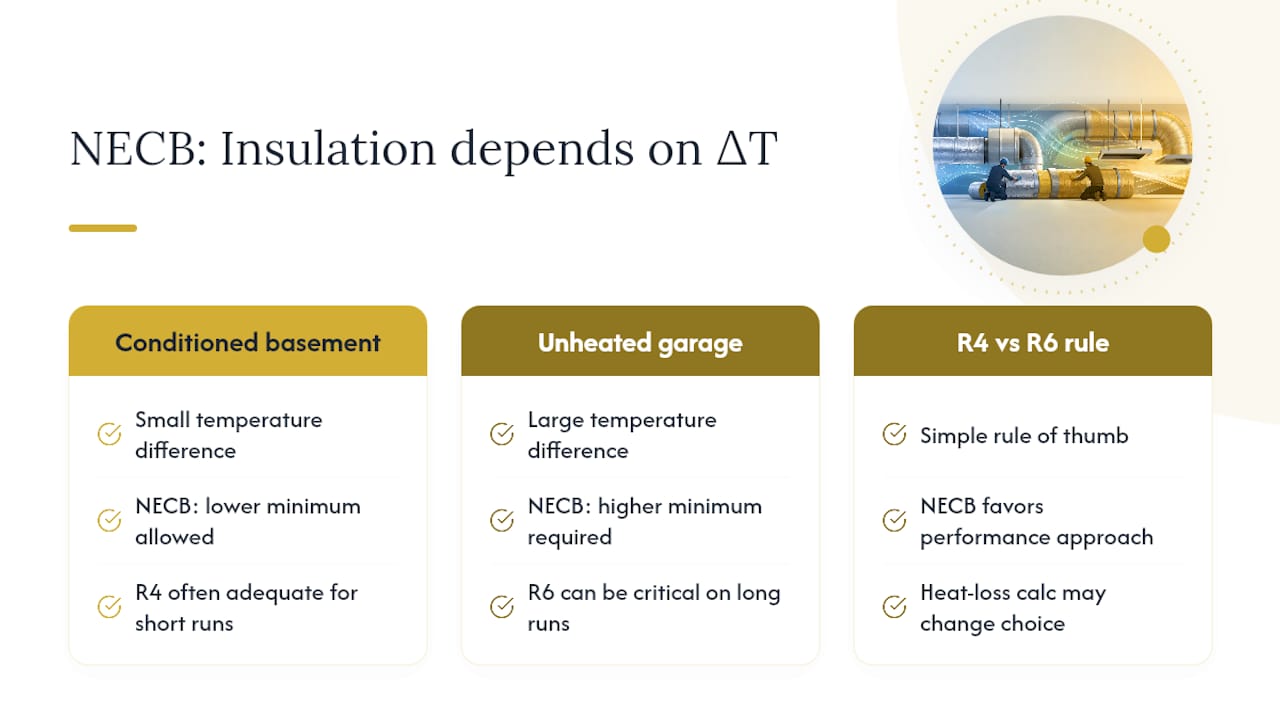
The National Energy Code of Canada for Buildings (NECB) 2020 sets minimum insulation levels for distribution systems based on the temperature difference between the air inside the duct and the surrounding space, meaning a duct running through an unheated garage needs more resistance than one running through a conditioned basement carrying air only a few degrees warmer than the room. NECB 2020 also shifted toward performance-based compliance, which means a straightforward R4-versus-R6 rule of thumb sometimes isn’t enough. An actual heat-loss calculation can show that jumping to R6 barely moves the needle on a short duct run in a mild climate, while that same jump is critical for long runs through cold, unconditioned spaces.
Fire safety rules that limit your material options
Canadian code doesn’t treat all insulation materials equally once fire risk enters the picture, and this is where foamed plastics run into trouble.
Combustible insulation and coverings on ducts face flame-spread and smoke-developed limits, generally capped at a flame-spread rating of 25 and a smoke-developed rating of 50, with narrow exemptions allowing flame-spread up to 75 in specific combustible assemblies. Foamed plastic is permitted on ducts only under defined conditions.
- Minimum distance from furnaces or other heat sources must be respected.
- Duct surface temperature can’t exceed the material’s rated limit.
- Foam generally cannot be used inside plenums without additional protection from heat exposure.
- Jackets, tapes, and adhesives need to meet CAN/ULC and ASTM standards, not just the base insulation material.
One installation habit trips up more inspections than any material choice: covering a fire damper or blocking an access panel with insulation. Specify removable panels or access collars at the fabrication stage, not after the wrap goes on.
Installing wrap, board, and liner without creating problems
The installation form matters as much as the material itself. Wrap suits round or irregular ductwork where flexibility beats rigidity, board holds tight on rectangular trunks with flat faces, and liner goes inside the duct to double up on acoustic damping, though it demands cleaner interior surfaces and careful edge treatment to avoid erosion into the airstream.
- Choose the form based on geometry. Tight bends and transitions favour wrap; long straight rectangular runs favour board.
- Seal every joint continuously. Use foil tape or mastic rated for the facing type, and never rely on staples alone to hold a vapour barrier together.
- Place the vapour retarder on the warm side of the insulation. Getting this backwards is one of the most common causes of hidden moisture damage.
- Size insulation thickness to prevent surface dewpoint issues, particularly on cold-air ducts where a thin layer simply won’t stop condensation from forming, a point materials selection guidance on condensation control backs up directly.
- Add mechanical protection or jacketing on exposed ducts in mechanical rooms, parking garages, or anywhere subject to foot traffic or impact.
How long duct insulation lasts and when to replace it
Fibreglass and mineral wool typically hold their performance for 15 to 20 years indoors, though moisture exposure or physical compression cuts that lifespan hard. Elastomeric foam tends to last a similar span but degrades faster under UV exposure if left uncovered outdoors.
Watch for these signs during routine inspection:
- Visible moisture staining or a musty odour near seams
- Compressed or sagging sections that no longer hold their original thickness
- Torn, cracked, or missing jacket facing exposing the fibre core
- Mould growth, which usually signals a vapour barrier failure rather than a material defect
Small, localized damage can often be patched with matching facing tape. Widespread compression, moisture saturation, or mould calls for full replacement, not a patch job. Keep a simple record of what material and thickness went where. It saves guesswork for whoever services the system next.
What fabrication teams see that insulation guides miss
Most insulation guidance assumes the ductwork is a fixed given. In practice, insulation fit is decided the moment a duct gets fabricated, not after. Flange design, seam placement, and fitting tolerances all determine whether board insulation sits flush or bridges awkwardly at transitions, forcing installers to compensate with extra tape and mastic in the field.
Coordinating fabrication and insulation selection at the design stage avoids that rework entirely. A duct built with clean, consistent seams and predictable fitting geometry takes wrap or board cleanly the first time, whether it’s a straight commercial run or a tight residential retrofit through a Greater Montreal triplex basement.
— Ash
Getting insulated ductwork built and installed right
There’s a real gap between buying insulation off a shelf and getting a duct system that’s fabricated to fit it properly the first time. Manaracorp closes that gap for Greater Montreal contractors and homeowners by handling both sides: custom duct fabrication with clean seams and consistent flange geometry, plus on-site installation that accounts for insulation thickness and jacketing before the metal ever leaves the shop.

Expect proper vapour-barrier continuity at every joint, jacketing and tapes that meet CAN/ULC and ASTM standards, and documentation you can hand to whoever services the system down the line. Some local metal fabrication companies fabricate rectangular and round ductwork in-shop and install it across the island, Laval, the South Shore, and the West Island, working directly with contractors and homeowners in both French and English. If you’re planning a retrofit or a new install, reach out for a quote and get ductwork built to fit the insulation from the start, not adjusted around it after the fact.
Sources
- National Energy Code of Canada for Buildings (NECB) 2020
- Thermal Insulation Association of Canada best practices guide
- OBC 9.33.6.4 — Coverings, linings and related provisions (CodeIndex)
- NAIMA Canada — piping and duct insulation types
FAQ
What are the different types of insulation used on HVAC ducts?
The main types are fibreglass (board, blanket, liner), mineral wool, elastomeric closed-cell foam, foamed plastics, and reflective foil, each suited to different temperature and moisture conditions.
What type of insulation is best for ductwork?
There’s no single best material. Fibreglass board or liner suits general supply ducts, while closed-cell elastomeric foam is the stronger choice for cold ducts prone to condensation.
What are five types of duct insulation?
Fibreglass, mineral wool, elastomeric foam, foamed plastics, and reflective or bubble insulation cover the five main categories used on ductwork today.
What is the difference between R4 and R6 duct insulation?
R6 offers roughly 50% more thermal resistance than R4 at a similar thickness increase, and the National Energy Code of Canada for Buildings ties the required minimum to the temperature difference the duct experiences rather than a flat rule for every application.
Can foamed plastic insulation be used on ducts in Canada?
Only under specific exemptions, such as minimum distance from heat sources and restrictions near plenums, since foamed plastics carry flame-spread and smoke limits under the National Building Code provisions.