Yes, you can weld galvanized steel, but the job demands real preparation and serious fume control. The primary hazard is zinc oxide fume, generated the instant your arc melts the coating, and the professional standard, per AWSPV.pdf) and reinforced by ANSI Z49.1, is to strip zinc from the weld zone wherever the joint is structural. Manaracorp’s shop in Lachine handles galvanized fabrication for HVAC ductwork and structural components routinely, and the process rewards discipline more than raw skill.
Three things decide whether the weld holds and the welder stays healthy:
- Ventilation first. Zinc fume causes real, documented health effects, and no technique substitutes for extraction.
- Prep the joint. Removing coating 1 to 4 inches back from the weld, per industry guidance, cuts porosity and spatter dramatically.
- Expect defects if you skip steps. Porosity, lack of fusion, and poor bead profile almost always trace back to trapped zinc vapour.
Key Takeaways
Welding galvanized steel is safe and structurally sound when done with proper fume extraction, targeted zinc removal at load-bearing joints, and post-weld corrosion repair.
| Point | Details |
|---|---|
| Fume control comes first | Use local extraction and fit-tested respirators; switch to supplied air in confined spaces. |
| Remove zinc at structural joints | Strip coating 1 to 4 inches back from the weld on load-bearing connections per AWS guidance. |
| Match process to material | Slower MIG travel, whipped stick technique, or low-heat brazing each suit different thicknesses and joints. |
| Watch for porosity first | Widen root gaps and clean joint faces to prevent trapped zinc vapour from causing defects. |
| Restore coating after welding | Apply zinc-rich paint or thermal spray per ASTM A780 before the part returns to service. |
| Work with an experienced shop | Manaracorp fabricates and installs galvanized railings, stairs, and ductwork across Greater Montreal with full in-house prep and repair. |
Table of Contents
- What health and fume risks does welding galvanized steel create?
- How much zinc coating should you remove before welding?
- Which welding process works best for galvanized steel?
- Why does welding galvanized steel cause porosity and spatter?
- How do you restore corrosion protection after welding?
- How Manaracorp handles galvanized fabrication in-house
- What the standards get right, and what they leave out
- Get galvanized fabrication done right the first time
- Sources
- FAQ
What health and fume risks does welding galvanized steel create?
Zinc boils at roughly 907°C, well below the temperature of a welding arc, so the coating vaporizes and reforms as zinc oxide fume before it ever gets a chance to burn off cleanly. Breathing that fume in enough concentration triggers metal fume fever: chills, fever, metallic taste, headache, and chest tightness that typically shows up hours after exposure and resolves within a day or two. It’s unpleasant, not usually dangerous in an isolated exposure, but repeated exposure without controls is a different story, and occupational health research on welding fumes links chronic exposure to more serious respiratory outcomes.
Some welders swear by drinking milk before or after a galvanized job, on the theory that it coats the stomach or somehow binds zinc. There’s no mechanism that supports this, and it does nothing to protect your lungs, which is where the actual risk lives.
Controls follow a standard hierarchy, and skipping straight to a respirator without the steps ahead of it is a common mistake:
- Eliminate or reduce the coating in the weld path when the joint allows it.
- Engineer the exposure down with local extraction. Gun-mounted fume extractors work well for mobile MIG work, fixed extraction hoods suit repetitive bench welding, and a proper booth handles high-volume shop production.
- Manage exposure administratively through job rotation, scheduled breaks in fresh air, and positioning the welder upwind of the fume plume rather than leaning directly over it.
- Wear the right PPE. A fit-tested half-face or full-face respirator rated for metal fume handles most open-shop conditions.
- Use supplied air in confined spaces. Tanks, ducts, and enclosed structural cavities concentrate fume fast enough that a cartridge respirator isn’t sufficient, and ANSI Z49.1 treats confined-space galvanized welding as its own risk category requiring supplied air.
Pro Tip: If you can smell metallic fume through your respirator, stop. That means the seal has failed or the cartridge is saturated, not that the smell is “just part of the job.”
How much zinc coating should you remove before welding?
AWS guidance calls for stripping the coating 1 to 4 inches (roughly 2.5 to 10 centimetres) back from either side of the joint on structural or load-bearing welds. Anything carrying real stress, a railing post, a stair stringer, a duct hanger bracket, gets full removal in that zone. Cosmetic or low-stress tack welds sometimes tolerate coated-through welding with adjusted technique, but that’s a judgment call, not a shortcut you take by default.
Removal methods each carry trade-offs:
- Grinding is the most effective and controllable method, and the one most shops default to.
- Mechanical wire brushing works for light coatings but leaves more residual zinc than grinding.
- Shearing or flame heating to push back coating ahead of the arc suits high-volume production but adds its own fume and burn hazard.
The sequence that actually produces clean welds: clamp and fixture the piece solidly, since galvanized sheet distorts more than bare steel under heat. Put on respiratory protection before you strike an arc, not after you notice fume. Run extraction while grinding, since zinc dust is its own inhalation hazard, not just the vapour from welding. Wipe the joint clean of grinding debris and oxide before welding, and have your zinc-rich repair coating staged and ready for immediately after the weld cools, since bare steel starts oxidizing the moment it’s exposed.
Which welding process works best for galvanized steel?
There’s no single best process. The right one depends on material thickness, coating weight, and whether you need a structural weld or a sealed sheet-metal seam.
GMAW (MIG) handles most galvanized fabrication work. Drop travel speed by 10 to 20 percent on thin sheet to let zinc vapour escape ahead of the puddle instead of getting trapped in it. A 75/25 argon/CO2 blend gives a more stable arc and less spatter than straight CO2, though CO2 penetrates deeper on thicker material. ER70S6 wire, with its higher deoxidizer content, handles the oxide contamination better than leaner wire chemistries. Short circuit transfer suits thin sheet and out-of-position work; spray transfer suits thicker, flat-position joints where you want more deposition.
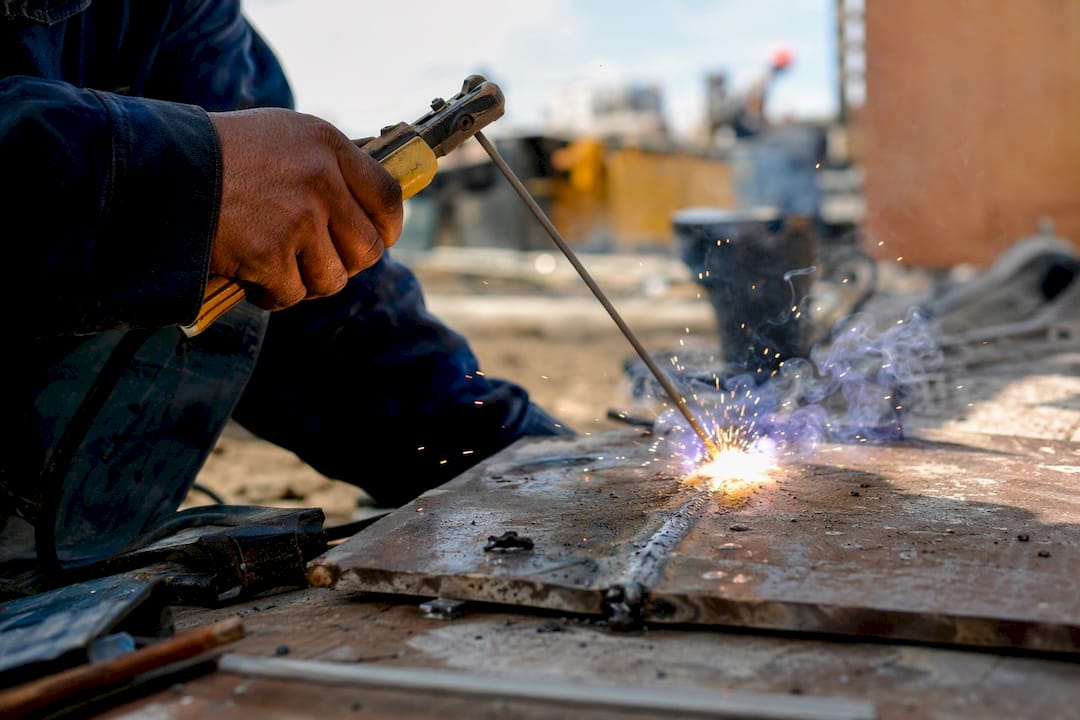
SMAW (stick) remains the go-to for field repairs and dirty or rusty galvanized steel where MIG shielding gas would get disrupted by wind. Use a whipping motion rather than a steady drag to let fume clear the puddle, shorten your arc length to reduce fume generation, and angle the electrode slightly more than you would on bare steel to direct the arc force away from trapped vapour. Bump electrode diameter up one size on thicker coatings when you need more penetration to punch through.
GTAW (TIG) and braze welding suit thin, precision sheet metal where heat input has to stay low. Brazing, in particular, often beats welding outright on light-gauge galvanized ductwork, since it melts at a lower temperature than the base steel and burns off far less zinc. Increase shielding gas flow slightly to counter the extra vapour, and watch your tungsten. Zinc contamination on the electrode tip shows up as an unstable, wandering arc almost immediately.
FCAW works well on thicker material outdoors where wind rules out gas shielding. Resistance welding suits high-volume sheet production, but electrode life drops noticeably as coating weight increases, since zinc alloys with the copper electrode tip and degrades conductivity.
| Process | Best suited for | Key adjustment |
|---|---|---|
| GMAW (MIG) | General fabrication, sheet to medium plate | Slower travel, Ar/CO2 blend, ER70S6 wire |
| SMAW (stick) | Field repair, dirty or windy conditions | Whip motion, shorter arc, steeper angle |
| GTAW/braze | Thin precision sheet, ductwork seams | Higher gas flow, low heat input, clean tungsten |
| FCAW | Outdoor, thicker material | Self-shielded flux for wind resistance |
| Resistance | High-volume sheet production | Monitor electrode wear closely |
Coating type matters too. A 2025 study on thin-gauge automotive steel found galvanneal coatings produced fewer defects and a more stable arc than standard hot-dip galvanized sheet of similar thickness, since the galvanneal’s alloyed zinc-iron layer releases vapour more evenly than pure zinc. If you’re working with galvanneal stock, you can often run parameters closer to bare-steel settings than you would with hot-dip material.
Why does welding galvanized steel cause porosity and spatter?
Porosity is the signature defect of galvanized welding, and it happens because zinc vapour gets trapped in the solidifying weld pool faster than it can escape. The fix starts before you strike an arc: a wider root gap gives vapour an escape path, and removing coating from the joint face itself, not just the surface around it, matters more than most welders realize.
Work through defects in this order:
- Porosity. Widen the root gap, slow travel speed slightly, and confirm the joint faces themselves are clean, not just the surrounding surface.
- Excess spatter. Switch to an argon-rich shielding blend, reduce voltage slightly, and check that your contact tip isn’t zinc-contaminated.
- Lack of fusion. Increase amperage or electrode diameter, and slow down enough to let the arc actually penetrate rather than skate over oxide.
- Poor bead profile. Adjust travel angle and confirm you’re not weaving too wide for the joint.
Porosity that’s cosmetic and confined to the cap pass rarely affects structural performance. Porosity that clusters through the weld’s depth is a different matter. On anything fatigue-loaded, a railing bracket that flexes under repeated load or a structural connection carrying dead weight, clustered internal porosity reduces the effective load-bearing cross-section and shortens fatigue life. That’s when radiographic or ultrasonic testing earns its cost, rather than relying on visual inspection alone.
How do you restore corrosion protection after welding?
Every inch of coating you removed and every square centimetre the arc burned off needs protection restored before the part goes into service. ASTM A780 governs how repair of damaged galvanizing is done, and it recognizes a few accepted methods:
- Zinc-rich paint is the most common field fix. Grind or wire-brush the weld area to bright metal, remove all soot and oxide, and apply the coating while the surface is clean and dry, since trapped moisture undercuts adhesion fast.
- Thermal spray zinc metallizing gives a thicker, more durable repair than paint and suits parts that will see heavy wear or outdoor exposure, though it needs a proper spray gun and more surface prep than a brush-on product.
- Re-galvanizing the entire fabricated part in a hot-dip bath gives the most complete protection, but it’s often impractical once a part is assembled, since it means shipping the finished piece to a galvanizing kettle and it can distort thin sheet metal under the bath’s heat.
How Manaracorp handles galvanized fabrication in-house
Manaracorp fabricates and installs structural components and custom sheet metal across Greater Montreal, and galvanized work follows a set sequence in the shop: identify which joints carry load and need full coating removal, extract fume at the source during both grinding and welding, weld with parameters matched to the specific coating and thickness, then inspect and apply corrosion repair before the piece leaves for installation.
A weld on galvanized steel isn’t finished when the bead cools. It’s finished when the corrosion protection around that bead matches what the rest of the part had before the torch ever touched it.
That last step gets skipped more often than any other in field repairs, and it’s usually the reason a “repaired” galvanized joint rusts through within a year.
What the standards get right, and what they leave out
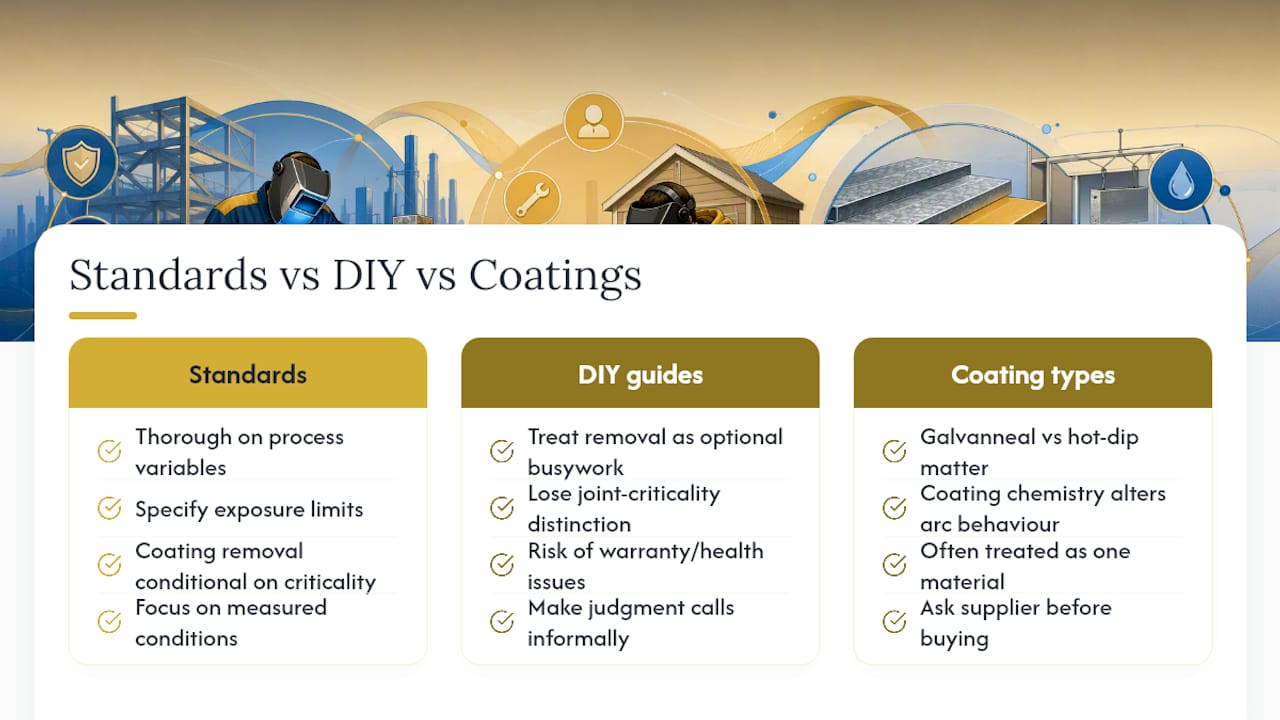
The AWS and ANSI documents governing this work are thorough on process variables and exposure limits, and any shop skipping them is cutting corners that show up later as warranty claims or, worse, health complaints. But standards describe conditions, not judgment calls, and that’s where a lot of DIY galvanized welding goes wrong.
The gap I’d flag: most home-shop guides treat coating removal as optional busywork, something you do if you’re being careful. Standards frame it as conditional on joint criticality, and that distinction gets lost in translation to hobbyist forums. A tack weld on a non-structural bracket and a load-bearing stair stringer connection are not the same decision, even though both are technically “welding galvanized steel.”
The 2025 research on galvanneal versus hot-dip coatings also deserves more attention than it gets in general welding guidance. Most advice still treats “galvanized” as one material with one set of settings, when coating chemistry changes arc behaviour enough to matter. If you’re buying material and have a choice, that’s worth asking your supplier about before you ever strike an arc.
Get galvanized fabrication done right the first time
Reading about zinc removal extents and shielding gas blends is one thing. Getting a galvanized railing, stair, or duct run fabricated and installed correctly in Greater Montreal is another, and it’s where Manaracorp’s shop-floor experience does the heavy lifting for you. Every galvanized job that comes through Lachine gets the same treatment covered above: proper coating removal at structural joints, fume extraction during grinding and welding, and zinc-rich repair before the part ships for installation.
Manaracorp fabricates and installs custom metal railings, stairs, fences, and HVAC ductwork for contractors, architects, and homeowners across the island, Laval, the South Shore, and the West Island, working in both French and English. If you’ve got a galvanized fabrication project, big or small, request a quote on Manaracorp’s welding services and get a straight answer on scope, prep, and timeline before any metal gets cut.
Sources
- Galvanizeit
- The effect of zinc coating type on weld-brazed thin-gauge automotive steel — ResearchGate
- PubMed reference on welding fume health effects
FAQ
Why do some welders drink milk after welding galvanized steel?
The idea that milk protects against metal fume fever has no real mechanism behind it. It does nothing to protect your lungs from zinc oxide fume, which is why extraction and respirators matter far more than any folk remedy.
Why are you not supposed to weld galvanized steel without precautions?
Welding galvanized steel without ventilation or coating removal exposes you to zinc oxide fume that can cause metal fume fever and creates porosity and spatter defects in the weld itself. With proper fume control and joint preparation, it’s a routine, safe fabrication process.
Can galvanized steel be welded?
Yes, galvanized steel can be welded successfully using GMAW, SMAW, GTAW, or FCAW, provided the coating is managed at the joint and fume is properly extracted. AWS guidance recommends removing coating 1 to 4 inches from the weld on structural connections.
What is the best welding process for galvanized steel?
There’s no single best process; GMAW suits general shop fabrication, SMAW suits field repairs and dirty conditions, and GTAW or brazing suits thin precision sheet metal like ductwork seams. The right choice depends on material thickness, coating type, and joint criticality.
Do I need to remove all the zinc coating before welding?
Not always. Full removal 1 to 4 inches from the joint is standard practice on structural or load-bearing welds, while lighter, non-structural tack welds sometimes tolerate coated-through welding with adjusted technique.