Use 304 for indoor, low-chloride environments. Choose 316 when the part will face salt spray, chlorinated cleaners, or chemical exposure. That’s the whole decision in one sentence. The reasoning comes down to one element: molybdenum, which 316 has and 304 doesn’t.
Three quick rules narrow it down fast. If the installation sits within 10 miles of a coastline, 316 is the recommended minimum grade. If the surface gets washed with bleach, chlorine, or de-icing salt on a regular basis, treat it the same way. And if contamination risk carries real consequences (medical, food processing, pharmaceutical), 316 removes a variable you don’t want to gamble on.
| Criteria | Favours 304 | Favours 316 |
|---|---|---|
| Location | Indoor, well inland | Within 10 miles of coast |
| Cleaning agents | Mild soap, water | Chlorine, bleach, de-icers |
| Budget | Tighter budget, general use | Premium justified by risk |
| Contamination risk | Low consequence if it fails | High consequence (medical, marine) |
- Indoor railing or kitchen counter with no chemical exposure? 304.
- Dock hardware, pool deck fixtures, or coastal railings? 316.
- Unsure which cleaning products will be used long term? Default to 316.
Key Takeaways
Choosing between 304 and 316 stainless comes down almost entirely to chloride exposure, since the two grades perform nearly identically everywhere else.
| Point | Details |
|---|---|
| Molybdenum is the deciding factor | 316’s 2-3% molybdenum content is the entire reason it resists chloride pitting better than 304. |
| Coastal proximity sets the grade | Within 10 miles of a coast, specify 316; 304 typically pits within 36 months in salt-laden air. |
| Strength is rarely the differentiator | Both grades share nearly identical yield strength, tensile strength, and elongation when annealed. |
| Specify L grades for welding | 304L and 316L limit carbon to reduce sensitisation risk in heat-affected zones. |
| Local fabrication affects outcomes | Manara Corp fabricates and installs both grades across Greater Montreal, from cutting through finishing. |
Table of Contents
- Chemical composition differences between 304 and 316 stainless
- How do 304 and 316 handle chloride and coastal exposure?
- Are 304 and 316 different in strength and temperature performance?
- What welding and fabrication issues matter for these grades?
- How much more does 316 cost than 304?
- Which grade fits your application, and how do you decide?
- What should you know about forming and finishing 304 or 316?
- Where specifiers get this decision wrong
- Get 304 or 316 parts fabricated locally in Greater Montreal
- Sources
- FAQ
Chemical composition differences between 304 and 316 stainless
The two alloys share a similar backbone. They aren’t, and the gap comes down to one addition.
316 contains about 2 to 3% molybdenum, while 304 has none at all. That’s the entire chemical story behind why 316 resists chloride attack better and costs more to buy.
| Grade | Chromium | Nickel | Molybdenum | Carbon | Typical PREN |
|---|---|---|---|---|---|
| 304 | 18-20% | 8% | None | ≤0.08% | ~18 |
| 304L | 18-20% | 8% | None | ≤0.03% | ~18 |
| 316 | 16-18% | 10% | 2-3% | ≤0.08% | ~24-27 |
| 316L | 16-18% | 10% | 2-3% | ≤0.03% | ~24-27 |
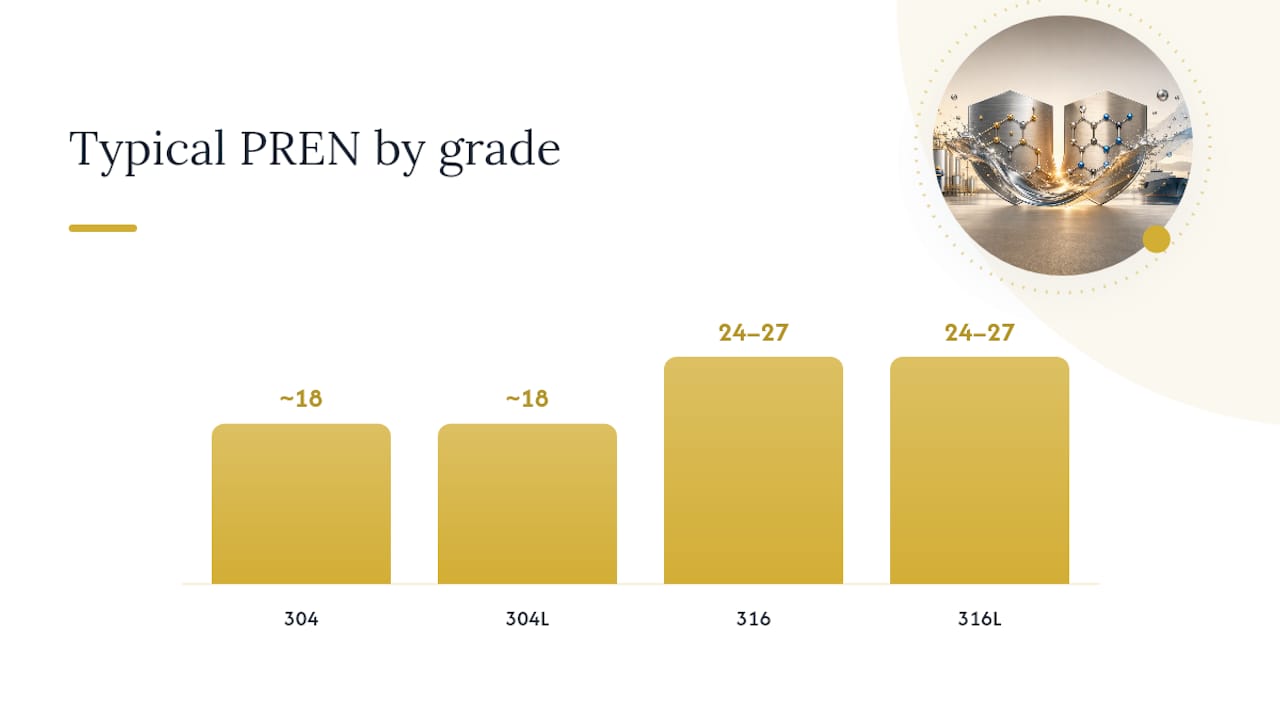
Molybdenum stabilizes the passive oxide layer against chloride ions, which is the mechanism behind pitting resistance. That’s captured numerically by PREN, calculated as %Cr + 3.3×%Mo + 16×%N. Run the numbers and 304 lands around 18, while 316L climbs to 24 to 27. That’s not a marginal gap. It’s the difference between a part that starts pitting in a few years near saltwater and one that shrugs off the same exposure for decades.
The “L” suffix matters more than most spec sheets let on:
- L grades cap carbon at 0.03% or less, versus up to 0.08% in standard grades.
- Lower carbon limits chromium carbide precipitation during welding, which otherwise strips chromium from the metal right next to the weld.
- Specify 304L or 316L whenever the part will be welded and then exposed to a corrosive environment. Skipping this step is one of the most common and expensive mistakes in stainless fabrication.
How do 304 and 316 handle chloride and coastal exposure?
The PREN gap between these grades isn’t academic once salt enters the picture. Pitting corrosion starts when chloride ions punch through the thin passive layer that gives stainless steel its name, and it doesn’t announce itself until small dark pits appear, usually followed by crevice corrosion wherever two surfaces meet or debris collects.
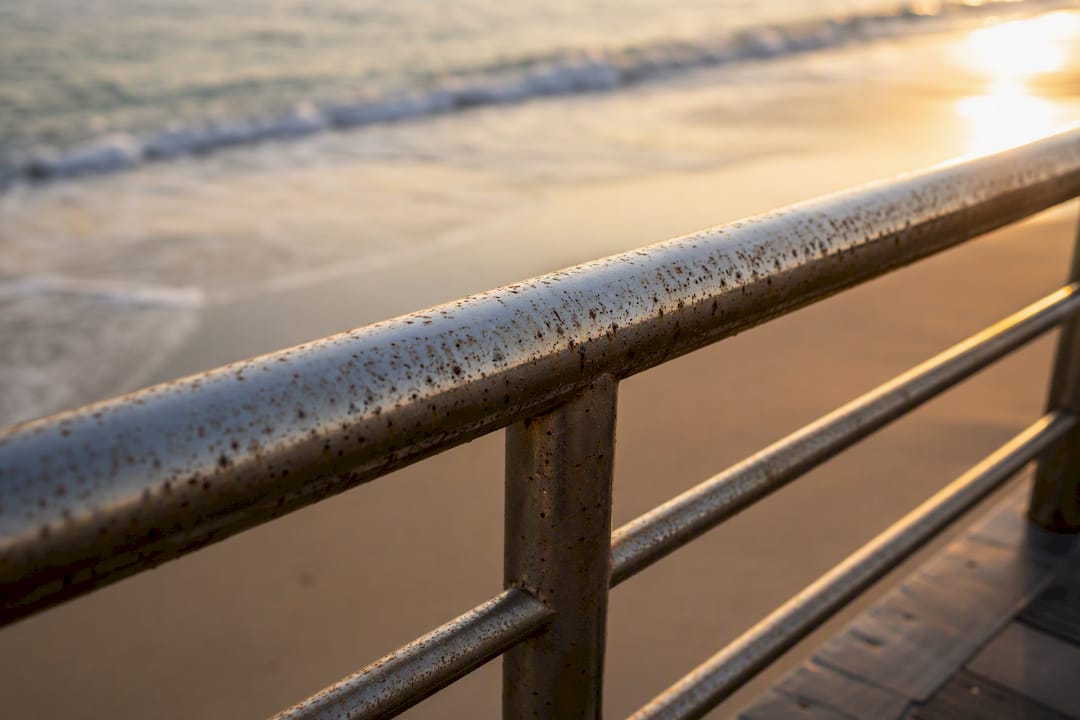
304 stainless can start pitting within a few years when exposed to salt-laden coastal air. Industry guidance recommends 316 for applications within approximately 0 to 10 miles of a coastline, while 304 is considered generally safe only well inland without chloride exposure. That 20-mile grey zone in between is where local wind patterns, storm frequency, and salt fog actually decide the outcome, not a map ruler.
Coastal air isn’t the only chloride source worth worrying about. Chlorinated pool water, cleaning products, and even sweat and bodily fluids all carry enough chloride to attack 304 over time, which is one reason 316 shows up so often in pharmaceutical and medical equipment. Swimming pool environments are particularly brutal: chlorine fumes plus splashed water plus warm, humid air is close to a worst-case corrosion scenario for either grade, though 316 lasts considerably longer.
Neither grade is bulletproof. 316 earns the “marine grade” label for good reason, but continuous seawater immersion, not just salt spray, calls for duplex or superaustenitic alloys with higher PREN values. If you’re building something that sits underwater permanently, 316 is the wrong answer regardless of budget.
A few practical moves reduce corrosion risk on either grade:
- Specify a smoother surface finish (2B or better) to reduce chloride pooling on rough texture.
- Electropolishing removes free iron from the surface and meaningfully extends service life in marginal environments.
- Design out crevices and standing-water pockets wherever possible; corrosion loves stagnant joints.
- Rinse salt deposits regularly. Even 316 needs periodic cleaning to perform as advertised.
Are 304 and 316 different in strength and temperature performance?
Mechanically, these two grades are close to twins.
Neither grade responds to heat treatment for hardening. Both gain strength only through cold working, whether that’s rolling, drawing, or forming, and both start out non-magnetic in the annealed condition, then pick up a slight magnetic response after heavy cold work.
At cryogenic temperatures, both alloys stay ductile rather than turning brittle, which is why austenitic stainless shows up in cryogenic tanks and piping where carbon steel would fail. If a part is underperforming mechanically, thickening the section or switching to a higher-strength alloy family fixes it. Upgrading from 304 to 316 changes corrosion behaviour, not load capacity.
What welding and fabrication issues matter for these grades?
Welding either grade introduces sensitisation risk: heat near the weld can precipitate chromium carbides at the grain boundaries, robbing that zone of the chromium it needs to stay corrosion-resistant. Left unaddressed, the heat-affected zone becomes the first place a welded assembly rusts, sometimes within months of installation.
The fix is straightforward. Specify 304L or 316L whenever a part will be welded and then exposed to moisture or chlorides; the lower carbon content in L grades slows carbide precipitation enough to protect the weld zone in real service conditions. Filler metal choice follows the base metal: ER308L pairs with 304/304L, and ER316L pairs with 316/316L.
A practical checklist before welding either grade:
- Confirm base metal certification (mill test report) before cutting, especially on mixed orders.
- Use matching or slightly over-alloyed filler metal, never a mismatch that leaves the weld more anodic than the parent metal.
- Control interpass temperature to limit time spent in the sensitisation range (roughly 425 to 815°C).
- Passivate or pickle welds afterward to restore the chromium oxide layer that welding heat disrupts.
Our welding services team treats filler selection and heat control as the two variables that decide whether a stainless weld lasts ten years or two.
Pro Tip: When joining dissimilar grades, like a 304 frame to a 316 fitting, weld with ER316L filler. It’s compatible with both base metals and gives the joint the corrosion resistance of the higher grade rather than the weaker one.
How much more does 316 cost than 304?
Expect to pay a real premium for 316, and expect that premium to move with commodity markets rather than sit still.
- Historical price premium for 316 over 304 typically runs 20 to 40%, driven almost entirely by nickel and molybdenum content.
- Molybdenum price spikes pushed 316 sheet costs higher relative to 304 in early 2026, so quotes from a year ago aren’t a reliable budget baseline anymore.
- Sheet, pipe, and standard fasteners in both grades are commonly stocked by metal distributors; expect longer lead times for heavier plate, unusual fastener sizes, or custom-rolled shapes.
- Buying in volume smooths out short-term price swings and is worth negotiating on any project ordering more than a few sheets or lengths.
Which grade fits your application, and how do you decide?
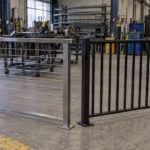
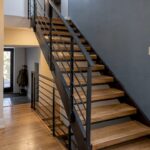
Sector habits tell you a lot before you even open a spec sheet. Kitchen and foodservice equipment leans on 304 almost universally, since indoor environments and standard cleaning rarely introduce enough chloride to matter. Architectural railings and interior stairs follow the same logic, unless the building sits near open water. Pharmaceutical and medical manufacturing default to 316 because contamination risk from any pitting is unacceptable. Marine hardware, pool surrounds, and coastal railings need 316 as a floor, not a ceiling. Chemical processing equipment often needs a case-by-case chemical compatibility check, since some acids and chlorides attack even 316 aggressively. HVAC ductwork usually runs galvanized steel or 304 indoors, with 316 reserved for corrosive exhaust or coastal installations.
A short checklist covers most specification decisions:
- How far is the installation from saltwater, and how exposed is it to prevailing wind?
- Will cleaning involve chlorine, bleach, or other aggressive chemicals on a routine basis?
- What’s the consequence if the part pits or fails, cosmetic, or a safety and contamination issue?
- What’s the expected service life, and does the project budget support the 316 premium?
- Are mechanical loads pushing toward a higher-strength family instead, independent of corrosion?
When even 316 isn’t enough, usually continuous seawater immersion or aggressive chemical processing, duplex grades like 2205 or superaustenitic alloys like 254 SMO step in with meaningfully higher PREN values. Those alloys cost more again and are worth a direct conversation with a fabricator before ordering.
What should you know about forming and finishing 304 or 316?
Both grades form, bend, and roll well, but 316 work-hardens slightly faster during heavy forming, which shows up during tight-radius bending or deep profile rolling. Shops that run both grades daily adjust tooling pressure and bend allowances accordingly rather than treating the two as identical in the brake.
Surface finish decisions happen after fabrication, not before. A brushed or 2B finish handles most indoor work fine; anything going outdoors or near water benefits from passivation and, in demanding cases, electropolishing to strip embedded iron particles left behind by cutting and forming tools.
Pro Tip: When ordering custom stainless parts, specify your grade, finish, and critical dimensions up front rather than leaving finish “to match existing.” Fit and appearance both suffer when that’s decided after the metal is already cut.
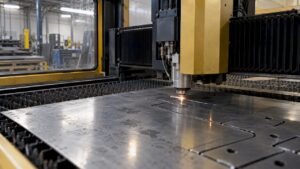
Manara Corp fabricates and installs both grades in-house across Greater Montreal, from CNC laser cutting through sheet bending and rolling, which keeps tolerances consistent from raw stock to installed part.
Where specifiers get this decision wrong
The most common mistake isn’t choosing the wrong grade, it’s choosing on instinct instead of exposure. Others under-specify 304 for a deck railing two blocks from open water, then wonder why pitting shows up inside three years.
Lifecycle cost, not sticker price, should drive the call. A 316 railing that never needs replacement often beats a cheaper 304 one that gets swapped out twice over the same period, maintenance included.
Get 304 or 316 parts fabricated locally in Greater Montreal
Once you’ve settled on a grade, the next problem is finding a shop that fabricates it to spec and installs it correctly the first time. Manara Corp cuts, bends, and welds both 304 and 316 stainless in-house, so your railing, staircase, or ductwork order doesn’t pass through three different subcontractors before it reaches your site.
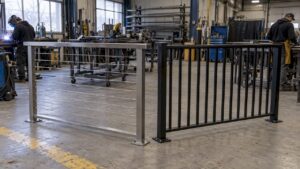
Whether you need custom railings rated for coastal exposure or an indoor staircase in standard 304, our team works from your drawings or helps develop them from scratch, then installs on-site anywhere across the island, Laval, the South Shore, or the West Island. Send your specs or a rough sketch through our welding services page to get a quote started, and mention your grade and finish requirements so we can price it accurately from the first call.
Sources
FAQ
What are the disadvantages of 316 stainless steel?
It also offers no mechanical advantage over 304, so paying extra for chloride resistance you don’t need is wasted budget.
Is 304 or 316 stainless steel stronger?
Neither. Annealed 304 and 316 share nearly identical yield strength, tensile strength, and elongation, so mechanical loading almost never determines which grade to pick.
Is 304 stainless safe for drinking water?
304 is widely used in food and beverage equipment and general potable water applications, but 316 is preferred where water carries higher chloride content or where contamination consequences are severe, such as pharmaceutical processing.
How can I tell if my stainless steel is 304 or 316?
You can’t reliably tell by sight, magnet test, or feel; both grades look and behave similarly to casual inspection. Confirming the grade requires PMI (positive material identification) testing or certified lab spectroscopy, especially before welding or specifying a critical application.