You're standing in front of a set of drawings that look fine on paper, but the jobsite is telling a different story. The ceiling is tighter than expected, the mechanical room has a weird offset, and the stock duct sizes from a catalogue aren't going to land cleanly without field cuts, extra seams, or a pile of rework.
That's usually the moment “I need ductwork” turns into “I need a shop that can build to the job.” For contractors searching hvac duct fabrication near me, the win isn't just distance. It's getting a fabricator who can read the drawing, ask the right questions, catch the site constraints early, and hand back parts that are ready to install without a second trip.
Table of Contents
- The Moment You Realize You Need a Local Duct Shop
- What HVAC Duct Fabrication Actually Includes
- Why Choosing a Local Shop Changes the Project
- Inside the Shop Workflow from Drawing to Delivery
- Rectangular, Spiral, and Custom Fittings Compared
- Quality Control and Pressure-Class Verification
- Turnaround Times and Service Area Across Greater Montreal
- How to Request a Quote That Comes Back Usable
The Moment You Realize You Need a Local Duct Shop
The call usually comes in after someone has already spent too long trying to make a standard part work. The drawing shows a clean rectangular run, but the actual ceiling cavity is pinched, the plenum depth is odd, and the elbow that looked harmless on the plan is going to fight the beam, the lighting, and the hanger layout all at once.
When the job stops being a stock-order job
That's where a local shop earns its keep. A fabricator who can look at the site, the PDF, and the sequence of installation can tell you whether the run needs a different transition, a shorter offset, or a split section that will fit through the access route without damage.
Practical rule: if the part needs field forcing to go in, it was already the wrong part.
This is why near me should mean more than a map pin. It should mean someone close enough to answer clarifications fast, see the problem in person when needed, and own the handoff from drawing to delivery instead of passing you to a call centre.
For Canadian buyers, that coordination matters even more on retrofit work, where the job rarely matches the clean conditions in the original layout. A local fabricator can often help turn a vague request into a real part list before anything gets cut, which saves time, labour, and argument on site.
The better conversations usually start with a simple sentence: “Here's the drawing, here's what's tight, and here's where I'm worried.” After that, the shop can tell you what it needs to quote cleanly, what can be built as drawn, and what should be changed before the first sheet ever goes on the table.
What HVAC Duct Fabrication Actually Includes
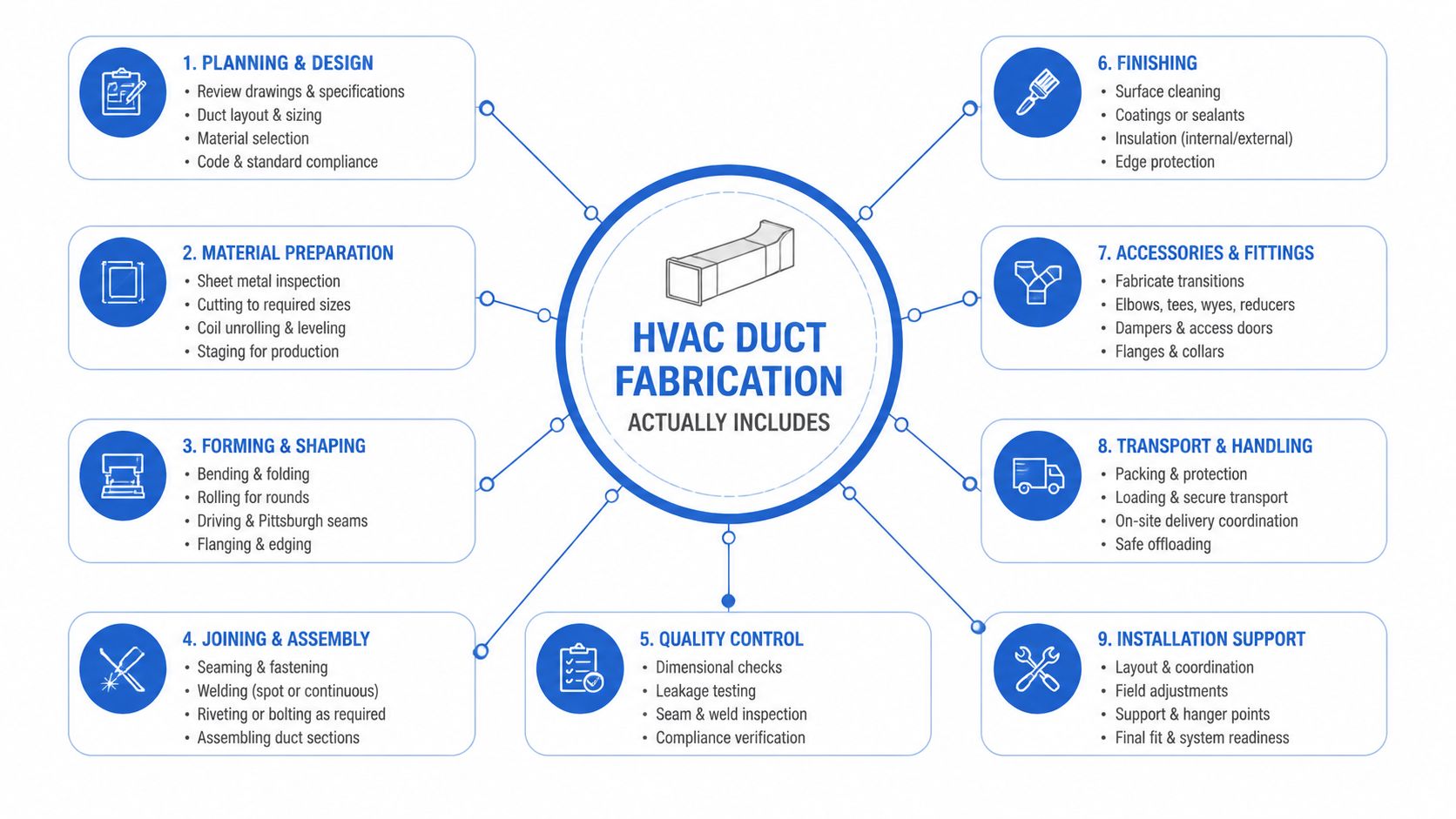
At its simplest, duct fabrication means taking a drawing and turning it into metal parts that can move air and fit the building. That includes straight rectangular sections, round or spiral runs, and the fittings that make a system connect, turn, drop, and branch without turning into a leak-prone mess.
The parts a shop is really building
A good local shop doesn't just make straight pipe or straight box. It produces elbows, transitions, offsets, tees, take-offs, access panels, cleats, and the custom pieces that tie the whole assembly together. That's the difference between buying material and buying a fabricated solution.
A helpful mental model is tailoring. Off-the-rack clothes cover a lot of people, but once the fit gets unusual, the cut matters more than the label. Ductwork works the same way, because a system with odd clearances, pressure limits, or special routing usually needs a made-to-measure piece, not a generic stock item.
Materials a local shop may work with
Most HVAC shops in the commercial world spend a lot of time in galvanised steel, because it's the standard starting point for much of the work. Depending on the application, they may also fabricate in stainless steel, aluminium, or other metals where corrosion resistance, cleanliness, or appearance changes the spec.
If the job is in a food environment, a corrosive area, or a visible architectural space, material choice matters just as much as geometry. That's why a real fabrication conversation should cover not only dimensions, but also coating, finish, and how the piece will be installed and maintained.
If you want a broader view of HVAC duct types and related components, this overview of air ducts and system components is a useful companion reference.
Why Choosing a Local Shop Changes the Project
A local shop changes the job in ways that don't show up in a glossy brochure. The biggest difference is not mileage, it's coordination, because the closer the fabricator is to the contractor, the easier it is to correct the small things before they become expensive things.
Four advantages that matter on real jobs
First, site visits are practical. If a plenum is oddly shaped, a ceiling height is changing, or a rooftop transition needs checking before release, a nearby shop can verify the condition and avoid building to a guess.
Second, drawing handoff is faster. When the estimator, drafter, and project manager can talk in the same timezone, questions don't sit overnight waiting for someone to notice them. A short clarification call can prevent a whole batch of wrong parts.
Third, schedule flexibility gets better. On retrofit work, the field team often discovers a clearance issue after a wall is opened or a shaft is exposed. A local fabricator can usually re-sequence a small batch more easily than an out-of-region supplier that's already locked into freight, production, and dock schedules.
Fourth, freight damage is lower-risk. Short truck runs are easier on spiral elbows, rectangular sections, and delicate custom fittings than long hauls with multiple handlings.
The cheapest duct on paper can be the most expensive duct once it arrives dented, late, or wrong.
There's also a labour angle. IBISWorld estimates the U.S. Heating and Air-Conditioning Contractors industry will reach $159.4 billion in 2026, with about 120,000 businesses operating nationally and growth at a 2.6% CAGR from 2021 to 2026 IBISWorld industry profile. In a market that large and fragmented, the contractor who can get usable parts quickly usually beats the contractor who only chased the lowest line item.
Inside the Shop Workflow from Drawing to Delivery
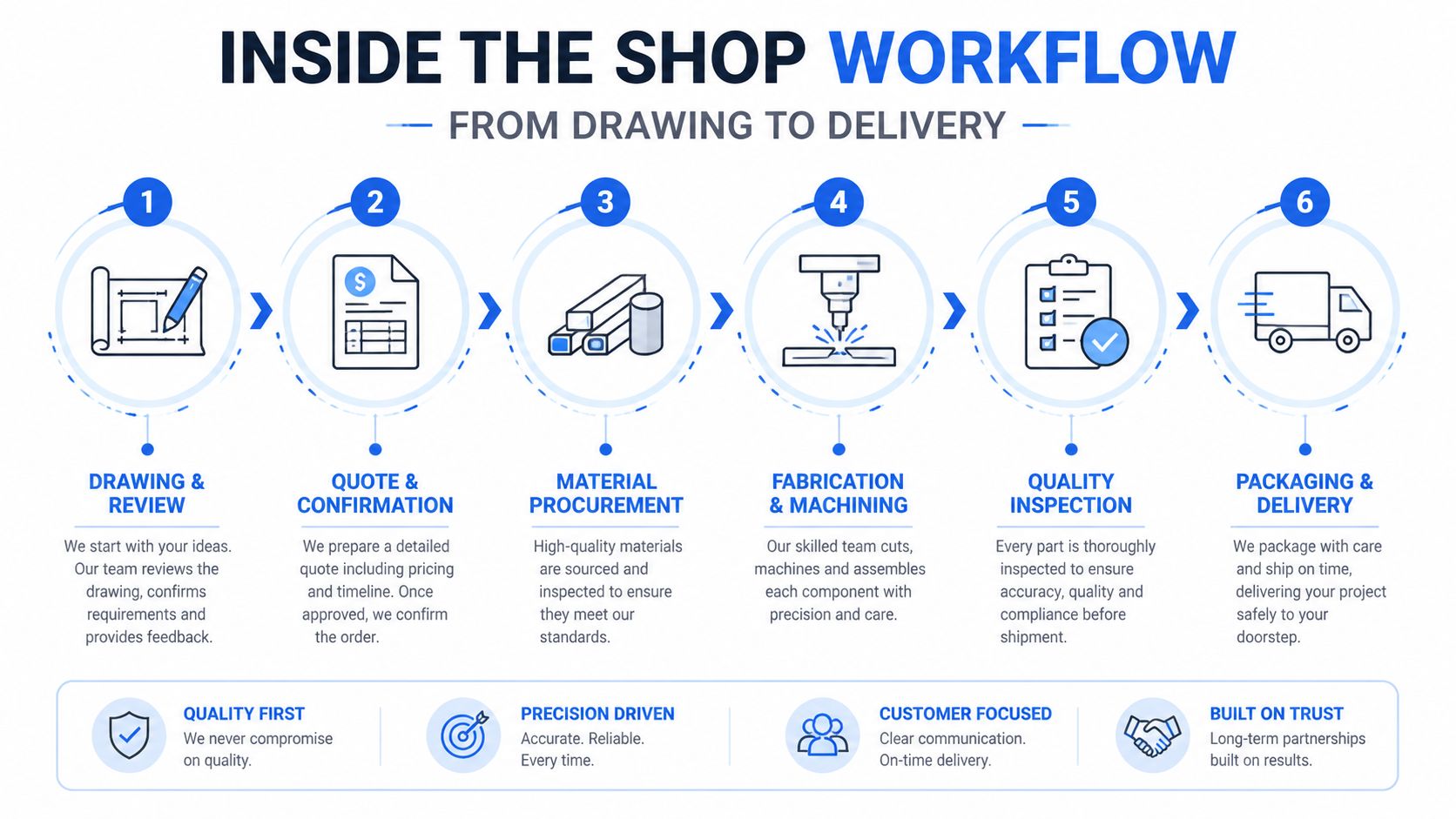
A clean fabricator workflow looks a lot like a kitchen brigade. One station doesn't do everything, each station handles a specific handoff, and the job falls apart when one part of the chain is vague or late.
From intake to cut parts
It starts with drawing intake. The shop checks dimensions, gauge calls, pressure class, material, and any odd site constraints before the parts are released for nesting, where the layout is arranged on sheet stock to reduce waste and keep the cut list efficient.
Then the flat pattern goes to cutting, often on a 5×10 fibre-laser table in shops that handle custom work at volume. On stainless or visible work, nitrogen-assisted laser cutting helps reduce discoloration on the cut edge, which saves finishing time and keeps the part cleaner before assembly.
From formed parts to finished assemblies
After cutting, the parts move to CNC press brake forming, shearing, welding, and profile rolling for round duct or other rolled shapes. Each station does one job well, and each handoff needs to preserve the fit from the previous step.
That matters because custom duct isn't just metal with holes in it. It's a sequence of parts that have to hold dimension, stay square where required, and line up at the seams and joints when they're installed. If one bend is off, the whole run starts to stack error.
A shop with organised equipment and disciplined sequencing can keep custom runs moving without turning every job into a rework exercise. Manara Corp, for example, lists laser cutting, sheet bending and rolling, welding, and profile rolling as part of its Montreal fabrication offering, which is the kind of integrated workflow that helps when the ductwork is tied to other metal parts as well Manara Corp.
Rectangular, Spiral, and Custom Fittings Compared
The right duct type depends on space, pressure, and how much site adjustment you want to avoid later. Rectangular duct is still the default in a lot of tight commercial ceilings, spiral duct is often the cleaner fit on long runs, and custom fittings are where a local fabricator stops being optional.
Duct Type Selection at a Glance
| Duct Type | Typical Application | Pressure Range | Best Fit Scenario |
|---|---|---|---|
| Rectangular | Tight ceiling cavities, common commercial branches, and mechanical rooms | Low to medium pressure | Best when height and width limits matter more than airflow efficiency |
| Spiral | Long main runs, exposed installations, and straighter distribution layouts | Medium to higher pressure | Best when you want smoother airflow and faster installation on straight segments |
| Custom fittings | Transitions, offsets, elbows, tees, and odd geometry tie-ins | Depends on the connected run | Best when the building geometry won't accept stock pieces without field forcing |
Choosing the geometry that actually fits
Rectangular duct is practical because it can be built to match awkward spaces. It's not glamorous, but in constrained commercial work, it's often the only shape that slides into the cavity without giving up clearance at the frame, the hanger, or the access panel.
Spiral duct tends to do well on longer, straighter runs because the shape is efficient and the installation is straightforward. The trade-off is that it doesn't solve every problem in a cramped building, so the benefit drops fast once the routing gets complex.
Custom fittings are where local fabrication earns the fee. A stock elbow or transition rarely lines up perfectly with a real site, and every time someone tries to “make it work” in the field, they add labour and uncertainty.
For contractors comparing options, the practical lens is simple. Use the shape that preserves the design intent and minimises field correction, then let the fabricator build the odd pieces cleanly. If you need a parts menu for fittings and transitions, this fittings reference is the kind of baseline that helps keep RFQs readable.
Quality Control and Pressure-Class Verification
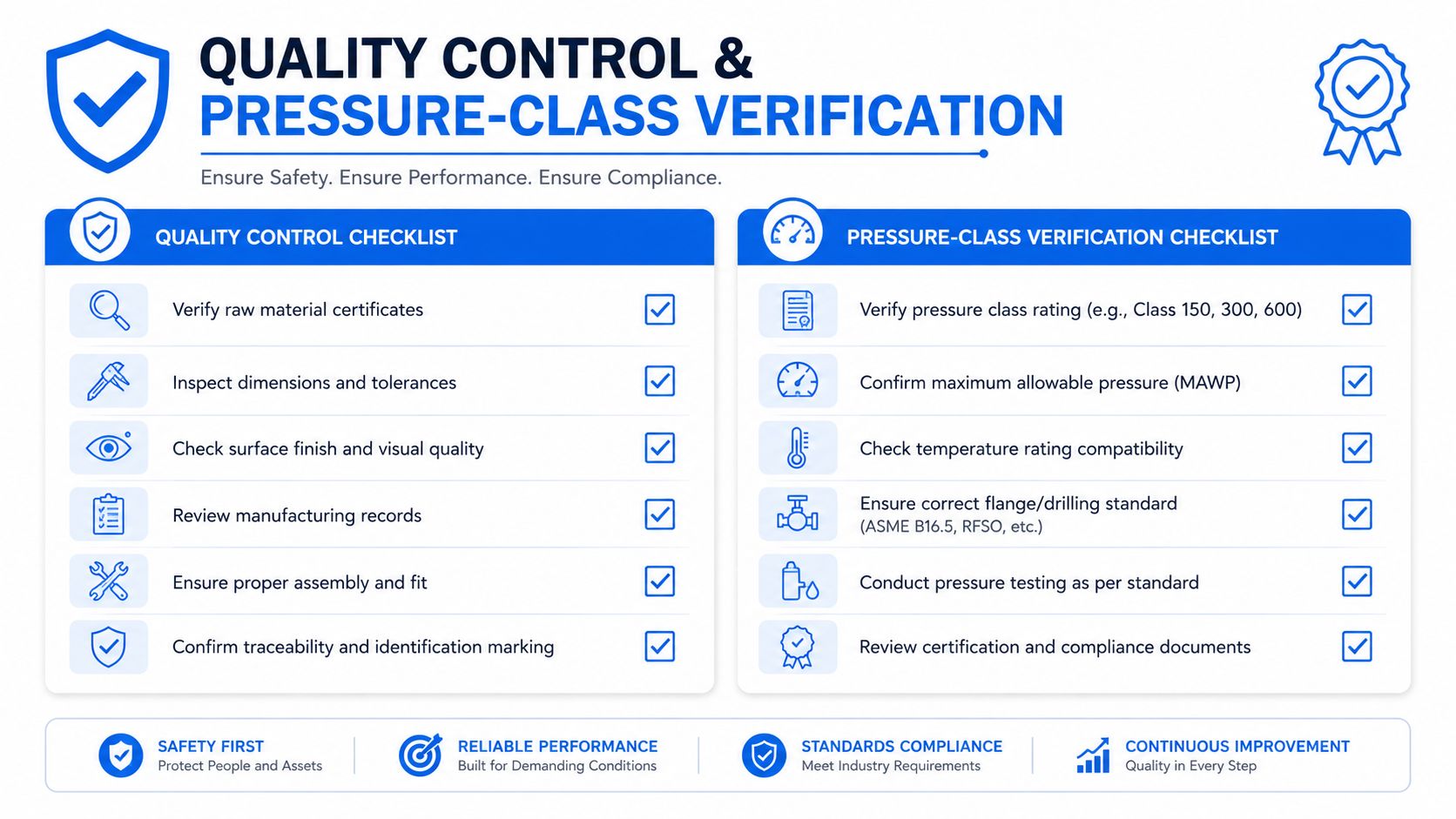
Quality control is the part of duct fabrication that protects the buyer after the truck leaves. A part can look fine from ten feet away and still fail on dimension, reinforcement, finish, or leakage readiness when it gets put under pressure on site.
What a real QC check should cover
At minimum, the shop should verify dimensions against the drawing, inspect cut edges for heavy burrs or ugly heat marks, confirm the gauge, and check reinforcement and tie-rod placement against the pressure class. Those checks are not cosmetic. They decide whether the duct holds shape and seals properly once air is moving through it.
**Buyers should ask one direct question, “How do you verify pressure class before release?” If the answer is vague, the quote probably is too.
The difference between a 2-inch w.g. supply run and a 4-inch w.g. supply run becomes real. The higher pressure class changes more than the sheet thickness, it affects reinforcement, stiffening, and how the seams and joints need to be built so the panel doesn't deflect or leak.
The questions worth asking before you approve the order
- Gauge and reinforcement: Ask how the shop chooses sheet thickness and stiffening for the specified pressure class.
- Seam sealing: Ask whether the duct is being prepared for the specified leakage class and what gets sealed before delivery.
- Edge finish: Ask how the shop handles burrs, discoloration, and sharp edges on visible or stainless work.
- Dimensional control: Ask what gets checked before release, especially on transitions and odd offsets.
Public agency specifications in California commonly tie ducts to SMACNA thickness, reinforcement, tie-rod, and joint intervals, and they also call out leakage control. That's the standard you want a fabricator to speak comfortably, not dodge SMACNA technical standards and public duct specifications that reference leakage classes example specification excerpt.
Turnaround Times and Service Area Across Greater Montreal
A shop with a single production facility in Lachine can usually keep custom work moving because cutting, forming, and shipping stay under one roof. That matters for contractors in Montreal, Longueuil, Laval, Brossard, and nearby areas, where short trucking distances help protect parts and reduce missed delivery windows.
What local service changes on a live job
The first gain is practical timing. If a drawing revision comes in, a local shop can often answer the correction sooner and keep the batch from drifting into the next production slot.
The second gain is order handling. Small-to-medium custom runs are easier to coordinate when the buyer can send drawings, gauge, pressure class, material, quantity, and site constraints in one clean package. When the information is complete, the quote comes back usable instead of full of assumptions.
The third gain is emergency response. A contractor who suddenly needs a small batch for a revised field condition can sometimes get help faster when the shop and the project are in the same regional service area.
If the truck route is short, the delivery has fewer excuses to go wrong.
The useful expectation is simple. Local fabrication doesn't remove lead time, but it trims avoidable friction. For most contractors, that's the real value of a nearby shop, less waiting, fewer handoffs, and less chance of opening a crate that no longer matches the site.
How to Request a Quote That Comes Back Usable
A clean quote starts with a clean package. Send the drawings with dimensions, call out the gauge, pressure class, and material preference, then list the quantity of each part and any site constraints that affect fit, access, or install sequence.
What should be in the first email or call
- Drawing set: Include PDFs or marked-up sketches with clear dimensions.
- Material callout: State whether the job needs galvanised steel, stainless, aluminium, or another specified metal.
- Pressure and leakage requirements: Note the pressure class and any leakage class or sealing expectation.
- Quantity and delivery window: Tell the shop how many pieces you need and when they're needed on site.
- Field constraints: Mention tight clearances, odd angles, limited access, or anything that could change the part design.
Missing dimensions slow the quote. Ambiguous callouts slow it more. Last-minute spec changes can turn a simple order into a redraw, a re-nest, and a new approval cycle.
For Montreal-area buyers, a local fabricator can usually use that information to turn around a more useful response because the shop can check the drawing, ask one or two clarifying questions, and move the job toward production without long delays. That's the coordination advantage hiding behind the phrase hvac duct fabrication near me.
If you need a Montreal shop that handles ductwork, laser cutting, forming, welding, and custom metal components under one roof, contact Manara Corp and send over your drawings, gauge calls, and site constraints. You'll get a better first conversation, a cleaner quote, and a duct package that's easier to release to the field.
Produced via Outrank