Choose HSS (hollow structural section) when a member must carry load in more than one direction, resist twisting or stay visible and clean-looking. Choose angle iron when you need a simple, easy-to-connect edge, bracket, lintel or support that loads along a known line. Most real projects use both, each where it does its best work. The rest of this guide explains why, and how to decide on a railing, a stair, a frame or a machine part.
TL;DR
- HSS is a closed tube (square, rectangular or round). Angle iron is an open L with two legs at 90 degrees.
- Closed sections resist twisting and multi-directional loads far better, which is why HSS suits posts, columns, frames and trusses.
- Angles are easy to cut, drill, weld and fasten, so they suit brackets, lintels, edge trim, shelf supports and bracing.
- Read an HSS size as outside dimensions plus wall thickness. Read an angle as leg by leg by thickness.
- For structural or guard applications in Quebec, the shape, steel grade and connection should be confirmed against the code and, where required, by an engineer.
Table of Contents
- What HSS and angle iron actually are
- Side-by-side comparison
- Strength, stiffness and resistance to twisting
- Where each shape works best
- How to read HSS and angle sizes
- Steel grade and material choices
- Welding, connecting and fastening
- Quebec and Greater Montreal: what the code adds
- How to decide: a short checklist
- Perspective
- Have us fabricate it
- FAQ
- Sources
What HSS and angle iron actually are
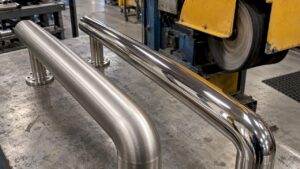
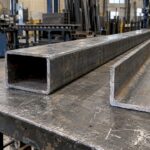
HSS stands for hollow structural section. It is a manufactured hollow steel member, usually square, rectangular or round, and in North America it is produced to standards such as ASTM A500 or A1085. In Canada the governing product standard is CSA G40.20/G40.21, which the Canadian Structural Section Tables cover for square, rectangular and round sections. Many people call square and rectangular HSS “tube steel” or “tubing”, and for most shop conversations the words are interchangeable.
Angle iron, also called structural angle or angle bar, is a length of steel with an L-shaped cross-section. The two legs can be equal or unequal. Despite the name, modern angle is steel, not iron.
The difference that drives everything else is geometry:
- HSS is closed. The wall runs all the way around the perimeter at a uniform thickness, so material sits far from the centre in every direction.
- Angle is open. Two flat legs meet at a corner. It is light and easy to work with, but it is not symmetrical, and its weakest direction is not the one you might assume by looking at it.
Side-by-side comparison
| Criterion | HSS (square, rectangular, round) | Angle iron (L-shape) |
|---|---|---|
| Cross-section | Closed, hollow, uniform wall | Open, two legs at 90° |
| Twisting (torsion) | Very good | Weak |
| Bending in two directions | Good in both axes | Strong in one direction, weaker in the other |
| Compression and buckling | Efficient as a column or brace | Needs care with orientation and connection |
| Connecting | Welded, or bolted through with extra detailing | Easy to bolt, weld or screw to a flat face |
| Appearance | Clean, closed, architectural | Visible edge and open corner |
| Typical roles | Posts, columns, frames, trusses, rails | Brackets, lintels, trim, supports, bracing |
Neither wins on every line. The right question is what the member has to do.
Strength, stiffness and resistance to twisting
Because an HSS is closed, it distributes material around both principal axes. That is why hollow sections are described as having excellent properties for resisting static loads, including buckling, biaxial bending and torsion. In practical terms, a square tube post resists a sideways push, a diagonal push and a twist in a similar way. That is exactly what you want in a guard post or a stair stringer frame that people lean on, bump and climb.
An angle is different. Its open section twists easily, and the leg that looks stiff in one direction can bend readily in another. An angle performs efficiently when the load lines up with the way it was designed to be used, for example a lintel carrying brick above an opening or a bracket supporting a shelf. Used as a free-standing post, it needs bracing or a connection that controls its orientation.
A few points keep comparisons honest:
- Size matters more than shape alone. A heavy angle can outperform a thin-walled tube in one direction. Compare actual section properties, not shape names.
- Wall thickness and grade matter. In Canada, CSA G40.21 includes weldable types such as W and WT, the latter with notch-toughness requirements, plus atmospheric corrosion-resistant types. The grade you specify affects both strength and how the part behaves when welded and when it sees cold.
- Section tables are the reference. Engineers use the CISC handbook data, published as the SST13 tables, which also provide the extra torsion properties needed for design under CSA S16:24.
One detail that surprises people: HSS corners are rounded, not sharp. The CISC explains that for HSS produced to CSA G40.20, the maximum outside corner radius runs from two to four times the wall thickness, and that this affects section property calculations. It also matters in the shop. Rounded corners change how a tube sits against a flat plate and how you plan a weld joint or a cut.
Where each shape works best
HSS: posts, frames, columns and visible members
The AISC’s Design Guide 24 describes HSS as appealing architectural members and as optimal for columns, bracing, trusses and large-span roofs. On the scale of a house or a small commercial building, that translates to:
- Railing posts and top rails on balconies, terraces and exterior stairs
- Stair stringers and landing frames built as tube structures
- Gate and fence frames
- Equipment frames, machine bases and mezzanine supports
- Canopies and architectural frames where a clean, closed profile is part of the design
A closed profile also has no inside corner where water and dirt can collect, which makes cleaning and finishing simpler. That is a practical point in a climate with freeze-thaw cycles and road salt, though the finish system still does most of the protection work.
Angle iron: edges, supports and connections
Angle is the shape you reach for when something needs to be held, edged or tied in:
- Lintels over openings and shelf angles that support masonry
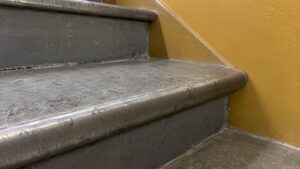
- Edge trim on stair treads and landings
- Brackets and clips that tie a guard post to a slab, wall or stringer
- Light bracing and cross-members
- Frames for panels, grates and covers
- Supports for shelving, platforms and equipment
Its flat faces make it easy to bolt or weld against concrete, steel or masonry. That convenience is the real reason angle is everywhere in a fabrication shop.
Using both in one assembly
A typical exterior stair shows how the two combine. Tube sections form the load-carrying frame and posts. Angle edges the treads, supports the landings and provides the attachment points to the building. Plate and bent sheet fill in the rest. When you plan a project, think in assemblies, not in either/or terms.
If your project is a stair, our overview of metal staircases shows how we approach the frame. Our guide on steel vs aluminum stairs for Montreal weather covers the material question that comes right after the shape question.
How to read HSS and angle sizes
Sizes look cryptic until you know the pattern.
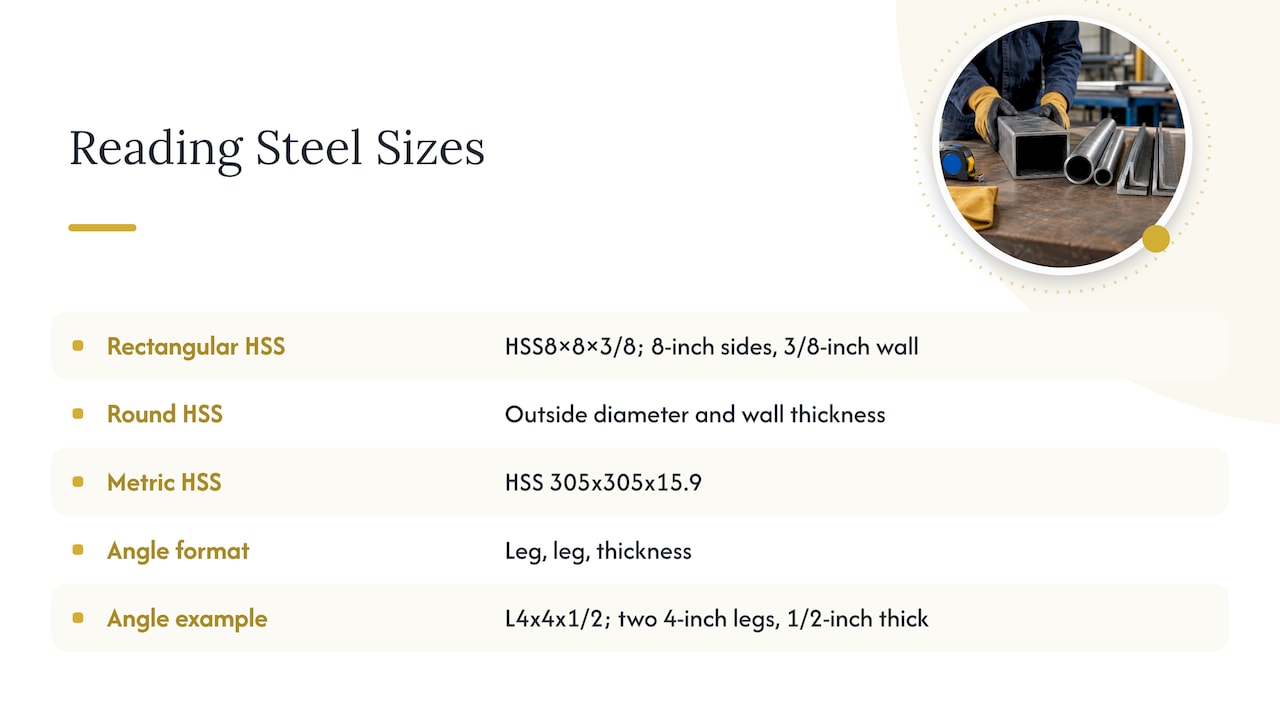
HSS. The AISC designates rectangular HSS by the letters HSS, the overall outside dimensions and the wall thickness. Its example is HSS8×8×3/8, a square tube eight inches across with a 3/8 inch wall. Round HSS is given by outside diameter and wall thickness. In Canada you will also see metric designations, for instance HSS 305x305x15.9, the largest seamless size in an Ontario Ministry of Transportation policy memo. The SST13 tables give designations in both metric and imperial.
Angle. Read it leg, leg, thickness. An L4x4x1/2 has two 4 inch legs and a 1/2 inch thickness. The metric equivalent is written like L102x102x12.7. The same Ontario memo, for example, mentions L102x102x9.5 and L127x127x9.5 as preferred sizes, and says angles are available up to L203x203 (8×8 inches).
When you request a quote, give the shape, nominal size, wall or leg thickness, steel grade and finish. If you only know the job and not the section, describe the load and the span and we can help you work towards a size with your engineer or designer.
Steel grade and material choices
Shape is only half the specification. In Canada, structural sections are normally ordered to CSA G40.21, with a grade such as 350W for weldable steel. Notch-tough WT grades are available for members that see low temperatures, which is relevant in a Quebec winter. Stainless steel, aluminum and copper can all be fabricated into angles and tubes as well, and they suit different environments:
- Carbon steel is the default for structural frames, with a protective finish such as paint or galvanizing.
- Stainless steel suits kitchens, food service, and visible railings in retail and restaurants.
- Aluminum suits lighter-duty railings and fences where weight and corrosion matter more than stiffness.
- Copper is used for decorative and architectural accents.
For welding these materials in our shop, see our custom metal welding page.
Welding, connecting and fastening
The two shapes behave very differently at the joint.
HSS connections
A tube joint is not just a weld around a perimeter. The AISC’s guidance on HSS connections notes that to maximize connection strength and stiffness, the main member wall should be relatively thick while the branch is thin and wide, and it lists ten potential failure modes, including chord wall plastification and punching shear. For a simple railing post welded to a base plate this rarely becomes complicated. For a truss or a heavily loaded frame, the joint design deserves an engineer’s attention.
Shop points for HSS:
- Rounded corners mean fit-up needs planning, and mitred or coped ends are common.
- A thin wall needs controlled heat to avoid distortion.
- Sealed ends or drainage details keep moisture out of exterior members.
Angle connections
Angles go together simply. You can weld an angle to a plate, bolt it through a leg, or fasten it against a wall. The things to watch are orientation and eccentricity: a load applied off the centre of an angle leg creates bending and twisting that the shape handles poorly. A good detail puts the load path through the connection in a controlled way.
Welded or bolted
Welded assemblies are rigid and tidy. Bolted assemblies are easier to transport and replace. Our article on welded vs bolted railings explains the trade-offs for Montreal projects. CSA S16 sets out the design rules for welded connections in structural steel, and a welded structural connection should follow them.
Quebec and Greater Montreal: what the code adds
A guard or stair is a life-safety element, so shape selection is never only about cost. In Quebec, guards, handrails and stairs fall under the construction code that applies to the building, which is based on the National Building Code of Canada, and on job sites the CNESST sets the safety rules for the people building them. Load requirements, opening sizes and handrail dimensions all affect which section you can use. Two of our guides go deeper: guardrail load requirements in Montreal and the handrail diameter code. If you manage a condo building, condo railing rules in Montreal covers owner responsibilities.
For a full list of the details we normally need to see on railing and stair projects, read our architectural metal specifications.
How to decide: a short checklist
- Define the job of the member. Is it a post, a frame, a support or an edge?
- Identify the loads. One direction or several? Any twisting, impact or people leaning on it?
- Consider the connection. What does it attach to, and can you get to both sides?
- Consider the look. Will it be seen? A closed profile reads cleaner.
- Pick material and finish. Carbon steel with a protective coating, stainless, aluminum or copper, based on exposure and appearance.
- Confirm the code. Check guard, stair and structural requirements for your building, and involve an engineer where the code or the design calls for one.
As a rule of thumb: posts, frames and anything that must resist twisting lean towards HSS. Edges, brackets, lintels and attachment points lean towards angle. A mixed assembly is normal and often the most economical design.
Perspective
Customers often ask us to name a winner between HSS and angle iron. We usually answer with a question: what does this piece have to do, and how will it be joined?
In our shop, the shape is a design decision that has to be made together with the cutting, forming and welding. We cut, bend, roll and weld everything in-house in Lachine, and our own team installs in Greater Montreal. That lets us adjust the section, the joint and the finish as the job develops, rather than passing drawings back and forth between several suppliers.
Our approach is to treat each railing, stair or frame as an assembly. Tube gives a clean, stiff structure. Angle gives easy, robust connections. Laser-cut plate and formed sheet complete the detail. Because we control each step, we can keep code compliance and timelines in view from the first sketch. We believe that is the best way to deliver both small repairs and large projects.
Ash
Have us fabricate it
If you already know which shape you need, or you would like help choosing, we fabricate and install custom railings, stairs and frames across Greater Montreal, including Laval, the South Shore and the West Island. We cut, form and weld steel, stainless steel, aluminum and copper in our Lachine shop, and we work with homeowners, contractors, architects, designers and property managers in French and English.
Send us your drawings, a sketch or just photos and dimensions through our main page, and we will talk through the options. For parts that need precision cutting or forming, see our laser cutting, sheet bending and rolling and profile rolling services. If you are weighing curved against folded parts, profile rolling vs forming explains the difference.
FAQ
Is HSS stronger than angle iron?
For twisting and for loads in several directions, HSS is generally the stronger shape, because its closed section spreads material around both axes. An angle can be very effective when its load lines up with its strong direction. Compare actual sections and grades, not shape names alone.
What is the difference between tube steel and HSS?
In everyday shop language they mean the same thing. HSS is the formal structural term for hollow square, rectangular or round sections, produced to standards such as CSA G40.20/G40.21 in Canada or ASTM A500 and A1085 in the United States. Always confirm the standard and grade on the order.
What steel is angle iron made of?
Structural angle is steel, not iron, and in Canada it is usually made to CSA G40.21. That standard covers weldable types and notch-tough weldable types, plus corrosion-resistant grades. Angles can also be made in stainless steel and aluminum for specific uses.
How do you read HSS sizes?
HSS is named with the letters HSS, then the outside dimensions, then the wall thickness. HSS8×8×3/8 means an 8 inch square tube with a 3/8 inch wall. Round HSS uses the outside diameter and wall thickness, and Canadian tables list metric and imperial designations.
Can I use angle iron for a railing post?
It is possible for light, braced assemblies, but an open L is weak in twisting and sideways loads. For free-standing guard posts, a closed tube is usually the more robust choice. Guards must meet the building code, so confirm the design before fabrication.
Sources
- Steel Solutions Center: HSS (AISC)
- Canadian Structural Section Tables SST13 (CISC-ICCA)
- Application of hollow sections in steel structures (Constructalia)
- CSA G40.21 standard record (Standards Council of Canada)
- HSS Corner Radii (CISC-ICCA)
- AISC Design Guide No. 24 article (Steel Tube Institute)
- Ontario Ministry of Transportation policy memo, 2025