For railings, stairs, guards and anything people touch every day, brushed stainless steel is usually the better choice. It hides fingerprints and wear, and a scratch can be blended out. Mirror-polished stainless suits low-contact, high-impact features, such as a feature panel, a lobby accent or a restaurant bar front, where a reflective surface is the whole point. The right answer depends on who touches the metal, how far away they stand, and how much maintenance you will accept.
This guide compares the two finishes on appearance, wear, cleaning, corrosion and cost of ownership. It then shows what to put in a specification so the finish you approve is the finish you receive.
TL;DR
- Brushed has a fine, linear grain that diffuses light. Mirror is polished and buffed until it reflects a clear image.
- For high-contact elements such as handrails, brushed is the usual standard because it hides wear and needs less upkeep.
- Scratches on a brushed surface can be abraded out. Repairing a mirror surface is harder and often means refinishing a whole section.
- Finish does not replace grade. In Montreal’s winters, de-icing salt and chlorides matter more than shine, so clean regularly and choose the grade for the environment.
- Ask for a sample made on your actual profile and approve it before production.
Table of Contents
- What the two finishes actually are
- Brushed vs mirror at a glance
- Which finish suits railings, stairs and guards
- Fingerprints, scratches and fabrication marks
- Cleaning and maintenance
- Does the finish change corrosion resistance?
- What to put in the specification
- Quick decision guide
- Our perspective
- Stainless steel fabrication and installation in Greater Montreal
- FAQ
- Sources
What the two finishes actually are
Both finishes start with the same stainless steel. The difference is what happens to the surface afterwards.
Brushed (satin) finish. An abrasive belt or pad drags across the metal in one direction and leaves fine parallel lines. Those lines scatter light, so the surface looks soft and matte, with a visible grain. The grain has a direction, and that direction becomes a design decision on a railing: along the length of a handrail or across it.
Mirror finish. The surface is ground through progressively finer abrasives, then polished and buffed. According to a guide to stainless steel finishes from the international stainless steel association, mirror finishes are produced by polishing and buffing with soft cloth mops and special compounds, giving a highly reflective surface that returns a clear, distinct image.
That last part matters for fabricators. A mirror surface is not simply a shinier brushed surface. It shows everything: the weld bead you ground, the slight waviness of a long tube, the reflection of the building across the street. A brushed surface forgives most of that.
Brushed vs mirror at a glance
| Criterion | Brushed | Mirror-polished |
|---|---|---|
| Look | Soft, matte, visible linear grain | Bright, reflective, shows a clear image |
| Fingerprints and smudges | Much less visible | Very visible |
| Light scratches | Can be abraded out along the grain | Stand out, harder to repair |
| Weld and fabrication marks | Easier to blend and hide | Show up; need careful finishing |
| Repair | Local grain-blending is often possible | Often needs refinishing to the same standard |
| Best for | Handrails, guards, stair components, doors, kitchen and public areas | Feature panels, signage, decorative trim, low-touch accents |
| Cleaning | Wipe with the grain | Wipe often to keep the shine clean |
The repair row is the one owners underestimate. The UK stainless steel association notes in its guidance on specifying polished, brushed and buffed finishes that scratches on brushed, striated finishes can be readily abraded out, while remedial polishing of reflective surfaces is more difficult. A buyer’s guide from a metals supplier makes the same point in practical terms: brushed finishes can be restored locally by blending the grain, while a polished finish needs complete refinishing to the same mirror standard.
Which finish suits railings, stairs and guards
Think of the finish as a function of contact. A handrail is gripped by hundreds of hands, in winter gloves and summer sweat. A guard on a condo balcony gets bumped by furniture, planters and bikes. Those surfaces will pick up marks no matter what you do.
The same UK guidance says brushed finishes are standard for high-contact elements such as elevator interiors and public railings, because they hide wear and require less maintenance. That matches what we see on Montreal jobs: the commercial lobby, the school stair, the condo guardrail and the restaurant counter edge all do better with a satin grain than with a mirror.
Mirror polish earns its place when:
- people see the piece but rarely touch it, such as a wall-mounted decorative panel or a high fascia;
- the design intent is reflection, for instance a retail display or an elevator surround with controlled lighting;
- the owner accepts a regular wipe-down as part of the look.
For a residential balcony or exterior stair, a mirror finish is rarely the practical call. Exterior metal collects dust, pollen, road spray and, in our climate, salt. Reflective surfaces make every deposit visible.
If you are still deciding between materials rather than finishes, our comparison of steel and aluminum stairs for Montreal weather covers that step. For the rules a handrail must satisfy before you think about finish, see our guide to the handrail diameter code in Montreal.
Fingerprints, scratches and fabrication marks
These three are where the finishes diverge most in daily life.
Fingerprints. Brushed grain breaks up the oils from skin, so prints blend into the texture. On a mirror surface a single palm print is obvious from across a room. If you are specifying a stair rail for a restaurant or office with constant traffic, this alone usually settles it.
Scratches. All stainless scratches. The question is whether you can fix it. A scratch that runs with the grain on a brushed part can be blended in on site. A scratch on a mirror surface interrupts the reflection, and polishing one spot tends to leave a visible patch unless the whole area is redone.
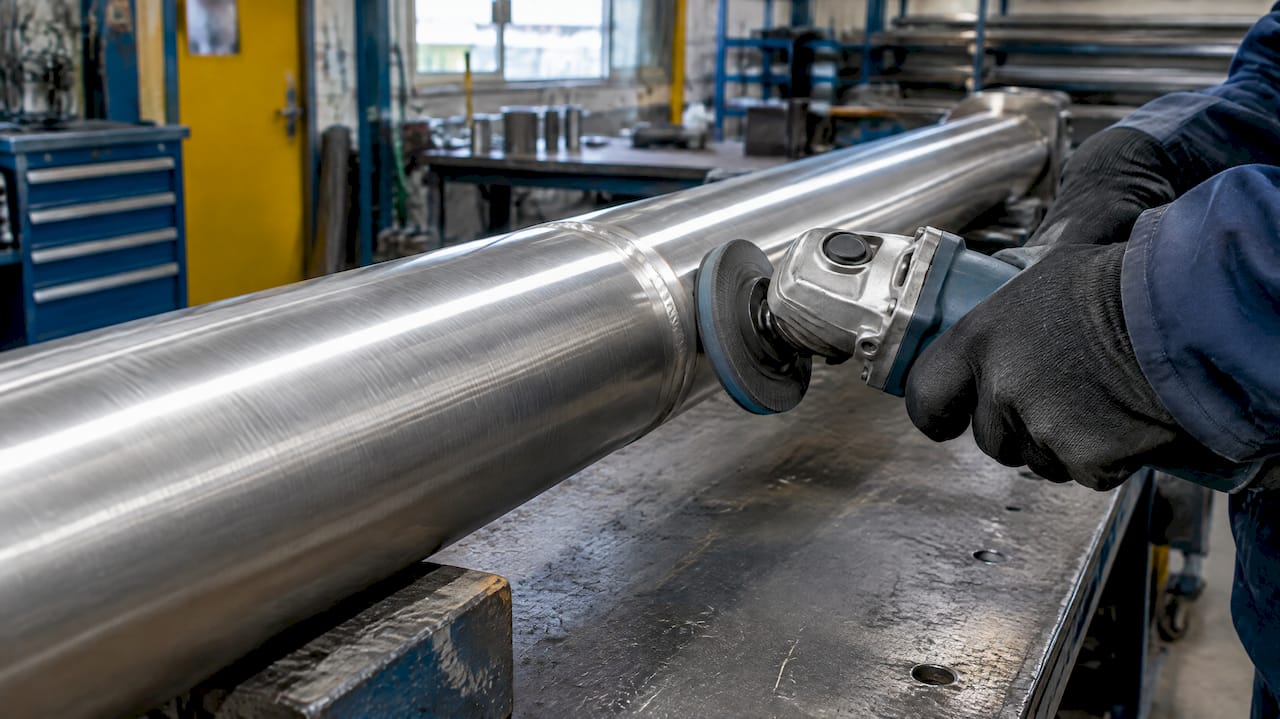
Fabrication marks. Welds are where finish decisions get expensive. A welded joint on a railing has to be ground flush and then finished to match the surrounding tube. On a brushed finish, the fabricator re-grains the area in line with the existing direction. On a mirror finish, the same weld must be taken through every polishing stage so no ripple or dull halo remains. That is more labour, and more risk of a visible difference. If a design relies on welded joints being invisible, read our comparison of welded and bolted railings before locking in a finish.
Cleaning and maintenance
Stainless is low maintenance, not no maintenance. A Canadian manufacturer’s specification sheet from Frost Products recommends periodically wiping products with a damp soft cloth, using an approved stainless steel cleaner for scuffs or fingerprints, and avoiding bleach, acids, chlorides and harsh cleaners. The same document says to always wipe in the direction of the grain.
Practical routine:
- Wipe with a damp, soft cloth. Skip abrasive pads and steel wool, which scratch both finishes and can leave particles that rust.
- On brushed stainless, move along the grain, never across it.
- For fingerprints, use a cleaner made for stainless steel, then dry with a clean cloth to avoid water marks.
- Keep bleach and chloride-based cleaners away. Many bathroom and pool products contain them.
- Rinse exterior pieces after winter. Salt spray and de-icing residue are the main enemy in Greater Montreal.
The chloride warning is not a detail. The UK association’s guide on cleaning architectural stainless steel explains that stainless can stain or corrode when chloride or ferrous contaminants accumulate, so deposits should be removed and chloride-containing cleaners avoided.
One design tip from the international stainless steel association’s finishes guide: on exterior architectural work, orient the grain vertically where you can. That lets rainwater wash contaminants away and prevents deposits from sitting in horizontal crevices. On a balcony guard with vertical balusters, this is easy to do. On a horizontal top rail, it is a reason to keep the rail clean on a schedule.
Does the finish change corrosion resistance?
It can, but grade and environment usually count for more. The general principle is that a smoother surface gives dirt and salt fewer places to sit, while a rougher, grooved surface holds more contaminants and needs more frequent cleaning. Some supplier guides go further and claim polished stainless offers better corrosion resistance because of its lower surface roughness, and recommend 316 when a brushed finish is used in corrosive settings. Treat those as supplier guidance rather than a rule: the safer reading is that no finish makes up for the wrong grade or a neglected surface.
What this means for a Montreal project:
- Exterior, salt exposure. Choose the grade for the environment first (talk to us about 304 versus 316 for your site), then pick the finish. Plan a rinse after winter either way.
- Interior, dry. Both finishes perform well. Choose on look and touch.
- Mixed steel and stainless. Keep carbon steel tooling and particles away from stainless during fabrication, because iron contamination causes rust spots that get blamed on the finish.
If your concern is rust on railings in general, our guide to rust prevention for steel railings in Montreal goes through coatings, drainage details and maintenance.

What to put in the specification
Most finish disputes come from words like “brushed” or “mirror” being read three ways by the architect, the contractor and the fabricator. The cure is a sample, not an adjective.
An article in The Construction Specifier on stainless steel railing finishes advises requiring finish samples made on the actual railing profile, using a visual standard for aesthetic applications, and specifying a maximum surface roughness when corrosion resistance or cleanability is the goal. It also stresses that roughness (Ra) is not an optical specification: matching a finish depends on viewing distance, lighting conditions and approval of a reference panel. If you want a plain explanation of how roughness values are measured and specified, a guide to Ra and surface roughness specification covers the numbers for machined parts.
A clean specification line for a stainless railing usually covers:
- Grade (for example 304 or 316) and the product form: tube, bar, plate or sheet.
- Finish name and reference. Brushed or mirror, plus an approved sample or reference panel number.
- Grain direction relative to the member: lengthwise on handrails, vertical on exterior surfaces where possible.
- Weld treatment. Welds ground flush and re-finished to match, or left as visible detail.
- Surface roughness limit, if cleanability or corrosion is a driver.
- Protection and handover. Film on finished parts, and how installed items are protected until completion.
- Approval step. Who signs off the sample, under what lighting, and from what distance.
For how this fits with the rest of a drawing set, see our page on architectural metal specifications for railings and stairs.
Check the code before the finish
Finish is the last decision, not the first. Guards and handrails in Quebec must meet the building code requirements for height, openings and graspability under the National Building Code of Canada as adopted in Quebec’s construction code, and for work sites the CNESST rules apply to the people doing the installation. Your professional or inspector confirms which applies to your building. If you manage a condo and are replacing balcony guards, our condo railing rules guide is a good place to start.
Quick decision guide
| Your situation | Likely pick |
|---|---|
| Interior handrail, school, office or lobby | Brushed, grain along the rail |
| Exterior balcony guard or stair | Brushed, suitable grade for salt, vertical grain where possible |
| Restaurant counter edge or bar rail | Brushed, easy to blend after daily wear |
| Decorative feature wall or column cladding | Mirror, if lighting and viewing distance suit |
| Retail display, signage trim | Mirror, with a cleaning routine |
| Budget-sensitive, many linear metres | Brushed, fewer finishing stages and fewer rejected pieces |
We have deliberately left prices out of the table. Finishing cost depends on the geometry, the length, the number of welds and the number of polishing passes, so a quote on your drawings is the only honest number.
Our perspective
For most of the projects we fabricate, we recommend a brushed finish and we say so early. Railings and stairs are touched, bumped and cleaned all year, and a satin grain keeps looking right between cleanings.
Because we fabricate and weld in-house in Lachine and install ourselves across Greater Montreal, the finish is part of the conversation from the first drawing, not an afterthought at the end. We can discuss where welds fall, where the grain should run and how a joint will be blended, and we can put a sample in your hands before production starts.
If you do want mirror, we will tell you plainly where it will earn its place on the job and where it will show every mark. Either way, the decision is easier when we have your drawings, the exposure and the people who will use the space.
Ash
Stainless steel fabrication and installation in Greater Montreal
We cut, form, weld and install custom stainless steel, steel, aluminum and copper work for contractors, architects, property managers and homeowners on the island of Montreal, Laval, the South Shore and the West Island. Send us your drawings, your site conditions and the finish you have in mind, and we will help you settle grade, grain direction and weld details before anything is cut.

Start with our railings and stairs pages to see what we build, or look at our welding services if your project needs stainless joints done cleanly. To discuss a quote, reach us through manaracorp.com. We install locally and do not ship fabricated parts outside Greater Montreal.
FAQ
Is brushed or mirror stainless steel easier to keep clean?
Brushed is easier to live with day to day because fingerprints and light marks blend into the grain. Mirror looks cleaner only when it has just been wiped. For both, use a damp soft cloth, a stainless-specific cleaner for stubborn marks, and wipe with the grain on brushed surfaces.
Can you repair a scratch on mirror-polished stainless?
Rarely as a small spot repair. Remedial polishing of reflective surfaces is more difficult than blending a brushed grain, and a patch often shows against the surrounding mirror. Plan for refinishing a whole section, or choose brushed where scratches are likely.
Is a mirror finish more rust-resistant than a brushed one?
Some supplier guides say a smoother surface resists contamination better, but grade and environment matter more. In Montreal, de-icing salt and chlorides are the real risk, so choose the grade for your exposure, avoid chloride cleaners and rinse exterior pieces regularly.
Which finish is better for a condo balcony guardrail?
Brushed, in nearly every case. The guard is exposed to weather, bumped by furniture and touched constantly, so a finish that hides wear and can be refreshed locally is more practical. Confirm grade and code requirements with your professional before ordering.
What should I ask for so the finish matches my expectation?
Ask for a sample made on the actual railing profile and approve it under the lighting and viewing distance of the finished space. Put the grade, the finish reference, the grain direction and the weld treatment in writing.
Sources
- Guide to Stainless Steel Finishes, international stainless steel association
- Specifying mechanically polished, brushed and buffed stainless steel finishes, British Stainless Steel Association
- Stainless-Steel Surface Finishes: A Buyer’s Guide
- Frost Code 800-S Specification Information
- Cleaning Architectural Stainless Steel, British Stainless Steel Association
- Get a grip on stainless steel railing finishes, The Construction Specifier
- Brushed vs Polished Stainless Steel: Finish Process Guide
- CNC surface finish and Ra guide